

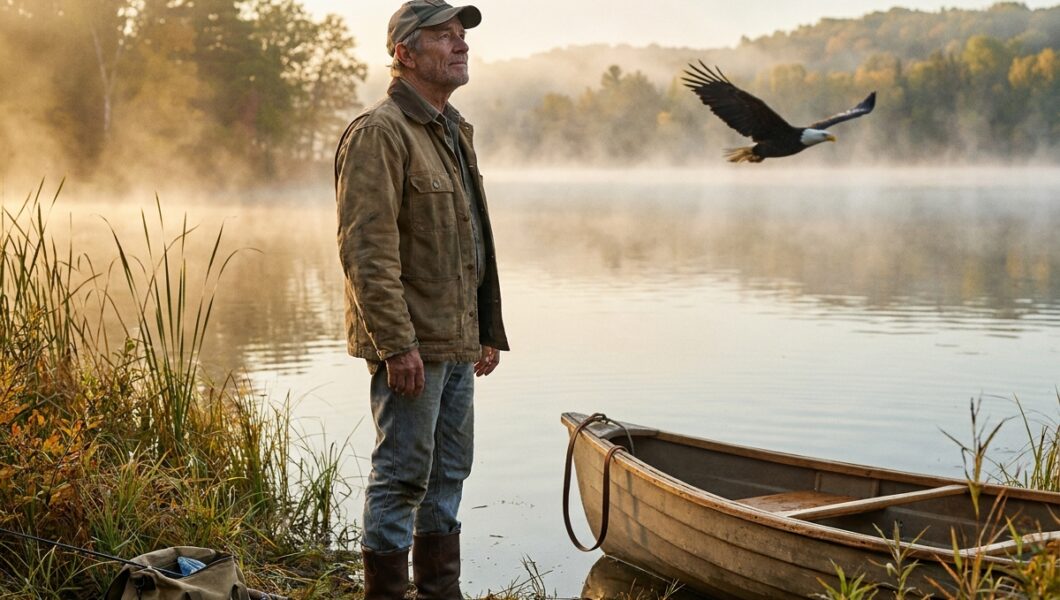
For a long time after Hank died, I avoided the lake.
I told myself it was because fishing wasn’t as enjoyable without him.
That was partly true.
But it wasn’t the whole reason.
The truth was that every time I drove down that familiar road, I could picture him sitting beside me in the truck.
His white muzzle resting against the window.
His ears lifting whenever I said the word “fishing.”
The impatient look he’d give me when I took too long to load the boat.
And, most of all, I remembered that morning.
The fog.
The cold water.
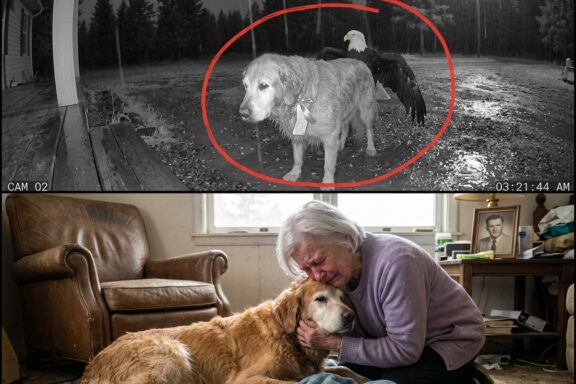
The fishing line wrapped around his leg.
And the bald eagle circling above the inlet.
For two years, I had wondered about that bird.
I wondered if it had recognized the danger.
I wondered if it had somehow understood that Hank was in trouble.
I wondered if it had remembered me.
There was no way to know.
So I stopped trying.
Then one Saturday morning in early October, I found myself driving toward the lake again.
I hadn’t planned it.
I had been cleaning out the garage when I found my old tackle box.
I opened it.
Inside was the knife I had used to cut Hank free.
I held it for a few seconds.
Then I put it in my pocket.
I grabbed my jacket and drove.
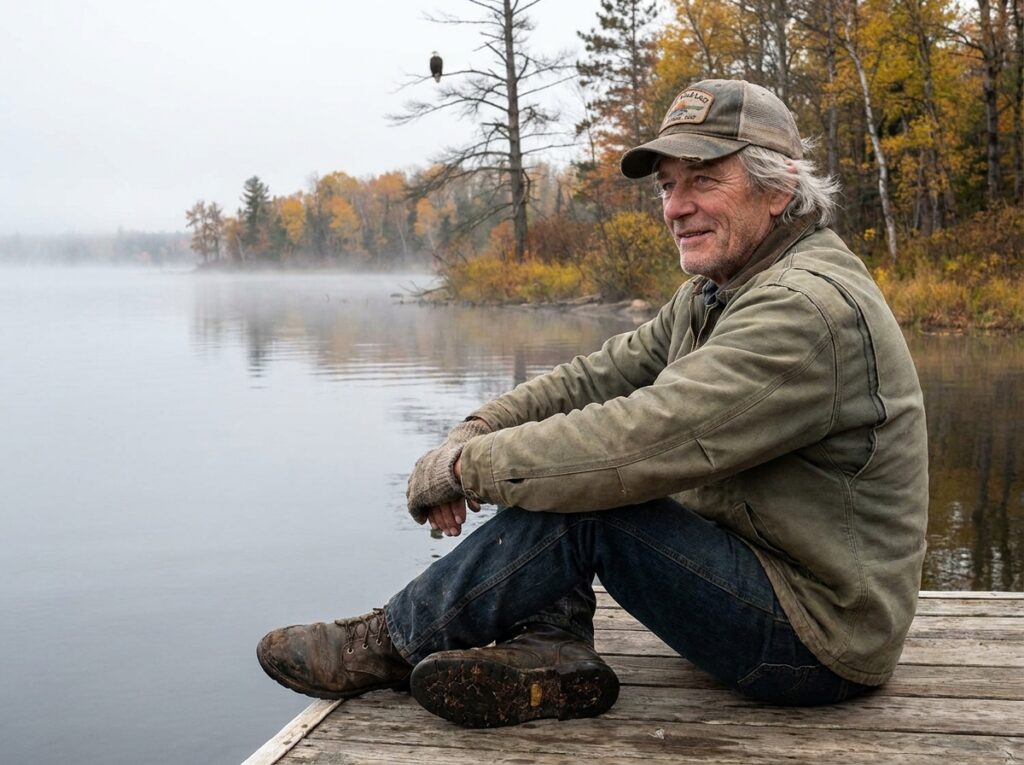
The lake looked almost exactly as I remembered it.
The trees along the shoreline had turned yellow and orange.
A thin layer of mist hovered above the water.
The fishing dock was empty.
I stood there for several minutes.
I could almost hear Hank’s nails clicking against the aluminum boat.
“Come on, old man,” I whispered.
Then I smiled.
“He’d be complaining about the cold.”
I sat at the end of the dock.
For the first time in two years, I didn’t feel like leaving.
I just watched the water.
A few minutes later, I heard a familiar cry.
I looked up.
A bald eagle was circling above the far side of the lake.
My heart jumped.
The bird made another pass.
Then it landed in the same dead tree near the inlet.
I stared at it.
There was something about the way it held its head.
The way it watched the shoreline.
I reached for my binoculars.
The eagle stayed there.
Then it flew lower.
It crossed the water.
And landed in a tree much closer to me.
I didn’t move.
Neither did the eagle.
For several seconds, we simply looked at each other.
Then I noticed something on its leg.
A small metal band.
I stood slowly.
“No way.”
The eagle turned its head.
I pulled out my phone and called the wildlife center.
They were able to identify the band.
It was the same eagle that had been rescued years earlier.
The same bird I had found tangled in fishing line before Hank’s accident.
The same bird that had been released near the lake.
I sat back down.
I didn’t know whether to laugh or cry.
The woman on the phone told me the eagle had been tracked intermittently over the years.
It had traveled hundreds of miles.
But it had returned to the lake repeatedly.
I looked across the water.
“Does it remember?”
She laughed softly.
“We don’t know what it remembers.”
Neither did I.
But suddenly, the question felt different.
Because I remembered.
And that was enough.
That afternoon, I walked along the shoreline.
I brought a garbage bag with me.
Old habits.
I found fishing line caught in the reeds.
I pulled it free.
There was a rusty hook buried in a fallen branch.
I removed that too.
Then I found something that stopped me.
A faded yellow tennis ball.
I picked it up.
Hank had loved those.
I stood there holding it.
For a second, I was twelve years younger again.
Hank was running along the shoreline.
My wife was still alive.
My kids were still coming home for Christmas.
The world seemed simpler.
I sat on a fallen log.
And for the first time since Hank died, I let myself cry.
Not because I was suddenly broken.
Because I wasn’t trying to avoid the memories anymore.
I missed him.
That was all.
And missing someone doesn’t mean you have to stop living.
I took the tennis ball home.
I washed it.
Then I put it on a shelf beside an old photograph of Hank sitting in the fishing boat.
A few weeks later, I called the wildlife center again.
I asked if there was anything local fishermen could do to make the lake safer for wildlife.
They gave me a list.
Dispose of fishing line properly.
Don’t leave hooks behind.
Cut damaged line immediately.
Keep plastic and bait containers out of the water.
Report injured wildlife instead of trying to handle it.
Simple things.
Things most people already knew.
But knowing something and doing something aren’t always the same.
So I called the local bait shop.
I told the owner what had happened to Hank.
He listened.
Then he said, “What if we put a collection box here?”
We did.
A week later, there was a small container beside the entrance.
A handwritten sign asked fishermen to deposit used fishing line and hooks.
Then another shop wanted one.
Then the marina.
Then the county park.
Before long, there were collection containers around the lake.
People started bringing bags of old line they had collected from the shoreline.
Some fishermen began picking up trash before they left.
A school science teacher asked if I would speak to her students about wildlife safety.
I almost said no.
I’d never spoken to a classroom before.
But I went.
The students asked questions for nearly an hour.
One boy raised his hand.
“Did the eagle really save your dog?”
I thought about it.
“I don’t know.”
The boy frowned.
“You don’t know?”
“No.”
“Then how do you know it helped?”
I smiled.
“I don’t.”
He looked confused.
So I explained.
“Sometimes you don’t have to know exactly what caused something. You just have to pay attention when something is trying to tell you that something isn’t right.”
The teacher smiled.
The boy thought about that.
Then he asked,
“Did your dog get better?”
I nodded.
“He did.”
The boy smiled.
“Good.”
I smiled too.
After that, I started visiting the lake more often.
Not to fish.
Just to walk.
Sometimes I brought the binoculars.
Sometimes I brought the garbage bag.
Sometimes I sat on the dock and did nothing.
The eagle appeared occasionally.
Never on a schedule.
Never close enough to touch.
I stopped trying to make every appearance mean something.
I simply enjoyed seeing it.
Then, one winter morning, I received a phone call from the wildlife center.
The woman sounded concerned.
“We need your help.”
I sat up.
“What happened?”
“There was an eagle reported near the north shore.”
“Is it injured?”
“We don’t know yet.”
I grabbed my coat.
“Where?”
She gave me the location.
It was only a few miles from my house.
I drove there.
The snow was coming down heavily.
When I arrived, I saw a group of people standing near the shoreline.
They pointed toward the trees.
I followed their eyes.
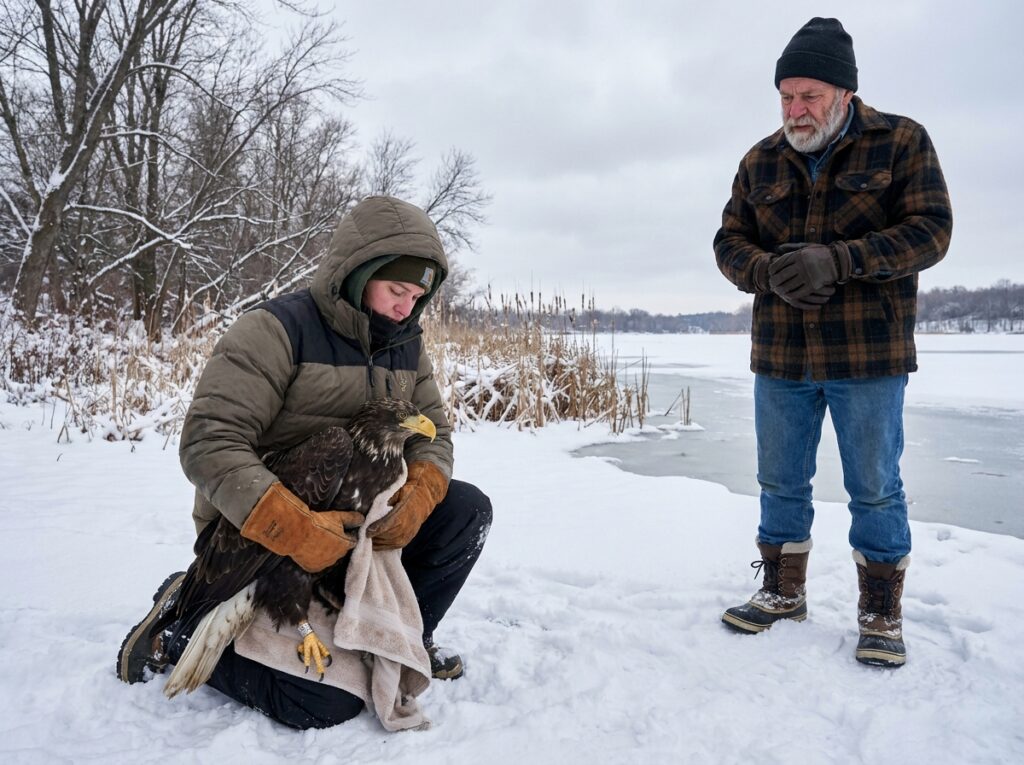
There was an eagle on the ground.
It wasn’t moving.
My heart started pounding.
I stayed back.
The wildlife rescuer arrived a few minutes later.
She approached carefully.
The eagle suddenly spread its wings.
Everyone stepped back.
It tried to fly.
It made it several feet.
Then landed again.
The rescuer looked at me.
“Same bird?”
I couldn’t answer.
She checked the band.
Then looked up.
“Yes.”
My throat tightened.
It was Scout.
The eagle from my first rescue.
The eagle from Hank’s last fishing trip.
The same bird my father had never known about.
The same bird I had spent years wondering about.
But this time, I wasn’t going to assume anything.
I watched while the rescuer examined it.
The eagle was exhausted but not seriously injured.
It had likely been struggling because of the severe weather.
After several hours of observation, they determined it could recover without being taken away.
I stood in the snow until they were finished.
Before leaving, the rescuer looked at me.
“You know, you’ve had quite a history with this bird.”
I laughed.
“Apparently.”
She smiled.
“Maybe it has a history with you.”
I looked at the eagle.
“Maybe.”
That evening, I sat at home with the old photograph of Hank.
I put it beside the photograph of the eagle.
Then I looked at both.
Hank had been twelve when I almost lost him.
The eagle had been at least old enough to have survived decades of Minnesota winters.
Both had changed my life without ever understanding that they had done it.
I thought about my wife.
I thought about my children.
I thought about the years I had spent believing that grief was something you were supposed to finish.
As if one morning you were supposed to wake up and stop missing someone.
It doesn’t work that way.
You don’t finish loving people.
You learn how to carry the love differently.
Hank had taught me that.
The eagle had reminded me.
And perhaps that was why I kept returning to the lake.
Not because I expected something extraordinary to happen.
Because the lake had become a place where I could remember without feeling trapped.
A place where I could miss Hank and still smile.
A place where I could think about my wife without feeling like I had to change the subject.
A place where I could watch an eagle fly and simply be grateful.
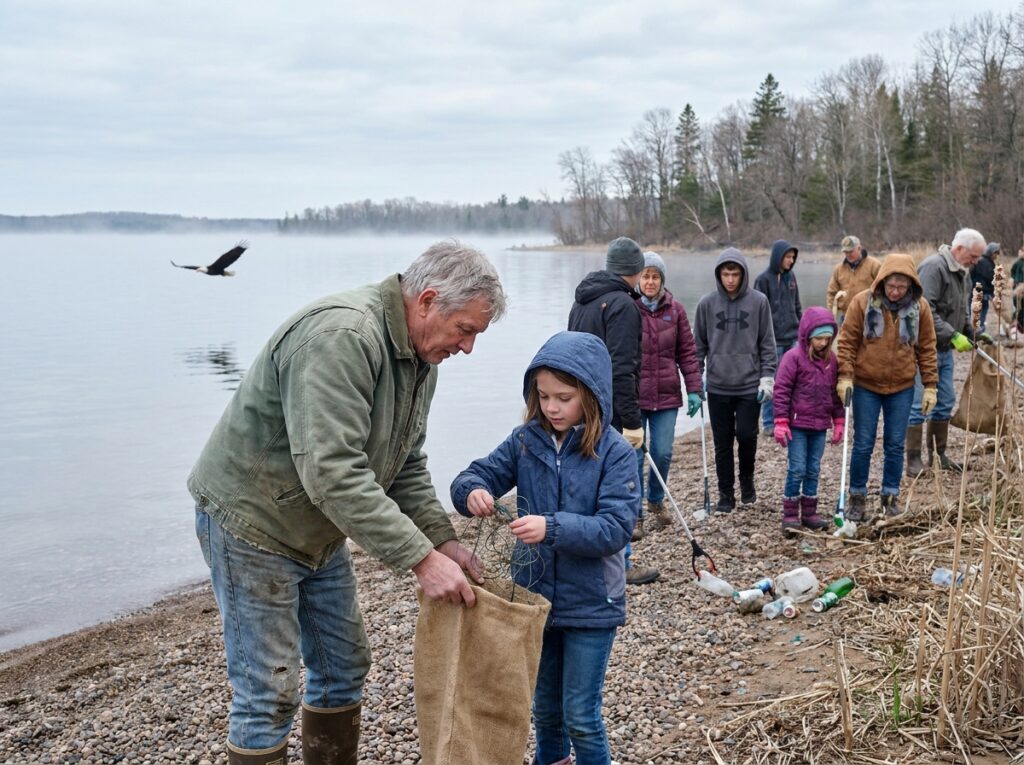
The following spring, I helped organize the first lake cleanup.
I expected maybe ten people.
Thirty-seven showed up.
Some brought boats.
Some brought gloves.
A group of teenagers collected fishing line from the reeds.
Parents brought their kids.
Older fishermen walked the shoreline with garbage bags.
Someone brought coffee.
Someone else brought doughnuts.
At one point, I looked around and realized something.
The lake was no longer just a place where I went fishing.
It had become a place where people took care of one another.
And the wildlife.
A young girl walked over holding a handful of tangled fishing line.
“Walter?”
“Yeah?”
“Is this what hurt Hank?”
I nodded.
“Something like this.”
She looked down at it.
Then she carefully placed it into the collection bag.
“I’m not leaving this here.”
I smiled.
“Good.”
She ran back to her father.
I watched her go.
Then I looked toward the lake.
An eagle was flying above the water.
I didn’t know if it was Scout.
But I smiled anyway.
A year later, I returned to the lake on the anniversary of the morning Hank fell into the water.
I brought flowers.
Not for the eagle.
For Hank.
I walked to the same inlet.
The water was calm.
The fog was beginning to lift.
I sat on the dock and placed the flowers beside me.
For a while, I said nothing.
Then I talked to Hank.
I told him about the cleanup.
I told him about the kids.
I told him people were still collecting fishing line.
I told him I still missed him.
Then I laughed.
“I still say fishing out loud sometimes.”
I looked down at the water.
“I know. It’s embarrassing.”
The wind moved through the trees.
Then I heard the cry.
I looked up.
An eagle was circling over the inlet.
It made one slow pass.
Then another.
Finally, it landed in the same dead tree.
I stared at it.
The bird looked down at me.
I didn’t move.
“Hey, old friend.”
The eagle stayed.
I don’t know how long we watched each other.
Five minutes.
Maybe ten.
Eventually, I stood.
I picked up the flowers.
I walked to the edge of the dock.
Then I placed them in the water.
They floated slowly toward the inlet.
The eagle watched.
I smiled.
“That’s for him.”
Then I looked toward the sky.
“And thanks for that morning.”
The eagle opened its wings.
It flew over the lake.
Once.
Twice.
Then it disappeared beyond the trees.
I stood there until I could no longer see it.
And for the first time, I understood why that morning had stayed with me for so long.
It wasn’t because an eagle had performed some impossible act.
It wasn’t because I believed the bird had been sent to me.
It was because I had been reminded to pay attention.
Hank had been old.
He couldn’t tell me what was wrong.
The eagle couldn’t tell me either.
But something made me look.
Something made me stop.
And that small moment changed the next two years of my life.
I started noticing things I used to overlook.
Fishing line in the reeds.
Plastic near the water.
Animals struggling in places they shouldn’t have been.
People who needed someone to listen.
And maybe most importantly, I started noticing myself.
I noticed when I was lonely.
I noticed when I was avoiding memories.
I noticed when I needed to call my children.
I noticed when I needed to sit quietly instead of pretending everything was fine.
That was the gift I had been given.
Not an answer.
Attention.
I still don’t know exactly what the eagle was doing that morning.
Maybe it saw Hank.
Maybe it heard him.
Maybe it was simply reacting to movement near the shore.
Science may eventually explain every detail.
And I hope it does.
Because understanding animals matters.
Protecting them matters.
Keeping fishing line and hooks out of their habitat matters.
But there will always be something science can’t measure for me.
What that moment meant.
Because I know what happened afterward.
An old dog survived.
I got two more years with him.
A grieving fisherman started looking forward again.
A lake became cleaner.
People started paying attention.
Children learned that small pieces of trash can become dangerous to wildlife.
And I learned that sometimes the thing that saves you isn’t the thing you expected.
Sometimes it’s a dog.
Sometimes it’s an eagle.
Sometimes it’s a stranger who picks up a garbage bag beside you.
Sometimes it’s simply a reason to get out of bed and go somewhere you haven’t been in a while.
Hank is gone now.
I still miss him.
I probably always will.
But I don’t think of that morning with only sadness anymore.
I think about his tail moving when I pulled him into the boat.
I think about the way he looked at me from the blanket at the veterinarian’s office.
I think about how much life he had left after that frightening morning.
And I’m grateful.
Grateful for the dog.
Grateful for the lake.
Grateful for the people who helped.
And yes, grateful for the eagle.
I still fish sometimes.
When I do, I bring my garbage bag.
Old habits.
I clean the shoreline before I leave.
And whenever I see a bald eagle circling over the water, I stop.
I don’t ask whether it’s Scout.
I don’t ask whether it remembers me.
I just watch.
Because I’ve learned that some moments don’t need to be explained to be meaningful.
They only need to be noticed.
That cold Saturday morning began with my dog disappearing into the fog.
I thought I was going to lose him.
Instead, I found him.
And somewhere along the way, I found a different part of myself too.
Maybe that is what Hank left me.
Maybe that is what the eagle gave me.
A reminder that even after loss, there are still things worth noticing.
There are still people worth calling.
There are still places worth caring for.
There are still mornings worth getting up for.
And there are still moments when something unexpected crosses your path and asks you to pay attention.
So if you ever hear a strange cry near the water, don’t automatically look away.
If you see something tangled in fishing line, don’t assume someone else will handle it.
If someone you love becomes unusually quiet, ask them how they’re doing.
And if an old dog looks at you like he wants one more adventure, take him if you can.
You never know how many adventures you have left.
I wish I’d known that then.
But I’m glad I know it now.
The lake is still there.
The fog still rolls across the water.
The eagles still circle above the trees.
And sometimes, just before sunrise, I can almost imagine Hank sitting beside me again.
His white muzzle resting on my knee.
Waiting for me to cast the first line.
I smile.
Then I look up.
And somewhere over the water, a bald eagle is already watching.
No Comments