

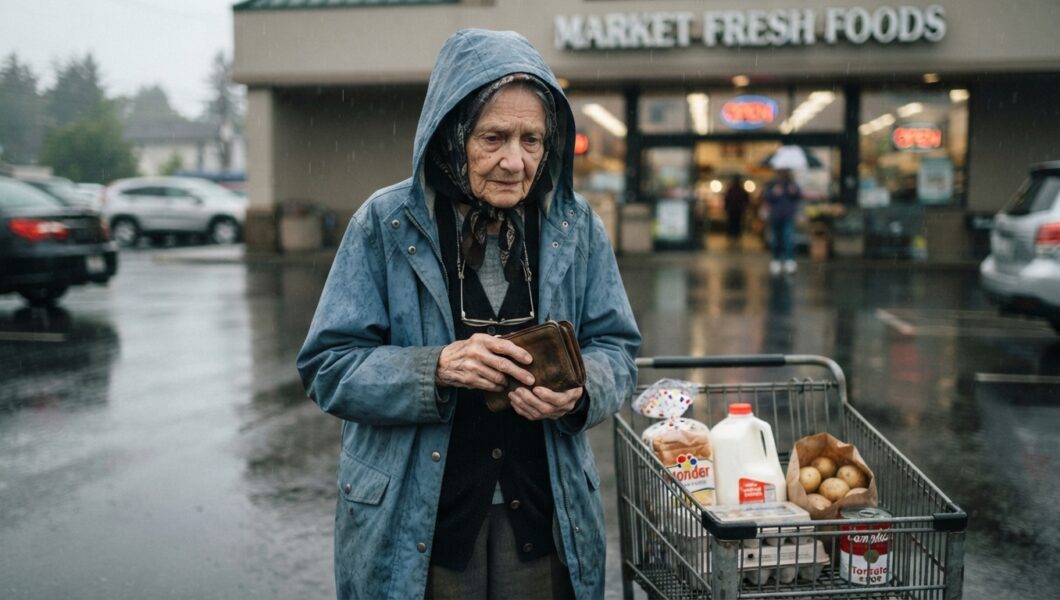
I didn’t expect to see her again.
That was the strange thing about that rainy Thursday morning. I had walked away from the grocery store thinking I had witnessed one of those rare moments people remember for a few days and then slowly forget. I assumed the woman would go home, put away her groceries, make herself something to eat, and continue learning how to live in a house that had suddenly become much too quiet.
I didn’t know she was going to come back.
Three days later, I was standing in that same grocery store when I heard someone behind me say my name.
I turned around.
There she was.
The blue raincoat was gone this time. She was wearing a cream-colored sweater, dark trousers, and a pair of old walking shoes. Her gray hair was neatly brushed, and she was holding a small paper bag against her chest.
For a moment, neither of us said anything.
Then she smiled.
“I was hoping you’d be here.”
I smiled back.
“I was hoping I’d see you too.”
She gave a quiet laugh.
“Well, don’t say that too loudly. People will think we’re friends.”
“We might be.”
She looked down at the paper bag.
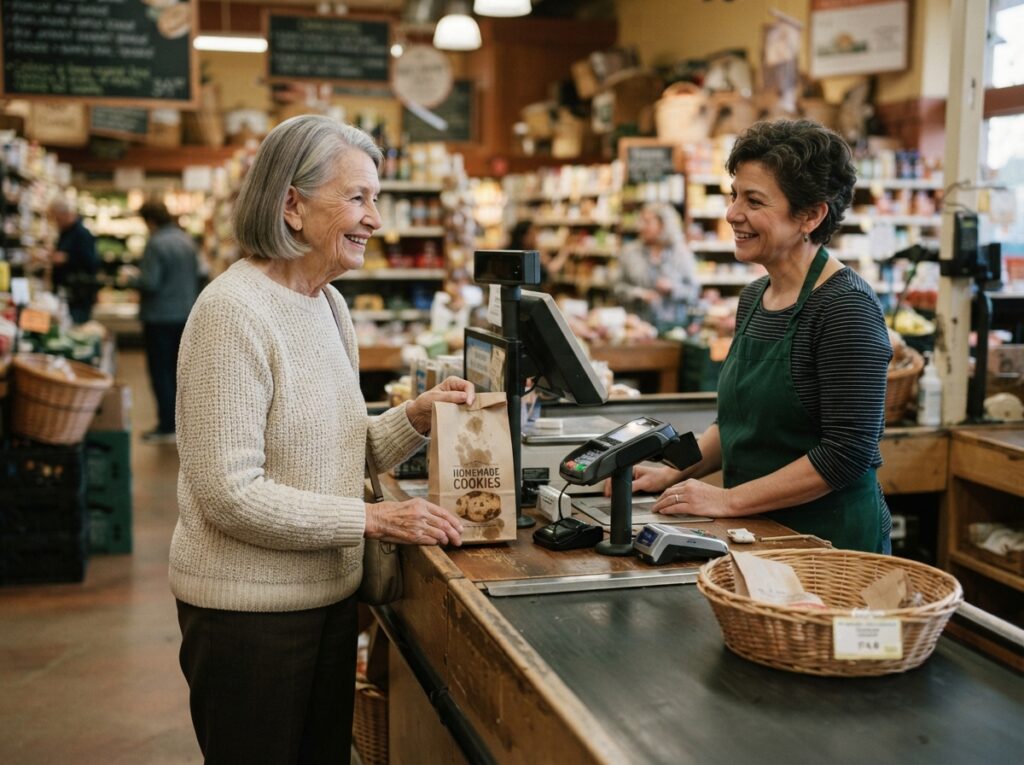
“I brought something.”
I thought maybe it was a thank-you card.
Instead, she opened the bag and pulled out a plastic container.
Inside were homemade chocolate-chip cookies.
They weren’t perfect. Some were larger than the others, and a few had cracked around the edges.
“They’re chocolate chip,” she said.
I took the container from her.
“They look great.”
“They’re not.”
I laughed.
“I didn’t say they were professional.”
That made her smile.
She looked toward the checkout lanes.
“I wanted to thank everyone.”
“You already did.”
“No.”
She shook her head.
“That morning, I was embarrassed. I wanted to disappear. I kept thinking everyone was watching me because I couldn’t afford seventeen dollars.”
She paused.
“But nobody was really watching my money.”
Her eyes moved around the store.
“They were watching me.”
I understood exactly what she meant.
She had spent so many years taking care of someone else that she had forgotten what it felt like to be cared for herself.
She handed me another small envelope.
“I brought this for the cashier.”
I looked at it.
“What is it?”
“Ten dollars.”
“Ten dollars for what?”
She pointed toward the front counter.
The small donation basket was still sitting there.
The grocery fund had already become something bigger than I expected.
The woman had come back to add her own money to it.
I stared at her.
“You don’t have to do that.”
She gave me the exact same look I had given her days earlier.
“I know.”
Then she smiled.
“But I want to.”
She walked toward the register.
The cashier recognized her immediately and came around the counter.
They hugged.
It wasn’t a polite hug.
It was the kind of hug people give when they already know something about each other’s hearts.
“I brought cookies,” the woman said.
The cashier laughed.
“You didn’t have to.”
“I know.”
They both smiled.
Then the woman handed her the envelope.
The cashier opened it.
When she saw the ten-dollar bill, her expression changed.
“What’s this?”
“My contribution.”
“You need this.”
The woman shook her head.
“Maybe.”
She looked toward the donation basket.
“But someone else might need it more.”
The cashier tried to hand the money back.
The woman wouldn’t take it.
“I spent fifty-one years sharing everything with my husband,” she said. “I’m not very good at keeping things for myself.”
The cashier reached across the counter and held her hand.
“Then we’ll make sure you’re taken care of too.”
The woman nodded.
“I’d like that.”
I thought that would be the end of the story.
I was wrong.
Over the next few weeks, something unexpected began happening at that grocery store.
People started talking.
Not about the woman’s personal life.
They talked about what had happened that Thursday morning.
Customers who had been standing in that checkout line began coming back.
One person brought twenty dollars.
Another brought five.
A retired teacher left fifty dollars.
A young mother placed three dollars into the basket and told the cashier, “It’s all I have today.”
The cashier thanked her.
She didn’t ask for more.
She didn’t need to.
The basket filled slowly.
Then it needed another basket.
Then an envelope.
Then a box.
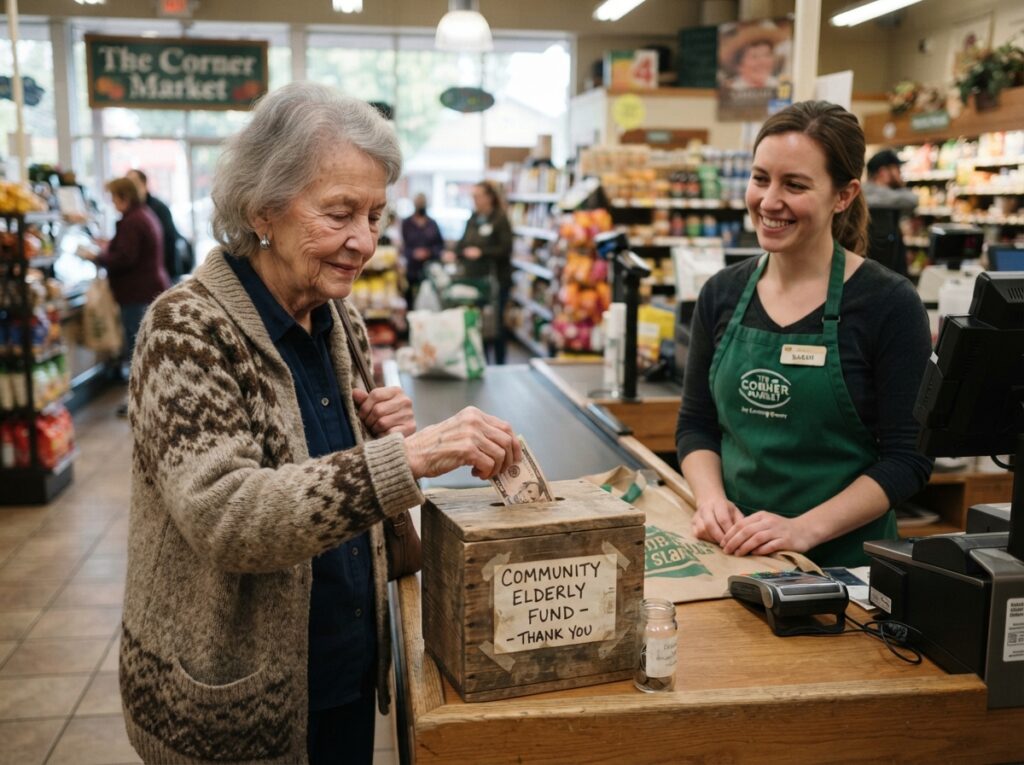
Eventually, the store manager placed a small wooden container beside the customer service desk.
A handwritten sign explained that the money would help elderly shoppers who were struggling to pay for basic groceries.
There were no names.
No photographs.
No questions.
Just help.
One afternoon, I walked into the store and saw the elderly woman sitting on a bench near the entrance.
She was talking to an older man.
He looked nervous.
She was listening.
I couldn’t hear what they were saying, so I kept walking.
A few minutes later, the man approached the customer service desk.
The woman stayed on the bench.
When I walked past her, she smiled.
“You see him?”
I nodded.
“He lost his wife last year.”
I sat beside her.
“How do you know?”
“He told me.”
She looked toward the man.
“He didn’t come here for groceries.”
“What did he come for?”
“Someone to tell him what to do next.”
I didn’t know what to say.
She smiled.
“I understand that.”
And suddenly I realized something.
The woman who had once stood at that checkout counter counting pennies had become someone different.
She had become someone who noticed other people.
Maybe she had always been that way.
Maybe grief had simply made her more sensitive to the loneliness other people carried.
She began volunteering at the grocery store once a week.
She helped organize the donation fund.
She spoke with elderly customers.
Sometimes she simply sat with them.
She told me people didn’t always need solutions.
“Sometimes they just need somewhere to put their sadness for a little while,” she said.
That sentence stayed with me.
One Saturday morning, I found her in the parking lot.
She was loading groceries into the trunk of her car.
I walked over to help.
“You know,” I said, “you’re becoming famous around here.”
She laughed.
“I hope not.”
“You’ve got people donating money because of you.”
She closed the trunk.
“Not because of me.”
“Then because of what happened.”
She shook her head.
“Because people were reminded.”
“Reminded of what?”
“That they can help.”
She looked toward the store.
“People want to be good. Sometimes they just need someone to go first.”
I thought about that.
She was right.
Maybe kindness isn’t rare.
Maybe courage is.
The courage to stop.
The courage to ask.
The courage to put your phone away and look at someone who is struggling.
The courage to spend five minutes on a person you don’t know.
The courage to say, “I’ve got it.”
The courage to wait.
The courage to care when nobody is asking you to.
A few weeks later, I saw the woman sitting near the entrance again.
This time, the older man she had spoken with was sitting beside her.
They were talking quietly.
Neither seemed as nervous as before.
I walked over.
The woman smiled.
“He’s helping me with something.”
The man laughed.
“She’s helping me more than I’m helping her.”
“What are you two doing?”
The woman pointed toward a stack of grocery bags.
“We’re putting together packages.”
“For who?”
“For people who need them.”
I looked at the bags.
Each one contained basic groceries.
Bread.
Rice.
Canned food.
Milk.
Pasta.
A few simple things most people never think twice about.
But for someone counting every dollar, those simple things could mean the difference between eating and going hungry.
The older man looked at me.
“I thought I came here because I was lonely.”
He smiled.
“Turns out I just needed somewhere to be useful.”
The woman nodded.
“That’s what I told him.”
“You’ve become quite the counselor,” I said.
She laughed.
“I’ve had practice.”
Months passed.
The fund continued growing.
There were stories.
An elderly couple who couldn’t afford their groceries after their rent increased.
A widower who had been choosing between medication and food.
A woman who had lost her job while caring for her disabled sister.
Nobody knew all their names.
Nobody needed to.
The store simply helped.
And every Thursday morning, the elderly woman came in.
Sometimes she bought groceries.
Sometimes she brought cookies.
Sometimes she contributed five dollars.
Once, she arrived with only a dollar and twenty cents.
She placed the money into the donation box.
The cashier looked at her.
“You don’t have to keep doing this.”
The woman smiled.
“I know.”
Then she added, “But I remember what it felt like to count.”
The cashier hugged her.
I happened to be there that morning.
I watched them.
And I realized that the money had never really been the point.
The twenty dollars I gave her hadn’t fixed her life.
The groceries hadn’t erased her grief.
The strangers hadn’t brought her husband back.
But for one morning, they had interrupted her loneliness.
Sometimes that’s all kindness can do.
And sometimes, that’s enough.
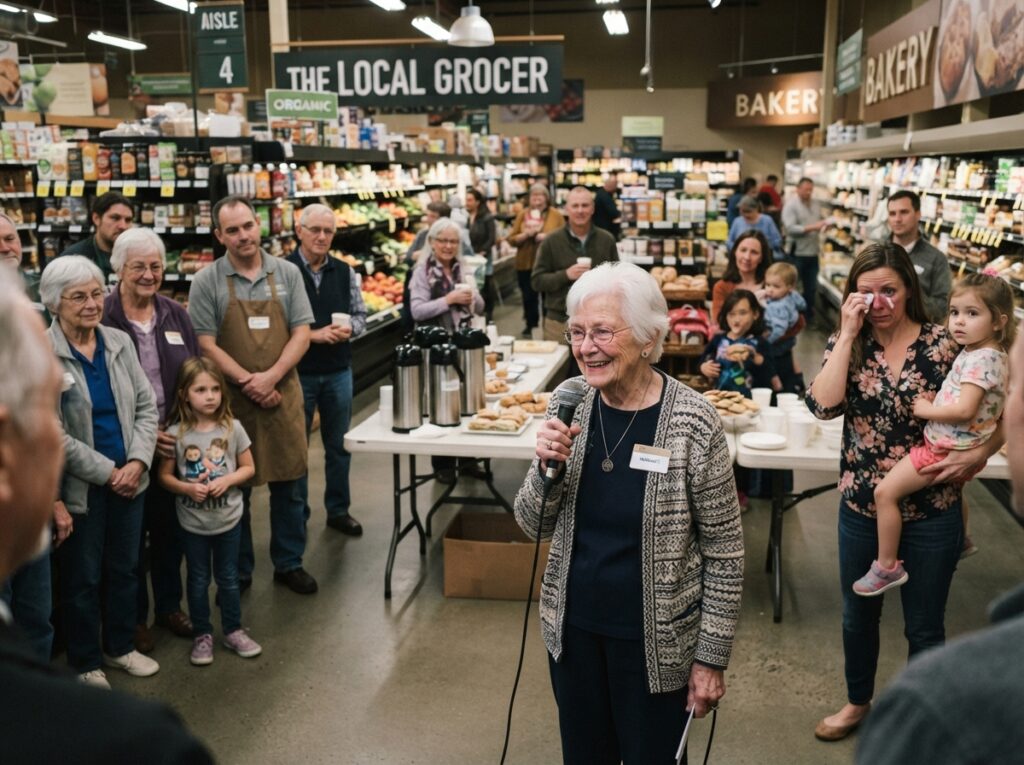
Almost a year after the rainy Thursday morning, the grocery store held a small gathering.
Nothing fancy.
A few folding tables.
Coffee.
Cookies.
Sandwiches.
The manager wanted to thank the people who had contributed to the fund.
The elderly woman stood near the front.
She looked nervous.
The manager handed her a microphone.
She immediately shook her head.
“No.”
Everyone laughed.
“You started this,” the manager said.
“I didn’t start anything.”
“You inspired it.”
She looked around the room.
Then she took the microphone.
“I don’t know how to make speeches.”
Nobody said anything.
She looked down at her hands.
“My husband was a mechanic.”
A few people smiled.
“He could fix almost anything.”
She paused.
“Except his memory.”
The room became quiet.
She took a breath.
“For two years, I watched the man I loved forget things.”
She looked at the floor.
“He forgot where his tools were. He forgot what day it was. Sometimes he forgot my name.”
Her voice trembled.
“But I never forgot his.”
Nobody moved.
She continued.
“When he died, I thought my job was finished.”
A tear ran down her cheek.
“I didn’t know what I was supposed to do anymore.”
She looked toward the checkout lanes.
“Then one Thursday morning, I came here.”
She smiled.
“And I counted pennies.”
People laughed softly through their tears.
“I was ashamed.”
She looked at the crowd.
“But you didn’t let me stay ashamed.”
She pointed toward the donation box.
“You gave me groceries.”
Then she pointed toward the cashier.
“You gave me kindness.”
She looked around the room.
“And somehow, you gave me a reason to get up on Thursday mornings.”
The room was silent.
Then she said something I will never forget.
“I thought losing my husband meant my life had become smaller.”
She took a breath.
“But it didn’t.”
She smiled.
“It became different.”
She lowered the microphone.
“I still miss him every day.”
Nobody needed her to explain that.
“But now, when I walk into this store, I know there are people who know my name.”
She looked toward the cashier.
“And that matters.”
The applause started slowly.
Then everyone stood.
She covered her face with both hands.
She was crying.
So was I.
So was almost everyone else.
Later that evening, I asked her what she thought her husband would have said about everything.
She smiled.
“He’d complain.”
“About what?”
“The price of eggs.”
We laughed.
Then she looked toward the parking lot.
“And he’d probably say I should stop giving my money away.”
“What would you tell him?”
She smiled.
“I’d tell him I learned something.”
“What?”
She looked at me.
“Sometimes you have to give away a little of what you have to realize how much you still have.”
I think about that sentence often.
Because we spend so much of our lives measuring what we have by what is sitting in our bank accounts.
Money.
Time.
Possessions.
Things we can count.
But some of the most valuable things cannot be counted.
A conversation.
A hand held at the right moment.
A stranger who waits.
A cashier who says, “Take your time.”
A person who looks at someone struggling and decides not to look away.
That rainy morning began with $11.86.
It ended with a room full of people remembering that they mattered to one another.
And maybe that’s the part of the story I didn’t understand when I first walked into that grocery store.
I thought I had helped an old woman.
I was wrong.
She helped all of us.
She reminded us that kindness doesn’t always begin with someone who has plenty.
Sometimes it begins with someone who has almost nothing and still chooses to give.
Sometimes the person counting pennies is the person who teaches everyone else what generosity really means.
And sometimes the person you stop to help becomes the reason you start paying attention to everyone else.
I still go to that grocery store.
Every Thursday if I can.
I still see the donation box.
And sometimes, when I’m standing at the checkout counter, I notice someone counting coins.
When that happens, I don’t check my phone.
I don’t look at the line.
I don’t wonder how long it’s going to take.
I simply wait.
Because now I know something I didn’t know that rainy morning.
The person standing in front of you may be carrying a story you will never see.
They may have spent fifty years loving someone.
They may have lost the person who knew every version of them.
They may be learning how to live alone.
They may be trying to make seventeen dollars stretch until Friday.
Or they may simply be having the worst morning of their life.
And you may never know.
But you can still choose to be kind.
The woman with the blue raincoat taught me that.
She also taught me something else.
Being seen can change a person.
Being remembered can give someone strength.
And being kind doesn’t always mean doing something extraordinary.
Sometimes it means standing beside someone while they count their pennies.
Sometimes it means saying, “Take your time.”
Sometimes it means paying for the milk.
And sometimes, months later, it means watching that same person put ten dollars into a box for someone else.
She became one of the second kind.
Maybe that’s what happens when someone finally sees you.
You remember what it feels like.
And once you know what it feels like to be seen, you start looking for people who are standing in the shadows.
So the next time you’re in a grocery store and someone is taking a little longer than you’d like, remember the woman with the blue raincoat.
Don’t rush them.
Don’t judge them.
Look up.
You might be looking at someone who needs a little kindness.
And you might never know just how far that kindness travels.
I don’t know what happened to all the people that fund helped.
I don’t know how many meals were bought or how many prescriptions were delivered or how many elderly shoppers walked out of that store with a little less worry.
But I know where it began.
With rain.
A grocery cart.
A worn brown wallet.
And eleven dollars and eighty-six cents.
And I know that somewhere, every Thursday morning, an elderly woman still walks through those grocery-store doors.
She doesn’t come in counting pennies anymore.
She comes in carrying a small paper bag.
And inside that bag are usually homemade chocolate-chip cookies.
Because some people receive kindness and simply say thank you.
Others receive kindness and spend the rest of their lives finding ways to pass it on.
She became one of the second kind.
Maybe that’s what happens when someone finally sees you.
You remember what it feels like.
And once you know what it feels like to be seen, you start looking for people who are standing in the shadows.
So the next time you’re in a grocery store and someone is taking a little longer than you’d like, remember the woman with the blue raincoat.
Don’t rush them.
Don’t judge them.
Look up.
You might be looking at someone who needs a little kindness.
And you might never know just how far that kindness travels.
But there was one thing I hadn’t learned yet.
The story wasn’t actually finished.
Because almost a year after that rainy Thursday morning, someone walked into the grocery store asking a question that made the cashier stop what she was doing.
He wasn’t there to buy groceries.
He wasn’t there to donate money.
And he wasn’t looking for the elderly woman.
At least, not at first.
He was looking for someone who had once owned an old blue pickup truck.
When the cashier heard his question, she immediately thought of the woman.
And when she told me what he had asked, I knew I had to find out who he was.
Because sometimes a story doesn’t end when the kindness is returned.
Sometimes that’s when the real story begins.

No Comments