

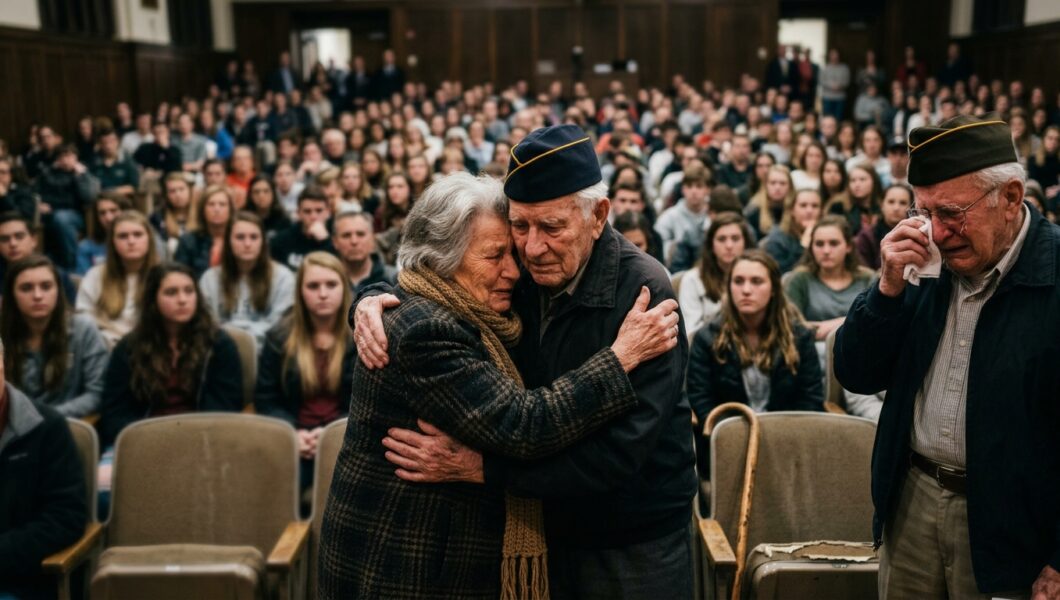
I thought the story ended when we walked out of that auditorium.
I was wrong.
For the next several days, I kept thinking about the elderly woman who had stood at the back of the room and told two World War II veterans that they had saved her country. I could still hear the tremble in her voice. I could still picture the way she held her little purse against her chest as though it gave her something to hold onto while she opened a part of her past she had carried for most of her life.
But there was one thing I couldn’t stop thinking about.
Why had she waited so long?
Seventy-five years is a lifetime.
My son and I talked about the event several times during the week, although neither of us really knew what to say. He was still thinking about the age of the soldiers. I was still thinking about the woman’s face when she looked at the veterans.
Then, a few days later, something unexpected happened.
My son came home from school and told me that one of his teachers had mentioned the woman.
Apparently, she had stayed after the event for a while and spoken with one of the teachers. She had told them that she wanted to see the veterans again.
My son looked at me.
“Dad, do you think she’ll get to?”
“I don’t know,” I said.
Then he asked something that caught me completely off guard.
“Do you think the veterans remember people they helped?”
I thought about it for a moment.
“I think they remember more than we realize.”
Neither of us knew that a few weeks later, we would get an answer.
The school contacted several families who had attended the living history event and invited them to a small follow-up gathering. It wasn’t advertised as another public event. There were no reporters, no large audience, and no stage.
It was simply an opportunity for students, veterans, and members of the community to sit together and talk.
When we arrived, Thomas Berg was already there.
He looked smaller than he had on the auditorium stage.
Perhaps it was because there was no podium separating him from everyone else. No microphone. No spotlight. Just an elderly man sitting in a chair with his cane resting beside him.
Tom MacElwee was sitting nearby, talking with a group of students.
And then I saw her.
The elderly woman from the back of the auditorium was standing near the entrance.
She looked nervous.
For several seconds, she simply stood there looking at the two veterans.
Then she slowly walked toward them.
Berg noticed her first.
His face changed immediately.
He smiled.
“You came back,” he said.
The woman nodded.
“I told you I would.”
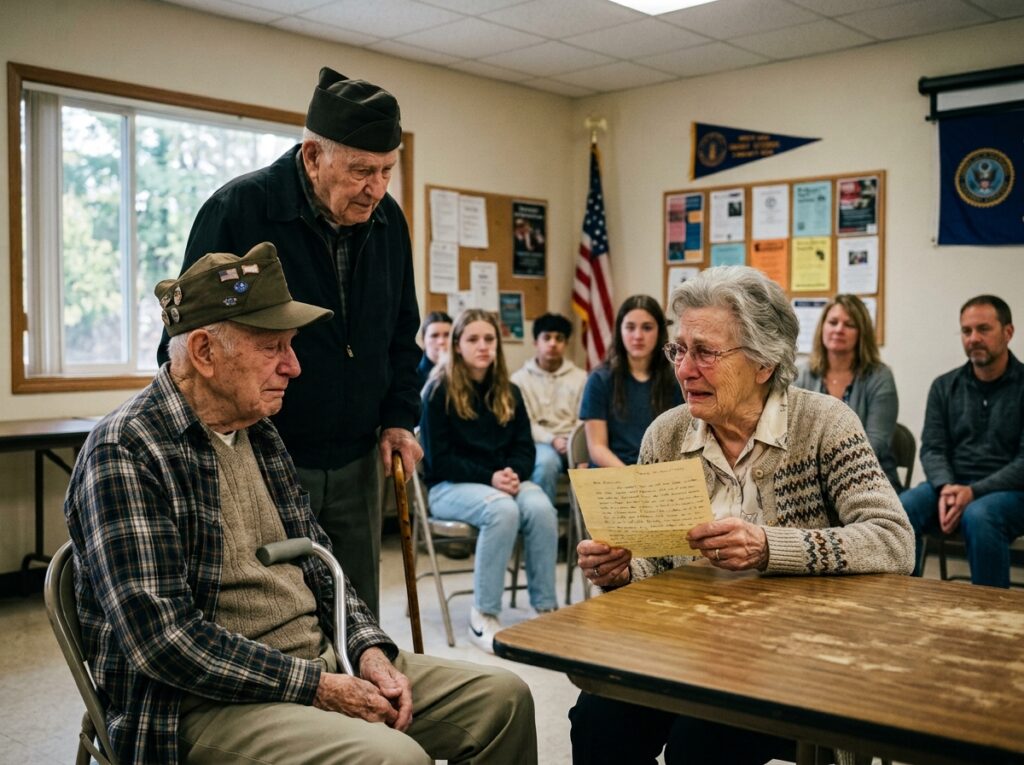
She reached into her handbag and pulled out a small envelope.
It was old and yellowed, with soft edges that looked as though it had been handled hundreds of times.
She held it carefully in both hands.
“I brought something,” she said.
Everyone around them became quiet.
She looked at Berg and MacElwee.
“I’ve kept this for a very long time.”
She opened the envelope.
Inside was a piece of paper.
She explained that when she was a little girl in the Netherlands, her family had lived through years of occupation, fear, hunger, and uncertainty. She remembered being told to stay quiet when unfamiliar sounds came from outside.
She remembered adults whispering.
She remembered windows being covered.
She remembered her parents worrying about food.
But she remembered something else too.
The morning the family finally understood that the war was changing.
She had been too young to understand everything happening around her, but she remembered the excitement in the adults’ voices.
She remembered people crying.
Not because they were afraid.
Because they were free.
She unfolded the paper.
It was a copy of a note her family had received during those final days.
The original had been damaged over the decades, but she had preserved a copy because, as she explained, she never wanted her grandchildren to forget what it meant.
She read it aloud.
Her voice was quiet.
Her hands trembled.
But she kept going.
When she finished, there wasn’t a sound in the room.
Tom MacElwee leaned forward.
“How old were you?” he asked.
“Nine.”
He closed his eyes for a moment.
“Nine,” he repeated.
The woman nodded.
“Yes.”
Then she looked at him.
“And you were twenty?”
He smiled faintly.
“Something like that.”
She shook her head.
“You were children.”
MacElwee looked down at his hands.
“So were you.”
The woman smiled through her tears.
“Yes. But I was a child who got to grow old.”
Nobody knew what to say after that.
One of the students began crying quietly.
Another put his hand over his mouth.
My son was sitting beside me, staring at the veterans.
I watched his face.
He wasn’t looking at them the way he had during the original presentation.
Something had changed.
He wasn’t simply seeing two old men anymore.
He was seeing the young men they had once been.
Young men who had families.
Young men who had been scared.
Young men who probably wondered whether they would ever make it home.
And suddenly, the distance between history and the present seemed much smaller.
The woman explained that she had spent decades wondering whether the young soldiers who liberated her town ever understood what their arrival meant to the people waiting for them.
“They probably thought they were just doing their job,” she said.
Berg smiled.
“We were.”
“No,” she answered gently. “You were doing more than that.”
She turned toward the students.
“That’s what I want you young people to understand.”
Everyone looked at her.
“Freedom can become invisible when you are born with it.”
Those words stayed with me.
She continued.
“When you wake up and go to school, when you walk outside without being afraid, when you complain about your parents, when you argue with your friends, when you sit at a table and eat dinner with your family… you don’t think about freedom.”
She looked at my son.
“And that’s normal.”
Then she looked back at the veterans.
“But there were people who dreamed about those ordinary things.”
Her voice broke.
“People who dreamed about going to school. People who dreamed about having enough food. People who dreamed about hearing their country’s streets become quiet again.”
She wiped her eyes.
“Ordinary life was not ordinary to us.”
Nobody moved.
I looked around the room.
Teenagers who had been laughing together only minutes earlier were now sitting completely still.
For the first time, I understood why these living history events mattered.
It wasn’t really about memorizing dates.
It wasn’t about knowing the names of battles or ships.
It was about understanding what those events meant to actual people.
A war isn’t just something written in a textbook.
It is a mother waiting for her son.
It is a nine-year-old girl listening to adults whisper about danger.
It is a twenty-year-old sailor wondering whether he will ever see home again.
It is a family eating less because there isn’t enough food.
It is a young man stepping onto a ship knowing that some of the people beside him may never return.
And sometimes, decades later, it is an elderly woman standing in a school hallway holding an old piece of paper and saying thank you.
The conversation continued for almost two hours.
Students asked questions.
The veterans answered when they could.
Sometimes they remembered small details that had nothing to do with military strategy.
One remembered the smell of coffee.
Another remembered the sound of boots on a metal deck.
One student asked MacElwee what he thought about when he was afraid.
He paused.
“My mother,” he said.
That simple answer seemed to affect everyone.
Another student asked Berg whether he ever regretted serving.
He looked at the young man for several seconds.
“No,” he said. “I regretted the things we lost. I regretted the friends who didn’t come home. But I never regretted trying to protect the people who needed us.”
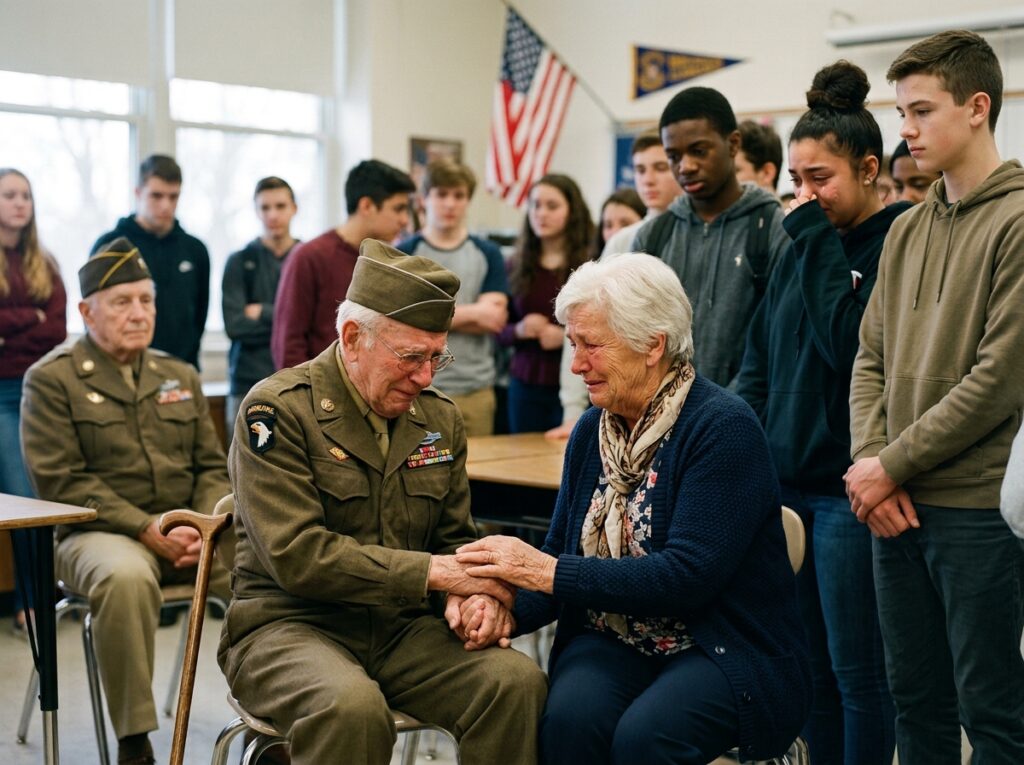
Then the Dutch woman reached over and placed her hand on his.
“That’s why I needed to come back,” she said.
Berg looked at her.
“You don’t have to thank us.”
She smiled.
“I know.”
Then she squeezed his hand.
“But I still will.”
When the gathering finally ended, my son approached the veterans.
I stayed several feet behind him.
He didn’t say much.
He simply shook their hands.
Then he turned toward the woman.
She smiled at him.
“How old are you?”
“Seventeen.”
Her expression changed.
For a moment, she just stared at him.
Then she looked toward MacElwee.
“You were seventeen once.”
He nodded.
She looked back at my son.
“Don’t waste it.”
My son smiled awkwardly.
“I won’t.”
She placed her hand gently on his shoulder.
“Live a good life. That’s the best thank you.”
That sentence stayed with him.
It stayed with me too.
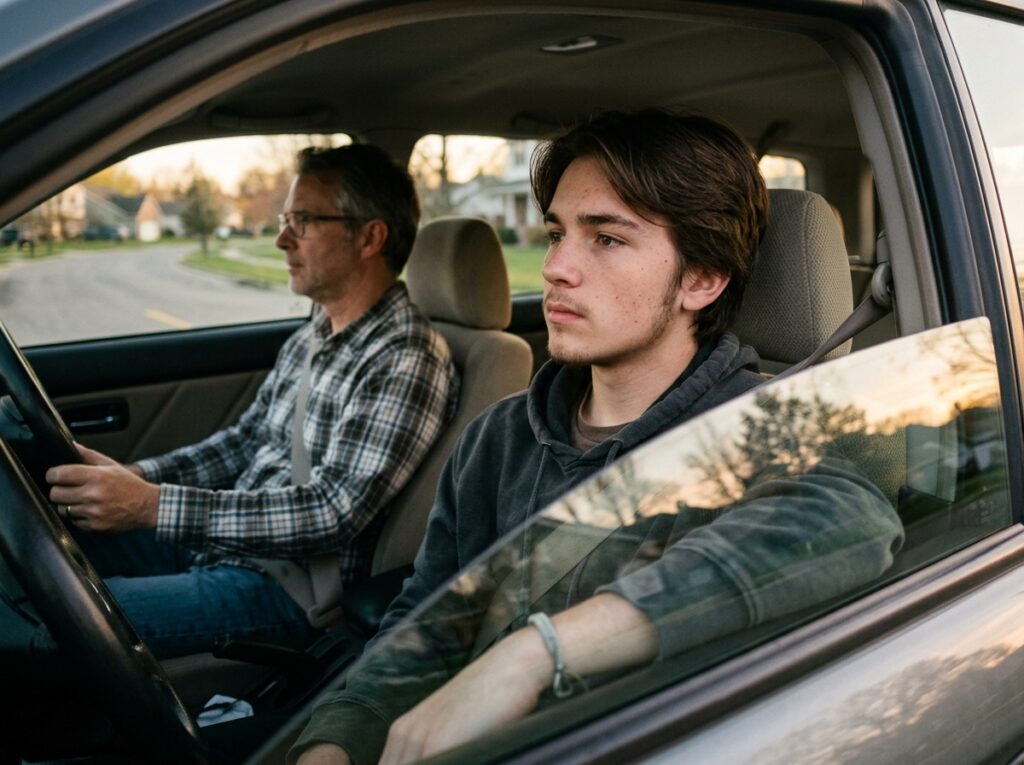
On the drive home, my son didn’t turn on his music.
He usually did.
Instead, he stared through the passenger-side window.
After several miles, he finally spoke.
“Dad?”
“Yeah?”
“What do you think those guys wanted when they were seventeen?”
I thought about it.
“Probably the same things you want.”
He looked at me.
“Like what?”
“Friends. Family. A future. Maybe a job. Maybe a girl they liked. Maybe they wanted to travel. Maybe they just wanted to figure out what they were going to do with their lives.”
He was quiet.
“And then the war happened.”
“Yeah.”
He looked out the window again.
After another few minutes, he said something I will never forget.
“I guess they didn’t know they were going to become history.”
I smiled.
“No. They were probably just trying to survive it.”
That was the real lesson.
The people we call heroes rarely know they are becoming heroes while it is happening.
They are simply people making decisions in difficult moments.
They are young men boarding ships.
Young women working long shifts.
Parents sending letters.
Families waiting.
Children hoping tomorrow will be safer than today.
Years pass.
Decades pass.
And eventually, the people who lived through those moments become elderly.
Their photographs fade.
Their voices become quieter.
Their memories become harder to retrieve.
And one day, there may be nobody left to tell us what it felt like.
That’s why I keep thinking about that woman.
She didn’t need recognition.
She didn’t want applause.
She simply wanted two old men to know that somewhere across an ocean, a little girl had grown up remembering them.
Maybe that is what gratitude really is.
Not a speech.
Not a ceremony.
Not a flag waved for a few minutes.
Sometimes gratitude is simply remembering.
Remembering the people who came before us.
Remembering what they lost.
Remembering the ordinary lives they wanted.
And understanding that the peaceful life we consider normal may have once been someone’s impossible dream.
I sometimes wonder what happened to that piece of paper.
I wonder where the original is now.
Maybe it sits inside a drawer.
Maybe it is tucked into a family photo album.
Maybe someday one of her grandchildren will find it and ask what it means.
And maybe that child will hear the story.
The story of a little girl in the Netherlands.
The story of two young American servicemen.
The story of a war that crossed an ocean.
The story of a freedom that arrived with an enormous price.
And perhaps that child will understand something that my son began to understand that night.
History isn’t dead.
It is sitting beside us.
It is in the faces of grandparents.
It is in old photographs.
It is in handwritten letters.
It is in the stories people tell before their memories disappear.
And sometimes, history walks into a school auditorium carrying a cane.
Sometimes it stands at the back of the room with tears in its eyes.
Sometimes it reaches across seventy-five years and wraps its arms around a stranger.
And sometimes, all it asks from us is that we remember.
That evening changed the way my son looked at those veterans.
It changed the way I looked at them too.
Before that night, I knew their generation had sacrificed.
I had read about it.
I had seen photographs.
I had watched documentaries.
But knowing something intellectually is not the same as sitting a few feet away from someone who was actually there.
It is not the same as watching an elderly woman say, through tears, “You came to save us.”
It is not the same as looking at your seventeen-year-old son and realizing that the young men who fought that war could have been sitting beside him in a classroom.
We left that second gathering just before sunset.
As we walked toward the parking lot, my son stopped.
He looked back at the building.
“Do you think they’ll come back next year?”
“I don’t know,” I said.
He nodded.
Then he said, “I hope they do.”
So do I.
Because there are some stories we cannot afford to lose.
There are some memories that deserve to be carried forward.
And there are some thank-yous that should never arrive too late.
If you read Part 1, you know how an ordinary school event became a moment none of us expected.
But what happened afterward taught me something even more important.
The story wasn’t really about two veterans.
It wasn’t even really about one elderly woman.
It was about what happens when generations meet, when memories are shared, and when young people finally realize that the history they read about in books was once someone’s present.
My son walked into that auditorium thinking he was going to listen to history.
He walked out understanding that history had once been seventeen years old too.
And I think that’s something he will remember for the rest of his life.

No Comments