

Rebecca Carter stared at her ninety-year-old father, unable to believe what she had just heard.
For fifty-two years, she had believed her younger brother, Samuel, had died when he was six years old.
She remembered the funeral.
She remembered her mother crying behind a closed bedroom door.
And she remembered the small white headstone that had once stood in the children’s section of Oakwood Memorial Cemetery.
Now her father was telling her that Samuel had been alive all those years.
“Dad,” Rebecca whispered, “what do you mean, that’s what you told me?”
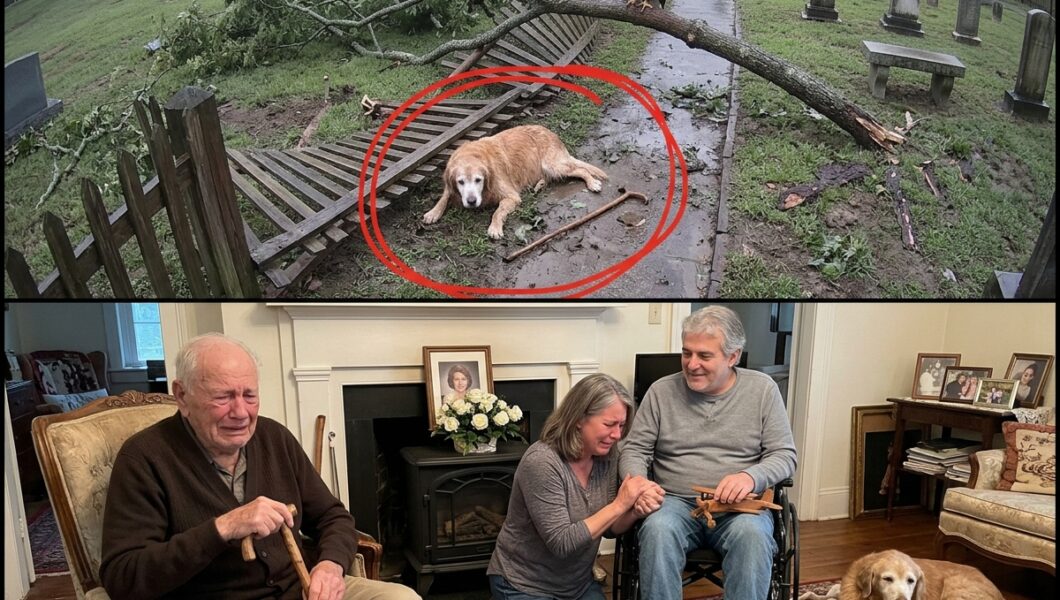
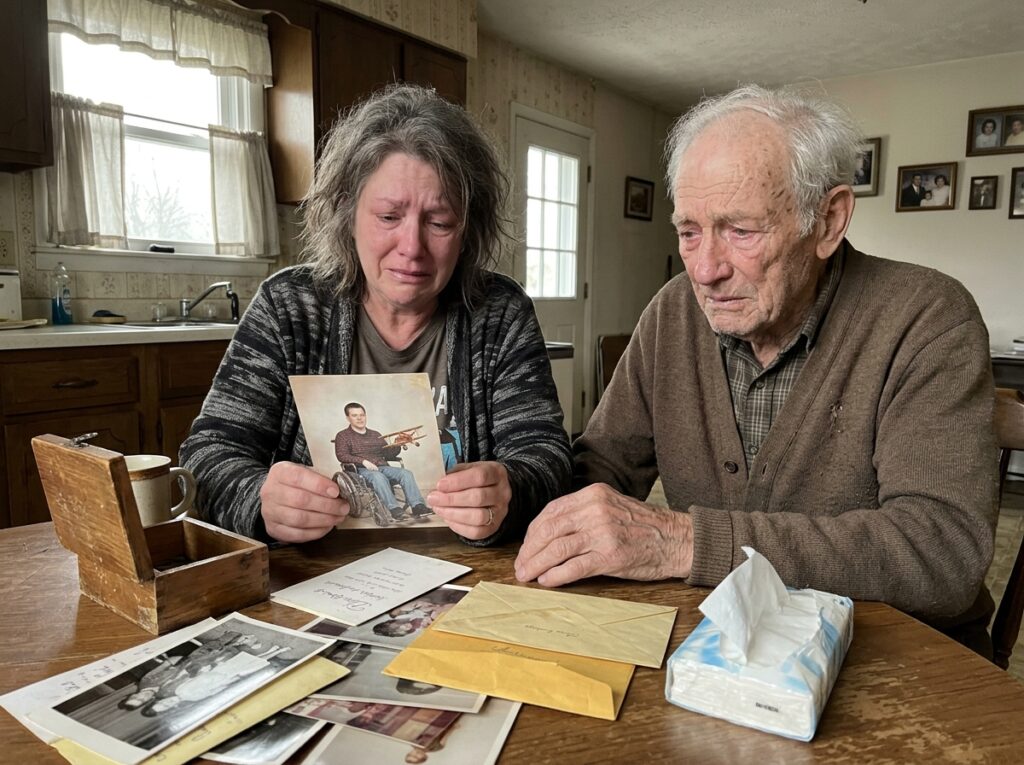
William Carter sat quietly beside the fireplace. His fifteen-year-old golden retriever, Charlie, slept on a blanket near his feet, recovering from the injuries he had suffered during the storm.
William’s hands trembled.
“Your brother didn’t die, sweetheart.”
Rebecca stepped backward.
“No.”
William lowered his eyes.
“He was taken away from us.”
Rebecca stared at him.
“Taken where?”
William looked toward the photograph of his late wife, Margaret.
“To a hospital in North Carolina. Then to a long-term care facility.”
Rebecca felt her stomach tighten.
She had been six years old when Samuel disappeared from her life.
She remembered him as a quiet little boy with sandy hair, bright blue eyes, and a habit of carrying a small wooden toy airplane everywhere he went.
He had been born with a serious neurological condition that affected his movement and development.
As he grew older, his health became increasingly fragile.
There were hospital visits.
Specialists.
And long nights when Margaret sat beside his bed, afraid to fall asleep.
Then, one winter morning in 1974, Rebecca woke to find her brother’s room empty.
Her mother told her Samuel had gone to heaven.
And for fifty-two years, Rebecca had believed her.
“Why?” she whispered.
William began crying.
“Because we were frightened.”
He explained that Samuel’s condition had worsened when he was six.
He required specialized care that wasn’t available near their home.
Doctors recommended a residential medical program where he could receive continuous support.
William and Margaret were devastated.
They had tried caring for Samuel at home, but his needs had become more complex than they could safely manage.
Eventually, they agreed to the transfer.
But Margaret struggled terribly with the decision.
She believed sending Samuel away meant abandoning him.
William tried to reassure her.
He told her they would visit.
They would write letters.
They would remain his parents, no matter where he lived.
But when Rebecca asked why her brother wasn’t coming home, Margaret broke down.
She couldn’t explain his illness to a frightened six-year-old.
And in a moment of grief and panic, she told Rebecca that Samuel had died.
William should have corrected her.
He knew that.
But he was exhausted, ashamed, and terrified of causing more pain.
So he allowed the lie to continue.
Days became months.
Months became years.
And eventually, the truth seemed impossible to tell.
Rebecca covered her mouth.
“You let me believe my brother was dead?”
William nodded.
Tears rolled down his cheeks.
“Yes.”
Rebecca began crying.
“All those years, Dad. I cried for him. I visited his grave.”
William lowered his head.
“I know.”
“How could you?”
He couldn’t answer.
There was no explanation that could make it right.
For the first time in his life, William understood that protecting someone from painful information could create a wound far deeper than the truth itself.
Rebecca sat down.
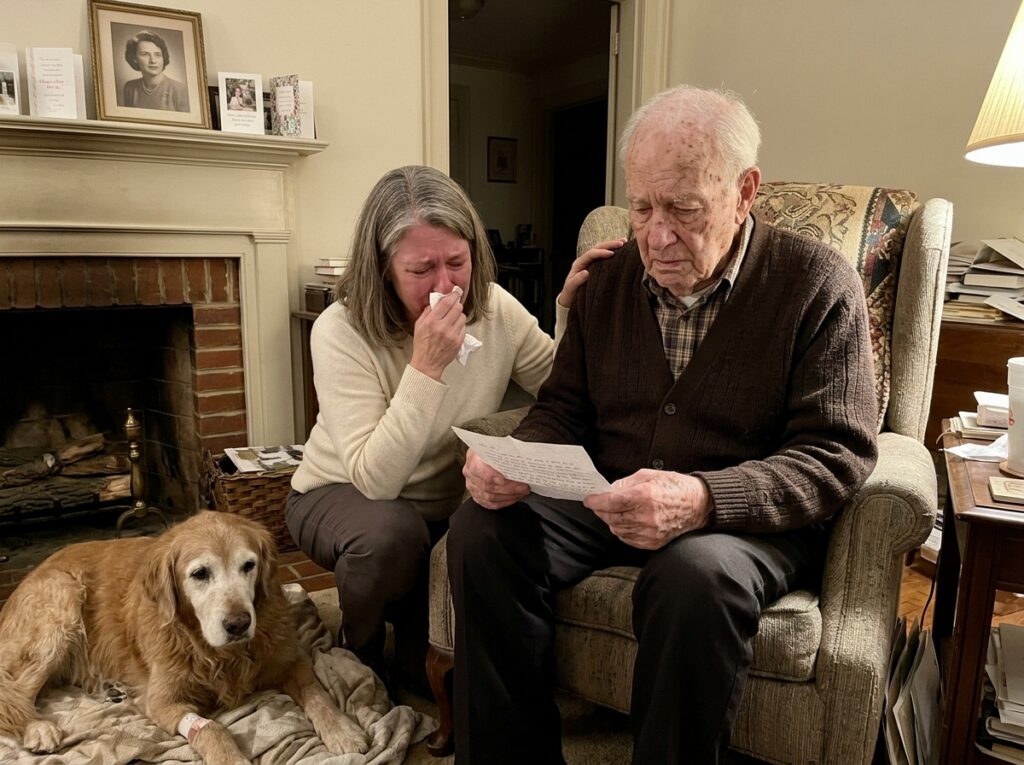
She stared at the thirty envelopes spread across the table.
“Did Mom know he was alive?”
William nodded.
“Yes.”
“Did she ever see him again?”
William wiped his eyes.
“Every chance she could.”
Rebecca looked up.
“What?”
William explained that Margaret had traveled to North Carolina several times each year to visit Samuel.
She brought photographs.
She read him stories.
She played the music he loved.
And whenever she returned home, she cried because she had to leave him again.
William visited when his military and later civilian work allowed.
They sent money for Samuel’s personal needs and kept in contact with his care team.
But they never told Rebecca.
As she grew older, the lie became harder to correct.
When Rebecca asked questions about Samuel, Margaret changed the subject.
When she wanted to visit his grave, William took her to a small memorial stone they had placed in the cemetery.
It wasn’t a burial site.
It was a marker for the child they believed they had lost in every way that mattered.
Rebecca stared at her father.
“You made me mourn someone who was still alive.”
William began sobbing.
“I know, sweetheart.”
She stood.
“I need some air.”
William nodded.
“Of course.”
Rebecca walked onto the front porch.
The evening air was cool.
Rainwater still dripped from the gutters.
She leaned against the wooden railing and began crying.
For fifty-two years, she had carried memories of a little boy she believed had died.
Now those memories were changing.
The funeral.
The empty bedroom.
Her mother’s tears.
The small headstone.
Everything felt different.
She didn’t know whether to feel relieved, angry, betrayed, or hopeful.
Perhaps all four.
Behind her, the screen door opened.
William stepped outside slowly, leaning on his walking stick.
“Rebecca?”
She turned.
“Did he ever ask about me?”
William’s eyes filled.
“Yes.”
Rebecca began crying harder.
“What did you tell him?”
William looked down.
“That you loved him.”
She covered her face.
“I did love him.”
William nodded.
“I know.”
Rebecca wiped her tears.
“Do you know where he is now?”
William hesitated.
Then he nodded.
“Yes.”
Rebecca stared at him.
“Is he alive?”
William took a shaky breath.
“Yes, sweetheart. Samuel is alive.”
For several seconds, Rebecca couldn’t speak.
Then she whispered, “I want to see him.”
William closed his eyes.
“I hoped you’d say that.”
The following morning, Rebecca returned to her father’s house.
William had placed a small wooden box on the kitchen table.
Inside were photographs, letters, medical correspondence, and birthday cards.
Rebecca opened the box carefully.
The first photograph showed Samuel at ten years old, sitting in a wheelchair beside a garden.
Another showed him at twenty, smiling beside a nurse.
A third showed him in his forties, holding a small wooden toy airplane.
Rebecca stared.
“The airplane.”
William smiled sadly.
“He kept it.”
She remembered buying it for him at a county fair when she was five.
It had cost fifty cents.
Samuel had carried it everywhere.
Rebecca began crying.
“He still has it?”
William nodded.
“Yes.”
She pressed the photograph against her chest.
Then she opened another envelope.
Inside was a birthday card.
On the front were colorful balloons.
Inside, in large uneven handwriting, were the words:
“To Rebecca. Love, Sam.”
Rebecca looked up.
“He wrote to me?”
William nodded.
“With help from his caregivers.”
Rebecca began sobbing.
“Why didn’t you give me these?”
William lowered his head.
“Because every year I told myself I would finally explain. And every year I was too afraid.”
Rebecca stared at him.
For a long time, neither spoke.
Then she whispered, “You should have trusted me.”
William nodded.
“Yes.”
He reached for her hand.
“I can’t change what I did. But I can tell you the truth now.”
Rebecca looked toward the photographs.
She had lost fifty-two years with her brother.
She didn’t want to lose another day.
Three days later, Rebecca and William traveled to North Carolina.
Daniel Brooks, the cemetery groundskeeper who had helped rescue Charlie, offered to drive them.
William’s health made long journeys difficult, and Rebecca didn’t want her father traveling alone.
Charlie remained at home under the care of a trusted neighbor, following the veterinarian’s recovery instructions.
During the drive, William was unusually quiet.
He held a photograph of Margaret in his lap.
Rebecca watched him from the passenger seat.
“Dad?”
“Yes, sweetheart?”
“Why did Mom keep visiting Samuel after she got sick?”
William looked toward the window.
“Because she never stopped being his mother.”
Rebecca nodded.
“Did he understand who she was?”
William smiled faintly.
“Sometimes he called her Mama. Sometimes he just smiled when she walked into the room.”
He paused.
“But she always knew he was happy to see her.”
Rebecca wiped her eyes.
“Did he know she died?”
William lowered his head.
“His caregivers helped him understand as best they could.”
Rebecca looked down.
She had spent years believing her mother had been grieving only the loss of a child.
Now she understood Margaret had been carrying a different kind of sorrow.
She had loved a son who was alive but far away.
And she had hidden that love from her daughter.
Rebecca didn’t know whether she could forgive her parents.
But she knew she wanted to understand.
When they arrived at the residential care facility, a staff member greeted them warmly.
“Mr. Carter?”
William nodded.
“Yes.”
“We’ve been expecting you.”
Rebecca’s hands began trembling.
The staff member led them through a quiet hallway toward a bright common room.
Several residents were sitting near large windows.
Soft music played in the background.
Then Rebecca saw him.
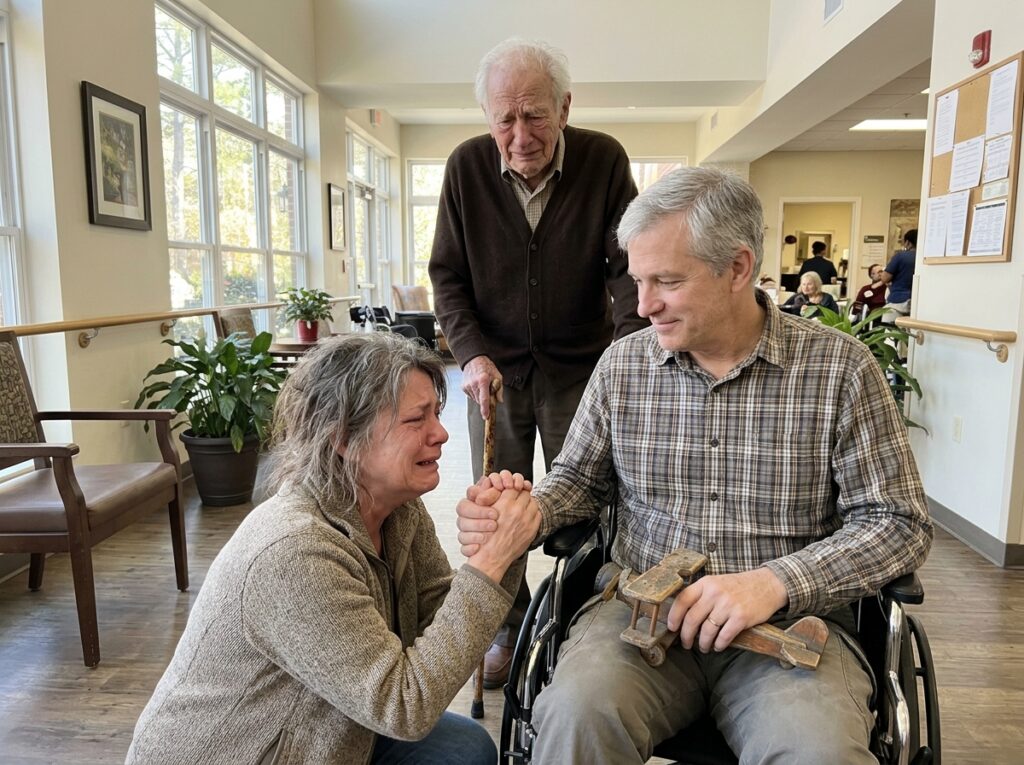
A man in his late fifties sat in a wheelchair beside a table.
His hair was mostly gray.
His shoulders were slightly rounded.
And resting in his lap was a small wooden airplane.
Rebecca stopped walking.
Her breath caught.
“Samuel?”
The man looked up.
For several seconds, he studied her face.
Then he smiled.
“Becky?”
Rebecca covered her mouth.
Nobody had called her Becky since she was a little girl.
She began crying.
“Oh, Sam.”
She walked toward him slowly.
Then she knelt beside his wheelchair.
“It’s me.”
Samuel smiled again.
“Becky.”
Rebecca reached for his hand.
He held it gently.
For a long time, neither spoke.
Then Samuel lifted the wooden airplane.
“Yours,” he said.
Rebecca began sobbing.
She remembered the county fair.
The little wooden toy.
Her brother running across the grass, pretending it could fly.
She had believed those memories were all she had left.
Now the little boy she remembered was sitting in front of her.
Older.
Different.
But alive.
“I gave you that,” she whispered.
Samuel nodded.
“Becky gave.”
Rebecca pressed her forehead gently against his hand.
“Yes, Sam. I did.”
William stood nearby, crying quietly.
For fifty-two years, he had imagined this moment.
But he had never believed he would live long enough to see it.
Over the following hours, Rebecca learned about Samuel’s life.
His caregivers showed her photographs of birthday celebrations, holiday gatherings, and trips to nearby parks.
They explained that Samuel enjoyed music, simple woodworking activities, and watching birds through the window.
He had made friends with several residents.
He had favorite meals.
And he loved looking through old family photographs.
Rebecca listened carefully.
She asked questions.
She wanted to know what made him laugh.
What frightened him.
What he enjoyed.
And what helped him feel safe.
For the first time, she was learning about the brother who had grown up without her.
Samuel’s communication was limited, but he understood more than Rebecca expected.
When she showed him a photograph of Margaret, he smiled.
“Mama.”
Rebecca nodded.
“Yes, Sam. That’s Mom.”
He touched the photograph gently.
Then he looked toward William.
“Dad.”
William began crying.
“Yes, son. I’m here.”
Samuel smiled.
For a moment, the room was quiet.
Then Rebecca reached for her father’s hand.
She wasn’t ready to forgive everything.
But she was ready to begin.
Over the following months, Rebecca visited Samuel regularly.
She brought photographs of her childhood.
She played the music their mother loved.
And she listened as the caregivers helped Samuel share stories through pictures, gestures, and simple words.
Sometimes he remembered things she had forgotten.
Other times, he seemed content simply to sit beside her.
Rebecca learned that rebuilding a relationship didn’t require recovering every lost year.
It required showing up now.
William began accompanying her whenever his health allowed.
And each time they visited, Samuel smiled when he saw them.
Meanwhile, Charlie continued recovering from his injuries.
The elderly golden retriever regained enough strength for short, gentle walks.
The veterinarian recommended continued monitoring and careful support because of his age.
William followed every instruction.
He knew Charlie had already given him fifteen years of companionship.
He wanted whatever time remained to be comfortable and peaceful.
One Sunday morning, Rebecca arrived at William’s house carrying a small bouquet of white roses.
“Dad?”
William looked up from his chair.
“Yes, sweetheart?”
“Would you like some company at the cemetery?”
William smiled through his tears.
“I’d like that very much.”
They drove to Oakwood Memorial together.
Charlie rested safely at home that morning.
The cemetery grounds were quiet.
The storm-damaged fence had been repaired.
The fallen oak branches had been removed.
And the narrow path toward Margaret’s grave was clear.
William walked slowly, leaning on his cane.
Rebecca carried the roses.
When they reached Margaret’s headstone, William stopped.
He removed his cap.
“Hello, sweetheart,” he whispered.
Rebecca knelt beside the grave.
She placed the flowers carefully against the stone.
Then she looked at her father.
“Did Mom ever want to tell me?”
William nodded.
“Every year.”
Rebecca wiped her eyes.
“Why didn’t she?”
William looked toward the headstone.
“Because she was afraid you’d hate us.”
Rebecca sat quietly.
Then she whispered, “I was angry.”
William nodded.
“You had every right to be.”
She looked toward the roses.
“I’m still angry sometimes.”
“I understand.”
Rebecca took a slow breath.
“But I’m glad you finally told me.”
William began crying.
“Me too, sweetheart.”
For a long time, they remained beside Margaret’s grave.
Then Rebecca reached into her handbag.
She removed a small photograph.
It showed Samuel smiling beside her during their most recent visit.
Rebecca placed it against the headstone.
“Mom,” she whispered, “I found him.”
William covered his face.
Rebecca continued.
“I found my brother.”
The old man began sobbing.
For thirty years, he had brought white roses to his wife’s grave.
He had told her about the weather.
About Charlie.
About the changes in the neighborhood.
And about the daughter he had lost through years of silence.
Now, for the first time, he could tell her something different.
“Margaret,” he whispered, “our children are together.”
Rebecca reached for his hand.
They stood quietly beneath the old oak tree.
Then she asked, “Dad, who was leaving flowers beside Mom’s grave all those years?”
William smiled faintly.
“Samuel.”
Rebecca looked confused.
“How?”
William explained that Samuel’s caregivers had helped him send flowers to Margaret’s grave each year on her birthday.
Sometimes a staff member arranged delivery.
Sometimes William collected the bouquet and placed it beside the headstone himself.
The flowers were always yellow daisies.
Margaret’s favorite after white roses.
Rebecca began crying.
“He remembered her.”
William nodded.
“In his own way, he never forgot.”
Rebecca looked toward the headstone.
For years, she had believed her mother was buried beside the memory of a child who died young.
Now she understood that the flowers had been a quiet connection between a mother and the son she loved.
A connection that had survived distance, illness, and silence.
Several weeks later, Rebecca arranged for Samuel to visit Virginia with appropriate support from his care team.
It was a carefully planned trip.
William prepared the house.
He placed old family photographs on the mantel.
He made sure the doorway was accessible.
And he asked Daniel Brooks to help with transportation arrangements.
When Samuel arrived, Charlie was resting beside the fireplace.
The elderly dog lifted his head.
Samuel smiled.
“Dog.”
Rebecca laughed softly.
“That’s Charlie.”
Samuel reached out carefully while a caregiver supervised.
Charlie gently sniffed his hand.
Then he rested his gray muzzle against Samuel’s knee.
William began crying.
For fifteen years, Charlie had been his closest companion.
The dog had walked beside him through loneliness, grief, and countless Sunday mornings.
Now he was meeting the son William had spent decades hiding from the world.
Samuel smiled.
“Good dog.”
William wiped his eyes.
“Yes, son. He’s a very good dog.”
That afternoon, the family sat together in the living room.
Rebecca showed Samuel photographs.
William told stories about Margaret.
And Charlie slept peacefully beside the fireplace.
For the first time in more than fifty years, the Carter family felt connected in a way William had almost stopped believing possible.
But the most emotional moment came later that evening.
Rebecca opened the wooden box of letters.
She selected one written shortly after Margaret’s death.
It was dated October 1996.
William had written:
“My darling Margaret,
I brought you white roses today.
The house feels empty without you.
Rebecca is far away, and Samuel still asks for you.
I don’t know how to fix the mistakes we made.
But I promise I will keep visiting.
I will keep bringing flowers.
And I will keep loving our children, even if I never find the courage to tell them everything.”
Rebecca read the words slowly.
Then she looked toward her father.
“You were afraid all those years.”
William nodded.
“Yes.”
She wiped her eyes.
“And you thought keeping quiet would protect us.”
He lowered his head.
“I did.”
Rebecca reached for his hand.
“But it didn’t.”
William began crying.
“No, sweetheart. It didn’t.”
She squeezed his fingers.
“We can’t change that.”
He nodded.
“But we can stop doing it.”
William looked up.
Rebecca smiled through her tears.
“No more secrets, Dad.”
William began sobbing.
“No more secrets.”
Several months later, William celebrated his ninety-first birthday.
Rebecca organized a small gathering at his house.
Samuel attended with support from his caregivers.
Daniel Brooks came from the cemetery.
Several veterans from the local community stopped by.
And Charlie rested comfortably on his favorite blanket beside William’s chair.
Rebecca brought out a birthday cake.
Samuel smiled when everyone began singing.
William looked around the room.
For years, he had believed his life was slowly becoming smaller.
His wife was gone.
His daughter had stopped visiting.
His son lived far away.
And his aging dog was the only companion who remained beside him every day.
Now the house was filled with voices.
Laughter.
Photographs.
And the family he had nearly lost forever.
When Rebecca asked him to make a wish, William looked toward Samuel.
Then toward Charlie.
Then toward Margaret’s photograph above the fireplace.
He closed his eyes.
For a moment, he imagined Margaret standing beside him.
Smiling.
Holding a single white rose.
He opened his eyes.
“I don’t need a wish,” he whispered.
Rebecca smiled.
“Why not, Dad?”
William reached for her hand.
“Because I already got something I never thought I’d have again.”
She leaned closer.
“What?”
He looked around the room.
“My family.”
Rebecca began crying.
Samuel smiled.
And Charlie’s tail moved slowly against the blanket.
That Sunday, William returned to Oakwood Memorial Cemetery.
This time, Rebecca walked beside him.
Samuel accompanied them with his caregivers.
Charlie remained at home, resting comfortably.
They followed the repaired path toward Margaret’s grave.
William carried white roses.
Rebecca carried a photograph of the three of them together.
And Samuel held a small bouquet of yellow daisies.
When they reached the headstone, William stopped.
He looked toward the engraved words.
Margaret Carter — Beloved Wife and Mother.
Then he turned toward his children.
For thirty years, he had visited that grave alone.
He had believed keeping his promise meant never missing a Sunday.
Now he understood that Margaret’s greatest wish had never been about flowers.
It had been about the family they built together.
William placed the white roses against the stone.
Samuel’s caregiver helped him place the daisies beside them.
Rebecca set down the photograph.
Then William whispered:
“Margaret, they’re both here.”
His voice broke.
“Our children are together.”
Rebecca wrapped her arms around him.
Samuel smiled softly beside them.
And beneath the old oak tree, the Carter family stood together in the quiet morning air.
The storm had passed.
The damaged fence had been repaired.
Charlie was safe at home.
And a secret that had divided a family for more than fifty years had finally been brought into the light.
William looked toward the sky.
Then he whispered the words he had carried in his heart for thirty years.
“I kept my promise, sweetheart.”
He paused.
“And this time, I brought everybody home.”
The End.
This is a fictional family reunion and animal kindness story created for emotional storytelling.
No Comments