

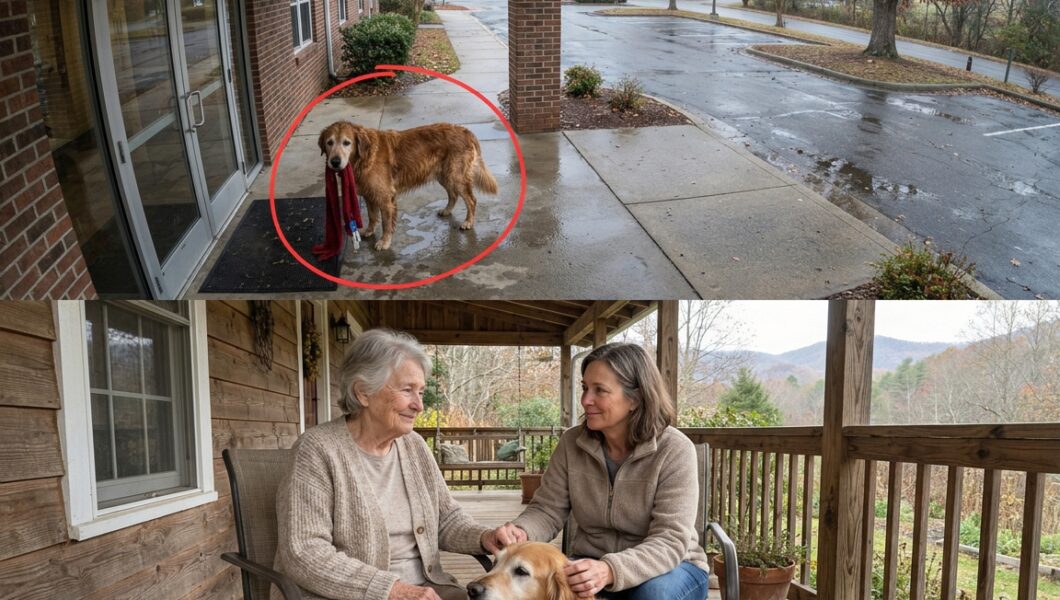
AT 7:03 PM, A NORTH CAROLINA DEPUTY DISCOVERED THAT THE NURSE WHO HAD BEEN LEADING THE SEARCH FOR A MISSING 78-YEAR-OLD WOMAN HAD SECRETLY HELPED HER DISAPPEAR, BUT WHEN THE NURSE FINALLY EXPLAINED WHY, INVESTIGATORS UNCOVERED A FIFTY-ONE-YEAR-OLD SECRET THAT HAD DESTROYED TWO LIVES AND NEARLY COST A MOTHER HER LAST CHANCE TO SEE HER DAUGHTER AGAIN.
Deputy Daniel Brooks stared at the nursing home security footage.
On the screen, nurse Emily Carter opened the garden door.
Margaret Wilson stood beside her.
The elderly woman’s red knitted scarf was wrapped around her neck.
And Buddy, her twelve-year-old golden retriever, waited at her feet.
Emily handed Margaret an envelope.
Margaret opened it.
Read the contents.
Then covered her mouth.
Seconds later, the three disappeared into the darkness.
Daniel paused the recording.
Emily had told investigators she knew nothing about Margaret’s disappearance.
Yet she had been standing beside Margaret when she left.
And now Emily was calling him.
Crying.
“Deputy Brooks, I need to tell you something.”
Daniel kept his voice steady.
“I’m listening.”
Emily took a shaky breath.
“I didn’t help Margaret escape.”
She paused.
“I helped her find Anna.”
Daniel glanced toward the photograph recovered from the abandoned farmhouse.
Margaret and Anna.
Christmas 1974.
A mother smiling beside her little girl.
A child who had supposedly died the following year.
“Emily, where did you get the information about Anna?”
Emily began crying harder.
“From a letter.”
“What letter?”
“A letter that was never supposed to reach Margaret.”
Daniel leaned forward.
“Who wrote it?”
Emily whispered:
“Anna did. And someone at the nursing home had been hiding it.”
At 7:18 PM, Daniel met Emily in a private interview room at the sheriff’s office.
She looked exhausted.
Her eyes were red.
And her hands trembled as she placed a small envelope on the table.
Inside was a folded letter.
The paper was yellowed.
The handwriting was careful but uneven.
Daniel opened it.
The letter began:
Dear Mom,
I don’t know whether you are still alive.
I don’t know whether you remember me.
But I have spent my whole life trying to understand why you never came.
Daniel looked up.
“Where did you find this?”
Emily swallowed.
“Three weeks ago, I was helping reorganize Margaret’s personal records.”
She explained that Willow Creek Care Center had recently changed its records storage system.
Several old boxes had been moved from a locked administrative office.
Emily was sorting them when she discovered a folder bearing Margaret’s name.
Inside were copies of correspondence.
Some were decades old.
Others had been written recently.
Every letter was addressed to Margaret.
None had been delivered.
Daniel frowned.
“Why would the nursing home have letters from decades before Margaret became a resident?”
Emily shook her head.
“That’s what frightened me.”
She had initially assumed the folder had been transferred from an earlier care facility.
But the documents included a handwritten instruction.
DO NOT RELEASE TO RESIDENT OR FAMILY.
The instruction carried the initials of the care center’s former administrator.
H.R.
Daniel wrote them down.
“Who was H.R.?”
Emily looked toward the door.
“Harold Reeves.”
“Where is he now?”
“He retired eight months ago.”
Daniel waited.
Emily whispered:
“And his father was the man who handled Anna’s case in 1975.”
Daniel felt a chill.
“His father?”
Emily nodded.
“Charles Reeves.”
The name appeared in the archived records investigators had recovered earlier that day.
Charles Reeves had been a county child welfare administrator in the 1970s.
He had signed several documents concerning Anna Wilson’s transfer into state custody after the accident.
Daniel looked down at the letter.
“Emily, why didn’t you bring this to the police?”
She began crying.
“I should have.”
She wiped her eyes.
“But I thought Margaret deserved to know first.”
Emily explained that she had spent days trying to verify the letters.
She contacted a retired records clerk.
She checked old addresses.
And she discovered that Anna Wilson had been placed with another family after the accident.
Anna had grown up under a different surname.
She had spent years searching for Margaret.
But every inquiry seemed to lead nowhere.
Then Emily found a recent letter.
It had been written only four months earlier.
Anna said she had finally located Margaret at Willow Creek Care Center.
She wanted to visit.
But someone had told her Margaret was too ill to receive visitors.
Daniel looked up.
“Who told her that?”
Emily’s voice trembled.
“Harold Reeves.”
At 7:42 PM, Daniel contacted the sheriff.
The investigation was expanding.
Margaret and Anna had been found alive.
But the evidence suggested someone had deliberately prevented their reunion for decades.
And the nursing home had continued the deception.
Daniel returned to Emily.
“Tell me exactly what happened the night Margaret disappeared.”
Emily nodded.
She explained that Margaret had been unusually quiet that afternoon.
Emily had finally shown her one of Anna’s letters.
Margaret read it.
Then asked the same question repeatedly.
“Is my little girl alive?”
Emily told her that the evidence suggested Anna had survived the accident.
Margaret began crying.
She insisted on seeing her daughter.
Emily offered to contact the sheriff’s office.
But Margaret became frightened.
She said the authorities had been the ones who told her Anna was dead.
She feared someone would stop the reunion again.
Emily tried to reassure her.
Then Margaret showed her something.
A small photograph.
It had arrived in the mail that morning.
On the back was a handwritten message.
MOM, I AM STILL HERE. PLEASE LET ME FIND YOU.
Emily recognized the handwriting from the letters.
Anna.
Margaret insisted that she wanted to leave immediately.
Emily admitted she made a serious mistake.
Instead of contacting emergency services and arranging a safe meeting, she helped Margaret reach the garden courtyard.
She believed Anna would be waiting nearby.
But when they reached the courtyard, nobody was there.
Then a white medical transportation van appeared near the service road.
Thomas Reed stepped out.
Emily recognized him.
He regularly transported residents to medical appointments.
Thomas told Margaret that Anna had arranged the meeting.
Emily hesitated.
She asked Thomas for confirmation.
He showed her a photograph of Anna.
And a handwritten message bearing Margaret’s name.
Emily believed him.
Margaret climbed into the van.
Buddy followed.
Emily watched them leave.
Then she returned inside.
Daniel stared at her.
“You allowed a vulnerable resident to leave with someone whose story you hadn’t independently verified?”
Emily lowered her head.
“Yes.”
“Why did you tell investigators you knew nothing?”
Emily began sobbing.
“Because I panicked.”
She covered her face.
“I thought I had sent her into danger.”
At 8:11 PM, investigators contacted Thomas Reed.
His van had been recovered beside the abandoned motel.
Margaret and Anna had been found nearby.
But Thomas was missing.
His phone had been switched off.
And his home was empty.
Daniel reviewed the available evidence.
The van had been recorded near the abandoned farmhouse.
Margaret’s cardigan had been found inside.
A room had been locked from the outside.
And someone had kept a medication schedule for her.
Thomas had claimed his van was stolen.
Yet security footage showed him driving it after the reported theft.
Daniel believed Thomas knew far more than he had admitted.
Then another detail emerged.
The white van had been leased through a transportation company partially owned by Harold Reeves.
The former nursing home administrator.
Daniel looked toward the sheriff.
“Reeves and Thomas are connected.”
The sheriff nodded.
“Find out how closely.”
At 8:46 PM, detectives obtained archived information about the 1975 accident.
The records described a collision on a mountain road outside Willow Creek.
Margaret had been driving.
Nine-year-old Anna was in the passenger seat.
Their vehicle had left the road during heavy rain.
Margaret suffered serious injuries.
Anna was taken to a separate medical facility.
The original reports contained conflicting information.
One document described Anna as critically injured.
Another stated she had been transferred to state custody.
But there was no verified death certificate.
And the official state records did not establish that Anna had died.
Daniel studied the documents.
The central question was becoming clearer.
Why had Margaret been told her daughter was dead when the child was alive?
Then an investigator discovered a financial record.
In 1975, Margaret’s late husband had established a substantial trust for Anna.
The funds were intended to support her education and future care.
After the accident, the trust had been placed under temporary administration.
Charles Reeves had been involved in arranging that administration.
Daniel read the names carefully.
Then looked toward the sheriff.
“We need the financial records.”
At 9:32 PM, investigators located a retired attorney who had worked on the original trust.
The attorney was eighty-six years old.
He remembered the Wilson family.
And he remembered the accident.
During a recorded interview, he explained that Margaret had been hospitalized for months.
Her recovery was complicated.
She had suffered serious injuries and periods of confusion.
Anna had survived.
But the child was placed into temporary state care while Margaret recovered.
The attorney said he had later been told that Margaret was medically incapable of caring for Anna.
He had also been told that Anna had been transferred to a permanent placement.
Daniel asked:
“Who provided that information?”
The attorney hesitated.
“Charles Reeves.”
“Did you ever speak directly with Margaret?”
“No.”
“Did you ever meet Anna after the accident?”
“No.”
Daniel looked toward the sheriff.
The attorney continued.
“I always assumed the family had agreed to the arrangement.”
Daniel asked:
“Did you know Margaret was told Anna had died?”
The old attorney went silent.
Then whispered:
“No.”
The next morning, investigators interviewed Margaret at the hospital.
Her doctors confirmed she was stable enough for a short conversation.
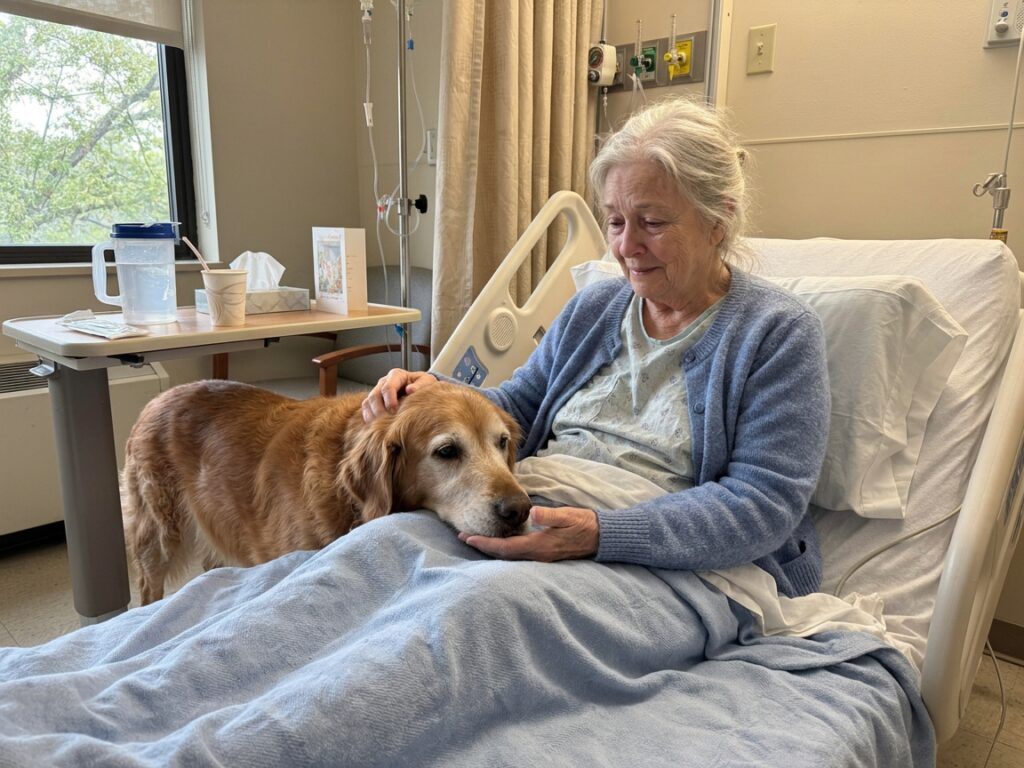
Buddy rested beside her bed.
The elderly golden retriever’s gray muzzle lay against the blanket.
His paws had been cleaned and treated.
He was exhausted.
But he refused to move far from Margaret.
Daniel sat beside her.
“Mrs. Wilson, I need to ask you about the accident.”
Margaret looked down.
“That was a long time ago.”
“I know.”
She stroked Buddy’s ears.
“It was raining.”
Her voice trembled.
“Anna was singing in the passenger seat.”
Daniel waited.
Margaret continued.
“I remember the road.”
“The headlights.”
“The sound of the tires.”
Then she closed her eyes.
“After that, I remember waking up in a hospital.”
“Did anyone tell you where Anna was?”
Margaret nodded.
“A man came to see me.”
“Do you remember his name?”
She looked toward Daniel.
“Reeves.”
Daniel felt his chest tighten.
“Charles Reeves?”
Margaret nodded.
“He told me Anna hadn’t survived.”
Tears filled her eyes.
“I begged to see her.”
She paused.
“He said it wasn’t possible.”
Daniel spoke gently.
“Did anyone ever show you a death certificate?”
Margaret shook her head.
“No.”
“Did you attend a funeral?”
“No.”
She began crying.
“They told me I was too sick.”
Buddy lifted his head.
Margaret stroked his ears.
“For fifty-one years, I believed my little girl was gone.”
Daniel waited.
Then Margaret whispered:
“And all that time, she was looking for me.”
At 11:18 AM, Daniel received a call from the hospital.
Anna Wilson had regained consciousness.
The woman found unconscious in the motel bathroom was sixty-one years old.
She was weak.
Dehydrated.
And recovering from a medical episode that doctors were still evaluating.
But she could speak.
Daniel entered her room.
Anna lay beneath a white blanket.
Her hair was streaked with gray.
Her face was pale.
But her eyes were remarkably similar to Margaret’s.
Daniel introduced himself.
“Anna, I’m Deputy Brooks.”
She nodded.
“Where’s my mother?”
“She’s safe.”
Anna began crying.
“Is she really here?”
Daniel nodded.
“She’s in another room.”
Anna covered her mouth.
“Oh, thank God.”
Daniel pulled up a chair.
“Can you tell me what happened?”
Anna took a shaky breath.
Then began explaining.
Anna remembered the accident.
She remembered the rain.
The car leaving the road.
And waking in a hospital without her mother.
She had been told Margaret was too ill to care for her.
Later, she was told Margaret had chosen not to see her.
Anna had written letters.
At first, she wrote every week.
Then every month.
Then whenever she could bear the disappointment.
She sent birthday cards.
Christmas letters.
Photographs.
But Margaret never answered.
When Anna became an adult, she began searching for her mother.
She contacted government offices.
Requested records.
And hired investigators when she could afford it.
But every lead ended in confusion.
Some records were missing.
Others contained incorrect addresses.
And several people told her Margaret had moved away.
Anna eventually discovered that her mother was living in North Carolina.
Then she learned Margaret had entered Willow Creek Care Center.
Anna contacted the facility.
But Harold Reeves told her Margaret was medically unable to receive visitors.
Anna believed him at first.
Then she began receiving contradictory information.
One staff member said Margaret was doing well.
Another said she was too ill to speak.
Anna became suspicious.
She continued writing.
Then, four months earlier, she received a short letter.
It claimed Margaret did not wish to see her.
Anna began crying as she remembered.
“I thought she hated me.”
Daniel shook his head.
“She never received your letters.”
Anna stared at him.
“What?”
“We recovered dozens of them.”
Anna covered her mouth.
Daniel continued.
“Your mother believed you died in 1975.”
Anna began sobbing.
For several minutes, she could not speak.
Then she whispered:
“She thought I was dead?”
Daniel nodded.
Anna closed her eyes.
“Oh, Mom.”
At 12:07 PM, Anna explained how she had finally reached Margaret.
She had contacted a former nursing home employee.
The woman told her that Margaret often sat beside the garden window with her golden retriever.
Anna sent a photograph.
And a handwritten note.
She hoped someone would deliver it.
Then Thomas Reed contacted her.
He claimed he could arrange a private reunion.
Anna was desperate.
She agreed.
Thomas told her to meet him near an abandoned farmhouse outside town.
But when she arrived, Margaret was not there.
Instead, Thomas insisted that the meeting had to be delayed.
He said Margaret was frightened.
And that the nursing home might report her missing.
Anna became suspicious.
Then Thomas brought Margaret to the farmhouse.
For the first time in fifty-one years, mother and daughter stood in the same room.
Anna began crying as she remembered.
“She looked at me.”
Her voice broke.
“She asked if I was really Anna.”
Daniel waited.
Anna continued.
“I showed her the scar on my left wrist.”
A childhood injury.
Something Margaret remembered.
Then Margaret touched her face.
And whispered:
“My little girl.”
Anna began sobbing.
“We held each other.”
For several minutes, she could not continue.
Then she looked toward Daniel.
“But Thomas wouldn’t let us leave.”
Anna explained that Thomas had locked them inside the farmhouse.
He claimed he was protecting them from Harold Reeves.
But he refused to contact police.
He took their phones.
And insisted they remain hidden until he could arrange transportation.
Margaret became frightened.
She wrote a note.
PLEASE DON’T SEND ME BACK.
She attached it to her red scarf with the small silver key.
The key belonged to a storage unit Anna had rented years earlier.
Anna had kept copies of letters, photographs, and documents there.
She had brought the key to show Margaret where the records were stored.
Buddy had been with Margaret the entire time.
The dog was restless.
He scratched at the farmhouse door.
And barked whenever Thomas approached.
Anna said that during a brief period when Thomas left the room, Margaret managed to open a side door.
Buddy slipped outside.
Margaret tied the note and key to her scarf.
Then gave it to the dog.
Anna began crying.
“She told him to go home.”
Daniel looked up.
“She sent Buddy back to the nursing home?”
Anna nodded.
“She said he knew the way.”
Daniel thought about the elderly golden retriever.
Twelve years old.
Arthritic.
Soaked in rain.
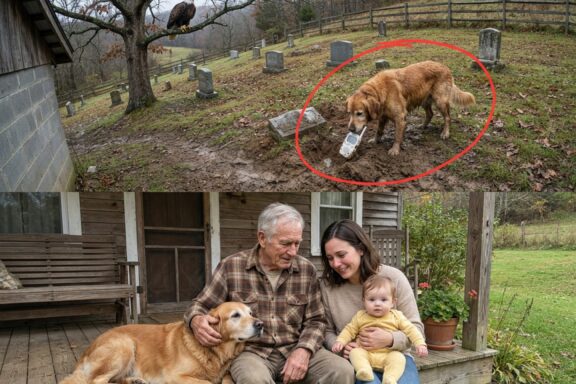
Walking through the woods with a red scarf in his mouth.
He had returned to the nursing home.
Scratched at the glass.
And delivered the first real clue.
Daniel looked toward Anna.
“Buddy brought us the scarf.”
Anna covered her face.
“Oh, thank God.”
But the story was not finished.
Anna explained that Thomas later moved them from the farmhouse.
He claimed the property was no longer safe.
He drove them toward the abandoned motel.
Margaret was exhausted.
Anna was becoming increasingly unwell.
And Thomas appeared frightened.
At the motel, he told them to remain inside while he made a phone call.
He left.
And never returned.
Anna tried to care for Margaret.
But she became dizzy.
Then collapsed in the bathroom.
Margaret called for help.
And eventually, deputies arrived.
Daniel listened carefully.
Then asked:
“Did Thomas ever tell you why he was involved?”
Anna nodded.
“He said he owed Harold Reeves money.”
Daniel wrote it down.
“Did he say anything else?”
Anna hesitated.
Then whispered:
“He said Harold couldn’t afford for my mother and me to meet.”
Daniel looked up.
“Why?”
Anna shook her head.
“He wouldn’t explain.”
At 2:36 PM, investigators obtained records relating to the Wilson family trust.
The documents showed that money intended for Anna’s care had been administered for decades through a series of accounts.
Several transfers required further investigation.
Some records appeared inconsistent with the stated purpose of the trust.
And certain payments were connected to entities associated with Charles Reeves.
Later records showed payments to a company connected to Harold Reeves.
Daniel reviewed the documents.
The evidence suggested a possible financial motive for keeping Margaret and Anna separated.
But investigators still needed to determine who had authorized the transfers and whether any laws had been broken.
The sheriff’s office referred the financial evidence to appropriate investigators.
Meanwhile, Thomas Reed was located at a relative’s property in a neighboring county.
He agreed to speak with detectives.
His account confirmed that Harold Reeves had asked him to prevent Anna from meeting Margaret until certain records could be removed from storage.
Thomas admitted lying about the van being stolen.
He also admitted keeping the women inside the farmhouse and later leaving them at the motel.
Investigators continued examining his role.
But the most important fact was already clear.
Margaret and Anna had survived.
And after fifty-one years, they were finally about to see each other again.
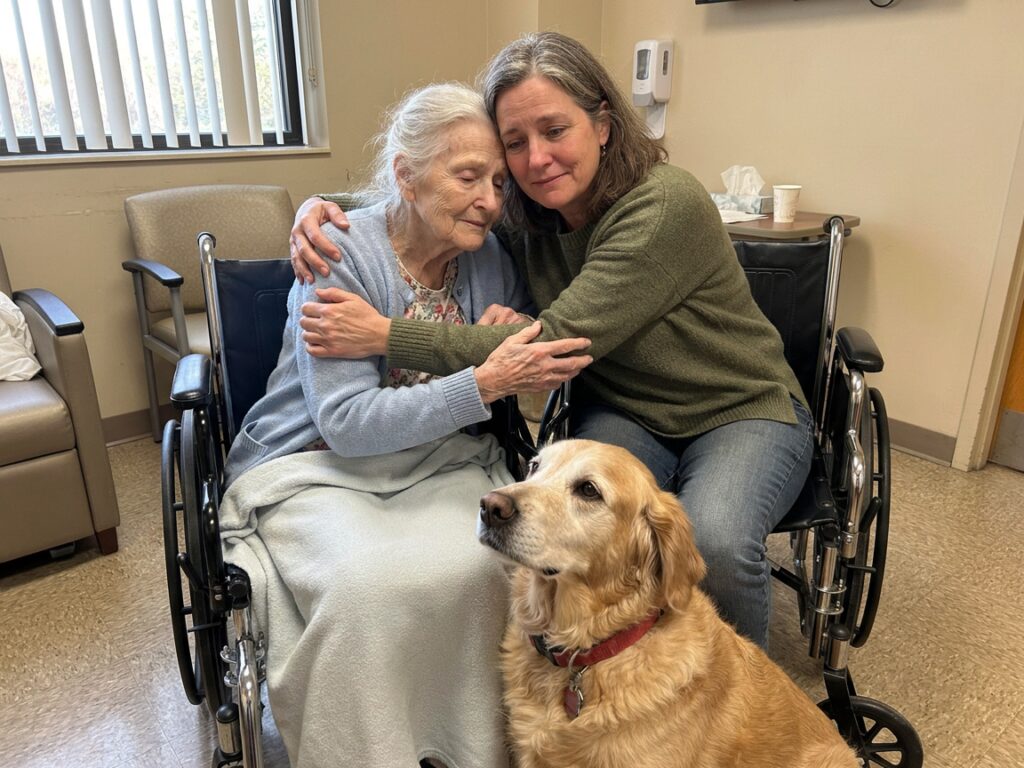
At 3:18 PM, hospital staff arranged a supervised reunion.
Margaret was sitting in a wheelchair near the window.
Buddy rested beside her.
His gray muzzle lay across her knee.
Emily Carter stood nearby.
She had been placed on administrative leave while the nursing home reviewed her conduct.
She had cooperated with investigators.
But she knew her decision to conceal Margaret’s departure had created serious risks.
Now she waited quietly.
Then the door opened.
A nurse entered, pushing another wheelchair.
Anna.
Margaret looked up.
For a moment, neither woman spoke.
Anna’s eyes filled with tears.
“Mom?”
Margaret covered her mouth.
“Oh, Anna.”
The nurse gently positioned the wheelchairs close together.
Anna reached forward.
Margaret took her hands.
They stared at each other.
Fifty-one years.
Birthdays.
Christmas mornings.
School graduations.
Weddings.
Illnesses.
Ordinary afternoons.
A lifetime of moments they had never shared.
Anna began crying.
“I thought you didn’t want me.”
Margaret shook her head.
“Oh, sweetheart.”
Her voice broke.
“I thought you were gone.”
Anna covered her face.
Margaret reached toward her.
“I never stopped loving you.”
Anna leaned forward.
Margaret wrapped her arms around her daughter.
Both women began sobbing.
“I’m here, Mom.”
Margaret held her tighter.
“My little girl.”
Anna cried.
“I’m here.”
Buddy lifted his head.
He watched the two women.
Then slowly stood.
His tail began wagging.
He approached Anna’s wheelchair.
Anna looked down.
“Oh, Buddy.”
The dog gently sniffed her hand.
Anna stroked his gray muzzle.
“You’re the one who brought help.”
Margaret smiled through tears.
“He always comes back to me.”
Buddy rested his head against Anna’s knee.
And for the first time in fifty-one years, Margaret sat beside her daughter without anyone trying to separate them.
Over the following weeks, the investigation continued.
Authorities reviewed the actions of Charles Reeves, Harold Reeves, and Thomas Reed.
They examined the historical child welfare records.
The Wilson family trust.
And the letters that had never reached Margaret.
Investigators also reviewed the nursing home’s handling of correspondence and resident safety procedures.
The case raised serious questions about failures that had lasted across generations.
Emily Carter cooperated fully.
She acknowledged that helping Margaret leave without proper safeguards had been wrong.
She had wanted to reunite a mother and daughter.
But her actions had placed a vulnerable resident at risk.
The nursing home reviewed its procedures.
And Margaret’s family arranged for her to receive care in a safer environment.
Meanwhile, Anna continued recovering.
Her doctors monitored her health.
And she began planning a future she had once believed impossible.
A future with her mother.
Three months later, Margaret moved into a small cottage near Anna’s home.
It had a covered porch.
A bright kitchen.
And a garden filled with flowers.
Anna visited every morning.
Sometimes they drank tea.
Sometimes they looked through old photographs.
And sometimes they simply sat together.
Talking.
There was so much to say.
Margaret told Anna about her years as a schoolteacher.
About her late husband.
About the students she remembered.
Anna told Margaret about her childhood.
Her first job.
Her marriage.
And the years she spent searching.
They did not pretend the lost time could be returned.
Fifty-one years could not be replaced.
But they could decide what to do with the time they still had.
And they chose to spend it together.
Buddy remained with Margaret.
The elderly retriever had recovered from his exhausting journey.
His arthritis still made walking difficult.
But he enjoyed short, gentle walks in the garden.
And every afternoon, he rested beside Margaret’s chair.
Sometimes Anna sat on the other side.
And Buddy stretched himself between them.
As though he had always belonged there.
One Sunday afternoon, Anna brought an old cardboard box to the cottage.
Margaret looked curious.
“What’s that?”
Anna smiled.
“Something I’ve kept for a very long time.”
She opened the box.
Inside were photographs.
Birthday cards.
School drawings.
And dozens of letters.
All addressed to Margaret.
Margaret picked up the first one.
The handwriting was childish.
The paper had yellowed.
She read the words aloud.
“Dear Mom, I got an A on my spelling test.”
Her voice broke.
Anna smiled through tears.
“I was ten.”
Margaret pressed the letter against her chest.
“Oh, sweetheart.”
Anna handed her another.
It was dated Christmas 1978.
“Dear Mom, I hope you are warm. I hope you are happy. I wish you could see the snow.”
Margaret began crying.
Anna reached for her hand.
“I wrote every Christmas.”
Margaret looked up.
“I would have answered every one.”
Anna nodded.
“I know that now.”
They sat together for hours.
Reading.
Remembering.
And slowly filling the silence that had separated them for half a century.
Buddy slept beside their chairs.
His tail moved occasionally when one of them laughed.
A few weeks later, Robert Hayes, the retired cemetery caretaker who had helped search for Margaret, visited the cottage.
He brought a basket of fresh flowers.
And a small package for Buddy.
Inside was a new blue collar.
Margaret laughed softly.
“Oh, Robert.”
He smiled.
“Thought the old fellow deserved something nice.”
Buddy sniffed the collar.
Then wagged his tail.
Robert gently scratched his ears.
“You gave us quite a scare, didn’t you?”
Margaret smiled.
“He certainly did.”
Anna looked toward the dog.
“I still can’t believe he walked all that way.”
Robert nodded.
“Neither can I.”
Margaret stroked Buddy’s gray muzzle.
“He was always stubborn.”
Anna laughed.
“Sounds familiar.”
Margaret raised an eyebrow.
“Are you talking about me?”
Anna smiled.
“Maybe.”
For a moment, they laughed together.
A mother and daughter.
Not strangers.
Not a tragedy from the past.
Just family.
That evening, Margaret sat on her porch.
The North Carolina mountains stretched beyond the trees.
The air was cool.
And the last light of the day settled over the garden.
Buddy rested beside her chair.
His breathing was slow.
His gray muzzle lay against her slipper.
Margaret looked down at him.
“Buddy?”
The dog lifted his head.
She smiled.
“You know something?”
His tail moved.
“I thought I’d never see my little girl again.”
Buddy blinked.
Margaret looked toward the cottage window.
Inside, Anna was preparing tea.
Margaret could hear her humming softly.
A familiar tune.
One Margaret used to sing when Anna was little.
Her eyes filled.
“For fifty-one years, I thought she was gone.”
She stroked Buddy’s ears.
“And then you came back with that scarf.”
The old retriever rested his head against her knee.
Margaret smiled through tears.
“You didn’t know what was written on that paper, did you?”
Buddy wagged his tail.
“No.”
She laughed softly.
“You just knew you had to come home.”
Margaret looked toward the distant trees.
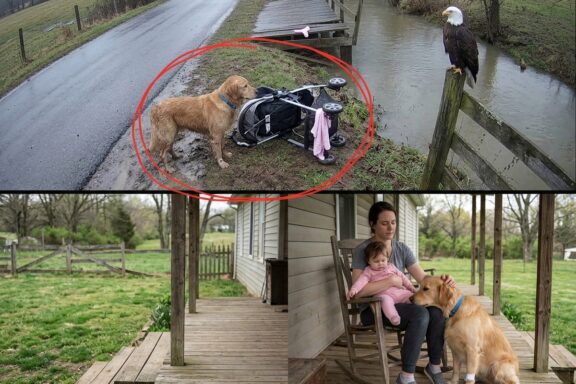
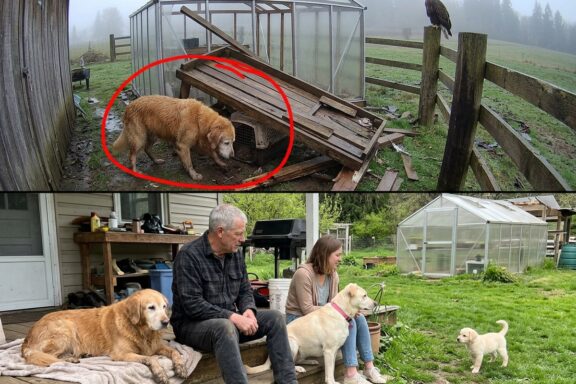
An adult bald eagle glided above the wooded hillside.
Its white head caught the evening light.
She remembered the bird perched above the nursing home on the morning Buddy returned.
The eagle had simply landed there.
It had not been trying to warn anyone.
But its presence became part of the security footage that the community remembered.
A muddy golden retriever.
A red scarf.
A silver key.
And a note that changed everything.
Margaret looked down at Buddy.
“You brought help.”
The dog closed his eyes.
“And because of that, I got my daughter back.”
Inside the cottage, Anna called:
“Mom?”
Margaret turned.
“Yes, sweetheart?”
“Tea’s ready.”
Margaret smiled.
“Coming.”
She stood carefully.
Buddy rose beside her.
His legs were stiff.
But his tail wagged.
Together, they walked toward the door.
Anna was waiting.
The house was warm.
And for the first time in fifty-one years, Margaret did not have to wonder whether her daughter was alive.
She knew.
Because Anna was home.
Buddy never understood the missing letters, the hidden records, the false story of a child’s death, or the people who had kept a mother and daughter apart. He never knew why Margaret was frightened or why she tied a silver key and a desperate note to her red scarf. But when the elderly golden retriever carried that scarf through the rain and returned to the nursing home, he helped begin a search that uncovered a lifetime of deception and brought two women back together after fifty-one years.
Margaret opened the door.
Buddy followed her inside.
And the family that had been separated for half a century finally had the chance to make new memories.
THE END.
No Comments