

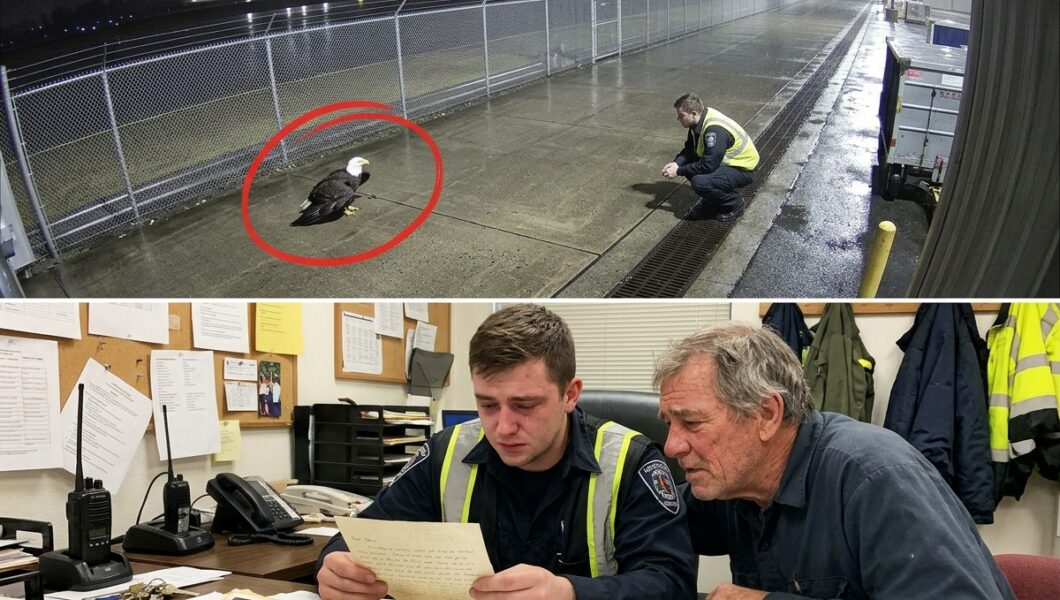
Marcus Bennett stared at the handwritten letter in his hands. For twenty years, he had believed his father died in a highway accident on a rainy November night. Now he was sitting at Thomas Reed’s dining room table, reading words that suggested his father had been hiding something before his death.
“If my son ever works at this airport, there’s something he deserves to know about the night I disappeared.”
Marcus read the sentence again.
Across the table, Thomas lowered his eyes. His daughter Emily sat beside him, recovering from her recent surgery, while his wife watched silently from the kitchen doorway.
“Tom,” Marcus whispered, “what does he mean by disappeared?”
Thomas took a slow breath.
“Your father didn’t die the night he left the airport, Marcus.”
Marcus felt his stomach tighten.
“What?”
“He died three days later.”
For a moment, the room seemed to stop moving.
Marcus had been six years old when his father died. His mother had always told him that his father was killed in a highway accident while driving home from work. She never mentioned anything about three missing days.
“Why would Mom lie to me?”
Thomas shook his head.
“I don’t think she knew the whole story.”
Marcus looked down at the letter.
“Then tell me.”
Thomas reached for an old photograph showing two younger men standing beside a damaged aircraft in a maintenance hangar.
“Your father, David Bennett, was one of the best mechanics I ever worked with. He was careful, patient, and never willing to take shortcuts when someone’s safety was involved.”
Marcus felt tears gathering.
His father had always been a collection of memories.
A deep voice.
A warm hand holding his while they watched airplanes take off.
And Sunday mornings spent looking for bald eagles along the Washington coast.
Now he was learning about the man his father had been when Marcus wasn’t watching.
Thomas continued.
“In November 2006, we were working an overnight maintenance shift. A heavy equipment stand shifted unexpectedly while we were inspecting an aircraft. I was standing in the wrong place.”
He paused.
“Your father saw it moving before I did.”
Marcus stared at him.
“He pulled me away.”
Thomas nodded.
“The stand struck him instead.”
Marcus covered his mouth.
Thomas’s eyes filled with tears.
“He saved my life that night.”
For several seconds, nobody spoke.
Then Marcus whispered, “But Mom said he died in a car accident.”
Thomas looked toward the photograph.
“He survived the hangar accident. He was injured, but conscious. Emergency personnel took him to the hospital.”
Marcus leaned forward.
“What happened after that?”
Thomas hesitated.
“That’s where the story gets complicated.”
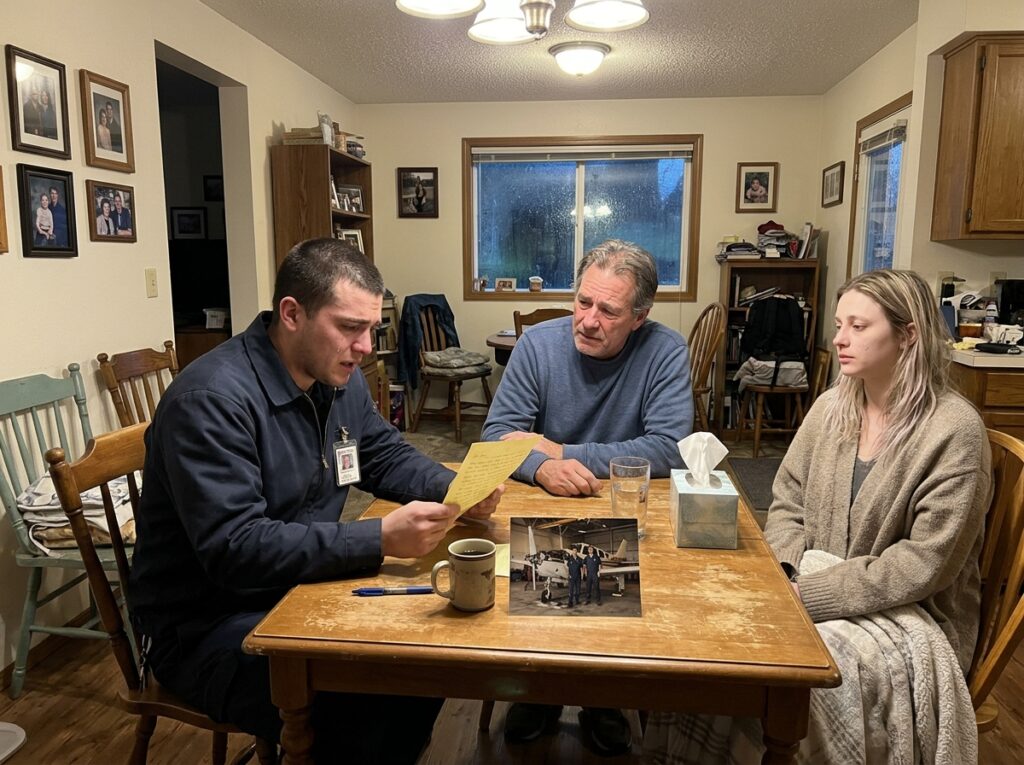
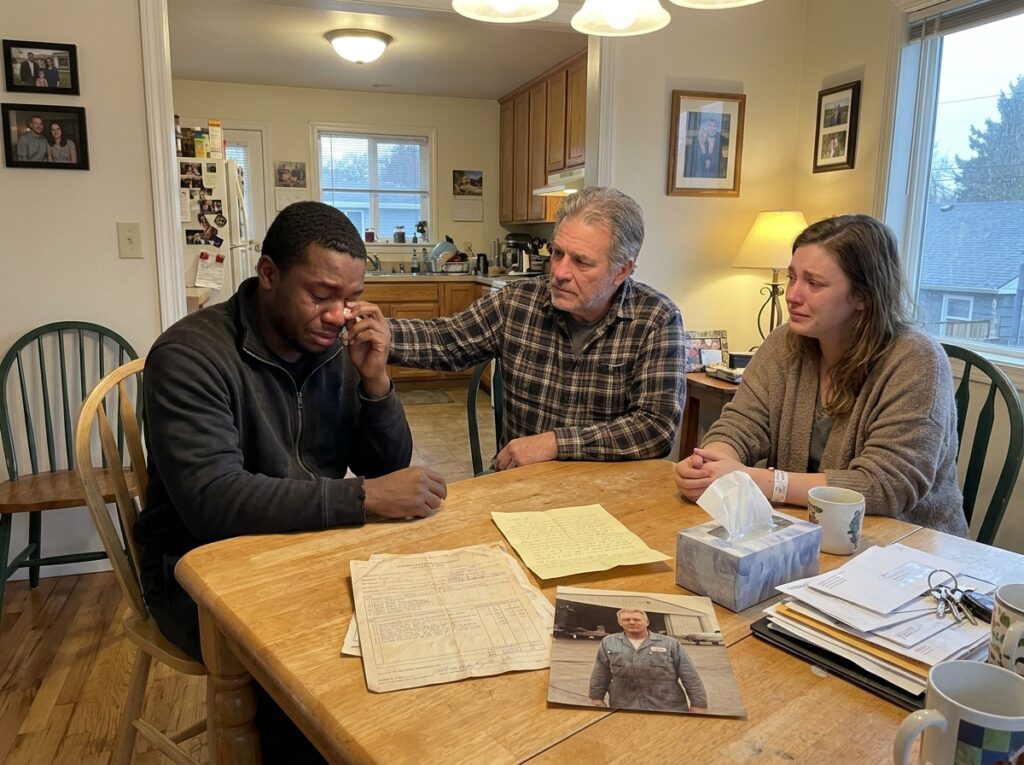
Thomas explained that David had suffered injuries serious enough to require several days of hospital treatment. During that time, he became increasingly concerned about what had caused the equipment to shift.
“He believed the stand had been improperly secured,” Thomas said. “He wanted the accident investigated before anyone else got hurt.”
Marcus looked at him.
“Was it investigated?”
“Yes. But your father was worried the people responsible would try to make it sound like ordinary worker error.”
Thomas opened a second envelope.
Inside were copies of old maintenance records, an incident report, and several handwritten notes.
“David asked me to keep these,” he said. “He wanted someone to know he hadn’t been careless.”
Marcus studied the documents.
The reports described a maintenance equipment incident that had injured one worker and nearly struck another.
But something else caught his attention.
A handwritten note from David.
“Thomas, if anything happens to me, make sure Marcus knows I never walked away from my family.”
Marcus stared at the sentence.
“Walked away?”
Thomas nodded slowly.
“Your father was afraid the accident might cost him his job. He thought management might blame him for the damaged equipment.”
Marcus looked confused.
“But he was the one who got hurt.”
“I know.”
Thomas explained that David had spent years saving money for Marcus’s future. He wanted his son to attend college, learn a trade, and have opportunities he himself had never received.
After the accident, David worried that losing his job would destroy those plans.
“He kept saying he couldn’t let you grow up thinking he had failed you.”
Marcus lowered his head.
“He never failed me.”
Thomas reached across the table.
“I know, son.”
Then he revealed what had happened during those missing three days.
David had remained in the hospital while doctors treated his injuries. After being discharged, he visited an independent workplace safety adviser and submitted his concerns about the equipment incident.
He also met with Thomas.
“That was the last time I saw him alive,” Thomas whispered.
Marcus looked up.
“What happened next?”
Thomas’s voice trembled.
“On his way home, your father was involved in the highway accident your mother told you about.”
Marcus closed his eyes.
For twenty years, he had imagined his father dying instantly on a lonely road after finishing an ordinary shift.
Now he understood that David had spent his final days trying to protect his coworkers and secure his family’s future.
“He didn’t disappear,” Marcus whispered.
Thomas shook his head.
“No. He was trying to make sure what happened in that hangar never happened again.”
Marcus pressed the letter against his chest.
For the first time in years, he began crying for the father he had barely known.
Thomas stood and moved beside him.
“I’m sorry I didn’t tell you sooner.”
Marcus wiped his face.
“Why didn’t you?”
Thomas looked down.
“After David died, your mother was overwhelmed. I tried to contact her, but she moved away from the neighborhood. I kept the records because I promised David I would.”
He paused.
“When you started working at the airport, I didn’t know you were his son. Bennett isn’t an uncommon name. And you never talked much about your family.”
Marcus nodded slowly.
He had spent four years working beside the man whose life his father had saved.
Neither knew the connection existed.
Until one rainy night, when Thomas needed someone to cover his shift so he could reach his daughter in the hospital.
Marcus looked toward Emily.
She smiled through tears.
“Dad told me what you did.”
Marcus shook his head.
“It wasn’t anything special.”
Emily reached across the table.
“It was to me.”
Her voice broke.
“I was scared before surgery. I kept asking for Dad. When he walked into my room, I thought I was dreaming.”
Thomas wiped his eyes.
“I got to hold her hand before they took her in.”
He looked at Marcus.
“Your father saved my life. And twenty years later, you gave me the chance to be there when my daughter needed me.”
Marcus covered his face.
For several minutes, nobody spoke.
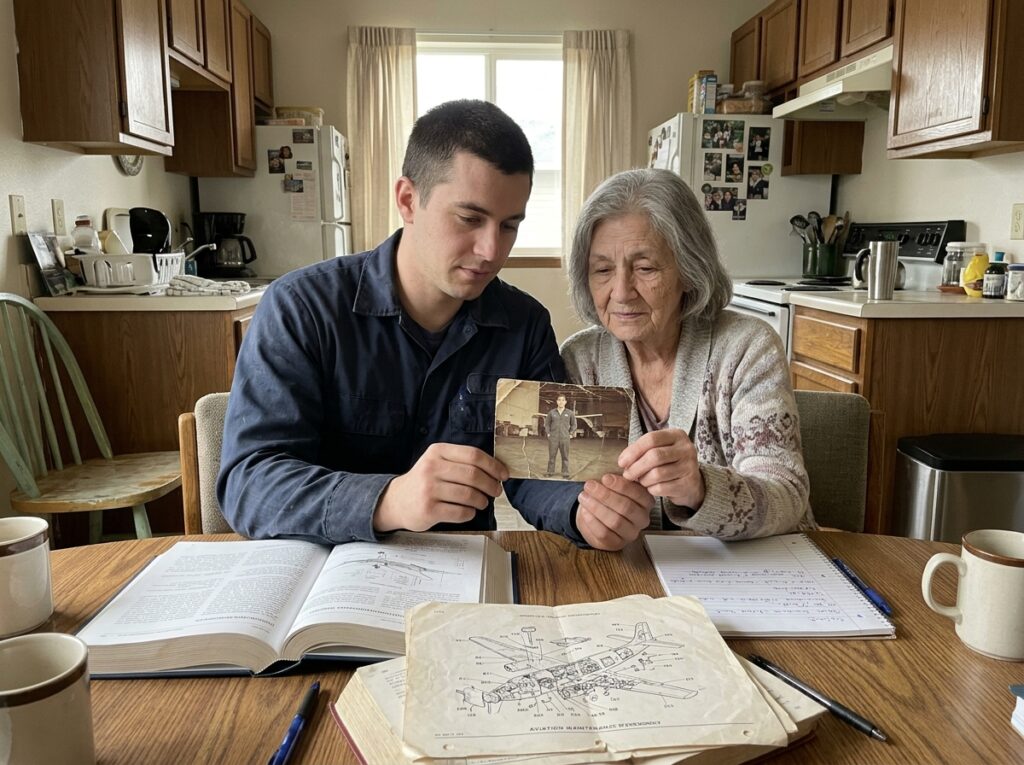
The following morning, Marcus drove to his mother’s apartment.
Evelyn Bennett was seventy-one now, with silver-gray hair, gentle eyes, and hands that had grown stiff from years of hard work.
She was sitting at the kitchen table when Marcus arrived.
“You’re early, sweetheart.”
Marcus placed the letter in front of her.
“Mom, I need to ask you something about Dad.”
Evelyn looked at the envelope.
Then her face changed.
“Where did you get this?”
“Thomas Reed.”
She stared at him.
“Thomas?”
Marcus nodded.
“He worked with Dad. He was there when Dad got hurt in the hangar.”
Evelyn slowly sat back.
For several seconds, she said nothing.
Then tears began rolling down her cheeks.
“Oh, David.”
Marcus sat beside her.
“Mom, why didn’t you tell me about the accident at work?”
Evelyn wiped her eyes.
“Because I didn’t want you to remember your father as a man who suffered.”
Marcus reached for her hand.
“I don’t remember him that way.”
She looked at him.
“I remember him taking me to watch eagles. I remember him teaching me how to use a screwdriver. I remember him carrying me on his shoulders.”
Evelyn began crying harder.
Marcus continued.
“And now I know he saved someone’s life.”
Evelyn nodded.
“Your father was always helping people.”
She explained that David had been deeply troubled by the maintenance accident. He worried that other workers might be injured if the equipment problems weren’t addressed.
But he had also been frightened about money.
They had been saving for a better apartment and Marcus’s education.
David feared that a prolonged recovery could cost him his position.
“He kept telling me everything would be all right,” Evelyn whispered.
Marcus looked down.
“Did he ever tell you about the letter?”
Evelyn shook her head.
“No.”
Marcus handed it to her.
She read slowly.
When she reached the line about David never walking away from his family, she covered her mouth.
For several minutes, she couldn’t speak.
Then she whispered, “He never would have.”
Marcus embraced her.
They sat together, crying for the man they had loved and lost.
Eventually, Evelyn looked at her son.
“Your father wanted you to have a better life than we did.”
Marcus smiled faintly.
“I’m trying, Mom.”
She touched his face.
“I know you are.”
Marcus told her about the aircraft maintenance trainee position.
He explained that he had missed the original interview because he covered Thomas’s shift and reported the injured eagle.
Then he told her that the interview had been rescheduled and he had earned the position.
Evelyn began crying again.
“Your father would be so proud.”
Marcus looked toward the window.
For the first time, he believed it.
Over the following weeks, Marcus began his maintenance training.
The work was demanding.
He studied aircraft systems, safety procedures, maintenance documentation, and inspection requirements.
Some days he came home exhausted.
But every time he opened his textbooks, he remembered his father.
David had believed that careful work could save lives.
Now Marcus was learning the same responsibility.
Thomas continued working at the airport.
His daughter Emily recovered steadily from surgery, and he often thanked Marcus for helping him reach the hospital that night.
Marcus always gave the same answer.
“You would’ve done it for me.”
Thomas smiled.
“Your father used to say that.”
Meanwhile, the injured bald eagle remained at the licensed wildlife rehabilitation center.
Veterinarians confirmed that the bird had suffered significant trauma to its right wing.
Its recovery required rest, treatment, and careful monitoring.
The rehabilitation team couldn’t promise that it would fly again.
Marcus understood.
He had learned enough from his father’s story to know that recovery wasn’t always simple.
Some injuries healed.
Others left permanent limitations.
But he continued asking for updates.
The eagle was eating well.
Its condition was stable.
And after several weeks, it began showing encouraging signs of improvement.
Marcus shared the news with his mother.
Evelyn smiled.
“Your dad would’ve loved that.”
Marcus nodded.
“I know.”
Three months later, Marcus received another call from the wildlife rehabilitation center.
The eagle had made substantial progress.
Its wing had healed well enough for supervised flight conditioning.
The bird was beginning to regain strength and coordination.
Marcus felt a familiar warmth in his chest.
He remembered standing in the freezing rain near the airport fence, watching the eagle struggle to lift its injured wing.
He had felt helpless that night.
Now the bird was learning to fly again.
The rehabilitation team continued its assessments over the following weeks.
Finally, the eagle was cleared for release.
Marcus was invited to observe from a designated safe distance.
He asked Thomas and Evelyn to come with him.
On the morning of the release, the three traveled to a suitable location selected by wildlife professionals in western Washington.
The sky was pale blue.
A cool breeze moved through the trees.
Marcus carried a small photograph of his father in his jacket pocket.
When the rehabilitator opened the transport carrier, the eagle hesitated.
Then it stepped forward.
Its white head turned toward the open sky.
Marcus held his breath.
The bird spread its enormous wings.
For a moment, it remained still.
Then, with several powerful beats, it lifted into the air.
It climbed above the clearing, turned toward the distant trees, and continued flying until it disappeared beyond the ridge.
Evelyn began crying.
Thomas placed a hand on Marcus’s shoulder.
Marcus looked toward the sky.
“Fly safe, old friend.”
For several minutes, nobody spoke.
Then Evelyn whispered, “Your father would’ve loved this.”
Marcus nodded.
“I think he would’ve.”
Thomas looked toward the distant mountains.
“David always said being strong didn’t mean you never needed help.”
Marcus smiled through his tears.
“He told me that too.”
Thomas turned toward him.
“And you remembered.”
Marcus looked at the empty sky.
He thought about the night he had missed his interview.
The night he believed he might lose his job.
The night he chose to help a coworker and report an injured bird instead of pretending he hadn’t noticed.
At the time, he had believed he was sacrificing his future.
Now he understood that he had been living the very lesson his father had tried to teach him.
A few days later, Marcus received an unexpected invitation to the airport manager’s office.
Sarah Mitchell greeted him with a smile.
“Marcus, have a seat.”
He sat nervously.
Sarah placed a folder on the desk.
“Your training supervisor says you’re doing excellent work.”
Marcus smiled.
“Thank you.”
She continued.
“We also reviewed some of the historical safety records connected to your father’s accident.”
Marcus straightened.
“My father’s records?”
Sarah nodded.
“The documents Thomas preserved helped us locate the archived incident report. It appears your father raised concerns about equipment handling procedures before his death.”
Marcus looked down.
Sarah continued.
“We can’t change what happened twenty years ago. But we can make sure those lessons remain part of how we train people today.”
She opened the folder.
Inside was a proposed addition to the airport’s internal safety training materials.
It described the importance of reporting equipment hazards, documenting incidents accurately, and protecting coworkers from preventable injuries.
At the bottom was a dedication.
“In memory of David Bennett, whose commitment to safety and his fellow workers continues to inspire.”
Marcus stared at the words.
His eyes filled.
“You’re naming it after my dad?”
Sarah smiled gently.
“With your family’s permission, we’d like to.”
Marcus covered his mouth.
For twenty years, he had believed his father was remembered only by a few fading photographs.
Now the airport where David had worked wanted to preserve the lessons from his final days.
Marcus nodded.
“He would’ve liked that.”
Sarah reached into her desk and removed a small white envelope.
Marcus smiled nervously.
“Another envelope?”
Sarah laughed softly.
“This one is different.”
Inside was a letter confirming that Marcus had successfully completed the first phase of his aircraft maintenance trainee program.
His supervisors had recommended him for continued training.
Marcus read the letter twice.
Then he looked up.
“Thank you.”
Sarah shook her head.
“You earned it.”
That evening, Marcus returned home carrying the letter.
Evelyn was sitting beside the kitchen window, looking through an old photo album.
When Marcus showed her the training confirmation and the proposed dedication, she began crying.
“Oh, sweetheart.”
Marcus sat beside her.
For a long time, they looked through photographs of David.
There was one of him holding Marcus as a baby.
Another showed them standing beside a small fishing boat.
And one showed David pointing toward a bald eagle soaring above the Washington coast.
Marcus touched the photograph.
“I used to think Dad’s story ended on that highway.”
Evelyn looked at him.
“And now?”
Marcus smiled.
“Now I think part of it is still being written.”
Evelyn reached for his hand.
“Through you.”
Marcus looked toward the window.
Outside, the evening sky was turning gold.
An airplane passed overhead, its lights blinking against the clouds.
Marcus thought about Thomas sitting beside the baggage cart, frightened for his daughter.
He thought about the injured eagle struggling near the airport fence.
And he thought about his father pulling a coworker away from danger twenty years earlier.
Three moments.
Three choices.
All connected by the same simple belief.
That another life mattered enough to stop and help.
Marcus closed the photo album.
Then he looked at his mother.
“Mom, I think I’m finally becoming the kind of man Dad hoped I’d be.”
Evelyn smiled through her tears.
“You already are.”
That night, Marcus placed his father’s photograph beside his maintenance textbooks.
He set his alarm for another early shift.
And before going to bed, he read the final line of David’s letter one more time.
“Being strong doesn’t mean you never need help.”
Marcus smiled.
For years, he had believed strength meant carrying every burden alone.
Now he understood something different.
Strength could mean asking for help.
It could mean protecting someone who couldn’t protect themselves.
And sometimes, it could mean giving up something important because another person needed you more.
Outside, the rain began falling softly against the windows.
Marcus looked toward the sky.
Somewhere beyond the city, a bald eagle was flying free.
And somewhere in the quiet memories of a family that had carried grief for twenty years, David Bennett’s kindness was still alive.
The End.
This is a fictional kindness and wildlife rescue story created for emotional storytelling.
No Comments