

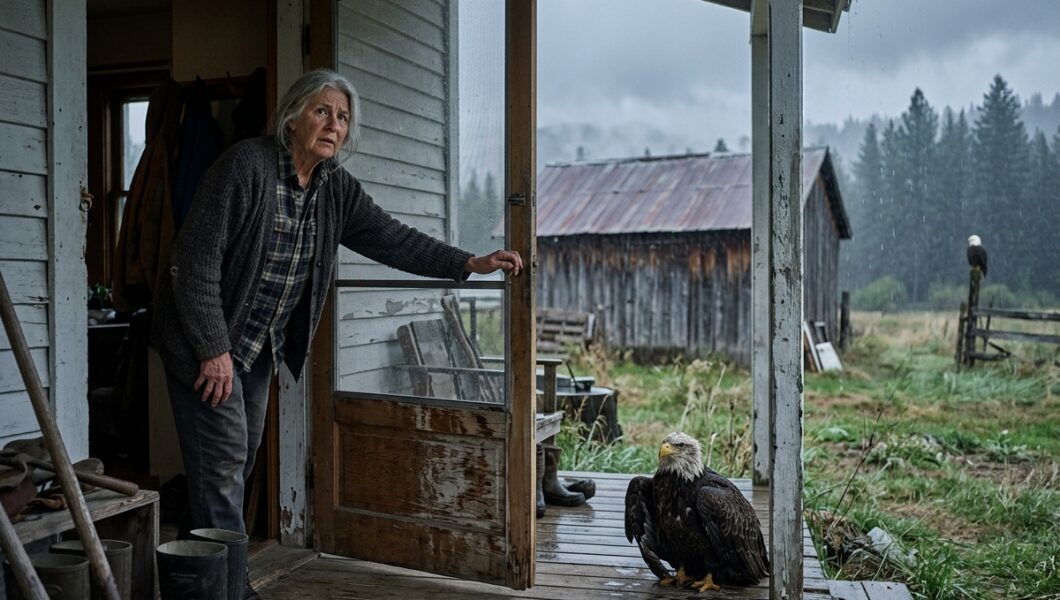
Margaret Wilson did not move from her computer for several seconds after Daniel finished speaking.
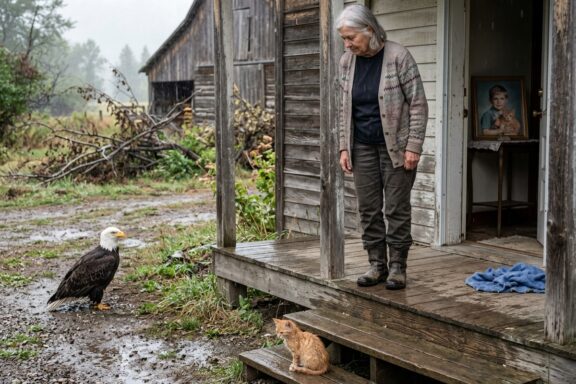
Outside, rain hammered against the farmhouse windows. The old wooden shed stood at the edge of the garden, half-hidden behind dripping branches. Its door had been locked for years, and Margaret could not remember the last time anyone had opened it.
Now someone was inside.
And somehow, the injured bald eagle on her porch, the second eagle on the fence, and the mysterious visitor all seemed connected.
But Margaret knew that suspicion was not proof. She had already contacted the authorities, and until they arrived, she would remain inside.
“Daniel,” she said quietly, “I need to know if that bird is in danger because of whatever is happening here.”
“I understand,” he replied. “The veterinary team is examining the eagle now. Our priority is its safety. The authorities should handle the person at your shed.”
Margaret ended the call and watched the driveway camera.
At 9:24, a county patrol vehicle turned onto her property. Two officers approached the front door, and Margaret let them inside after confirming their identities.
She showed them the recordings, including the shadow near the mailbox, the second eagle on the fence, and the figure entering the shed.
One officer studied the footage carefully.
“Did you hear any vehicles this morning?”
“No. The storm was too loud. I only noticed the dark shape on the camera.”
“Have you seen this person before?”
Margaret shook her head.
The officers asked whether the shed contained anything valuable, dangerous, or unusual. Margaret explained that it had belonged to her late husband, Robert. He had used it to store old tools, fishing equipment, wooden crates, and boxes of papers from projects he had worked on years earlier.
After Robert died, Margaret had closed the shed. She could not bring herself to sort through his belongings, and eventually the lock became part of the landscape. She passed it every day without thinking much about it.
The officers did not allow her to approach the building. Instead, they arranged to inspect the property safely.
While they waited, Margaret’s phone rang again.
It was Daniel, calling from the rehabilitation facility.
“The eagle has been examined,” he said. “It’s weak and has an injury to one wing, but it’s alive and receiving treatment. The veterinarian is still determining the full extent of the damage.”
Margaret pressed a hand against her chest.
“Can it fly again?”
“It’s too early to say. The team needs time to assess its recovery.”
Then Daniel explained the identification band.
The number belonged to a bald eagle monitored through a permitted wildlife research project. The bird had been recorded in the region before, and researchers had collected information about its movements. The band did not mean it belonged to a private owner, nor did it automatically indicate that anyone had harmed it.
However, the records included a note about another eagle that had disappeared from the same study area several weeks earlier.
“That missing bird was also being monitored?” Margaret asked.
“Yes. Researchers are reviewing the records now. They don’t yet know whether the two cases are connected.”
Margaret looked toward the back garden.
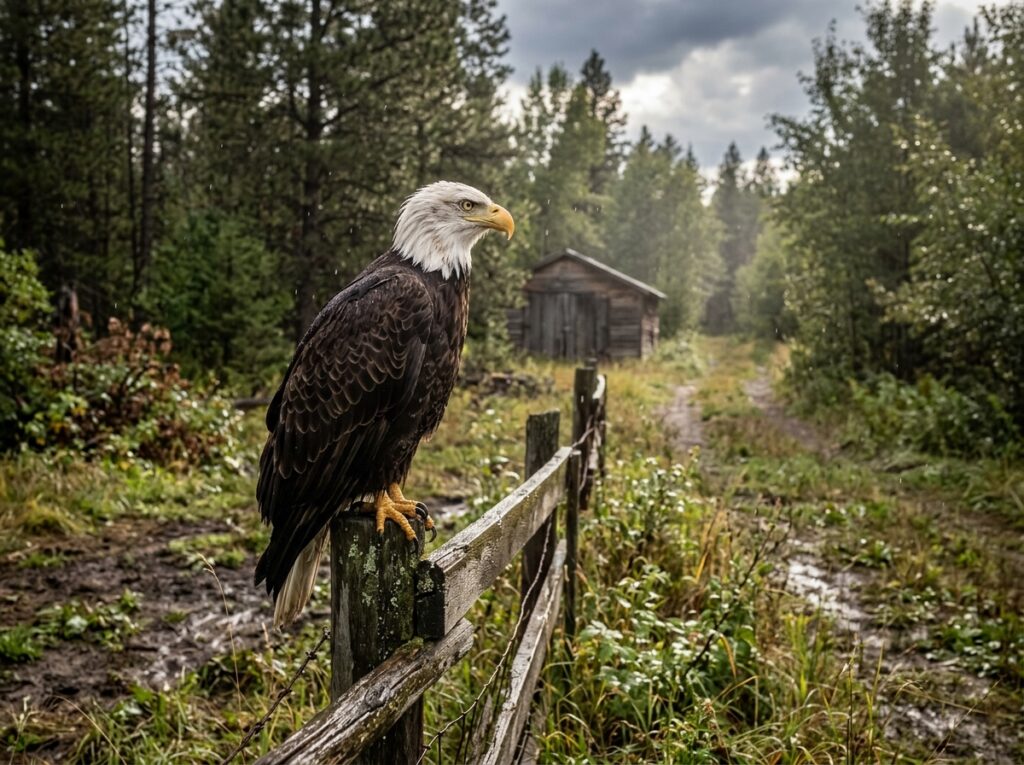
The second eagle had stood on her fence for almost a minute, facing the farmhouse before flying toward the woods. She could not stop wondering what had brought it there.
But she also remembered something Daniel had told her earlier: wild animals did not always behave in ways humans could easily interpret.
She decided to wait for facts.
At 10:07, one of the officers returned from the garden and spoke to his partner. They approached the farmhouse again and asked Margaret to remain inside while they inspected the shed.
The door was still closed.
The officers called out before entering and received no response. After checking the area, they opened the door cautiously.
Inside, they found an old workbench, several storage boxes, a rusted lantern, and shelves covered in dust. A narrow path through the clutter suggested that someone had moved around the room recently.
The officers also found a small metal case on the workbench.
It was not one Margaret remembered seeing there.
When they opened it, they discovered several old photographs, a folded map, and a notebook containing handwritten dates and observations about wildlife in the surrounding woods.
The notebook appeared to have belonged to Robert.
Margaret’s husband had loved the outdoors. He spent hours watching birds near the creek and keeping notes about the animals that visited the property. He had once helped a local conservation volunteer record sightings of deer, owls, and eagles.
But Margaret had never known that he had kept such detailed records.
The officers also found a loose feather near the shed doorway. It was white, but they did not assume it had come from the injured eagle. They photographed it and left its identification to someone qualified to examine it.
The person who had entered the shed was nowhere to be found.
There was no immediate sign that the individual had taken anything large, but the officers could not yet determine what had been removed or why the person had entered.
Margaret watched them carry the metal case toward the farmhouse.
When she saw the notebook inside, her eyes filled with tears.
She recognized Robert’s handwriting instantly.
For a moment, the storm and the mystery seemed to fade away. She could almost picture him sitting at the kitchen table, carefully recording the birds he had seen that morning.
She had thought those parts of his life were gone forever.
Now his handwriting had returned to her home, carrying questions she had never known to ask.
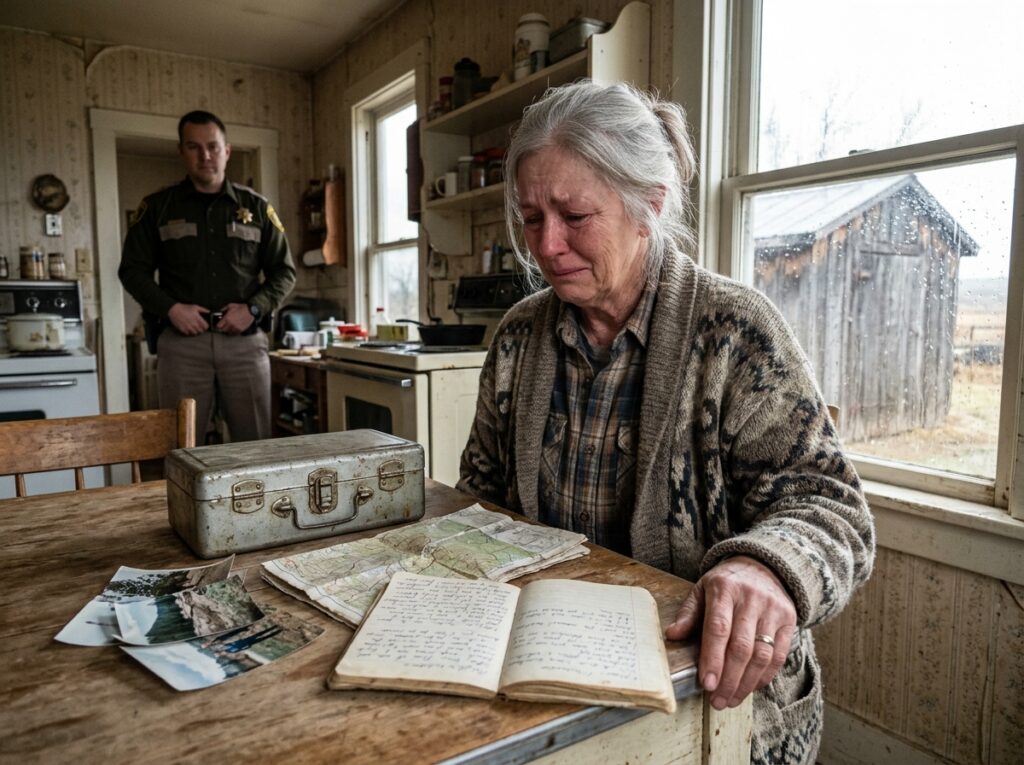
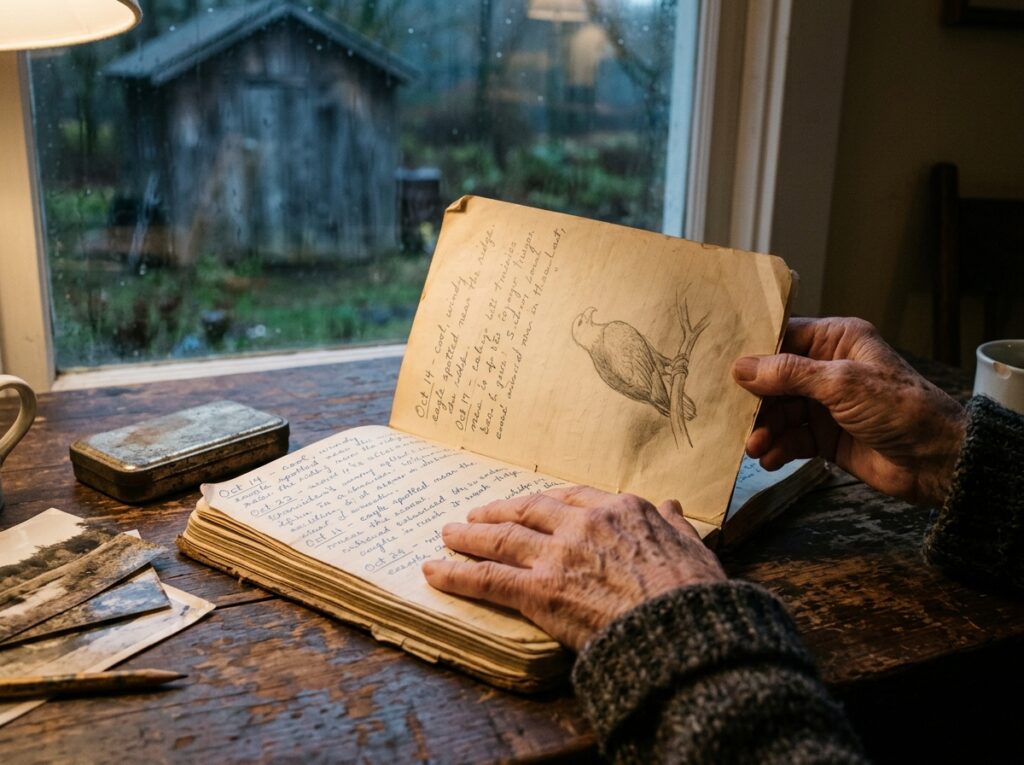
The notebook contained dates going back more than twenty years. Several pages described eagle sightings near the creek and along the wooded trail behind the shed. Robert had recorded which direction the birds traveled, when storms passed through, and where he had seen them perching.
Near the back of the notebook, the officers found a more recent entry written in a different hand.
It referred to a research contact and mentioned a bird identification number.
Margaret could not tell who had written it. The ink looked newer than Robert’s notes, and the handwriting was unfamiliar.
The officers photographed the page and contacted the relevant wildlife authorities.
By midday, the rain had begun to ease. The second eagle had not returned to the fence, and no one had seen the person who entered the shed.
Margaret made herself a cup of tea, though she barely drank it. She kept looking at the notebook and wondering why someone would return to a locked building to examine old records.
Then her phone rang once more.
This time, Daniel sounded more hopeful.
“The research coordinator has reviewed the initial records,” he explained. “The eagle on your porch was documented in the area before. The other bird may have been associated with the same study, but they need to compare the dates and observations before drawing conclusions.”
“Could someone have been following them?” Margaret asked.
“We can’t say that. There are several possible explanations for what you saw. The authorities are also investigating the shed incident separately.”
Daniel paused before continuing.
“One thing is clear, though. Your footage may help establish the timeline. Please keep the original recordings and don’t edit or delete them.”
Margaret promised she would.
The wildlife team planned to continue monitoring the injured eagle’s condition. If the bird recovered sufficiently, specialists would determine whether it could eventually be released. For now, it needed quiet, treatment, and time.
Margaret thanked Daniel and ended the call.
She went to the window and looked out at the wet garden.
The porch boards were empty now. The place where the eagle had rested was marked only by rainwater and a few scattered leaves.
She remembered how the bird had lifted its head when the lightning flashed. She remembered the narrow band around its leg, the second eagle on the fence, and the mysterious figure disappearing into the woods.
She had wanted the story to have one simple explanation. Perhaps the storm had forced the eagle down. Perhaps the second bird had been passing through. Perhaps the visitor had entered the shed for a reason that had nothing to do with either animal.
Every possibility remained open.
Yet the notebook suggested that Robert’s connection to the wildlife around their home had been deeper than she had understood.
That afternoon, one of the officers called with a new development.
They had identified a possible route the visitor used to reach the shed. The person appeared to have approached from the wooded trail rather than the main driveway. The camera had not captured a clear face, and the authorities were still working to establish an identity.
They had also found that the shed’s old lock had been disturbed before that morning. It was possible someone had accessed the building on an earlier occasion.
Margaret sat down slowly.
“So this wasn’t necessarily the first time?”
“We can’t confirm that yet,” the officer replied. “We’re checking the available footage and gathering information. If you remember anything unusual from the last few weeks, please let us know.”
After the call, Margaret searched her memory.
She recalled a few muddy marks near the back fence after a recent rainstorm. She had assumed they belonged to a deer. She remembered a faint sound near the shed one evening, but the wind had been blowing hard, and she had thought a loose board was rattling.
None of those memories proved anything.
Still, she wrote them down.
As evening approached, the clouds finally began to break. A narrow strip of pale sunlight appeared beyond the hills, touching the wet grass and the branches beside the creek.
Margaret opened Robert’s notebook again.
On one of the final pages, she found a sentence written in his familiar handwriting:
“Sometimes the best way to protect a wild thing is to leave it room to return.”
She read the words twice.
Robert had written them beside a date and a rough drawing of an eagle perched above the creek. There was no explanation, no name, and no clue about what he had meant.
For the first time that day, Margaret smiled faintly.
She could not know whether the injured eagle would recover, whether the second bird would return, or who had entered the shed. She could not know if the missing research bird had any connection to the one on her porch.
But she could help by preserving the evidence, cooperating with the authorities, and allowing the wildlife team to do its work.
That was enough for now.
Just before sunset, Margaret checked the porch camera one last time.
The rain had stopped. Drops of water glistened on the railing, and the empty steps shone beneath the fading light.
Then a movement appeared at the edge of the frame.
A bald eagle landed on the distant fence.
It remained there for only a few seconds, its white head turned toward the wooded trail. Then it opened its wings and flew into the trees.
Margaret watched until the bird disappeared.
She did not know whether it was the same eagle she had seen that morning. She did not know whether it had any connection to the injured bird at the rehabilitation facility.
But she saved the recording.
Tomorrow, she would give it to Daniel and the wildlife researchers. The officers would continue investigating the shed, and the notebook would be examined for clues about its history.
For now, Margaret closed her laptop and turned on the kitchen light.
The farmhouse was quiet again, but the questions remained.
Who had entered the shed, and what had they been looking for? Why had someone disturbed a building that had been locked for years? And would the injured eagle ever fly over Margaret’s creek again?
The answers were still waiting somewhere beyond the rain-soaked woods.
And Margaret had a feeling that the old notebook was only the beginning.
No Comments