

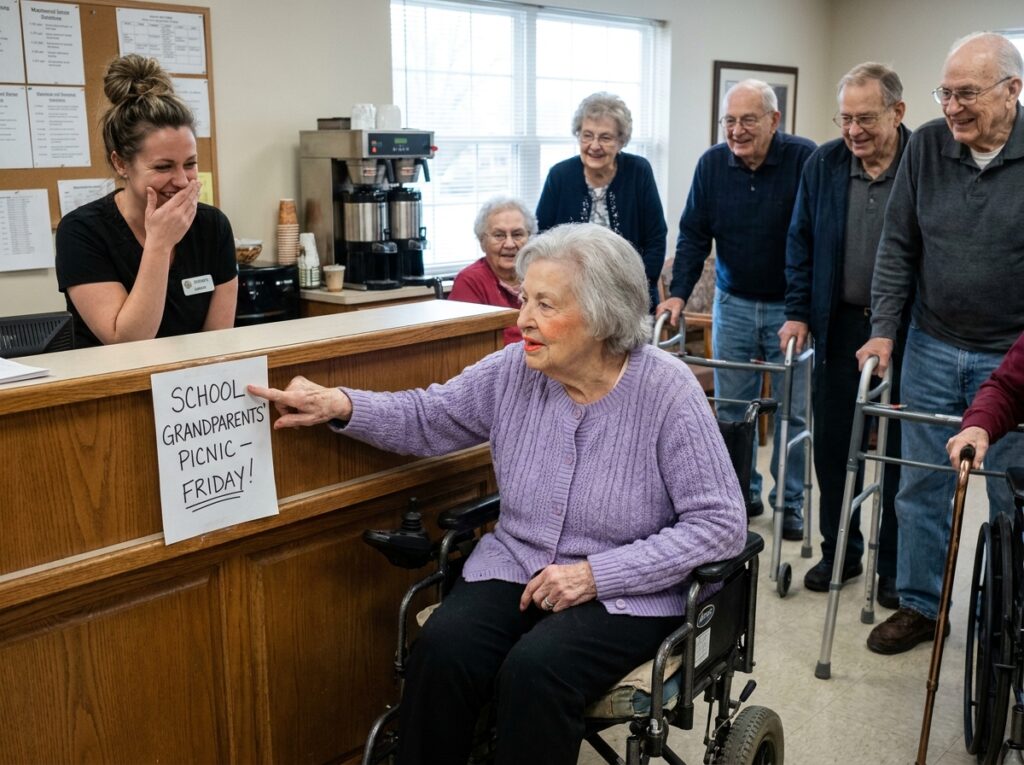
The following fall, Miss Dottie called me to the front desk and announced that we had a problem.
She had that look.
The one she usually got right before reorganizing something nobody had asked her to reorganize.
“What problem?” I asked.
She slid a school flyer across the desk.
GRANDPARENTS’ PICNIC — FRIDAY AT 11:30.
Same cheerful letters.
Same little paper flowers printed around the border.
Only this time, instead of making my stomach drop, it made me smile.
“Mia already told me.”
Miss Dottie folded her arms.
“That is not the problem.”
“Okay.”
She tapped the flyer.
“Carla says they only requested eight of us.”
I stared at her.
“Eight?”
“Yes.”
“That seems like a lot.”
She looked personally offended.
“There are twenty-two interested parties.”
Of course there were.
Apparently the photograph from the year before had turned the grandparents’ picnic into the most competitive social event at Cedar Grove.
People had opinions about who should go.
Strong opinions.
Miss Loretta believed anyone who fell asleep during afternoon bingo should lose eligibility.
Miss June argued that walkers should not be used against anyone because “mobility is not a personality flaw.”
Mr. Walter from Room 118 wanted in because he said children needed “at least one old man to explain things incorrectly with confidence.”
Even Harold, who claimed to dislike every organized activity since approximately 1957, had quietly asked Carla whether grandchildren were allowed to like baseball.
The four women who had gone with Mia the year before had told everybody about it.
Not the Facebook attention.
Not the school photo.
The children.
That was what they talked about.
The boy who had joined their table while his grandmother was stuck in traffic.
The girl who showed Miss Loretta a drawing of a horse.
The little boy who asked Miss Dottie why her wheelchair had “tiny bicycle tires.”
Miss Dottie had apparently told him it was a race car.
Now half the building wanted to go.
I laughed.
“So what do you want me to do?”
“Fix it.”
“I work at the front desk.”
“Exactly. You have access to phones.”
That was how the second year became much bigger than the first.
Carla called the school.
The school called us back.
Then the principal called.
Within two weeks, the plan had changed.
Instead of Cedar Grove simply sending a few residents as guests for children without grandparents available, the school created a sign-up option.
Any student who needed or wanted a “grand-type guest” could request one.
No explanation required.
That part mattered.
No kid had to stand in front of a teacher and say:
My grandmother died.
My grandfather lives too far away.
My grandparents don’t speak to us.
Nobody is coming for me.
They simply checked a box.
Yes, I would like a guest.
The school gave us first names, grade levels, basic interests, and allergy information where needed.
No private family details.
Then Carla matched residents.
It became the most serious matchmaking operation I had ever witnessed.
Mia helped.
Naturally.
“Ethan likes trains,” she said, looking at one sheet.
“Mr. Howard worked for the railroad,” I said.
“Perfect.”
“Sophie likes gardening.”
“Miss Loretta.”
“No,” Mia said immediately.
“Why not?”
“Miss Loretta kills plants.”
She wasn’t wrong.
We matched Sophie with Miss June, who had grown tomatoes for forty years.
A fourth grader who loved baseball got Harold.
A little girl who liked sewing got Miss Evelyn.
A boy who listed his favorite subject as “lunch” went to Miss Dottie.
“Why me?” Dottie asked.
“Because you both have priorities.”
She accepted that.
Mia got her original four.
She refused to negotiate.
“They were mine first.”
Miss Dottie overheard.
“Correct.”
By picnic day, fifteen residents were going.
The facility van made two trips.
Staff volunteered.
Parents helped.
The school rearranged tables.
What had once been a one-off act of kindness had become an actual partnership.
I worried it might lose something because of that.
Sometimes when kindness becomes a program, it becomes paperwork.
Rules.
Forms.
Name tags.
Liability waivers.
The warmth can disappear.
But that morning, as the residents lined up in the lobby, I realized I had underestimated them.
Miss Loretta was wearing pearls again.
Miss June had packed tissues.
Harold had a baseball scorecard in his pocket for absolutely no reason.
And Miss Dottie had a tote bag full of snacks she had been explicitly told not to bring.
Carla looked inside.
“Dottie.”
“What?”
“We discussed outside food.”
“These are emergency crackers.”
“There is no cracker emergency.”
“You don’t know that.”
Same Dottie.
Thank God.
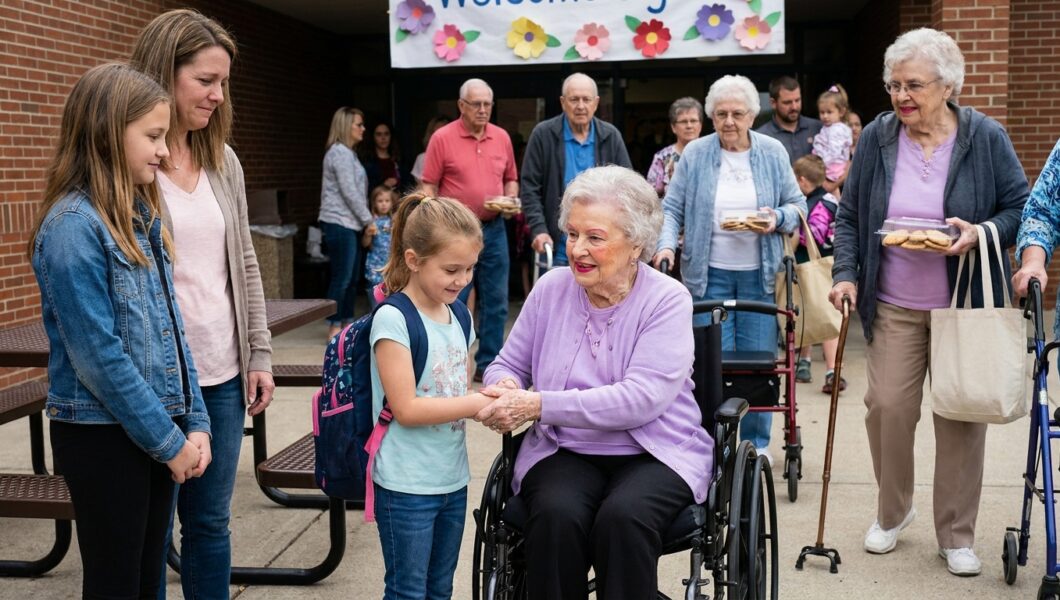
When we arrived, Mia was waiting near the cafeteria doors.
She was ten now.
A little taller.
More confident.
She didn’t run toward them this time.
She walked fast.
Trying to act grown.
Then Miss Evelyn opened her arms and Mia forgot herself completely.
She hugged all four.
Watching it hit me differently the second year.
The first time, I had seen women stepping into an empty place.
Now there was no empty place.
They belonged there.
And Mia belonged to them.
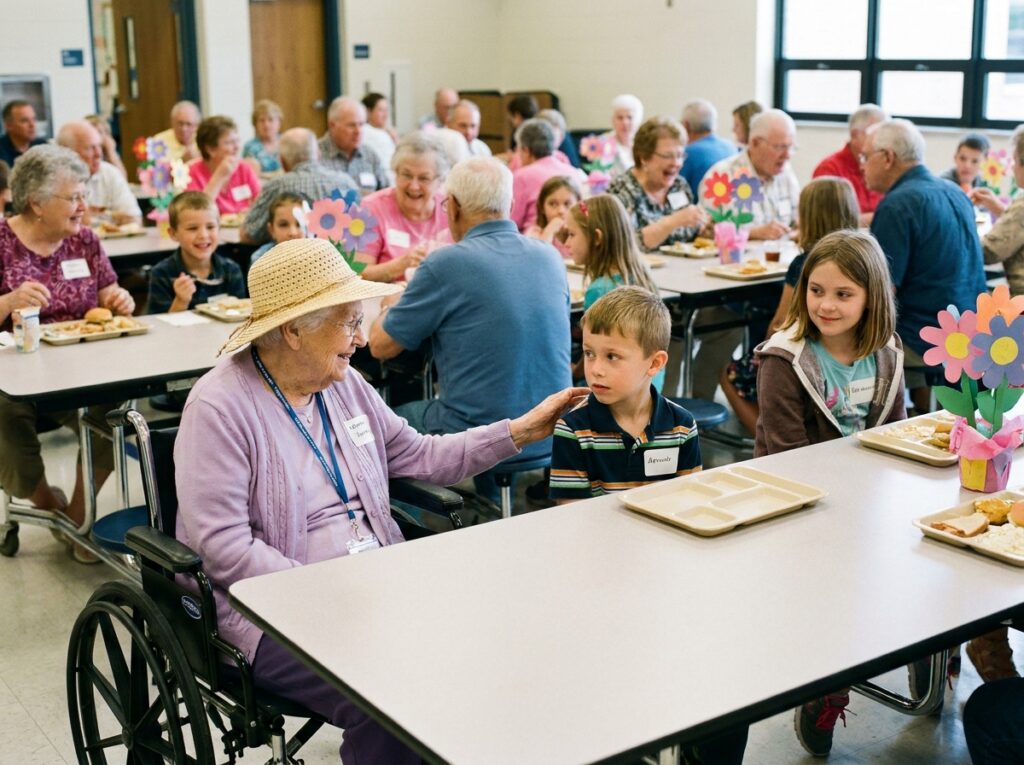
Across the cafeteria, other children were meeting their guests.
Mr. Howard sat with Ethan and drew railroad tracks on a napkin.
Harold was explaining baseball statistics to a nine-year-old who looked completely fascinated.
Miss June had a little girl holding both of her hands while talking about sunflowers.
No pity.
No charity.
Just people meeting people.
That was when I noticed one table near the wall.
A boy sat alone.
Maybe eight.
Brown hair.
Blue school polo.
His name tag said JACOB.
No guest.
I asked a teacher quietly.
“Was somebody coming for him?”
She nodded.
“His grandfather planned to, but he was admitted to the hospital last night.”
My heart sank.
Before I could ask what we should do, Miss Dottie had already seen him.
Of course she had.
She rolled across the cafeteria.
Stopped beside his chair.
“Are you Jacob?”
He nodded.
She pointed at her own table.
“We’ve got room.”
He looked uncertain.
“My grandpa was supposed to come.”
“I heard.”
His mouth tightened.
Miss Dottie softened immediately.
“Well, I’m not your grandpa.”
Jacob looked at her.
“Obviously.”
She stared at him.
Then burst out laughing.
“So you’ve got jokes. Good. Come sit with us until he can get back on duty.”
Jacob smiled.
And moved his chair.
No announcement.
No photograph.
No teacher directing it.
She simply noticed the empty seat.
That was what the whole thing had always been about.
That year, there was no viral photograph.
And I was glad.
We already knew strangers online could be moved by a beautiful moment.
What happened afterward mattered more.
Jacob’s grandfather recovered.
Two weeks later, he came to Cedar Grove.
His name was Frank.
He arrived carrying a bakery box and asked for Miss Dottie.
She was playing cards.
He walked over and said, “You sat with my grandson.”
Dottie looked up.
“I’ve sat with a lot of people’s grandchildren.”
“Jacob.”
Her face changed.
“Oh.”
Frank set the bakery box down.
“I wanted to thank you.”
“You didn’t need to bring anything.”
“I know.”
Dottie smiled.
“That’s why it counts.”
I heard her say it from across the room.
The exact sentence she had once said to me.
Frank stayed for coffee.
Then another coffee.
Then cards.
He came back the following Thursday.
And the Thursday after that.
By Christmas, he was volunteering twice a month at Cedar Grove.
He wasn’t lonely in the dramatic way people write about loneliness.
He had family.
He had neighbors.
He had a house.
But after his wife died, his days had narrowed.
He told me once:
“I didn’t realize how much of my social life was actually hers.”
That sentence stayed with me.
Cedar Grove gave him somewhere to go.
Jacob came too.
Soon there were children doing homework in the activity room after school.
Residents helping with spelling.
Kids teaching seniors how to use tablets.
Seniors teaching kids card games that absolutely seemed designed to start arguments.
Mia still came every Tuesday.
Some weeks she barely spoke to me after walking through the door.
She headed straight for her people.
Miss Loretta taught her how to properly set a table.
Miss June taught her to plant herbs in old coffee tins.
Miss Evelyn showed her how to sew on a button.
Miss Dottie taught her poker.
I objected to that one.
Miss Dottie said:
“It’s math.”
Apparently gambling becomes educational when you’re eighty-two.
Then one Tuesday in February, Mia came into Cedar Grove crying.
That was unusual.
She was the kind of child who held tears until she was somewhere safe.
She walked past the desk.
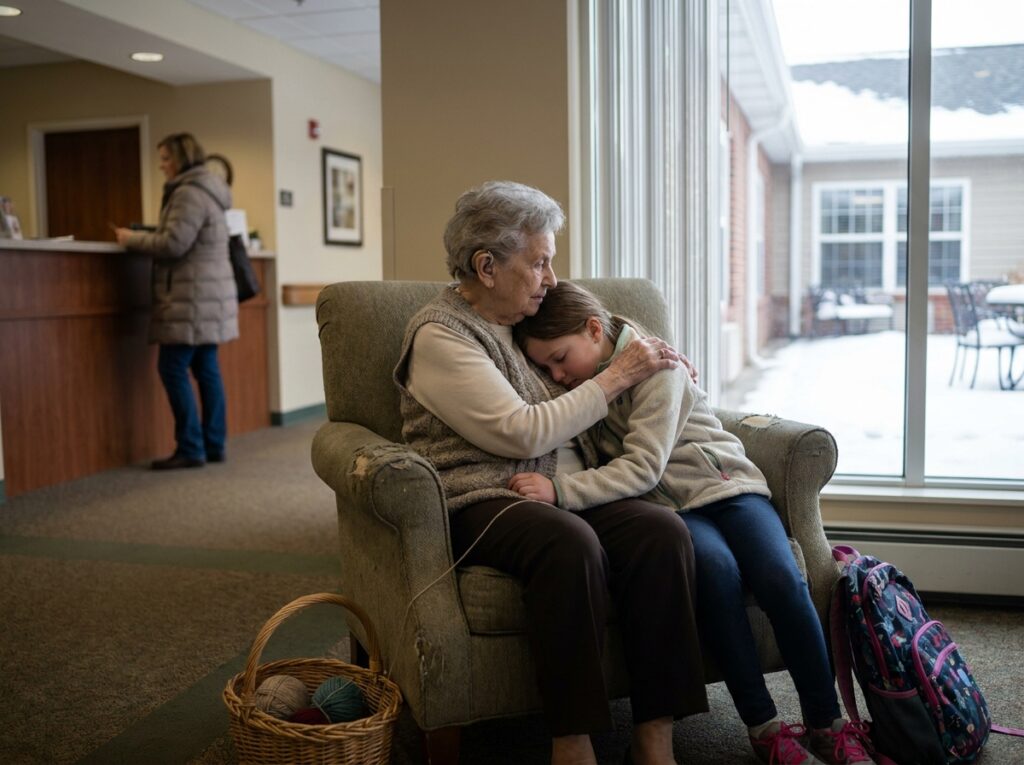
Straight to Miss Evelyn.
Evelyn was sitting near the window knitting.
Mia sat beside her and buried her face against her shoulder.
I started to move toward them.
Miss Evelyn caught my eye.
She gave one tiny shake of her head.
I’ve got her.
So I stayed at the desk.
That might have been one of the hardest things I’ve ever done.
Later, Mia told me she’d had a terrible day at school.
A friendship problem.
The kind that feels like the end of the world at ten.
Two girls had stopped including her.
There had been whispering.
A group chat.
A birthday invitation she thought she was getting and didn’t.
I wanted names.
I wanted details.
I wanted to solve it.
Miss Evelyn apparently just listened.
Then she told Mia about being fourteen in 1958 and eating lunch alone for nearly a month because her best friend had suddenly decided she was “boring.”
“What did you do?” Mia asked.
“I survived.”
Mia had laughed through tears.
Then Evelyn told her:
“People leaving a chair doesn’t mean you’ll sit alone forever.”
I wrote that one down.
There are things older people know because time has already proven them.
Kids need those people.
Adults do too.
By the third year, the school stopped calling it the Borrowed Grandparents Program.
Miss Dottie had complained enough.
Instead, they called it Generations Together.
She tolerated that.
The partnership grew beyond one picnic.
Residents attended school plays when families requested extra audience members.
Students made birthday cards for residents who rarely received mail.
A fifth-grade class came to Cedar Grove once a month to read.
A few residents recorded oral-history interviews for a social studies project.
One gentleman spent forty-five minutes describing life before television.
A child asked:
“What did you look at?”
He replied:
“Each other.”
The teacher nearly fell over laughing.
But there were hard parts too.
That comes with loving older people.
Miss June got sick.
Not suddenly.
Gradually.
She missed one Tuesday.
Then two.
Then she moved from her usual room into a higher-care wing.
Mia noticed immediately.
“Why isn’t she downstairs?”
I explained as gently as I could.
We visited.
June was thinner.
More tired.
But still June.
She asked Mia about school before Mia could ask about her.
On the way home, Mia was quiet.
Then she said:
“Extra grandmas can die too.”
There was no good answer.
“Yes.”
“I don’t like that.”
“Neither do I.”
She looked out the window.
“Is it still worth having them?”
There are questions children ask that are really questions adults spend entire lives answering.
I thought about my mother.
Three years before that first picnic, I had lost her.
Part of me had wanted to protect Mia from more attachment because attachment creates more things you can lose.
But that isn’t protection.
That’s loneliness wearing armor.
So I told her:
“I think loving someone is worth missing them later.”
She didn’t answer.
A month after that, June died.
Mia cried harder than I expected.
So did I.
At the funeral, Cedar Grove residents filled two rows.
Mia sat between me and Miss Dottie.
During the service, the pastor mentioned June’s tomatoes.
Mia started laughing.
Then crying.
Miss Dottie handed her a tissue.
Afterward, Mia asked whether she could put something in June’s memory box at Cedar Grove.
She chose a packet of sunflower seeds.
Because of the girl at the picnic.
The one who had talked with June about growing them.
That spring, the school planted sunflowers near the playground.
A little plaque said:
FOR MISS JUNE, WHO ALWAYS MADE ROOM AT THE TABLE.
No mention of viral posts.
No borrowed-grandma language.
Just that.
Room at the table.
That became the phrase I liked best.
Because that was what all of this had been from the beginning.
Not replacing anybody.
Nobody replaced my mother.
Nobody replaced Mia’s grandfather in Arizona.
Miss Dottie wasn’t pretending to be someone she wasn’t.
Miss Loretta wasn’t filling a role like an actor.
They were making room.
And letting Mia make room for them.
There is a difference.
Now Mia is twelve.
The yellow dress from the first picnic is long gone.
She’s taller.
She rolls her eyes professionally.
She still goes to Cedar Grove.
Not every Tuesday anymore.
Middle school has homework, clubs and friends.
But she goes.
Last month, she came with me on a Saturday because Generations Together was matching guests for the upcoming school picnic.
She sat behind the activity-room table with Carla.
Name sheets everywhere.
A second grader liked trains.
“Mr. Howard,” Mia said immediately.
A girl liked painting nails.
“Loretta.”
A boy loved baseball.
“Harold if he’s not grumpy.”
“I’m always grumpy,” Harold shouted from across the room.
“Exactly,” Mia yelled back.
Then Carla handed her one final sheet.
A little girl named Ava.
Under “interests” someone had written:
Cats. Drawing. Very shy.
Mia studied it.
Then glanced toward the lounge.
Miss Dottie was sitting by the window.
Eighty-five now.
Still pink lipstick.
Still bright nails.
Still running people’s lives.
Mia smiled.
“I know who gets her.”
On picnic day, I stood near the same cafeteria doorway where I’d cried years earlier.
I watched Ava wait beside an empty chair.
Then the Cedar Grove group came around the corner.
Walkers.
Wheelchairs.
Canes.
Pearls.
Purses.
A completely unreasonable quantity of emergency crackers.
Ava looked nervous.
Miss Dottie rolled up to her.
“Are you Ava?”
The girl nodded.
“Do you like cookies?”
Another nod.
“Good. We’re going to get along.”
Ava smiled.
And just like that, there was room at the table again.
Mia was standing beside me.
She watched for a moment.
Then she said:
“Remember when I thought I had nobody coming?”
I looked at her.
“Yeah.”
She smiled toward the Cedar Grove group.
“I had no idea.”
Neither did I.
I thought I was trying to prevent my daughter from feeling left out for one Friday lunch.
Instead, four women showed her something much bigger.
Family isn’t always the people whose names fit neatly on a tree.
Sometimes it’s the woman in the wheelchair who insists the lemonade is weak.
The lady in pearls who tells you to sit up straight.
The friend who teaches you to grow tomatoes.
The person who sits with you after a bad school day.
The grandfather who starts volunteering because someone showed kindness to his grandson.
The child who plants sunflowers for a woman she misses.
Nobody in that cafeteria was pretending loss didn’t exist.
Some children still wished their grandparents were there.
Some residents still missed grandchildren who lived far away.
Mia still missed my mother.
Miss Dottie still wasn’t actually her grandmother.
Love does not erase the empty seats.
It simply refuses to let an empty seat be the only thing you see.
Years ago, Mia looked at a Grandparents’ Picnic flyer and asked whether she could hide in the library instead.
Now she helps make sure other kids don’t have to.
That’s what kindness did.
It didn’t give her the family she thought she was supposed to have.
It showed her how much family can stretch.
And every year, when the Cedar Grove van pulls up outside the school and all those canes, walkers, wheelchairs and cookie tins start coming through the doors, I still hear Miss Dottie’s voice from that first morning:
“We know we don’t have to.
That’s why it counts.”

No Comments