

At 5:42 PM, Natalie Brooks stood beside the window of the Silverpine Lake research station, holding her phone so tightly that her fingers hurt.
“Will it ever fly again?”
The veterinarian’s answer came quietly.
“We don’t know yet. And that’s what worries me.”
Natalie looked toward the dark Minnesota lake.
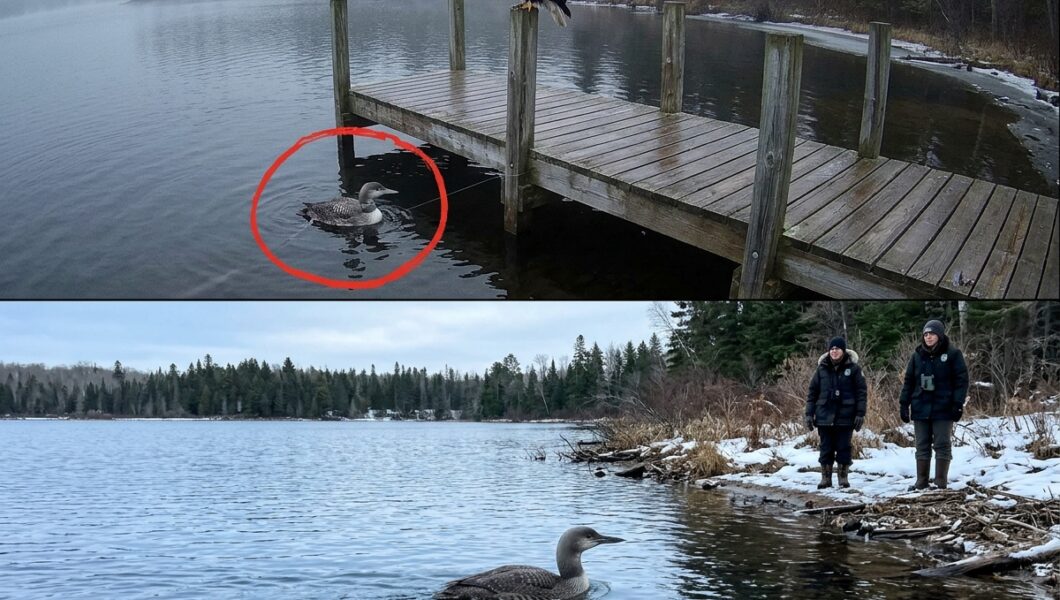
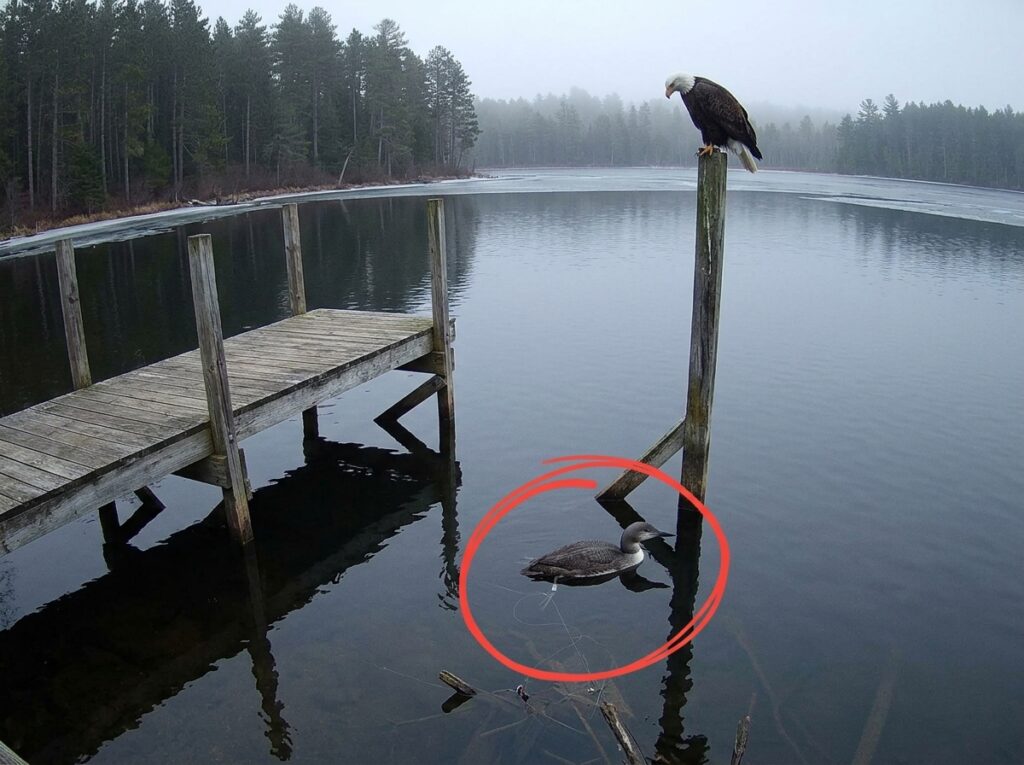
That morning, a bald eagle landing on a fishing dock had drawn her attention to a young loon trapped in discarded fishing line.
The rescue team had freed the bird.
But now specialists had discovered two potentially serious problems.
A dense object inside its digestive tract.
And an abnormal area near its left wing.
The loon might have swallowed fishing tackle.
And an injury could prevent it from returning to the wild.
Natalie swallowed.
“What happens now?”
Dr. Emily Carter, the rehabilitation veterinarian, answered carefully.
“We’re arranging additional testing. We need to identify the object, assess possible lead exposure, and determine whether the wing abnormality affects flight.”
“Is it in pain?”
“We’re treating the injuries and monitoring its condition. I don’t want to make promises before we understand what we’re dealing with.”
Natalie closed her eyes.
The bird had an identification number.
Loon 417.
Years earlier, her father, retired wildlife biologist Samuel Brooks, had helped band it during a summer research project.
Natalie still remembered him holding the young bird during the authorized banding procedure.
“One day, you might see this little one again,” he had said.
Now she had.
But she was terrified their reunion would end in tragedy.
At 6:18 PM, Natalie called her father.
Samuel answered from his home outside Duluth.
“How’s our old friend?”
Natalie hesitated.
“Dad, they found something inside its stomach. And there’s a problem near its wing.”
Samuel went quiet.
“Do they know what it is?”
“Not yet.”
He exhaled.
“Then we wait for the evidence.”
Natalie sat down.
“I thought getting the fishing line off would be enough.”
“I know.”
“What if it never flies again?”
Samuel paused.
“Then the specialists will have to make the right decision for the bird.”
Natalie’s eyes filled.
“You make that sound easy.”
“It isn’t.”
He spoke gently.
“But loving wildlife means caring about what the animal needs, not just the ending we want.”
Natalie stared at the old photograph on her desk.
Her father.
The young loon.
And the summer afternoon when she first learned how much patience wildlife research required.
“I just want it to survive.”
“So do I, sweetheart.”
The next morning, Emily called with the first results.
The dense object was consistent with swallowed fishing tackle.
Blood testing also indicated elevated lead exposure.
The veterinary team considered lead poisoning a serious concern and began treatment appropriate to the bird’s condition, while consulting specialists about the safest way to remove the object.
Natalie felt her stomach tighten.
“So it wasn’t just the fishing line.”
“No,” Emily answered. “The bird appears to have encountered more than one hazard.”
“What about the wing?”
“We’re reviewing the imaging with an avian specialist.”
Natalie waited.
Emily continued.
“The abnormality may represent an older healed injury. We haven’t found evidence of an obvious fresh fracture, but we need to assess the bird’s movement before we can judge its significance.”
Natalie leaned against the desk.
“An old injury?”
“Possibly. The imaging alone can’t tell us whether it will prevent normal flight.”
For the first time since the rescue, Natalie felt a small measure of hope.
The wing abnormality might not be the end of Loon 417’s story.
But the lead exposure remained dangerous.
At 9:16 AM, Andrew Keller arrived at the research station.
He found Natalie reviewing photographs from the north dock.
“Any news?”
She explained the test results.
Andrew studied the recovered fishing tackle.
A lead sinker lay inside a sealed evidence container.
Beside it were several tangled lengths of discarded line.
“One lake,” he said quietly. “Two different threats.”
Natalie nodded.
“Both nearly invisible.”
Andrew looked toward the water.
“We need to find out whether there’s more tackle around that dock.”
The conservation program arranged a targeted inspection with qualified personnel.
They did not disturb sensitive shoreline habitat unnecessarily.
Instead, they documented abandoned fishing equipment and coordinated safe removal from accessible areas.
Natalie joined the shoreline survey.
She carried a camera and field notebook.
At the dock, she stopped beside the piling where the bald eagle had landed.
The wooden boards were wet.
A thin layer of ice had formed along the sheltered shoreline.
And the lake was almost silent.
Natalie looked down.
Only hours earlier, Loon 417 had been struggling beneath those boards.
Its leg tangled in line.
Its body unable to escape.
She imagined how many times the bird had tried diving before the camera recorded it.
How exhausted it must have been.
And how easily the entire incident could have gone unnoticed.
Then Andrew called from farther along the dock.
“Natalie, come look at this.”
She approached.
A collection of old fishing line had become wrapped around a submerged support.
Several hooks and small weights were caught in the tangle.
Natalie photographed the material.
“There’s more.”
Andrew nodded.
“Unfortunately.”
The team documented the hazard for removal.
Natalie looked toward the open lake.
The problem was larger than one trapped bird.
And she knew they needed to do something about it.
Three days later, Natalie received another call.
Emily sounded cautiously encouraged.
“The object has been successfully removed by the veterinary team.”
Natalie stood.
“Really?”
“Yes. We’ve confirmed it was a small lead fishing sinker.”
Natalie covered her mouth.
“And the loon?”
“It’s recovering from the procedure. We’re continuing treatment and monitoring its blood lead levels.”
Natalie closed her eyes.
“Thank goodness.”
Emily continued.
“We’re not out of danger yet. Lead poisoning can cause serious neurological and digestive problems. Recovery depends on how much damage has occurred.”
Natalie nodded.
“I understand.”
But for the first time, the source of one major problem was gone.
Over the following days, Loon 417 began showing encouraging changes.
Its appetite improved under specialist care.
It became more alert.
Its balance gradually stabilized.
And the veterinary team recorded improving clinical signs as treatment continued.
Natalie followed each update carefully.
She kept a notebook beside her desk.
Every time Emily called, Natalie wrote down the date and what the team had observed.
Eating independently.
More alert.
Improved balance.
Continuing treatment.
One afternoon, Samuel visited the research station.
He was seventy-one now.
His hair had turned almost completely white.
And he walked a little more slowly than he had during their fieldwork years.
But his eyes still brightened whenever someone mentioned loons.
Natalie showed him the latest update.
Samuel smiled.
“Look at that.”
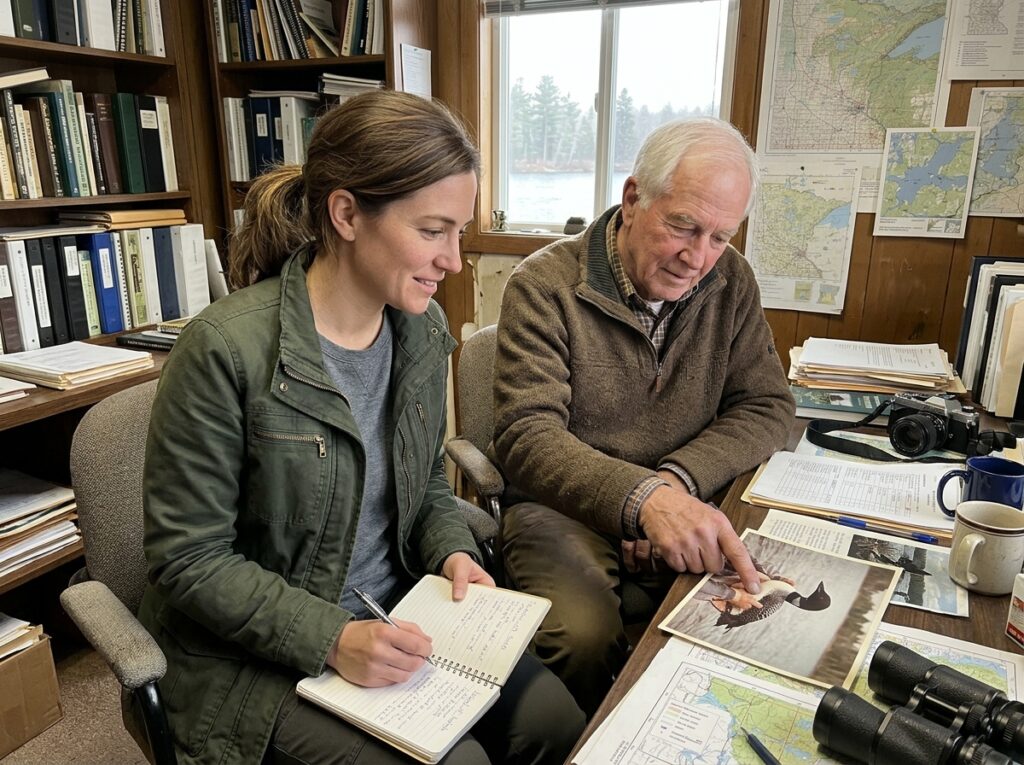
She handed him the old banding photograph.
He studied it for a long time.
“I remember that summer.”
Natalie laughed softly.
“You remember every summer.”
“Not every one.”
He pointed to the young loon in the photograph.
“But I remember this bird.”
Natalie looked at him.
“Why?”
Samuel smiled.
“Because you were the one who wrote down the band number.”
Natalie blinked.
“What?”
He nodded.
“You were helping with the field records. I handled the bird during the banding, but you checked the number and entered it into the database.”
Natalie stared at the photograph.
She remembered the boat.
The clipboard.
The warm summer afternoon.
But she had forgotten that small detail.
Samuel continued.
“You were nervous about making a mistake.”
Natalie laughed.
“I probably was.”
“And I told you to check the number twice.”
She smiled.
“You always said that.”
Samuel looked toward the lake.
“Good records matter. Sometimes they tell a story years later.”
Natalie looked down at the identification number.
The same number she had recorded as a young field assistant.
The same number that had allowed her to recognize the rescued bird.
She felt tears gathering.
“Dad, I didn’t remember that.”
Samuel smiled.
“That’s all right. The database did.”
For a moment, neither spoke.
Then Natalie reached for his hand.
“Thank you for teaching me.”
Samuel squeezed her fingers.
“You were always willing to learn.”
By the second week of rehabilitation, the veterinary team began evaluating Loon 417’s swimming and movement more closely.
The bird was recovering from lead exposure.
Its leg swelling had decreased.
And the skin irritated by the fishing line was healing.
But the wing remained a concern.
An avian specialist reviewed the imaging and examined the bird’s range of motion.
The abnormal area appeared consistent with an older healed injury.
It was not possible to determine exactly when it had occurred.
However, the specialist found no clear evidence that the abnormality alone would prevent normal wing movement.
Natalie received the update while working beside the lake.
“So it might still fly?”
Emily answered carefully.
“Possibly. We need to see how it performs during rehabilitation.”
Natalie smiled.
“That’s more than I hoped to hear.”
Emily continued.
“Loons are powerful swimmers, but flight requires excellent physical condition. We won’t consider release until the bird demonstrates the necessary abilities.”
Natalie nodded.
“Take all the time it needs.”
The rehabilitation team continued monitoring.
Loon 417 gradually regained strength.
It began swimming more confidently.
Its diving behavior improved.
And its appetite remained stable.
The team assessed its waterproofing, body condition, and ability to move normally.
Then came the next major milestone.
During supervised exercise, the loon began using both wings more fully.
At first, the movements were limited.
Then stronger.
The bird extended its wings.
Beat them against the air.
And settled back onto the water.
Emily documented the behavior.
It was encouraging.
But it was not yet proof of sustained flight.
Natalie understood.
Every improvement mattered.
But the team would not rush.
Meanwhile, Silverpine Lake’s conservation program had begun expanding its fishing tackle collection effort.
Andrew contacted local fishing clubs, cabin owners, and community volunteers.
They discussed the risks of discarded line and lead fishing weights.
The program encouraged anglers to use safer alternatives and dispose of damaged tackle responsibly.
Collection bins were inspected and maintained.
And shoreline cleanup efforts focused on areas where abandoned fishing equipment frequently accumulated.
Natalie helped prepare educational materials.
She used the story of Loon 417 as an example, without suggesting that every piece of tackle recovered from the dock had been swallowed by that bird.
The evidence was clear enough.
The loon had been entangled in discarded fishing line.
And a lead sinker had been removed from its digestive tract.
Those were two separate dangers that had nearly cost it its life.
One evening, Samuel joined Natalie at a community meeting.
He listened as she explained the rescue.
The fishing line.
The lead exposure.
The rehabilitation.
And the importance of reporting distressed wildlife to trained professionals.
When she finished, a young boy raised his hand.
“Did the eagle save the loon?”
Natalie smiled.
“The eagle was just behaving like a wild eagle.”
The boy looked disappointed.
She continued.
“But because it landed on the dock, I looked at the camera. That’s when I noticed the loon struggling.”
“So the eagle helped by accident?”
“In a way, its movement helped us notice the problem.”
The boy smiled.
Samuel watched his daughter from the back of the room.
He remembered teaching her to identify birds by their calls.
To record observations carefully.
To respect wild animals.
And never to assume that nature behaved according to human wishes.
Now she was passing those lessons on.
After the meeting, Samuel approached her.
“That was good.”
Natalie smiled.
“Thanks, Dad.”
He looked toward the lake outside.
“You know what I liked most?”
“What?”
“You told them what we knew. And you told them what we didn’t.”
Natalie laughed softly.
“You taught me that.”
Samuel smiled.
“Then I guess you were listening.”
In December, Loon 417 reached another important stage of recovery.
Its blood lead levels had improved.
Its balance had returned to normal.
And its swimming and diving behavior were becoming more consistent with those of a healthy loon.
The veterinary team continued evaluating its flight ability.
During supervised assessment, the bird demonstrated increasingly strong wing movements.
But cold weather was advancing across northern Minnesota.
Ice was spreading over sheltered bays.
And suitable open water was becoming more limited.
Loons require sufficient open water for takeoff and landing.
The rehabilitation team began considering appropriate release options if the bird met all medical and functional criteria.
Natalie understood that returning it to Silverpine Lake might not be possible during winter.
The most important goal was not a sentimental reunion with the exact dock where it had been found.
The goal was giving the bird the best chance of surviving independently.
On December 19, Emily called with news.
“Natalie, Loon 417 has passed its latest flight assessment.”
Natalie stood.
“What?”
“The bird has demonstrated sustained flight under controlled conditions. Its swimming and diving assessments are also encouraging.”
Natalie covered her mouth.
“Does that mean it can go home?”
Emily smiled.
“It means we’re much closer. The final release decision still depends on veterinary clearance and suitable conditions.”
Natalie began crying.
She thought about the question she had asked on the first evening.
“Will it ever fly again?”
And the answer that had frightened her so much.
“We don’t know yet.”
Now, weeks later, the bird had flown.
Not perfectly at first.
Not without treatment.
Not without careful rehabilitation.
But it had flown.
Natalie called Samuel immediately.
“Dad.”
He answered.
“What’s happened?”
“417 flew.”
There was silence.
Then Samuel asked:
“Really?”
“Really.”
She heard him exhale.
For a moment, neither spoke.
Then he said softly:
“That’s wonderful, kiddo.”
Natalie wiped her eyes.
“I wish you could see it.”
Samuel smiled.
“I don’t need to. I believe you.”
In early January 2027, Loon 417 received final veterinary clearance.
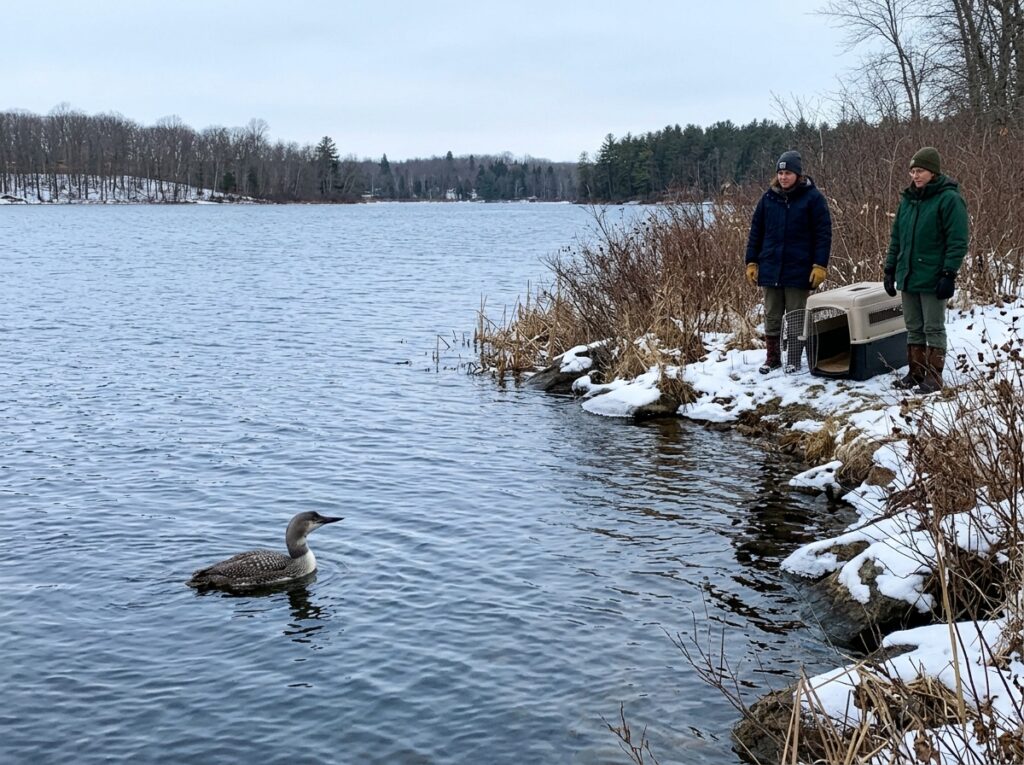
The rehabilitation team selected a suitable ice-free release location with appropriate habitat and weather conditions.
The release was carried out by authorized wildlife professionals.
Natalie did not attend.
She understood that the bird’s return to the wild should be managed for its welfare, not for an audience.
But that evening, Emily sent her a short video.
Natalie opened it.
The recording showed calm open water.
A transport carrier had been positioned appropriately for the controlled release.
Then Loon 417 entered the water.
For several seconds, it floated quietly.
Its head turned.
Its dark bill pointed toward the distant shoreline.
Then the bird began swimming.
Slowly at first.
Then farther.
Its body moved smoothly across the water.
It stopped.
Looked around.
And disappeared beneath the surface in a clean dive.
Natalie held her breath.
A few seconds later, the loon surfaced farther away.
It was swimming freely.
No fishing line.
No trapped leg.
No dock holding it in place.
Just open water.
Natalie watched the video again.
Then again.
Finally, she called her father.
“Dad, they released 417.”
Samuel was quiet.
“How did it look?”
“Strong. It swam away and dove.”
He exhaled.
“That’s exactly what we wanted.”
Natalie smiled through tears.
“I wish I could tell it how proud I am.”
Samuel laughed softly.
“I think it has more important things to do.”
She laughed too.
“You’re right.”
He continued.
“That’s the best part of wildlife work. When they don’t need us anymore.”
Natalie looked at the video one final time.
The loon had disappeared beneath the water.
And she realized her father was right.
The goal had never been to keep the bird close.
It was to help it return to the life it belonged to.
Over the following months, Silverpine Lake’s conservation program continued its work.
Fishing tackle collection bins were maintained.
Volunteers documented abandoned line along public shorelines.
Local fishing groups discussed safer tackle options.
And the research team continued monitoring waterbirds as the seasons changed.
Natalie kept the old photograph of her father and Loon 417 beside her desk.
She also printed a still image from the release video.
The two photographs sat side by side.
One showed the bird during its early research years.
The other showed it returning to open water after rehabilitation.
Between those moments lay years of migration, survival, and an extraordinary rescue.
But Natalie never claimed to know everything the bird had experienced.
The metal band had confirmed its identity.
The medical records documented its injuries.
And the release assessment showed it had recovered sufficiently to return to the wild.
What happened afterward remained uncertain.
That was the nature of wildlife research.
You could follow an animal for years.
Record its movements.
Learn from its behavior.
And still never know every part of its story.
In May 2027, Samuel visited Silverpine Lake.
Spring had returned.
The ice was gone.
Fresh green leaves covered the shoreline.
And the calls of loons echoed across the water.
Natalie stood beside him on the research dock.
The same dock where Loon 417 had been rescued.
Samuel looked toward the open lake.
“Beautiful morning.”
Natalie smiled.
“It is.”
A loon called from the far side of the bay.
Then another answered.
Samuel listened.
“Never gets old.”
Natalie laughed.
“You’ve been saying that for forty years.”
“And I’ll keep saying it.”
They stood quietly.
Then Samuel pointed toward a dark shape on the water.
“There’s one.”
Natalie raised her binoculars.
A common loon floated near the edge of the protected shoreline.
Its black-and-white breeding plumage was visible in the spring sunlight.
It turned its head.
Then dived.
Natalie watched the spot where it disappeared.
For a moment, she wondered.
Could it be 417?
Could the bird have returned to Silverpine Lake after its winter release?
She knew it was possible for a loon to return to familiar waters.
But the bird was too far away to read its leg band.
And appearance alone could not confirm its identity.
She lowered her binoculars.
Samuel looked at her.
“Well?”
Natalie smiled.
“Just a loon.”
He nodded.
“That’s enough.”
She laughed softly.
“Yeah. It is.”
They watched the water together.
Natalie thought about the bald eagle landing on the dock that cold November morning.
The fishing line tightening around the trapped bird’s leg.
The small metal band that had connected the present to her father’s research years.
The frightening discovery of swallowed lead tackle.
And the long weeks when nobody knew whether Loon 417 would survive, much less fly again.
Then she remembered the release video.
The bird entering the water.
Swimming away.
And disappearing beneath the surface.
She smiled.
One common loon had survived fishing-line entanglement, lead exposure, and weeks of uncertain recovery. But the most meaningful part of its story was not that people remembered it. It was that the bird had returned to the wild, where it no longer needed them.
Samuel placed a hand on Natalie’s shoulder.
“You know, I remember what I told you when we banded that bird.”
Natalie smiled.
“One day, you might see this little one again.”
He nodded.
“And you did.”
She looked toward the lake.
“Only because I was paying attention.”
Samuel laughed softly.
“Then I guess the lesson stuck.”
A bald eagle passed high above the shoreline.
Its white head caught the morning light.
Natalie watched it glide toward the far trees.
She couldn’t know whether it was the same eagle from the rescue.
And she didn’t need to.
The bird was simply doing what wild eagles do.
Flying.
Searching.
Living.
Just as the loons were doing below.
Natalie took one final look across Silverpine Lake.
Then she turned toward her father.
“Ready to head back?”
Samuel smiled.
“In a minute.”
He listened to another loon call.
Then said quietly:
“Let’s enjoy this a little longer.”
Natalie stood beside him.
And together, they watched the lake come alive.
THE END
No Comments