

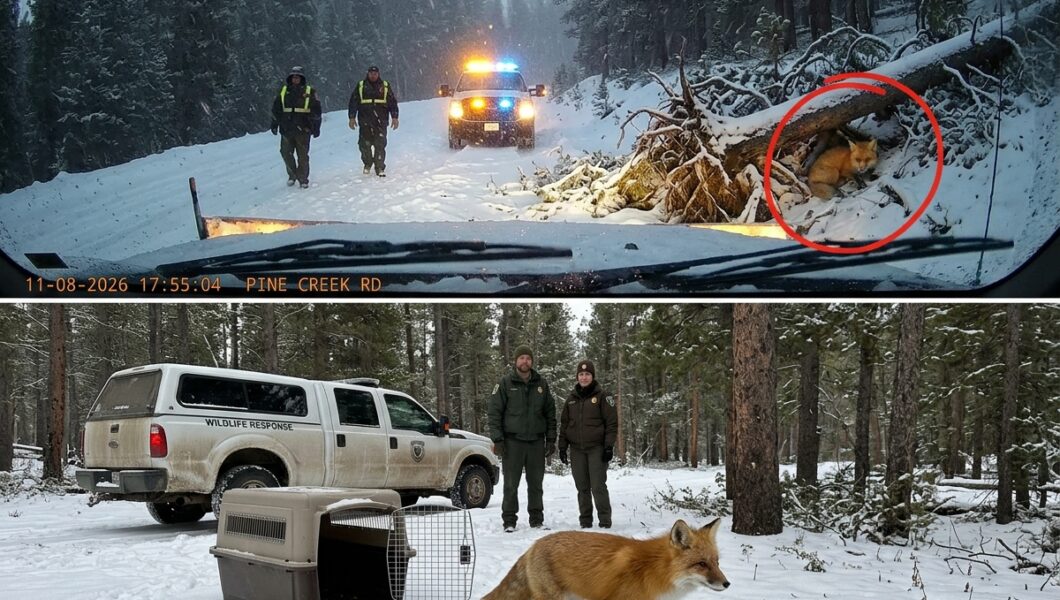
At 5:34 PM, Thomas Miller stood beside his snowplow on a remote Colorado mountain road, staring at a photograph on his phone.
Somewhere beyond the snow-covered embankment, another young red fox might be dying.
The dashcam recording was nearly twelve hours old.
And the temperature was dropping fast.
“Sarah, tell me someone’s going to check,” he said.
Wildlife officer Sarah Collins answered immediately.
“Daniel and I are heading there now. Thomas, stay in the turnout. Don’t approach the den.”
Thomas looked toward the dark pine forest.
“I understand.”
But understanding didn’t make waiting easier.
That morning, he had discovered a young fox trapped inside an overturned blue plastic barrel. Wildlife responders had freed the animal, treated its swollen paw, and transported it to a rehabilitation center.
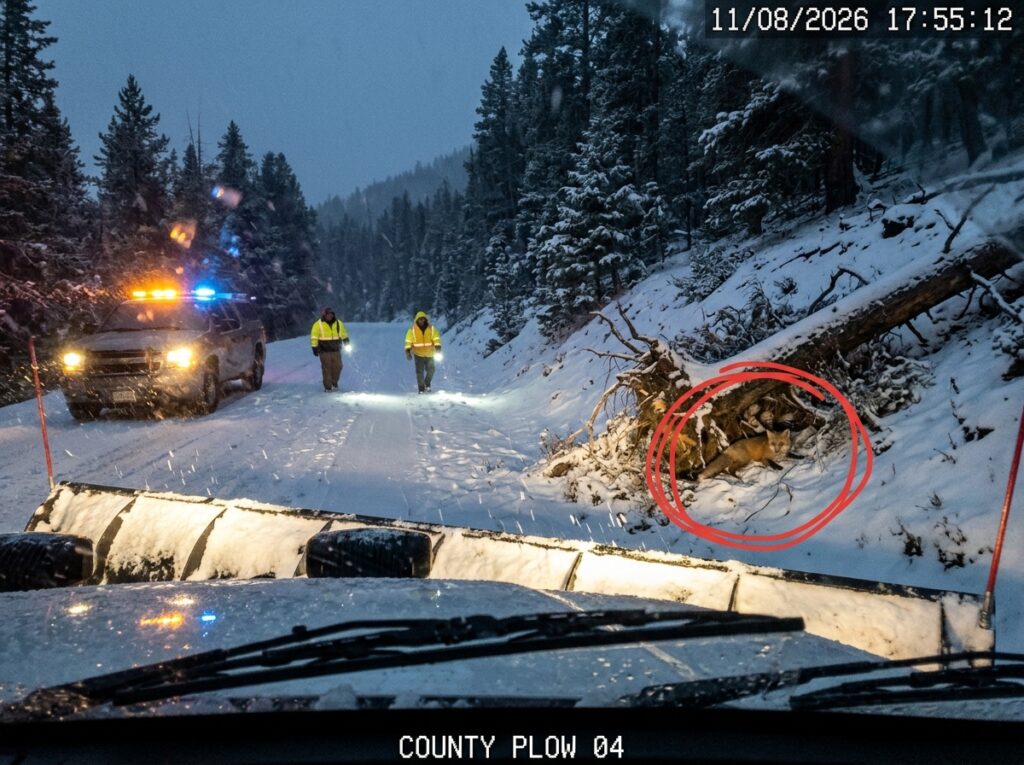
Now the rear-facing dashcam had revealed something nobody noticed during the rescue.
An adult red fox had approached the roadside.
And beneath the branches behind it, a second young fox had been lying almost motionless in the snow.
Thomas enlarged the photograph again.
The animal’s reddish-orange fur blended with the dead pine needles.
Its black paws were barely visible.
Only one pointed ear stood out against the white snow.
“Please still be alive,” he whispered.
At 5:49 PM, Sarah’s four-wheel-drive vehicle appeared through the snowfall.
Animal rescue technician Daniel Price stepped out carrying a thermal imaging device and wildlife response equipment.
Sarah studied the embankment.
“Show me exactly where you saw it.”
Thomas pointed toward the fallen log.
“Behind those branches. About fifteen feet uphill.”
Daniel scanned the area from the roadside.
At first, the thermal camera showed only cold rocks and snow-covered roots.
Then a faint warm shape appeared beneath the branches.
Daniel adjusted the angle.
“Sarah, I’ve got something.”
Thomas stepped closer.
“Is it moving?”
“Not that I can tell.”
Sarah examined the image.
The heat signature was small.
Low to the ground.
And partly concealed beneath the fallen log.
She looked toward Thomas.
“We’re going to assess it. Stay back.”
The responders approached cautiously, watching for the adult fox.
Daniel stopped several feet from the opening.
He listened.
Nothing.
Then a faint scratching sound came from beneath the roots.
Sarah lowered herself carefully to look inside.
A small red fox lay curled against the frozen earth.
Its eyes were partly open.
One front paw rested beneath its chest.
Snow had collected along its back.
But its sides were moving.
“It’s breathing,” Sarah said.
Thomas closed his eyes.
“Thank God.”
The fox tried lifting its head.
It managed only a few inches before settling again.
Sarah noticed something else.
A dark cord was caught around one of its front legs.
The cord disappeared beneath the frozen branches.
Daniel examined the surrounding debris.
“Looks like another piece of discarded packing material.”
Sarah nodded.
“Possibly from the same roadside dumping.”
The fox had apparently become entangled while moving beneath the fallen log. Its struggling had pulled the cord tighter against a root.
The team carefully assessed the space before attempting to free it.
Thomas watched from the road.
He had never imagined that one abandoned barrel could lead them to another trapped animal.
At 6:07 PM, Daniel stabilized the loose branches while Sarah used appropriate protective handling equipment to restrain the frightened fox.
The animal struggled weakly.
Sarah kept her voice low.
“Easy. We’ve got you.”
Daniel cut the cord without pulling against the trapped leg.
The fox’s paw came free.
Sarah carefully transferred the animal into a ventilated wildlife transport crate lined for warmth.
The fox was conscious.
But it was severely exhausted.
Its breathing was shallow.
And its body felt dangerously cold.
Sarah contacted the rehabilitation veterinarian.
“We’ve recovered a second juvenile red fox. Cold exposure, dehydration suspected, possible limb injury. We’re bringing it in.”
Thomas approached only after Sarah secured the crate.
“Is it going to make it?”
She looked at him.
“I can’t promise that. But it’s alive, and we’re getting it help.”
Thomas stared at the small animal through the ventilation opening.
Two foxes.
Two pieces of discarded plastic.
And one snowstorm that had nearly hidden both.
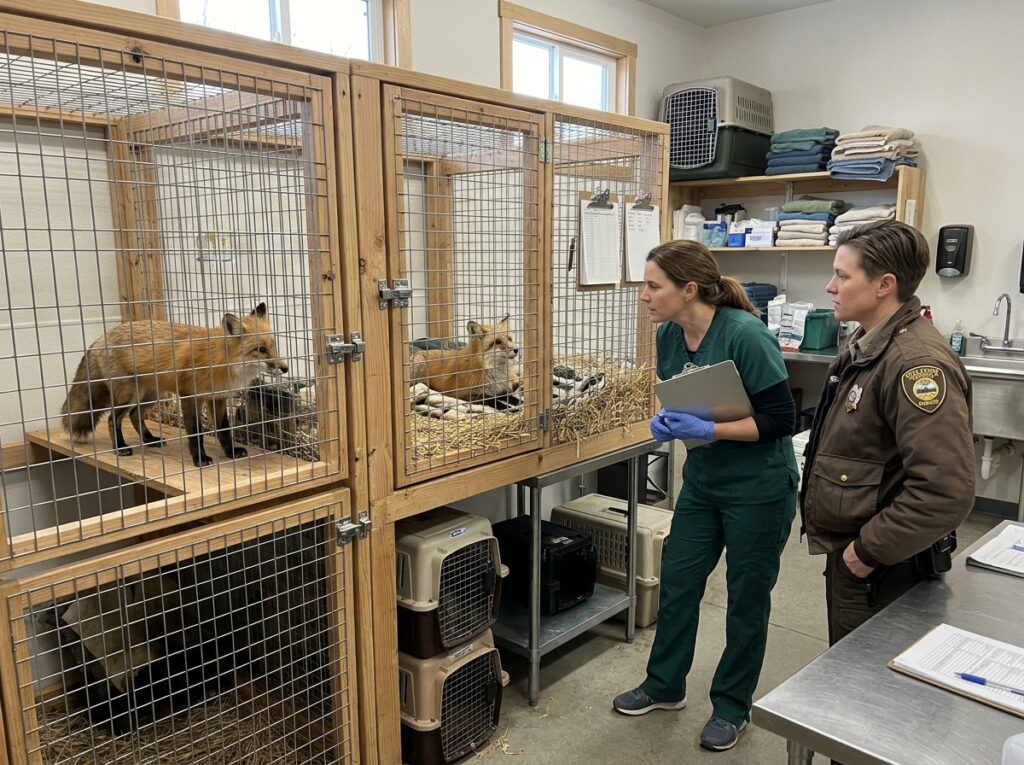
At 7:18 PM, the second fox arrived at the licensed wildlife rehabilitation center.
Dr. Megan Foster, the veterinarian who had examined the first fox earlier that day, was waiting.
Sarah explained what they had found.
“Another juvenile, possibly from the same local family group. Entangled beneath a fallen log. We don’t know how long it was there.”
Megan carefully examined the animal.
Its body temperature was below normal.
The trapped front leg showed swelling and superficial abrasions.
It was dehydrated.
But there were no obvious signs of a major fracture.
The veterinary team began controlled warming, supportive treatment, and monitoring.
Thomas had followed in his county truck.
He waited in the reception area, holding a paper cup of coffee he hadn’t touched.
At 8:06 PM, Megan came through the door.
“The second fox is stable enough for continued treatment.”
Thomas stood.
“That’s good?”
“It’s encouraging. But the next twenty-four hours are important.”
He nodded.
“Can I ask about the first one?”
Megan smiled.
“That fox is doing better. It’s alert, eating, and beginning to use its injured paw.”
Thomas looked down.
For the first time all day, he smiled.
“Two little fighters.”
Megan nodded.
“Two very lucky animals.”
The next morning, Thomas returned to County Road 18 with his supervisor, Frank Dawson.
They were not searching for more foxes.
Sarah had instructed them to leave the suspected resting area undisturbed while wildlife personnel assessed it.
Instead, the county maintenance crew was documenting and removing dangerous roadside rubbish from accessible locations.
The blue barrel had already been collected.
But Thomas now understood that it was only part of the problem.
Near an abandoned logging access road, the crew discovered several damaged plastic containers, loose packing cord, and broken storage materials partly buried beneath snow.
Frank photographed everything.
“Someone dumped a whole load of junk out here.”
Thomas picked up a length of cord using appropriate protective equipment.
It resembled the material that had trapped both foxes.
“How long has this been here?”
Frank shook his head.
“Could be months.”
Thomas looked toward the forest.
Wild animals had been moving through this area while discarded material lay hidden beneath the snow.
He wondered how many others had encountered it.
The county arranged a more extensive cleanup when conditions allowed safe access.
Meanwhile, Sarah placed a remote wildlife camera near the suspected fox resting area, without disturbing the shelter.
At 4:26 PM, the camera recorded movement.
An adult red fox emerged from the pine trees.
Its reddish-gray winter coat was thick.
Its tail was full.
It stopped beside the fallen log.
Sniffed the snow.
Then moved toward the opening where the second young fox had been found.
Sarah watched the recording later that evening.
The adult remained near the shelter for several minutes.
Then disappeared into the forest.
Thomas called when he received the update.
“Was it looking for them?”
Sarah answered carefully.
“It may have been investigating familiar scents. We can’t know exactly why it returned.”
“Could it be their mother?”
“Possibly. But we haven’t established that they’re related.”
Thomas understood.
Still, the image stayed with him.
An adult fox standing beside an empty shelter.
Two young foxes recovering miles away.
And a winter storm continuing to cover the mountains.
Over the following days, the rehabilitation center provided updates.
The first fox’s hind paw improved steadily.
The second fox required more time.
Its front leg was sore, and its strength returned slowly.
But both animals began eating normally.
Their body temperatures stabilized.
And their behavior became more alert.
Megan’s team minimized human contact to preserve their natural wariness.
Thomas never asked to hold them.
He never asked to visit their enclosures.
He simply called occasionally to ask whether they were recovering.
One afternoon, Megan told him something that made him laugh.
“The second fox is becoming quite difficult to examine.”
Thomas smiled.
“That sounds like good news.”
“For a wild fox, it can be.”
The young animal had regained enough strength to resist handling.
It was moving more confidently.
And its injured leg was healing.
Thomas leaned back in his chair.
“Good. Let it be wild.”
Two weeks after the rescue, Sarah received another camera recording from County Road 18.
The adult fox had returned.
This time, it appeared at 6:14 AM.
It crossed the snow-covered access road and paused beside the fallen log.
Then something unexpected happened.
A second adult fox emerged from the trees.
The two animals stood several yards apart.
They sniffed the ground near the shelter.
Then moved together toward the forest.
Sarah reviewed the footage with a wildlife biologist.
The behavior was consistent with foxes using an established territory.
But the recording still could not confirm a relationship to the rescued juveniles.
That uncertainty mattered.
The rehabilitation team could not simply release two recovering animals beside an adult fox and assume they would be accepted.
Instead, they planned to return the juveniles to suitable habitat within their known geographic area once both had met release criteria.
The first fox recovered faster.
Its hind leg swelling resolved.
It began moving normally.
The second fox needed another week before its front leg showed the same improvement.
Megan monitored both carefully.
They needed to be capable of traveling, hunting, and surviving independently.
On December 4, 2026, the veterinarian cleared the first fox for release.
The second was not quite ready.
Thomas received the news while servicing his snowplow.
“That’s wonderful,” he said.
Megan explained that the release would be carried out by authorized personnel at a suitable location away from traffic and hazardous debris.
Thomas nodded.
“I don’t need to be there. Just tell me how it goes.”
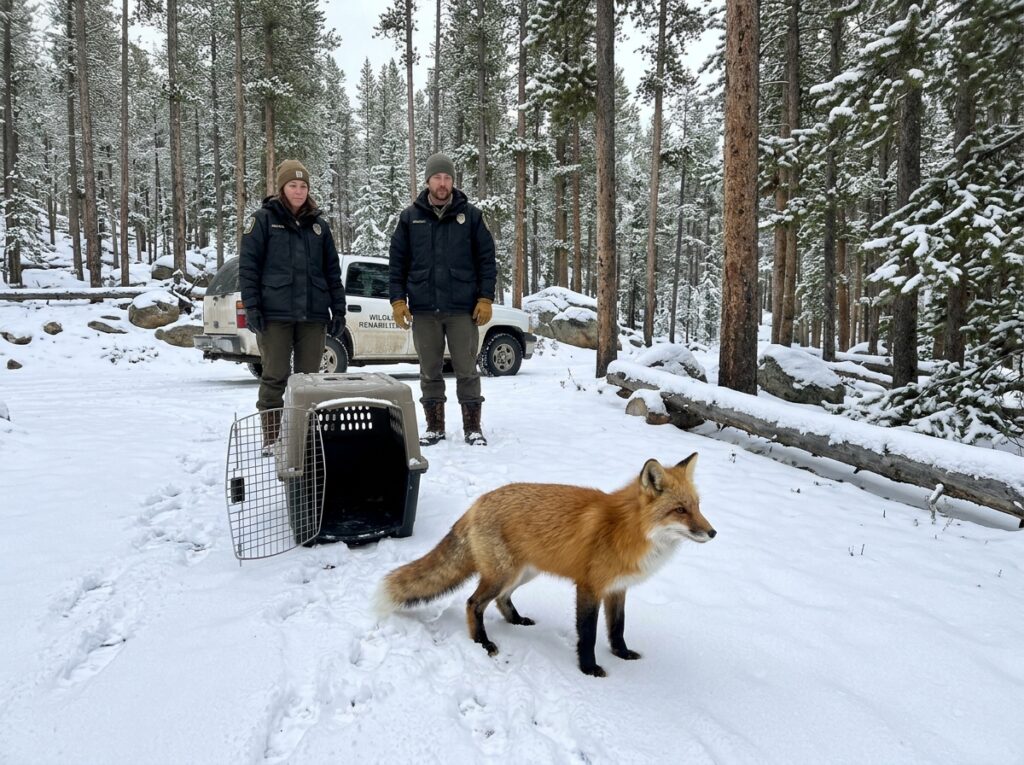
The release took place the following morning.
The fox emerged cautiously from its transport crate.
It paused in the snow.
Its ears turned toward the trees.
Then it trotted into the forest.
Within seconds, it disappeared among the pines.
Sarah recorded the release for the rehabilitation team’s records.
She sent Thomas a photograph afterward.
The small red fox stood at the edge of the forest, looking toward the trees.
Thomas stared at the image.
He remembered the blue barrel rocking beside the road.
The frightened orange face.
The plastic cord around its hind paw.
And the terrible cold.
Now the fox was free.
He smiled.
“Stay out of trouble, little guy.”
Ten days later, the second fox passed its final assessments.
Its front leg had healed.
It was moving normally.
Its body condition had improved.
And the rehabilitation team considered it ready to return to the wild.
Sarah arranged its release in suitable habitat within the same general area.
Thomas received a telephone call afterward.
“Both foxes are back in the forest,” she said.
He was silent for a moment.
Then asked, “Both?”
“Both.”
Thomas sat down.
Outside the maintenance garage, snowplows were preparing for another storm.
Engines rumbled.
Workers checked equipment.
The familiar sounds of winter filled the yard.
But Thomas barely heard them.
He thought about the second fox lying motionless beneath the branches.
How close they had come to missing it.
How the dashcam had recorded something nobody noticed until hours later.
And how the wildlife team had returned to the mountain before the night grew colder.
“Thank you, Sarah.”
She answered softly.
“You helped us find them.”
Thomas shook his head.
“You did the hard part.”
Sarah smiled.
“It took all of us.”
By January, the county had removed the remaining dumped material from the accessible roadside area.
The blue barrel was gone.
The loose packing cords had been collected.
And maintenance crews were instructed to report discarded containers, netting, and other materials that could trap wildlife.
Thomas continued driving County Road 18.
He still watched for black ice.
Still checked the dangerous curves.
Still worked through storms that left the road nearly invisible.
But he noticed something different now.
The forest beside the road no longer seemed empty.
Every fallen log could shelter an animal.
Every set of tracks told a story.
And every piece of rubbish could become a hazard.
One morning, Frank approached him at the maintenance garage.
“Got something for you.”
He handed Thomas a printed photograph.
It showed the original blue barrel lying against the snowbank.
Beside it was a second photograph.
The same roadside after cleanup.
No barrel.
No discarded cord.
Just clean snow and pine trees.
Frank smiled.
“Thought you might like to see the difference.”
Thomas studied the photographs.
He nodded.
“I do.”
Then he placed them in his locker.
On February 18, 2027, Thomas was clearing County Road 18 shortly after sunrise.
The storm had passed.
Fresh snow covered the forest.
As he rounded a familiar bend, movement appeared near the tree line.
A red fox.
Thomas slowed slightly while maintaining control of the snowplow.
The animal stood beside a fallen log.
Its winter coat glowed orange against the snow.
Then another fox appeared farther back among the trees.
Thomas smiled.
He had no way of knowing whether either animal was one of the foxes he had helped rescue.
There were no visible identifying marks.
And several foxes lived in the surrounding forest.
But seeing two healthy animals moving freely through the snow brought back everything that had happened.
The first frightened fox inside the blue barrel.
The second lying beneath the branches.
The adult fox caught on the rear dashcam.
And the bald eagle lifting into the snowy darkness.
Thomas watched the foxes disappear between the pines.
Then continued plowing.
Later that morning, he called Sarah.
“Saw two foxes near the old barrel site.”
“That’s nice,” she said.
“Probably not ours.”
“Could be. But we can’t know.”
Thomas laughed softly.
“Yeah. I figured you’d say that.”
Sarah smiled.
“Still good to see foxes using the area.”
Thomas looked toward the forest.
“Sure is.”
Before ending the call, Sarah mentioned that the county had adopted a more consistent system for documenting roadside wildlife hazards.
Discarded barrels, loose plastic, and dangerous debris would be reported for safe removal.
Thomas nodded.
“Good.”
He thought about how the entire story had begun.
Not with a dramatic rescue.
Not with an animal deliberately asking for help.
But with an ordinary bald eagle lifting from a roadside perch.
The eagle’s movement had caught his eye.
The headlights had revealed the blue barrel.
And inside, a frightened fox had been struggling to escape.
Without that moment, Thomas might have driven past.
Without reviewing the dashcam later, nobody might have noticed the second young fox beneath the branches.
And without Sarah, Daniel, Megan, and the rehabilitation team, neither animal would have received the care it needed.
Thomas had driven snowplows for twenty-nine winters.
He had always believed his responsibility ended at the edge of the road.
Keep the pavement clear.
Keep motorists safe.
Get the job done.
But now he understood that even an ordinary maintenance worker could notice something that mattered beyond the road itself.
He couldn’t rescue every animal.
He couldn’t prevent every storm.
And he couldn’t know what happened to the two foxes after their release.
But he had stopped.
He had called for help.
And he had looked closely at the footage when something seemed unusual.
Sometimes that was enough to begin changing an outcome.
That afternoon, Thomas returned to the maintenance garage.
He opened his locker.
The two photographs were still there.
The blue barrel before cleanup.
The empty roadside afterward.
He looked at them for a moment.
Then smiled.
Two young foxes had nearly died because of discarded plastic hidden beneath the snow. One was discovered by chance, and the other was found because someone looked again. Both received professional care and returned to the wild.
Thomas closed the locker.
Outside, another snowstorm was moving toward Pine Creek.
His snowplow was ready.
The road was waiting.
And somewhere beyond the snowbanks, the forest continued living its quiet, complicated life.
He climbed into the driver’s seat.
Started the engine.
And glanced toward the dashcam.
“All right,” he whispered.
“Let’s see what we can keep safe today.”
THE END
No Comments