

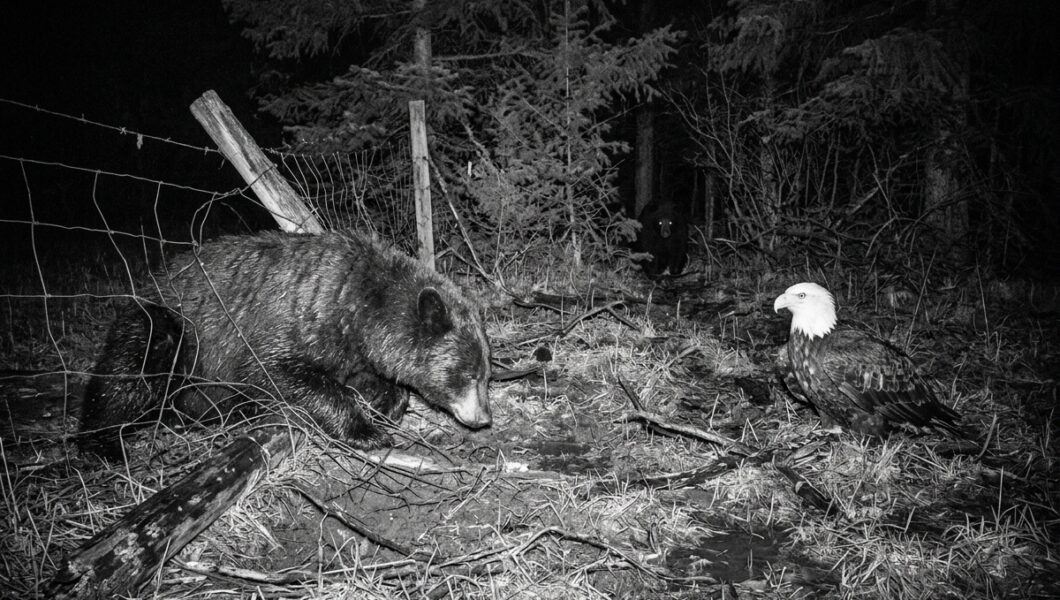
Walter Hayes watched the final recording three more times.
The person had disappeared into the darkness, leaving the small metal case beneath the fence post. Its lid stood open, and something inside reflected the infrared camera’s light.
Walter wanted to know what was inside.
But the wildlife officer’s warning was clear.
Stay inside. Do not approach the fence.
At seventy years old, Walter had learned that courage did not mean rushing toward danger. During his four decades on the ranch, he had seen enough injured animals and unpredictable weather to understand that one careless decision could make a bad situation worse.
He locked the back door, poured himself another cup of coffee, and called the officer.
“I’m watching the camera,” he told her. “The case is still there.”
“Good. Please don’t touch it or allow anyone else near it. We’re sending someone to investigate the property.”
“Do you know who left it?”
“Not yet. We have information suggesting that the equipment may be connected to an old wildlife monitoring project. We need to establish whether that is true before drawing conclusions.”
Walter looked toward the north pasture.
The old equipment shed stood beyond the neighboring property line, partly concealed by pine trees. He had passed it hundreds of times over the years. Its roof had sagged, its windows were dark, and weeds had grown around the door. As far as Walter knew, nobody had used it for a long time.
Now someone was visiting it after midnight, attaching unfamiliar wire to his fence, and leaving a metal case marked with a wildlife tracking symbol.
He opened the trail-camera application again.
The small bear had returned to the clearing after the adult was rescued. It had sniffed the ground beside the fallen fence post and paused as if listening. Then the healthy eagle appeared on a branch above it.
Walter knew he could not determine what either animal was thinking. The smaller bear might have been investigating familiar scents, and the eagle might simply have been using the branch as a resting place.
Still, their presence made the clearing feel more important than an ordinary stretch of pasture.
At 7:12 a.m., a county vehicle arrived at the ranch entrance.
A wildlife officer named Rebecca stepped out with another investigator. Walter met them at the house and showed them the original recordings on his computer. He explained exactly when he had noticed the wire, when the bear became trapped, and when the unidentified person appeared.
Rebecca listened carefully.
“Did you install any new fencing in that section recently?”
“No. The posts have been there for years. I was planning to repair the damaged section this weekend, but I hadn’t touched that wire.”
“Has anyone asked permission to work on your property?”
“Not that I remember.”
Rebecca made a note.
They reviewed the recording of the vehicle approaching the service road. The headlights illuminated part of the fence, but the camera did not capture a readable license plate. The person carrying the long object remained unidentifiable.
“We’ll preserve the original footage,” Rebecca said. “Don’t delete or edit anything. We’ll also document the case before opening it.”
Walter nodded.
“What could someone be doing with wildlife tracking equipment?”
“There are legitimate research projects that use identification tags, tracking devices, and monitoring equipment. But the symbol alone doesn’t tell us who owns this case or why it was left here. We’ll need to examine it.”
The investigators returned to the north pasture while Walter stayed behind the safety boundary.
From the kitchen window, he watched them approach the damaged fence. They photographed the surrounding ground, examined the wire, and recorded the case’s position before carefully securing it.
Walter waited for his phone to ring.
It did, twenty minutes later.
Rebecca was calling from the clearing.
“We’ve documented the case,” she said. “Inside, we’ve found a small tracking receiver, a folded map, and a card with a serial number. There are no explosives or other immediately dangerous items visible, but we’re treating the equipment as evidence until its origin is confirmed.”
Walter exhaled.
“What does the map show?”
“It marks several locations along the creek and the edge of the woodland. One of those points is close to the abandoned equipment shed.”
“Why would someone map those places?”
“We don’t know yet. The markings could relate to wildlife monitoring, property access, or something else. We’ll contact the appropriate agencies to verify the serial number.”
Walter looked at the screen again.
The map had made the shed part of the mystery, but it had not explained anything.
Then Rebecca added something that made him sit upright.
“We also found a second piece of wire near the fence. It appears to have been cut recently. We’re checking whether it matches the material used in the section that trapped the bear.”
Walter’s stomach tightened.
“So someone may have added the wire deliberately?”
“It’s one possibility we’re investigating. We cannot yet establish who installed it or why.”
Walter thought about the adult bear struggling in the rain. He remembered how the animal had jerked backward when the wire tightened around its leg. If the bear had panicked harder, the injury could have been much worse.
He was grateful the trained team had arrived before he attempted anything himself.
“Please let me know what you find,” he said.
“I will. And Walter, keep the livestock away from that section of the pasture until the fencing has been fully inspected.”
After the call, Walter walked through the barn and checked his animals from the safe side of the enclosure. The storm had left puddles along the track, and water dripped from the roof. Everything looked ordinary, yet he could no longer look at the north fence without remembering the bear trapped beside it.
He had always thought of fences as boundaries that kept animals safe.
Now he understood how easily a damaged or altered fence could become a hazard.
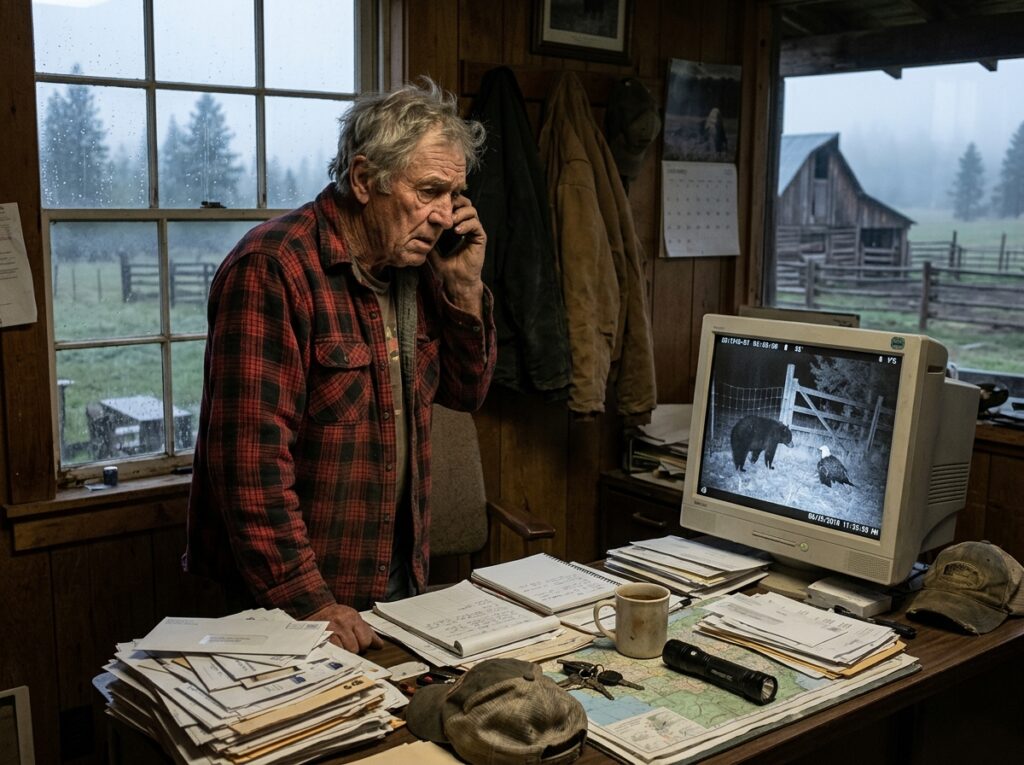
By late morning, the wildlife team had confirmed that the adult bear was receiving veterinary assessment. The wire had been removed safely, and the animal was being monitored for injuries caused by the entanglement. The team could not yet say when it would be safe to return the bear to the wild.
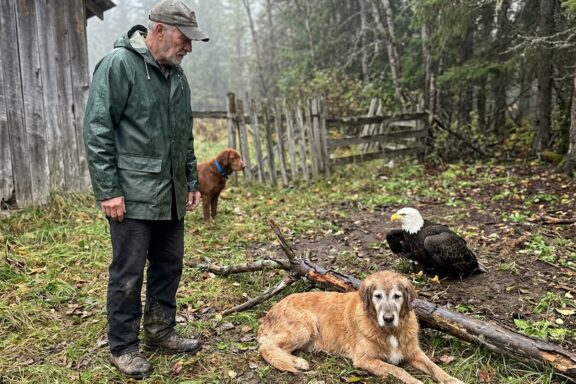
The bald eagle had been transported separately to a licensed rehabilitation facility. Its wing injury required further examination, and its recovery remained uncertain.
Walter felt relieved that both animals had received professional care.
But the case beneath the fence continued to bother him.
At noon, Rebecca called again.
“The serial number on the receiver appears to be associated with an older wildlife monitoring program,” she explained. “We’re contacting the people responsible for the project. The equipment may have been inactive for years, but we need to verify that.”
“Could the person have been trying to track the bear?”
“Possibly, but we don’t have evidence to establish that. The map contains several locations, and we need to determine what they refer to.”
Walter asked about the smaller bear.
“The tracks suggest it returned to the clearing after the adult was removed,” Rebecca said. “That doesn’t prove the two bears were related, although it’s possible they had been traveling through the same area. We’ll continue monitoring the location for safety.”
Walter thanked her and hung up.
He went to his desk and opened the recordings from the previous week. He began making a timeline, writing down the date and time of each unusual event. He included the fox, the deer, the smaller bear, the vehicle, and the person carrying the flashlight.
He did not want to guess at the meaning of any of it. He simply wanted a clear record.
At 1:34 p.m., he noticed something he had missed earlier.
In the recording from the night before the rescue, the person had stopped beside the fence and pointed the flashlight toward the ground. The beam moved along the wire, then toward the fallen post. The person remained there for several minutes before returning to the vehicle.
Walter enlarged the image.
The long object carried by the figure appeared to have a hooked end. It could have been a fencing tool, but the image was too blurry to be certain.
He sent the clip to Rebecca.
A few minutes later, she called back.
“That’s useful. We’ll compare it with the physical evidence. Please don’t make any changes to the recording.”
Walter promised he wouldn’t.
Then a new motion alert appeared.
This time, the camera near the old service road showed a vehicle approaching the neighboring property. It stopped near the abandoned equipment shed.
A person stepped out.
Walter watched as the figure walked to the building, unlocked the door, and disappeared inside.
The vehicle remained parked outside.
Walter immediately called Rebecca.
“I think someone is back at the shed.”
“Stay inside,” she said. “We’re checking the area now. Don’t approach the property or confront anyone.”
Walter watched the screen.
Several minutes passed.
Then the person emerged carrying a flat rectangular object. The figure looked toward the woodland, paused, and returned to the vehicle.
The vehicle drove away.
Walter saved the recording and wrote down the time.
He felt a growing concern that someone was using the old shed, but he could not know whether the visit was connected to the metal case or the injured animals.
The investigators would have to establish that.
At 3:08 p.m., Rebecca arrived at the farmhouse again. She had received new information from the people responsible for the older monitoring project.
“The project tracked animal movements in parts of this region several years ago,” she explained. “Some equipment was installed temporarily, and records were kept of where it was placed. The program ended, but some of the records were retained.”
“Does that explain the case?”
“It may explain the receiver and the symbol. It doesn’t explain why this particular case was placed beneath your fence, or who placed it there. We’re still checking the details.”
Walter showed her the map from the case, which had been photographed by the investigators.
One of the marked points appeared to be near a narrow bend in the creek. Walter recognized it as a place where the fence had been damaged during an earlier storm.
Another mark lay close to the abandoned shed.
Rebecca compared the map with the existing records.
“The locations may correspond to old monitoring points,” she said. “We’ll need confirmation from the project coordinator. The fact that someone visited the area last night is a separate matter we’re investigating.”
Walter leaned back.
For the first time that day, the mystery seemed to have a possible explanation for part of its details. The equipment might not have been new at all. Someone could have been retrieving old materials, checking a former monitoring site, or doing something unrelated.
But the newly attached wire remained unexplained.
And Walter could not forget the bear’s leg caught in it.
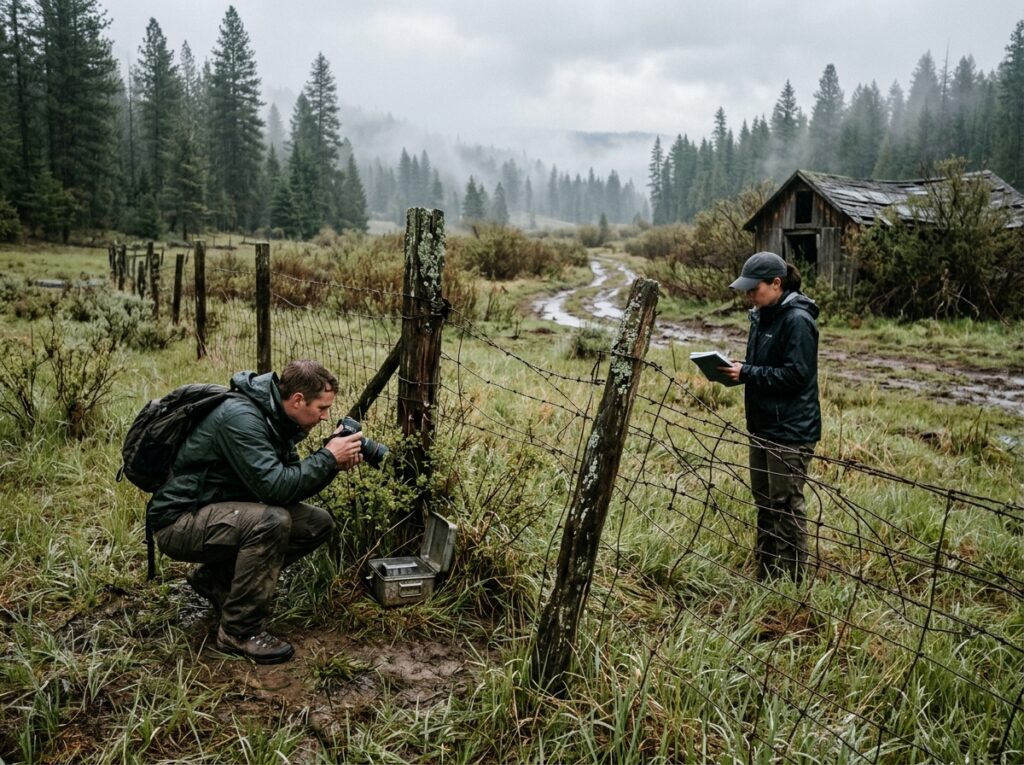
Later that afternoon, Rebecca called with an update about the person seen at the shed.
The sheriff’s office had identified a possible connection to a former contractor who had worked near the property years earlier. Investigators were attempting to contact the individual and verify whether the person had permission to access the neighboring land.
The name did not mean much to Walter at first.
Then Rebecca mentioned that the contractor had previously assisted with repairs and equipment removal at the old monitoring site.
Walter remembered a pickup truck visiting the area several years earlier. He had assumed it belonged to someone checking the neighboring property. He could not be sure it was the same vehicle.
“Does that person have anything to do with the animals?” he asked.
“We don’t know. We’re keeping the questions separate until we have evidence connecting them. The wire may have been installed recently, but we haven’t established who did it or whether the person in the recording is responsible.”
Walter appreciated the direct answer.
He had lived long enough to know how quickly a rumor could grow from a single unclear image. He did not want to accuse a neighbor or a stranger without evidence.
That evening, he checked the north pasture from the farmhouse window. The responders had marked off the damaged area, and the livestock were safely away from it. The sky had begun to clear, revealing a pale strip of light beyond the mountains.
Walter thought about the smaller bear returning to the clearing.
He wondered whether it would return again, but he knew there was no way to know what the animal would do. He hoped it would find food and shelter away from the damaged fence.
He also wondered about the healthy eagle seen in the tree. It might have been another bird passing through the woodland. Its presence did not prove that it was connected to the injured eagle.
The animals had their own lives beyond the human mystery unfolding around the ranch.
Walter wanted the investigation to help protect them, not turn them into characters in a story he could not verify.
At 8:42 p.m., his phone rang once more.
Rebecca had spoken with the coordinator of the old monitoring project.
“The receiver in the case is consistent with equipment used during that project,” she said. “The coordinator is reviewing the archived records to see whether the unit was ever reported missing or recovered.”
“What about the wire?”
“That remains under investigation. We have not found a record indicating that the project installed that section of wire. We’re comparing it with the materials documented on the site.”
Walter glanced toward the dark pasture.
“Could the case have been left as a warning?”
“We can’t determine someone’s intention from the object alone. It could have been left for many reasons. We need more information.”
He thanked her and ended the call.
Then he checked the trail-camera app one last time.
The north fence camera showed no movement. The creek camera captured only drifting branches and the occasional flash of rainwater reflecting infrared light.
Walter closed the application.
He had started the morning hoping to find out whether the bear and eagle would survive. He had learned that both were receiving care, but their futures remained uncertain. He had also discovered that an old monitoring project might explain the metal case, while the person visiting the shed and the new wire still required investigation.
There were no simple answers yet.
Before bed, Walter wrote one final note in his timeline:
“Do not assume. Preserve the evidence. Keep the animals safe.”
He placed the notebook beside his phone and turned off the kitchen light.
Outside, the ranch settled into darkness. The old fence remained closed off, the livestock rested in their enclosure, and the woods beyond the creek grew quiet.
Somewhere beyond the pasture, the smaller bear might still be moving through the trees. The healthy eagle might return to the river at dawn. At the rehabilitation facility, the injured eagle would continue its recovery under professional care.
Walter hoped the morning would bring better news.
But he also knew that the case was only one piece of a larger investigation, and he would wait for the facts rather than invent an answer.
The next day, Rebecca promised, the wildlife team would return to inspect the fence and assess the remaining hazards.
For the first time since watching the bear struggle in the rain, Walter felt that the situation was moving toward something useful.
The mystery had not been solved.
Yet perhaps the most important result of the frightening footage was already clear: a damaged fence had been identified, two injured wild animals had received help, and a rancher had learned to look more carefully at a place he thought he knew by heart.
No Comments