

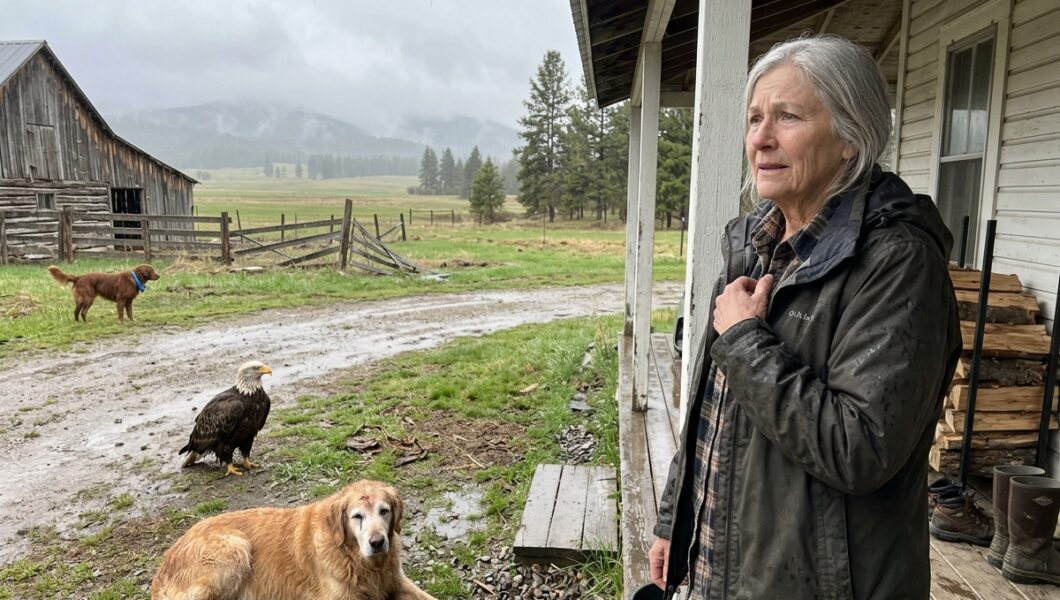
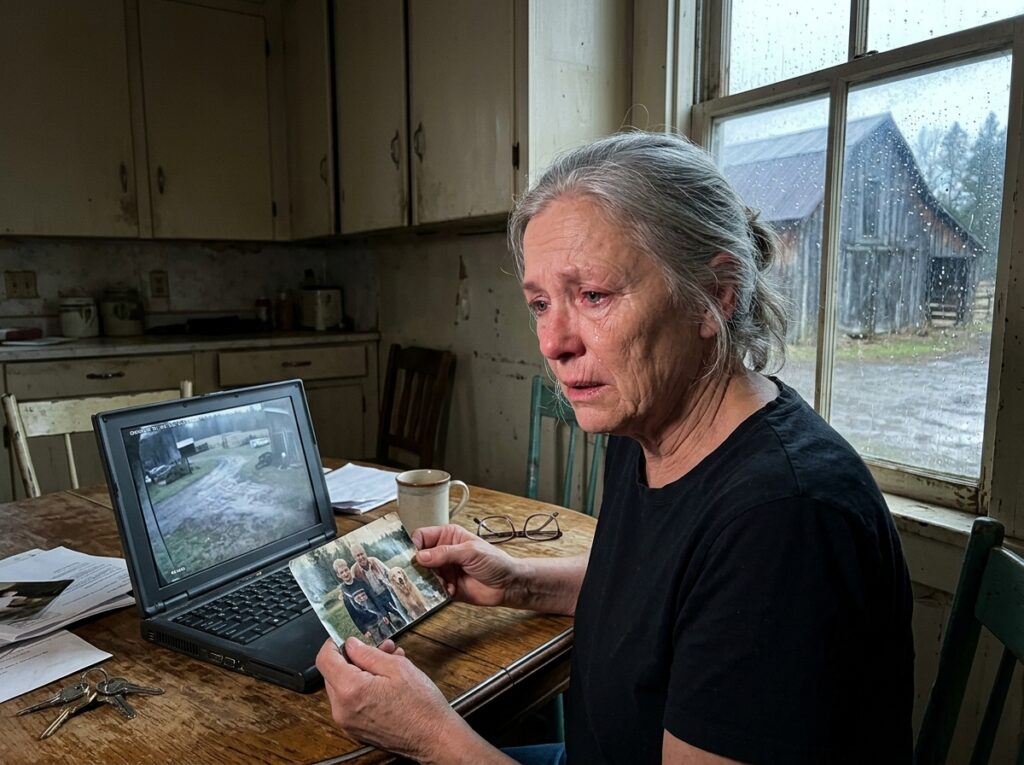
Margaret Wilson sat motionless beside the kitchen window, staring at the photograph on her security camera screen.
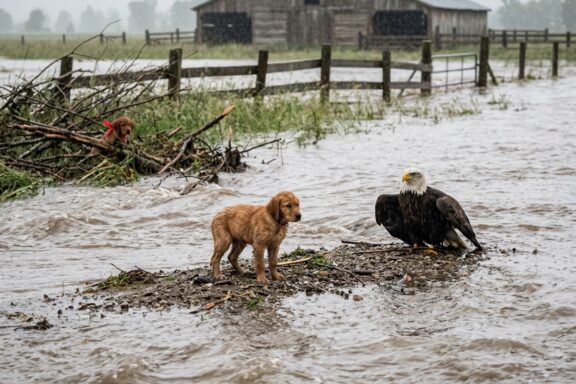
The small golden retriever stood near the damaged fence, rainwater dripping from its dark coat. The blue collar around its neck looked worn, and the silver tag caught a little light whenever the dog moved its head.
But Margaret barely noticed any of that anymore.
She was looking at the photograph.
Even through the grainy footage, she recognized the face.
It belonged to Daniel, the little boy who had once spent nearly every summer at her Montana farmhouse. Daniel had been her grandson, the child who followed her husband, Robert, around the garden and begged to help whenever Charlie’s food bowl needed filling. He used to sit on the porch steps with a book in his lap while the dogs slept beside him.
Then, twenty years earlier, a family disagreement had divided them. Angry words were spoken, phone calls stopped, and the distance between them grew until silence became the only thing left.
Margaret had written letters she never sent. She had kept old photographs in a drawer and occasionally wondered whether Daniel still remembered the farmhouse.
She had not expected to see his face again.
And she certainly had not expected it to arrive in the mouth of a strange dog beside her barn.
Her phone rang.
It was the animal rescue volunteer.
“Margaret, we’ve contacted the local authorities, and someone is on the way to check the property. Please don’t approach the second dog until we know whether it’s injured or frightened.”
Margaret swallowed hard.
“I know who is in that photograph,” she whispered.
“Who?”
“My grandson.”
There was a pause on the line.
“Are you sure?”
“I would recognize that face anywhere.”
The volunteer reminded her to remain indoors while they arranged for the dogs to be located safely. Margaret promised she would wait, although every part of her wanted to walk to the barn and discover where the little dog had come from.
Instead, she returned to the recordings.
She watched the second dog appear behind the barn. She watched it approach the fence, pause beside the eagle, and lift its head toward the camera.
Then she noticed something else.
The dog was limping.
Not severely, but enough that it placed less weight on one of its back legs. Its blue collar looked too loose, and its coat was tangled with grass and mud. It seemed tired, much as Charlie had looked when she first found him.
Margaret wondered whether the two dogs had been traveling together.
Perhaps Charlie had wandered farther than usual and encountered the smaller dog. Perhaps both had become lost in the storm. There were several possible explanations, and the footage could not answer them all.
But the photograph raised another question.
Why would Daniel’s picture be in the dog’s mouth?
At 3:16 that afternoon, a county animal control officer arrived with the rescue volunteer. They parked near the farmhouse and checked the barn and fence line before approaching the area where the second dog had last appeared.
Margaret watched from the porch doorway.
The dog was no longer beside the gate.
After a careful search, the volunteer spotted it beneath a section of the old barn roof, sheltered from the rain. The dog backed away when approached, so the volunteer crouched at a distance and spoke softly.
It took several minutes, but eventually the animal allowed the volunteer to move closer.
The photograph had fallen into the wet grass.
The volunteer picked it up carefully and placed it in a protective sleeve. The animal control officer checked the dog for obvious injuries before arranging transport for a veterinary examination.
Margaret stayed where she was until the volunteer returned.
“It’s a female,” he explained. “She’s thin and exhausted, and she has a small injury on one of her back legs. We’ll have a veterinarian examine her properly.”
“Does she have a name?”
“Nothing on the tag that tells us that. The silver tag has a number, but we’ll need to check whether it’s registered.”
Margaret looked toward the vehicle.
“Can I see her?”
“Once she’s settled and we know more about her condition.”
She nodded, though disappointment tightened her chest.
Then the volunteer handed her the photograph sleeve.
Margaret looked down.
The photograph showed Daniel standing beside Robert in front of the farmhouse. Daniel looked about ten years old, with a crooked smile and one arm wrapped around his grandfather’s waist. Charlie, still a young dog, sat at their feet.
On the back, someone had written a short message in faded blue ink.
For Grandma Margaret. Someday, I’ll bring them all home.
Margaret’s fingers trembled.
She remembered the day the picture had been taken. Daniel had spent the afternoon helping Robert repair the garden fence. Before leaving, he had insisted on taking a photograph with his grandfather and the dog.
But she had never seen that message before.
“Who gave you this?” she whispered, although the photograph could not answer.
The volunteer looked at the picture and then back at her.
“Could your grandson have left the dog here?”
“Possibly,” Margaret replied. “But I don’t know why he would do that without contacting me.”
She looked toward the road.
For twenty years, she had wondered whether Daniel would ever return. Now the evidence seemed to be appearing one piece at a time, yet she still had no way of knowing what it meant.
At the veterinary clinic, the smaller dog was examined and given water and a quiet place to rest. The veterinarian found that she was dehydrated and had a minor wound on her back leg, but there were no immediate signs of a life-threatening injury.
Her collar provided the next clue.
The silver tag carried a registration number associated with an old contact record. The clinic staff began checking the available information, while the animal control officer documented where the dog had been found.
Meanwhile, Margaret called Charlie’s veterinarian to ask how he was doing.
“He’s resting,” the veterinarian assured her. “His leg will need time and careful management, but we’re treating his dehydration and monitoring his pain. We’ll know more as he improves.”
Margaret closed her eyes in relief.
Charlie had been missing for nearly thirty-six hours. She had imagined him lost in the woods, frightened by the storm, or lying somewhere she would never find him.
Now he was safe.
But the second dog still troubled her.
Later that evening, the rescue volunteer called with an update.
“We’ve found a possible contact connected to the tag,” he said. “The information is old, so we’re trying to verify it before making assumptions.”
Margaret held the phone tightly.
“Does it have anything to do with Daniel?”
“We can’t confirm that yet. The photograph is a clue, but it doesn’t prove who brought the dog to your property or when.”
She knew he was right.
Still, she asked him to keep her informed.
After the call, Margaret walked into the small room she used for storage. She opened the drawer where she kept old family photographs, greeting cards, and a few letters from years ago.
She found the picture of Daniel and Robert taken in front of the farmhouse.
The same photograph.
But the one recovered from the barn appeared to be a second copy. Its edges were more worn, and the handwriting on the back was different from what she remembered seeing on family pictures.
Margaret turned it over again.
For Grandma Margaret. Someday, I’ll bring them all home.
She read the words slowly.
Could Daniel have written them when he was a child? Had someone kept the photograph all these years? Or had the message been added later?
She could not be certain.
Then she remembered something else.
When Daniel was young, he had loved dogs almost as much as Robert did. Whenever a stray animal appeared near the farmhouse, Daniel wanted to feed it and give it a name. Robert used to tell him that caring for an animal meant accepting responsibility for its safety, even when it was inconvenient.
Daniel had taken those words seriously.
Perhaps the second dog had found its way to the property because someone knew Margaret would help. Perhaps the photograph had been placed with the dog intentionally. Or perhaps the animal had picked it up from somewhere nearby.
Every explanation was possible.
None was proven.
The next morning, Margaret received a call from an unfamiliar number.
She almost let it go to voicemail.
Then she answered.
“Grandma?”
The voice was older than the one she remembered, deeper and hesitant. But she recognized it immediately.
“Daniel?”
For several seconds, neither of them spoke.
Then he let out a shaky breath.
“I didn’t know how to come back.”
Margaret sat down.
“Where have you been?”
“Not far enough away to forget you,” he said. “But far enough away that I kept telling myself it was too late.”
He explained that he had returned to Montana recently after years of living elsewhere. He had wanted to visit the farmhouse, but the old disagreement still weighed heavily on him. He was afraid she would not want to see him.
He also explained that the smaller dog, whose name was Daisy, had been traveling with him.
Daisy had escaped from his vehicle during the storm after a gate was left unsecured. Daniel had searched for her, but the heavy rain and poor visibility made it difficult to follow her trail. He had eventually found evidence that she had reached the wooded area near Margaret’s property.
He had not known whether Daisy had found shelter near the barn.
The photograph had been tucked into a small bag Daniel carried with him. He believed Daisy might have picked it up when the bag was left open during the search. He could not explain exactly how the photograph ended up in the dog’s mouth, but he suspected it had fallen out near the fence.
As for Charlie, Daniel had no clear explanation for why the older dog had wandered so far from home. He wondered whether Charlie had followed Daisy’s scent or simply become disoriented while searching for shelter.
The bald eagle, he admitted, remained a mystery.
“It may have been investigating Charlie when it found him on the ground,” Daniel said. “I don’t know. I saw your recording, and I was grateful that you didn’t try to approach it.”
Margaret listened quietly.
“Why didn’t you call me when you came back to Montana?”
Daniel hesitated.
“Because I was ashamed of how things ended. I thought you might still be angry. And the longer I waited, the harder it became to explain why I had stayed away.”
Margaret looked at the photograph on the table.
“I was hurt,” she said honestly. “But I never stopped being your grandmother.”
Daniel began to cry.
“I know. I’m sorry.”
She could not erase twenty years of silence in one conversation. There were old wounds that needed time, honest conversations, and a willingness to listen. But for the first time in decades, they were speaking again.
And that was a beginning.
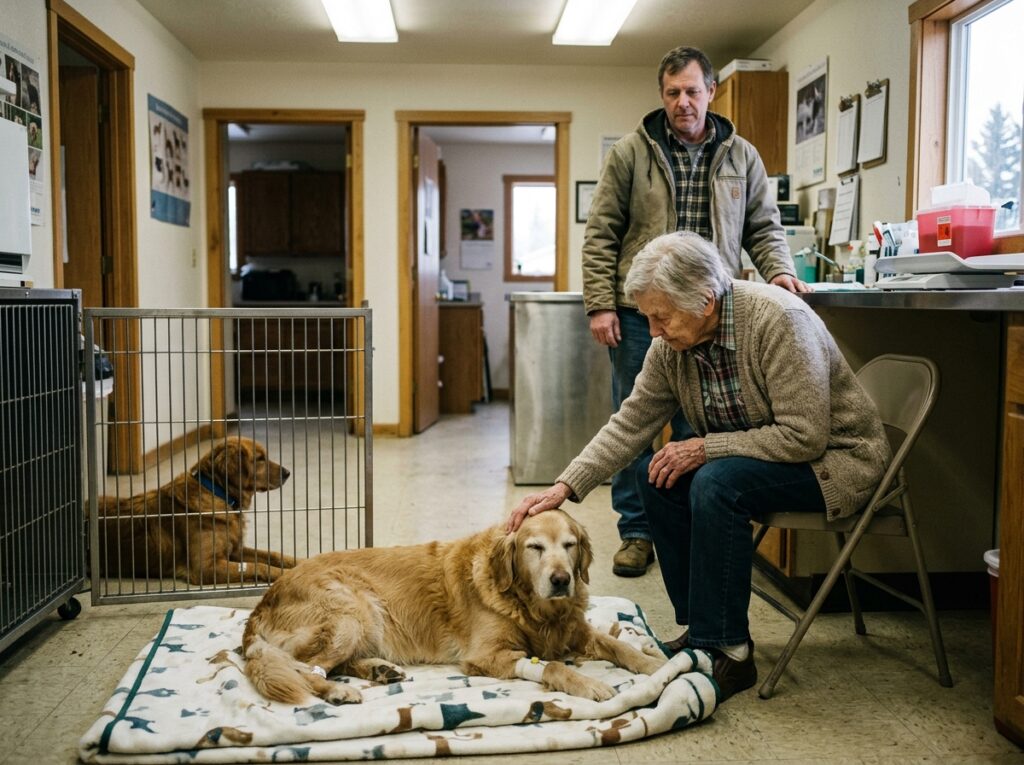
Two days later, Margaret visited the clinic.
Charlie was awake when she entered the room. His tail moved weakly against the blanket, and he lifted his head when he heard her voice.
“Oh, my old boy,” she whispered, kneeling beside him. “You gave me quite a fright.”
Daniel stood quietly near the doorway.
Daisy was recovering in the next room, receiving care for her leg and dehydration. The veterinarian explained that both dogs would need rest and follow-up treatment before returning to normal activity.
Margaret did not rush to forgive everything that had happened between her and Daniel. He did not ask her to.
Instead, they began with small things.
They talked about Robert. They looked through old photographs. Daniel told her about the places he had lived and the work he had done. Margaret told him how the farmhouse had changed and how she had kept Charlie’s old bed beside her rocking chair even after he grew too large to fit comfortably in it.
They spoke about the argument that had separated them, too. There were details each remembered differently, and some feelings were still painful. But neither walked away.
For the first time in twenty years, they were willing to hear each other.
When Charlie was finally allowed to leave the clinic, Margaret brought him home in the back seat of her car. Daniel followed with Daisy, who had been cleared to return with careful monitoring and instructions from the veterinarian.
The two dogs were introduced slowly in a quiet, enclosed area. They sniffed the ground, looked at each other, and eventually settled a short distance apart. No one could know whether they had traveled together during Charlie’s disappearance, but their reunion was calm.
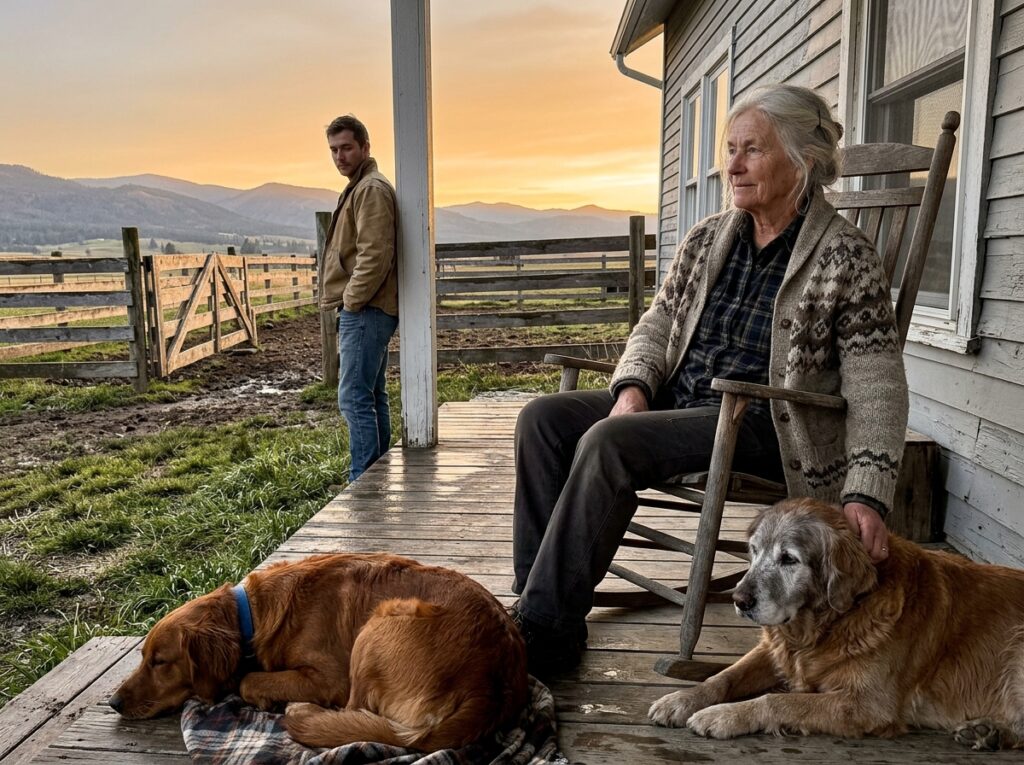
Margaret placed fresh water nearby and spread clean blankets on the porch.
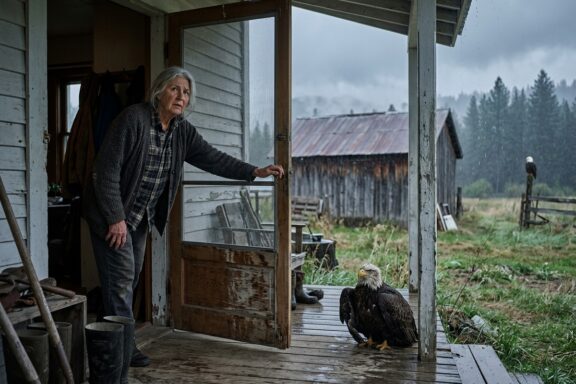
For a moment, she watched Charlie resting beneath the roof where the injured eagle had first appeared on the security footage.
The morning had started with fear, rain, and the sight of her missing companion lying helplessly in the mud. It had led to a rescue, an unfamiliar dog, an old photograph, and a phone call she had never expected to receive.
The eagle’s presence remained unexplained. Wildlife specialists would continue treating the injured bird and assessing whether it could eventually return to the wild. Margaret had learned not to force a meaning onto every strange moment.
Sometimes, the most important thing was simply to notice that someone needed help and respond carefully.
That evening, Daniel helped her repair the damaged fence. They worked slowly, pausing when Charlie needed attention and stopping when the light began to fade.
Before leaving, Daniel stood at the foot of the porch steps.
“Can I come back tomorrow?” he asked.
Margaret looked at him for a long moment.
“Yes,” she said. “You can.”
He nodded, struggling to find the right words.
“I should have come home a long time ago.”
“Perhaps,” Margaret replied gently. “But you’re here now. We can start with that.”
After Daniel left, Margaret checked the porch camera one last time.
Charlie was asleep beneath the window, his breathing slow and steady. Daisy rested nearby, her blue collar visible against her dark golden coat.
Beyond the fence, the trees moved softly in the evening breeze.
Margaret thought about the injured eagle, the mysterious photograph, and the years she had spent believing that some doors could never be opened again.
She had no proof that the eagle had brought Charlie home, or that it had guided Daisy toward the barn. She would never claim to know what had passed through the minds of the wild animals that morning.
But the camera had helped her find Charlie. The second dog had led her to a photograph. And the photograph had brought her grandson back into her life.
Sometimes, a story did not need a miracle to change everything.
Sometimes, it only needed one small reason for someone to make the call they had been afraid to make for twenty years.
That night, Margaret placed the old photograph beside Robert’s picture on the mantel.
For the first time in a long while, the farmhouse felt a little less empty.
And outside, beneath a clearing Montana sky, the old fence stood repaired, the dogs rested safely, and the quiet road stretched into the darkness.
Tomorrow would bring more healing, more conversations, and perhaps a few more answers.
For now, Margaret was grateful for the one thing she had almost lost forever: the chance to welcome her family home.
No Comments