

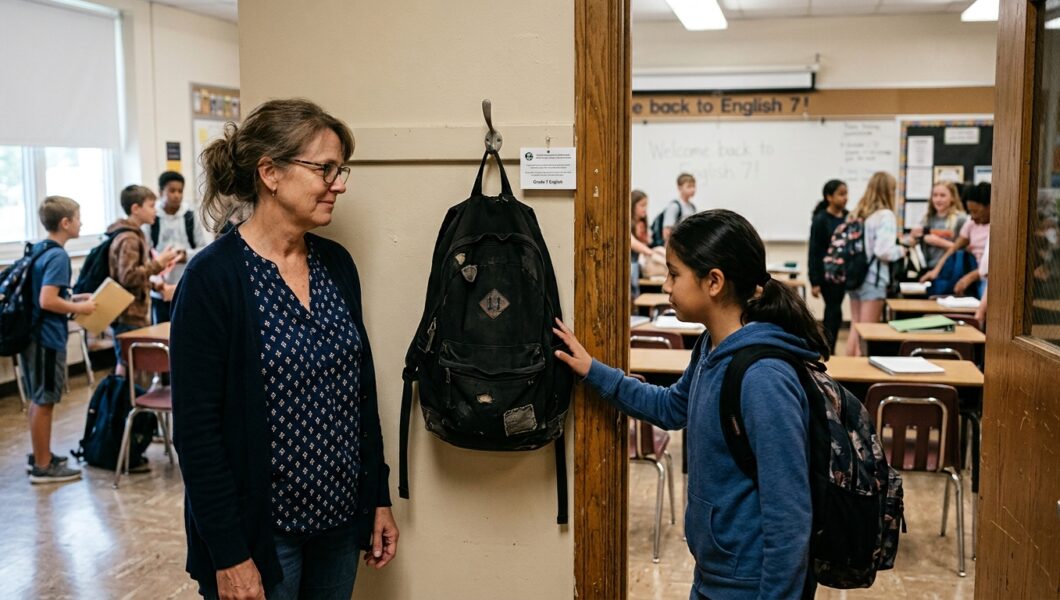
The morning after our emotional-baggage exercise, one desk was empty.
Third row.
Second seat.
Normally, I wouldn’t have panicked.
Middle schoolers miss school.
Dentist appointments.
Stomach bugs.
Overslept alarms.
Parents running late.
But after what thirty anonymous cards had revealed the day before, an empty desk didn’t feel ordinary anymore.
Especially because one of those cards had said:
I don’t want to live anymore but nobody knows because I always smile.
I need to explain something important.
I had not simply gone home after class and hoped everybody felt better.
That would have been irresponsible.
The moment I read a statement indicating that one of my students might be at risk of harming themselves, the activity stopped being only a lesson about empathy.
It became a safety issue.
I followed our school’s procedures.
I contacted the appropriate school counselor and administrators immediately.
We worked through the information we had, which was difficult because the cards had been anonymous.
That was my mistake.
I had wanted students to feel safe enough to be honest.
I hadn’t fully considered what anonymity would mean if a child disclosed an immediate danger.
That realization still bothers me.
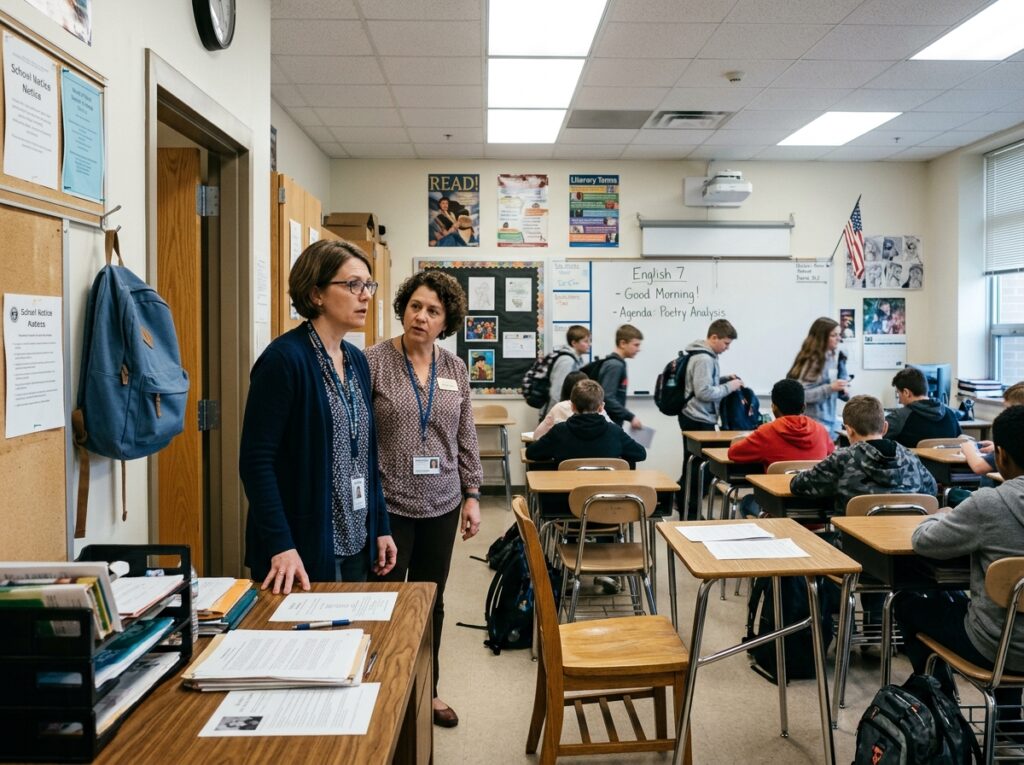
By the next morning, our counselor, Mrs. Alvarez, and I had already agreed that we needed to check in individually with students.
Privately.
Carefully.
Without turning the classroom into an investigation.
Then I saw the empty desk.
I walked into the hallway and found Mrs. Alvarez.
“One’s absent.”
She knew exactly what I meant.
Within minutes, attendance records were checked and the appropriate school staff followed established procedures to make sure the student was accounted for.
I stood in my classroom pretending to organize papers while twenty-nine seventh graders slowly arrived.
The backpack still hung beside the door.
Several touched it.
One boy tapped it twice.
Another girl whispered something to her friend.
Then Mrs. Alvarez came back.
The absent student was safe.
Home sick.
Nothing more sinister than a fever.
I leaned against my desk.
My knees actually weakened.
Mrs. Alvarez looked at me.
“You okay?”
I laughed once.
“No.”
“Good.”
I stared at her.
She smiled gently.
“Means you’re taking this seriously.”
Then she said something I needed to hear.
“We need to change the activity.”
She was right.
The first version had been powerful.
It had also asked children to carry things they weren’t equipped to carry.
I’d had students pull random disclosures from the bag and read them aloud.
At the time, I’d watched empathy spread through the room.
What I understood afterward was that empathy needed boundaries.
A twelve-year-old could care about a classmate without becoming responsible for that classmate’s safety.
A child who had experienced trauma shouldn’t unexpectedly have to read someone else’s description of something that might reopen their own.
And if a student disclosed thoughts of suicide, abuse, danger at home or another urgent concern, that needed trained adult attention—not simply a room full of compassionate seventh graders.
Mrs. Alvarez and I redesigned everything.
The backpack stayed.
But the rules changed.
Students could still write.
They could still put something inside.
But before anything was shared with the class, an appropriate adult reviewed it privately.
Students were told clearly that if they wrote something suggesting they or someone else might be unsafe, we could not promise to keep it secret.
We would get help.
No surprises.
No pretending confidentiality meant silence in an emergency.
And nobody had to read another student’s private disclosure aloud.
Instead, we created a second kind of card.
Those were called:
WHAT I WISH PEOPLE UNDERSTOOD
Students could choose whether those cards were shareable.
The difference seemed small.
It wasn’t.
One asked:
What are you carrying?
The other asked:
What do you want your community to understand?
That gave the students control.
And middle schoolers need more control than adults sometimes realize.
Their bodies are changing.
Families make decisions for them.
Schools tell them where to sit, when to eat, when to speak, when to move.
Giving them the ability to say “this is private” or “this can be shared” mattered.
The next week, we tried again.
I expected resistance.
Instead, one student raised his hand.
“Can we still touch the backpack when we come in?”
I smiled.
“Absolutely.”
So the backpack remained.
But it became quieter.
Less dramatic.
Better.
Students started leaving cards whenever they needed.
Some were serious.
Some weren’t.
My parents are getting divorced and I don’t want my friends asking questions.
I have a test today and I’m pretty sure my brain has resigned.
My grandma is in the hospital.
Someone keeps making fun of my shoes.
I got eight hours of sleep and would like official recognition.
That last one was mine.
They booed.
Good.
We needed laughter too.
Because something else had bothered me about that first day.
Afterward, I kept thinking about how easily adults can turn children’s pain into a beautiful story about empathy.
Look how brave they were.
Look how they opened up.
Look how everyone cried.
But the point couldn’t be the emotional moment.
The point had to be what happened after.
Did the child with the sick sister get support?
Did the student who couldn’t sleep because of fighting at home have a safe adult to talk to?
Did the child who felt invisible become more visible?
Did the student who wrote about not wanting to live receive appropriate help?
Otherwise, we’d simply created one intense classroom hour and congratulated ourselves for caring.
That wasn’t enough.
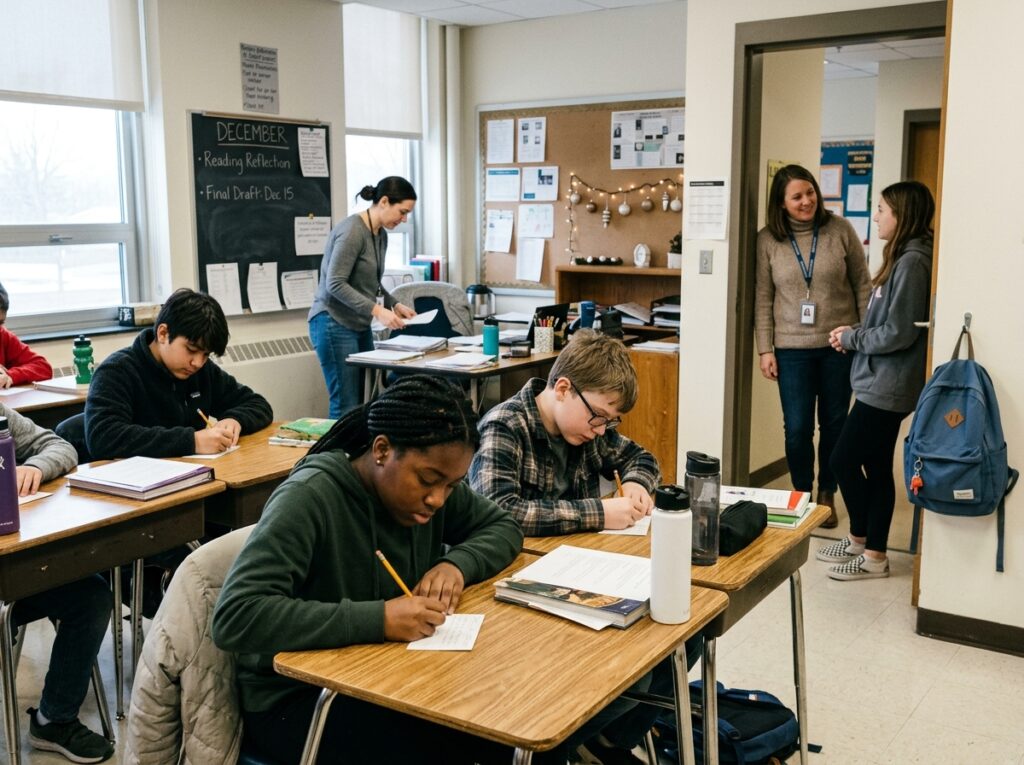
Over the next several weeks, Mrs. Alvarez spent more time in our room.
Not delivering lectures.
Just becoming familiar.
She’d stop by.
Borrow a marker.
Ask about the book we were reading.
Complain jokingly about the copy machine.
The students learned her face before they ever needed her office.
That mattered.
The counselor stopped being “the person you see when something is wrong.”
She became Mrs. Alvarez.
A human being.
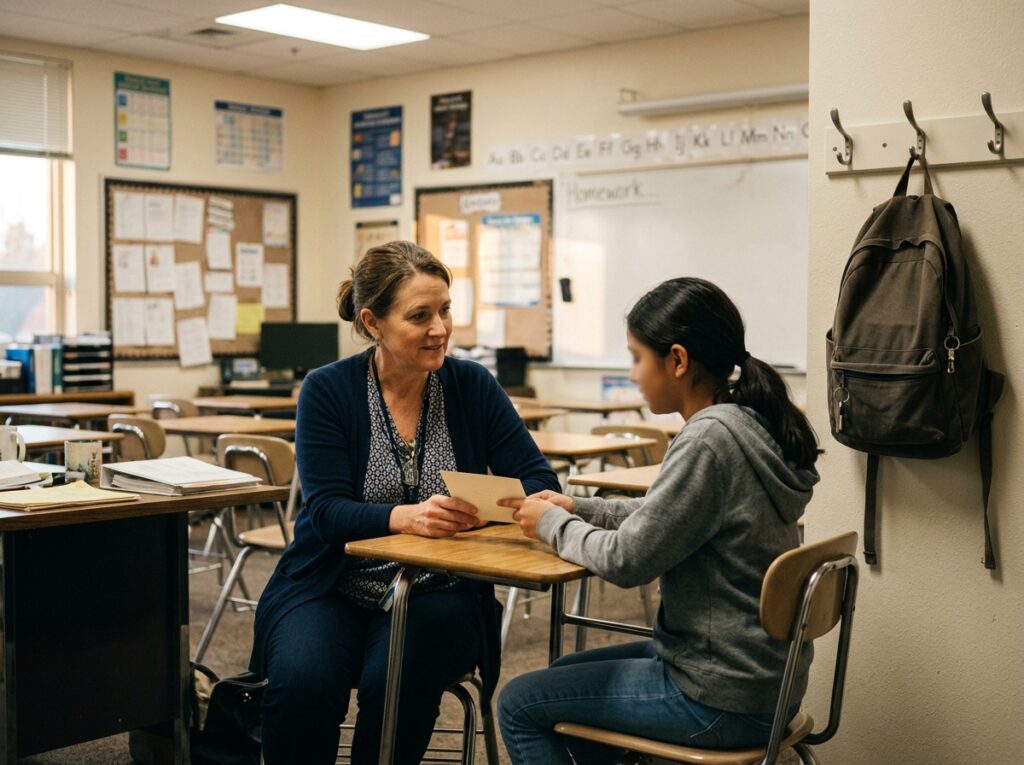
One Tuesday, a student stayed behind.
Everyone else had left.
She stood near the backpack.
“Can I put something in there now?”
“Of course.”
She wrote.
Folded it.
Then didn’t put it inside.
Instead, she handed it directly to me.
“Can you read it?”
I did.
I won’t tell you what it said.
That belongs to her.
What I can say is that she needed more help than I could provide.
I looked at her.
“Thank you for telling me.”
She started crying.
“Am I in trouble?”
“No.”
“Are you going to call my mom?”
I didn’t make promises I couldn’t keep.
I said:
“We’re going to figure out what needs to happen to keep you safe, and I’m going to explain each step as clearly as I can.”
Then we went to Mrs. Alvarez.
Together.
That was when I understood what the backpack had actually become.
Not a place to leave pain.
A doorway.
By October, the class itself had changed.
Not magically.
They were still seventh graders.
They still rolled their eyes.
They still forgot pencils despite apparently owning approximately nine million pencils at home.
Someone still made a fart noise during silent reading.
Two boys got into an argument because one allegedly “looked at the other guy’s Takis weird.”
Human transformation has limits.
But I noticed small things.
A boy who usually ate alone started sitting with two others.
A girl dropped her books in the hallway and three students helped instead of walking around her.
One afternoon, a student came to me and said:
“Can you check on Marcus?”
“Why?”
“He’s acting normal.”
I waited.
The student sighed.
“Too normal.”
That sentence got my attention.
Marcus was okay.
He’d had a rough morning.
Nothing dangerous.
But somebody noticed.
That was what had changed.
They were paying attention.
Not policing each other’s emotions.
Not becoming junior therapists.
Just noticing.
There is a difference.
In November, we had parent conferences.
One father sat across from me.
Big guy.
Work boots.
Hands that looked like he’d spent his life fixing things.
He wasn’t there to talk about grades.
“My daughter talks about the backpack.”
I wasn’t sure whether that was good.
“She does?”
He nodded.
“Started one at home.”
I smiled.
Then he said:
“I thought it was stupid.”
Fair enough.
“She made everybody write something.”
“Oh no.”
He laughed.
“My wife wrote that she’s worried about her mother. My son wrote that he’s scared about making the basketball team.”
“What did you write?”
His expression changed.
He looked toward the classroom door.
Then down at his hands.
“My hours got cut.”
I didn’t say anything.
“Haven’t told the kids.”
He swallowed.
“Been acting like everything’s fine.”
Then he laughed quietly.
“Guess I’m carrying baggage.”
That phrase sounded different coming from a forty-year-old man in work boots.
He told me his daughter had started helping pack lunches without knowing why.
His son had stopped asking for a new pair of shoes.
Not because they’d been told the details.
Because the family had begun paying attention to each other.
Before he left, he touched the backpack.
Just once.
“Don’t tell her I did that.”
“Absolutely telling her.”
He pointed at me.
“You teachers are trouble.”
Probably.
The backpack became part of the classroom.
Not the center.
That’s important.
English class still needed to be English class.
We read novels.
We argued about character motivation.
We wrote terrible first drafts and slightly less terrible second drafts.
We learned commas.
Or attempted to.
I didn’t want my classroom to become a daily therapy session.
I’m a teacher.
Not a therapist.
But learning doesn’t happen in a vacuum.
The kid analyzing a poem is still the kid whose parents fought until two in the morning.
The girl writing an essay is still worried about her sister’s medical appointment.
The boy making jokes in the back row may be doing it because silence feels dangerous.
I couldn’t fix those things.
But I could remember they existed.
Then December arrived.
Holidays.
Decorations.
Concerts.
Excitement.
And grief.
I remembered the anonymous card from August.
I miss my mom. She died on Thanksgiving but everyone acts happy during holidays and I pretend to be too.
We didn’t know who had written it.
We didn’t need to.
Instead of forcing cheerfulness, I put a new prompt beside the backpack:
THE HOLIDAYS CAN FEEL DIFFERENT FOR EVERYONE. WHAT DO YOU NEED THIS WEEK?
Students could answer privately.
Some wanted quiet.
Some wanted snacks.
One requested “no Christmas music before 9 AM.”
Reasonable.
One wrote:
I need people to stop asking why I’m not excited.
That changed how I spoke to the class.
Instead of:
“Everybody excited for break?”
I started saying:
“I hope break gives you some of what you need.”
Small change.
But small changes were becoming the whole point.
In January, the backpack broke.
The zipper had been failing for weeks.
Then one morning, a student pulled it open and the entire zipper track separated.
He looked horrified.
“Mrs. Carter.”
“Yes?”
“I killed therapy.”
The class exploded laughing.
I did too.
“It’s a backpack, Tyler.”
“It represented our emotional stability.”
“That explains why it broke.”
More laughter.
I thought I’d replace it.
The students objected.
Apparently this specific cheap black backpack had become sacred.
So Tyler’s grandmother repaired it.
She reinforced the zipper.
Patched one corner.
Added a small piece of fabric inside.
When it came back, Tyler handed it to me like he was returning a museum artifact.
His grandmother had sewn a tiny sentence into the lining.
You couldn’t see it unless you opened the bag.
It said:
HEAVY DOESN’T MEAN HOPELESS.
I stared at it.
“Your grandmother wrote this?”
“Yeah.”
“Why?”
Tyler shrugged.
“She said adults have baggage too.”
Smart woman.
By spring, the students didn’t use the backpack as much.
At first, I worried that meant the idea had failed.
Mrs. Alvarez saw it differently.
“Maybe some of them have learned other ways to ask.”
She was right.
They came directly to us more often.
They checked on each other.
They used words they’d previously hidden behind sarcasm.
“I’m overwhelmed.”
“I need a minute.”
“Can I talk to you privately?”
“I don’t know what’s wrong, but something is.”
Those aren’t impressive sentences.
Unless you’re twelve.
Then they can be enormous.
On the last day of school, I took the backpack down.
The students noticed immediately.
“What are you doing?”
“Cleaning.”
“Put it back.”
“You’re leaving in twenty minutes.”
“Doesn’t matter.”
So I hung it back up.
Before the final bell, I gave everyone one last card.
This time the prompt wasn’t about what felt heavy.
It said:
WHAT WOULD YOU TELL THE PERSON YOU WERE ON THE FIRST DAY OF SCHOOL?
Those cards were theirs.
Nobody collected them.
Nobody read them aloud.
I watched students write.
Some laughed.
Some stared for a long time.
One boy wrote three words and folded his card immediately.
A girl filled both sides.
When the bell rang, they started leaving.
And just like they had on that first emotional day in August, several touched the backpack.
Tap.
Pat.
Fingers across the fabric.
Tyler saluted it.
Middle school.
Then one student stayed behind.
I recognized her as one of the quietest students in the class.
She waited until everyone left.
“Mrs. Carter?”
“Yes?”
“Do you remember the first day with the cards?”
“Of course.”
“Do you remember the one that said somebody didn’t want to live anymore?”
Every part of me became still.
“Yes.”
She looked at the floor.
“That was mine.”
I didn’t speak.
She looked up.
“I’m okay.”
Then she corrected herself.
“Not always okay.”
That was a better answer.
She told me she’d gotten help.
Her family knew.
She had ongoing professional support.
There had been difficult months.
There still were difficult days.
But she had people she could tell now.
Then she said:
“I was mad at you.”
That surprised me.
“Why?”
“Because after I wrote it, adults started talking about getting help.”
She gave a tiny smile.
“I thought you’d ruined everything.”
I understood.
“And now?”
“Now I’m glad somebody ruined it.”
I laughed.
Then cried.
So did she.
I didn’t ask to hug her.
She hugged me.
Briefly.
Then stepped away.
Before leaving, she touched the backpack.
“You should do it again next year.”
I shook my head.
“Not exactly the same way.”
“Why?”
“Because teachers are supposed to learn too.”
She smiled.
“Good.”
Then she walked out.
I sat alone for a long time.
That summer, I redesigned the activity again.
The next group would never be asked to publicly read anonymous disclosures.
The safety expectations would be explained before anyone wrote.
Our counselor would be involved from the beginning.
Students would always know which things could remain private and which things adults had to act on to keep them safe.
Because emotional honesty without a safety plan isn’t enough.
Good intentions aren’t enough either.
That may be the biggest thing eighteen years of teaching has taught me.
Caring about children means being willing to learn when the way you tried to care for them needs improving.
The following August, year nineteen began.
New students.
New seating chart.
New nervous faces pretending not to be nervous.
The repaired backpack hung beside the door.
One student pointed.
“What’s that?”
I smiled.
“We’ll talk about it later.”
Inside the lining, Tyler’s grandmother’s words were still there.
HEAVY DOESN’T MEAN HOPELESS.
But beside the backpack was something new.
A small card listing the trusted adults students could talk to at school and explaining how to ask for immediate help.
Because the backpack was never supposed to carry what adults needed to carry.
It was only supposed to help us notice.
That’s what I understand now.
Teachers don’t need to know every private detail of a child’s life.
We don’t need to turn pain into a classroom lesson.
We don’t need to fix what we’re not trained to fix.
But we do need to notice.
Notice the student whose jokes suddenly stop.
Notice the one whose jokes never stop.
Notice the child falling asleep.
The kid eating alone.
The student who suddenly stops turning in work.
The one who says they’re fine too quickly.
And when something is bigger than us, we don’t become heroes.
We bring in help.
We stay steady.
We follow through.
We keep teaching.
A year after that first experiment, I still believe in the backpack.
Just differently.
I once thought the lesson was:
Everyone is carrying something.
Now I think that’s only half of it.
The other half is:
You shouldn’t have to hand that something to another child and hope they know what to do with it.
Sometimes it belongs with a parent.
A counselor.
A doctor.
A social worker.
A trusted adult.
Someone trained to help carry what has become too heavy.
The backpack still hangs beside my classroom door.
Most days nobody touches it.
Some days somebody does.
And occasionally, after the room empties, I find a folded card inside.
I read it.
I decide what belongs with me.
What needs another adult.
What requires immediate action.
And what simply needs a quiet:
“I hear you.”
Eighteen years into teaching, I used to think experience meant knowing what to do.
I don’t anymore.
Experience means knowing when you don’t know enough to do it alone.
My students taught me that.
Thirty slips of paper.
One cheap backpack.
And a room full of twelve-year-olds carrying things no grade book could ever measure.
I still teach English.
Nouns.
Essays.
Novels.
Commas.
But before any of that can matter, the child sitting in front of me has to know something simpler.
If the weight becomes too much, there are adults here who will listen.
And if what you’re carrying isn’t safe to carry alone, we will help you find someone qualified to carry it with you.
Not because you’re weak.
Not because you’re in trouble.
Because you matter enough for us to take you seriously.

No Comments