

Six months after Samuel’s books found their way into Hannah’s school library, one of them disappeared.
Not checked out.
Not misplaced.
Gone.
Mrs. Patel noticed on a Monday morning.
It was a hardcover book about North American mammals.
Nothing rare.
Nothing valuable.
The cover was scratched.
Someone had taped the spine years earlier.
It was exactly the kind of used book Samuel liked collecting.
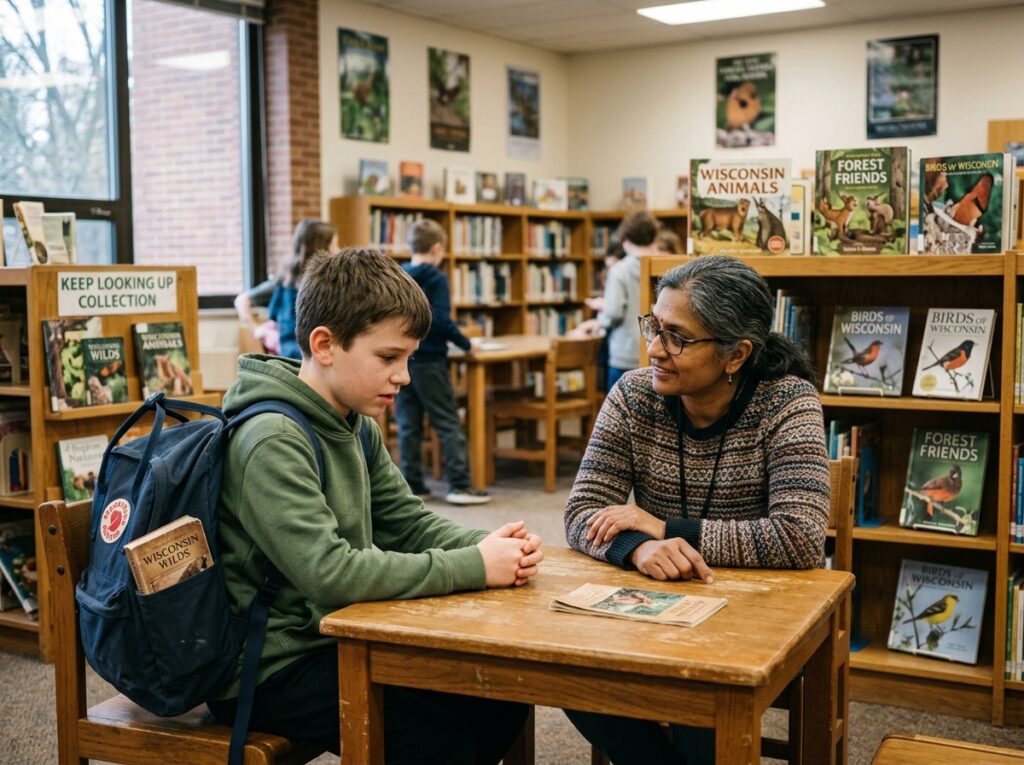
The “Keep Looking Up Shelf” had grown by then.
What began with Samuel’s eighty-four books had become nearly two hundred.
Some were regular library books that stayed at school.
Others were on the small take-home shelf Mrs. Patel had created after Samuel’s story spread through the community.
Those books worked differently.
A child could take one.
No library card.
No due date.
No questions.
If it came back, good.
If it didn’t, that was okay too.
That was the whole point.
But the missing mammal book wasn’t from that section.
It belonged to the permanent collection.
Mrs. Patel mentioned it to Hannah almost casually.
“Probably got put on the wrong shelf.”
Hannah was thirteen by then.
Still incapable of leaving anything alone.
She checked.
Not there.
She searched the reading corner.
Classrooms.
Book-return cart.
Nothing.
Three days later, another book disappeared.
This one was about Wisconsin birds.
Then a third.
Hannah came home concerned.
“Someone’s stealing Samuel’s books.”
I was making dinner.
“They’re school books, Hannah.”
“You know what I mean.”
“Maybe somebody forgot to check them out.”
“Three times?”
I shrugged.
“Kids forget things.”
She didn’t like that answer.
The following week, Mrs. Patel found out what was happening.
A fifth-grade boy named Eli had one of the books in his backpack.
She noticed it when he opened the bag looking for a pencil.
Eli froze.
Mrs. Patel recognized the book immediately.
She could have sent him to the principal.
Instead, she asked:
“Is that from our nature shelf?”
Eli stared at the floor.
“Yes.”
“Did you check it out?”
“No.”
“Why not?”
Silence.
Then:
“I was going to bring it back.”
Mrs. Patel pulled out a chair.
“Okay.”
That one word changed the conversation.
Not:
Why did you steal?
Not:
You know better.
Okay.
Eli sat.
He was eleven.
Small for his age.
Quiet.
He wasn’t a troublemaker.
He wasn’t especially noticeable either.
The kind of child who finished enough work to avoid attention and spoke only when teachers called on him.
Mrs. Patel asked again:
“Why didn’t you check it out?”
Eli rubbed his thumb along the book’s damaged corner.
Then he said:
“My mom doesn’t want me bringing library books home.”
“Why?”
Another long silence.
“Because we move a lot.”
That was the beginning.
Eli and his mother had moved four times in three years.
Apartments.
A relative’s basement.
A motel for several weeks.
Another apartment.
His mother worked two jobs.
Sometimes bills caught up.
Sometimes they didn’t.
Eli had learned not to collect things.
Possessions became problems when everything had to fit into bags or the back of a car.
But he loved animals.
That was why he’d started visiting Samuel’s shelf.
At first, he read during lunch.
Then he began hiding books in his backpack.
Not to keep forever.
Just overnight.
He read them in bed.
Then returned them before school.
Usually.
The first missing book had stayed home because his mother worked late and Eli fell asleep reading it.
The second stayed because they’d unexpectedly spent two nights at his aunt’s apartment.
The third was still underneath his pillow.
Mrs. Patel listened.
Then she asked:
“Why didn’t you just take one from the free shelf?”
Eli shrugged.
“They’re not the same.”
“How?”
He looked toward Samuel’s collection.
“Those have better pictures.”
That made her smile.
Then Eli said:
“I didn’t want to get in trouble if something happened to one.”
There it was.
The exact problem the shelf had supposedly been created to solve.
We had made books available without questions.
But a child who was used to losing addresses, rooms and possessions still believed borrowing something meant accepting a risk he couldn’t afford.
Mrs. Patel didn’t lecture him.
She didn’t make him confess to his class.
She didn’t call it stealing.
She made a new rule.
Not just for Eli.
For everybody.
Any book on the Keep Looking Up shelves could be taken home.
If it returned, wonderful.
If it didn’t, nobody would chase a child for it.
Some books would still need normal library procedures, of course.
But donated copies were marked differently.
A small green sticker inside the cover meant:
READ ME. RETURN ME IF YOU CAN. PASS ME ON IF YOU CAN’T.
When Hannah told Margaret, she expected her to be upset about Samuel’s books possibly disappearing.
Margaret wasn’t.
She was eighty-two then.
Her hearing wasn’t as good.
Her patience for unnecessary rules was even worse.
She said:
“Samuel almost couldn’t take his first book because there wasn’t room in a trailer.”
Then she looked at Hannah.
“You think he’d care about inventory?”
Fair point.
The next morning, Margaret came to school.
She asked to meet Eli.
Mrs. Patel checked with his mother first.
Then Eli agreed.
Margaret brought crackers.
Of course she did.
She sat beside him in the library.
“So you’re the criminal mastermind.”
Eli looked terrified.
Hannah nearly fell out of her chair.
Margaret smiled.
“I’m joking.”
Eli relaxed a little.
She told him about Samuel.
Not the polished version.
She told him about the muddy shoes.
The brown jacket.
The missing lunches.
The eleven checkouts of the eagle book.
Then she told him how Samuel had tried to return that book because there wasn’t room to take it when he moved.
Eli listened carefully.
“He moved a lot too?”
“At least for a while.”
“Did he lose books?”
“I imagine he lost all sorts of things.”
“Did he give this one back?”
Margaret looked toward the old eagle guide.
“Eventually.”
“How long?”
“Forty-nine years.”
Eli’s eyes widened.
“So I have time?”
Margaret laughed.
“Plenty.”
That was the first time I met Eli.
Hannah introduced us at a school open house a few weeks later.
He didn’t say much.
He was holding a book about wolves.
I asked:
“Good one?”
He nodded.
“Third time.”
“You’ve read it three times?”
“Almost.”
Then he added:
“Wolves aren’t as dangerous as people think.”
That sounded exactly like the kind of fact Samuel would’ve enjoyed.
By summer, the Keep Looking Up Shelf had changed again.
Parents started donating duplicate field guides.
A local nature center sent children’s books they no longer needed.
A used bookstore offered a box every few months.
Someone built a second shelf.
Then another.
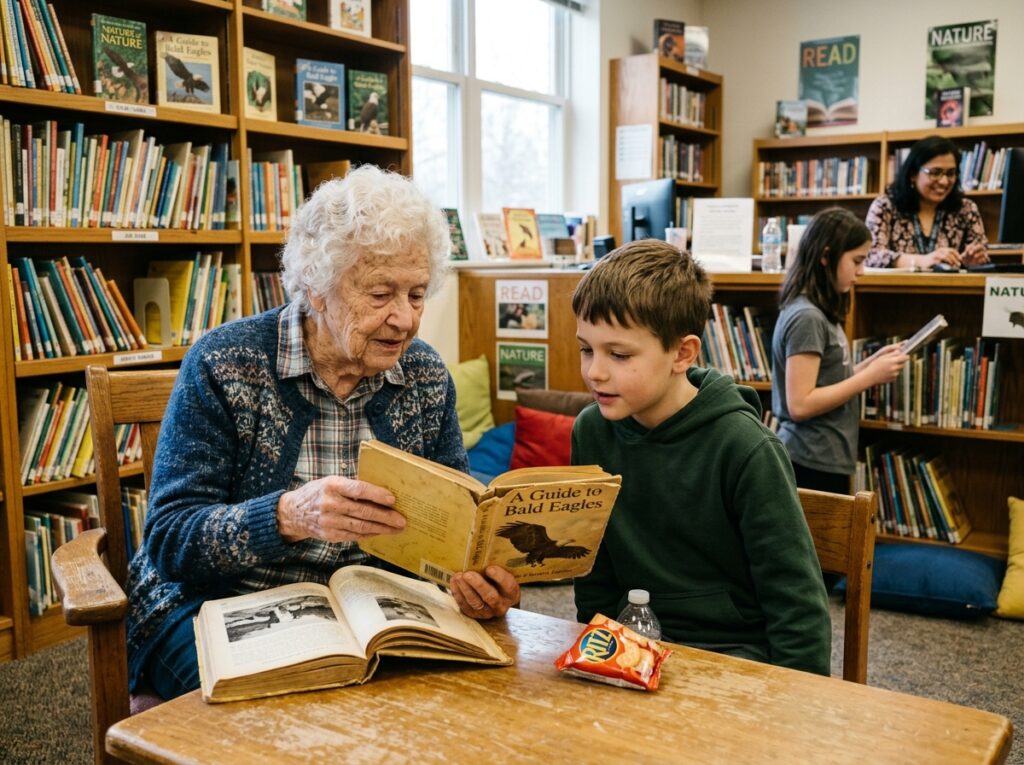
But Mrs. Patel kept Samuel’s original eagle guide separate.
Not locked away.
Just protected in a clear library cover.
Children could read it at school.
They could turn the same pages Samuel had turned.
They could see Margaret’s faded inscription.
Keep looking up.
The book became worn in new places.
Margaret loved that.
“Means somebody’s reading it.”
One afternoon in September, I stopped at the school to pick up Hannah.
She wasn’t ready.
No surprise.
While I waited, I noticed Eli sitting at a library table.
He was drawing.
Beside him was the eagle guide.
I walked over.
“What are you working on?”
He turned the paper.
A bald eagle.
Not bad.
Actually, surprisingly good.
“You draw a lot?”
He shrugged.
“Sometimes.”
Mrs. Patel heard us.
“He draws constantly.”
Eli looked embarrassed.
She ignored him.
“He’s making identification cards for younger students.”
Eli had noticed that some first and second graders couldn’t easily use the larger bird guides.
So he started drawing common birds on index cards.
Robin.
Cardinal.
Blue jay.
Canada goose.
Bald eagle.
Simple facts on the back.
He had made thirty-seven.
Nobody assigned it.
Nobody graded it.
He just did it.
Margaret found out.
She asked to see them.
Eli brought the cards to her house one Saturday with his mother.
Margaret looked through every one.
When she reached the bald eagle, she stopped.
“You know Samuel would’ve loved these.”
Eli asked:
“Do you think they’re good enough for the library?”
Margaret frowned.
“That’s the wrong question.”
“What?”
“Are they useful?”
“I think so.”
“Then they’re good enough.”
The school laminated them.
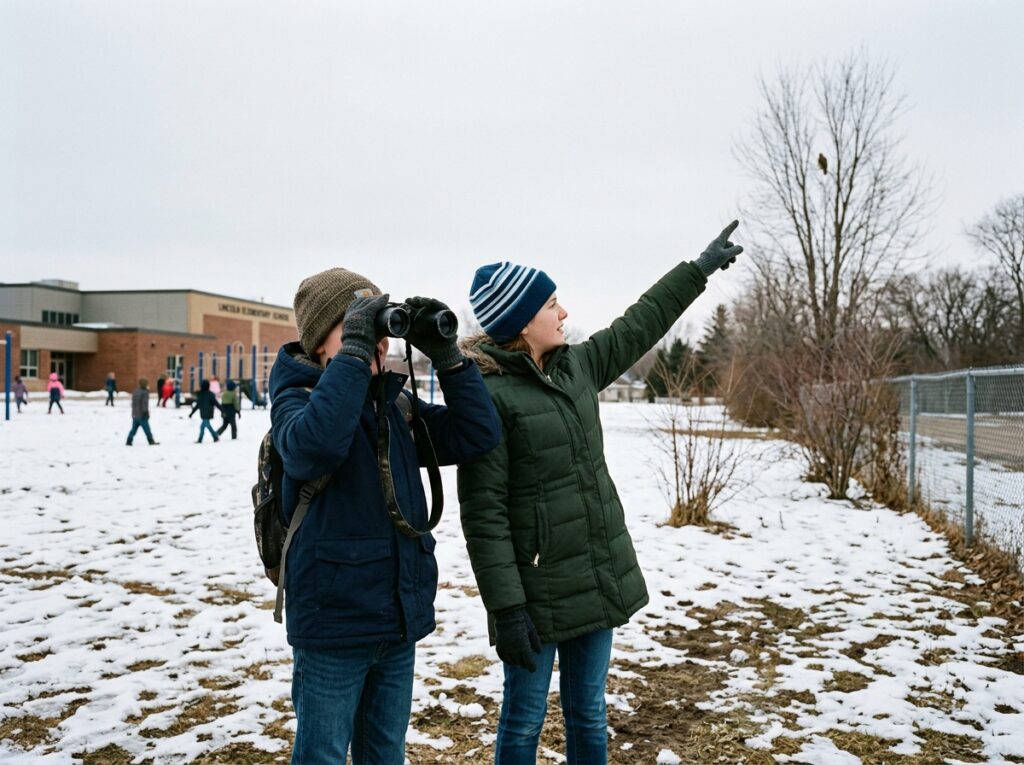
Kids started taking them outside during recess.
That winter, Eli started a bird list.
Not because anyone suggested it.
He found an empty notebook on the free shelf.
On the first page he wrote:
BIRDS I ACTUALLY SAW
Hannah loved the title.
His first entries were ordinary.
Crow.
Crow.
More crows.
Pigeon.
Canada goose.
Cardinal.
“Bird watching is mostly seeing the same birds repeatedly,” I told him.
He looked disappointed.
Then one February afternoon, he saw a red-tailed hawk above the playground.
You would’ve thought he’d discovered a new species.
He ran into the library after recess.
“Hawk!”
Mrs. Patel looked up.
“Inside voice.”
“HAWK!”
“Still not inside voice.”
That story reached Margaret.
She laughed so hard she started coughing.
For her birthday, Hannah bought Eli a used pair of binoculars at a thrift store.
Ten dollars.
One lens cap missing.
Scratch on the body.
Perfectly usable.
Eli refused them.
“I can’t.”
Hannah stared at him.
“Why?”
“They cost money.”
“Yes. That’s generally how stores work.”
“I can’t pay you.”
Hannah’s face changed.
She understood.
So she said:
“They’re not a loan.”
Eli still hesitated.
Then Hannah pointed toward Samuel’s eagle guide.
“Do you know how much Mrs. Ellis paid for that?”
Eli nodded.
“A dollar twenty-five.”
“And how long did Samuel keep it?”
“Forty-nine years.”
“Exactly. So you’ve got a while to figure out what to do with ten dollars.”
Eli took the binoculars.
Margaret would’ve been proud of that argument.
Then Margaret’s health began declining.
Slowly.
She had heart problems.
Nothing immediately catastrophic.
But she stopped driving.
Then stopped visiting the school as often.
Hannah and I started visiting her instead.
Sometimes Eli came with his mother.
He brought bird cards.
Margaret brought crackers.
Their friendship made absolutely no sense on paper.
An eighty-three-year-old retired teacher.
A twelve-year-old boy.
But books had introduced them.
That was enough.
One afternoon, Eli asked Margaret:
“Do you think Samuel knew you kept all his postcards?”
Margaret looked toward the box where she stored them.
“I told him once.”
“What did he say?”
“He said I was sentimental.”
“Are you?”
“Terribly.”
Then Eli asked:
“Do you miss him?”
Margaret thought.
“Yes.”
“But you hadn’t seen him since he was ten.”
“No.”
“Then how?”
It was a good question.
Margaret answered carefully.
“I miss knowing he was somewhere.”
Eli became quiet.
That sentence stayed with me too.
There are people we haven’t seen in decades who still occupy a small place in the world for us.
A childhood friend.
A former student.
A neighbor.
Someone whose Christmas card comes every few years.
We don’t need them nearby.
We just like knowing they’re out there.
Then one day they’re not.
The world becomes slightly smaller.
Margaret died the following spring.
Eighty-four.
Peacefully.
Hannah cried for days.
So did Eli.
At the funeral, Margaret’s family displayed photographs from her thirty-seven years of teaching.
Class pictures.
School plays.
Field trips.
Margaret at twenty-five.
Forty.
Sixty.
Always surrounded by children.
Near the guest book was one small photograph.
Margaret sitting on the abandoned school steps eating crackers with Hannah and me.
The cottonwoods behind her were yellow.
There was no eagle in the picture.
I’m glad.
That morning had never really been about the eagle.
It had simply made Hannah look.
After the funeral, Margaret’s daughter found an envelope marked:
FOR THE SCHOOL LIBRARY
Inside was a check.
Not huge.
Enough to buy books.
There was also a note in Margaret’s handwriting:
Please don’t buy eighty-four copies of anything boring. Let the children choose.
Mrs. Patel followed instructions.
Every class got to suggest titles.
Graphic novels.
Nature books.
Funny books.
Mysteries.
Books about dinosaurs.
One child requested “something about sharks where nobody gets eaten.”
They did their best.
But there was another envelope.
This one said:
ELI
His mother brought him to the library when he opened it.
Inside was Margaret’s old copy of Samuel’s Alaska postcard.
Not the original.
She had kept that with her family.
A copy.
On the back, Margaret had written:
Samuel kept looking up. So did I. Your turn.
Eli cried.
Quietly.
The way Samuel once had.
Then he placed the postcard inside his bird notebook.
He didn’t say anything profound.
He was twelve.
He just said:
“I wish she could’ve seen my eagle.”
Nobody understood.
“What eagle?”
He opened the notebook.
Two mornings before Margaret died, Eli had been waiting for the school bus.
A bald eagle crossed above a nearby field.
His first wild bald eagle.
He had written:
April 7. 7:02 AM. Bald eagle. Finally.
He’d planned to tell Margaret that weekend.
He never got the chance.
Hannah put her arm around him.
For a while, they just stood there.
There was no lesson that could make that fair.
Sometimes timing is cruel.
Sometimes the person you most want to tell is gone before you can tell them.
Mrs. Patel finally said:
“She would’ve been thrilled.”
Eli nodded.
“I know.”
That mattered.
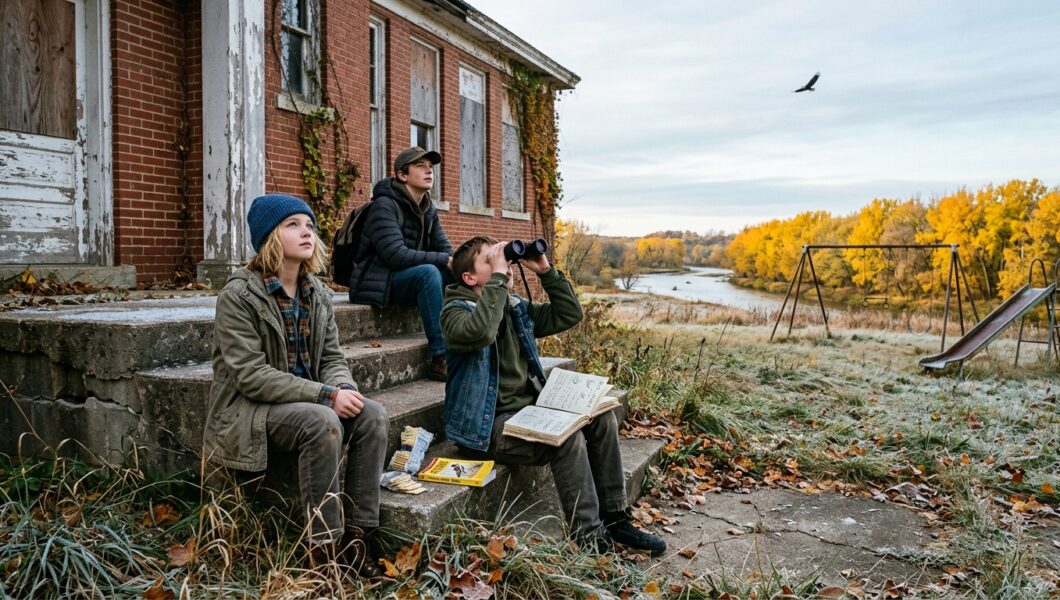
The following October, Hannah and I returned to the old Miller Creek School.
We still did that sometimes.
The building hadn’t changed much.
Faded brick.
Locked doors.
Frost on the grass.
Cottonwoods turning yellow.
I brought coffee.
Hannah brought crackers.
“Why do we keep bringing these?”
“Tradition.”
“Margaret would say they’re stale.”
“She probably would.”
We sat on the steps.
Then a car pulled up.
Eli and his mother got out.
He had his binoculars.
We hadn’t planned it.
Apparently Hannah had.
She smiled innocently.
Traitor.
Eli sat beside us.
For a while, we watched the river.
A crow crossed.
Then another.
Eli identified a woodpecker by its call.
I pretended to understand.
At 8:23, he lifted the binoculars.
“Eagle.”
Hannah looked.
I found it a few seconds later.
An adult bald eagle was moving high above the cottonwoods toward the river.
Far away.
Wild.
Completely unaware that three people on some abandoned school steps cared that it existed.
We watched.
Nobody said Samuel.
Nobody said Margaret.
Nobody called it a sign.
Eli simply smiled.
Then he opened his notebook.
October 16. Frost. Miller Creek School. One eagle.
He stopped.
Then added:
Hannah saw it too. Daniel was slow.
“Hey.”
Hannah laughed.
Margaret would’ve loved that.
A year later, Eli’s family moved again.
Different town.
Different school district.
Before leaving, he came to the library.
He returned every book he had.
Except one.
Mrs. Patel noticed.
“The wolf book?”
Eli nodded.
“I’ve read it six times.”
“You know you can keep it.”
“I know.”
“Then why do you look guilty?”
He smiled.
“Old habit.”
He took the wolf book.
His binoculars.
His bird notebook.
Margaret’s postcard.
Before leaving, he placed something on the Keep Looking Up Shelf.
A stack of forty laminated bird cards.
His drawings.
New copies.
On top was a note:
FOR KIDS WHO DON’T KNOW WHERE TO START.
No last name.
No big goodbye.
Then he left.
Months later, Mrs. Patel received an envelope.
Inside was a postcard.
On the front was a bald eagle.
For a moment, nobody in the library said anything.
Then she turned it over.
The message said:
New school.
Lots of crows.
One hawk.
No eagle yet.
Still looking.
— Eli
Mrs. Patel made a copy.
She put it beside Samuel’s Alaska postcard.
Two children.
Separated by nearly fifty years.
Both moved away.
Both carried books.
Both looked up.
But she didn’t make a memorial display.
She placed the copies near the bird guides where children could find them naturally.
The Keep Looking Up Shelf is still there.
Books still disappear.
Some return.
Some don’t.
Nobody panics anymore.
That’s the point.
A book isn’t doing much good if protecting it becomes more important than letting a child read it.
Samuel taught us that without trying.
Margaret understood it.
Eli proved it.
And Hannah?
She’s older now.
She doesn’t need me driving her to school.
Sometimes I miss those mornings more than I expected.
Even the late ones.
Especially the late ones.
Because if we hadn’t been late at 8:16 on one frosty October morning, maybe I would’ve driven past an elderly woman standing beside two cardboard boxes.
Maybe Hannah wouldn’t have noticed.
Maybe someone else would have.
I like to think so.
Kindness doesn’t depend entirely on one person.
But sometimes it does depend on somebody slowing down.
That’s the part I remember.
Slow down.
Look.
Ask.
There are people carrying boxes beside locked doors.
Children taking books home because they don’t know where they’ll live next month.
Old teachers still trying to keep promises made to ten-year-olds.
People holding things that need somewhere else to go.
You won’t solve their lives.
Margaret didn’t solve Samuel’s.
Hannah didn’t solve Eli’s.
A book doesn’t solve poverty.
Crackers don’t fix a family.
Binoculars don’t guarantee a future.
But small things can give someone room.
Room to become interested.
Room to feel noticed.
Room to imagine themselves somewhere beyond whatever is difficult today.
Samuel used that room.
Then he made more of it for other children.
Margaret kept the door open.
Eli walked through.
And someday, perhaps, some child will take one of Eli’s bird cards outside, look toward a tree, and notice something they would’ve missed.
They may never know Samuel’s name.
They may never know Margaret’s.
That’s okay.
Kindness doesn’t need its entire family tree attached.
It only needs somewhere to go next.
A used book.
A packet of crackers.
A scratched pair of binoculars.
A teacher who notices.
A child who asks her father to slow down.
Forty-nine years later, Samuel’s promise didn’t really end when his eagle book came home.
It simply changed hands.
And somewhere out there, Eli is still looking up.



No Comments