

About a year after that afternoon at the river, I got a text from Claire.
It was only one sentence.
You need to come see what Ethan did.
No explanation.
No warning.
Just that.
By then, Ethan was fourteen.
He was spending less time in the hospital and more time doing the normal things he had once missed so badly.
School.
Homework.
Arguments about screen time.
Complaining about early mornings.
Pretending he was too old for the things he had loved at eleven while still keeping half of them in a drawer.
His treatment schedule had changed.
There were still appointments.
Still blood work.
Still days when Claire’s voice sounded tired over the phone.
But the hospital no longer felt like his entire life.
That mattered.
I drove over that Saturday morning.
The children’s floor looked almost exactly the way I remembered.
Same humming lights.
Same polished floors.
Same smell of disinfectant and breakfast trays.
But the nature board had grown.
What had once been a simple sheet asking:
WHAT DID YOU SEE OUTSIDE TODAY?
had become an entire wall.
There were photographs.
Drawings.
Bird lists.
Leaves taped to construction paper.
Cloud descriptions.
A child’s drawing of three squirrels apparently committing a bank robbery.
Someone had written beneath it:
UNCONFIRMED.
I laughed.
“Ethan?”
Claire smiled.
“His influence.”
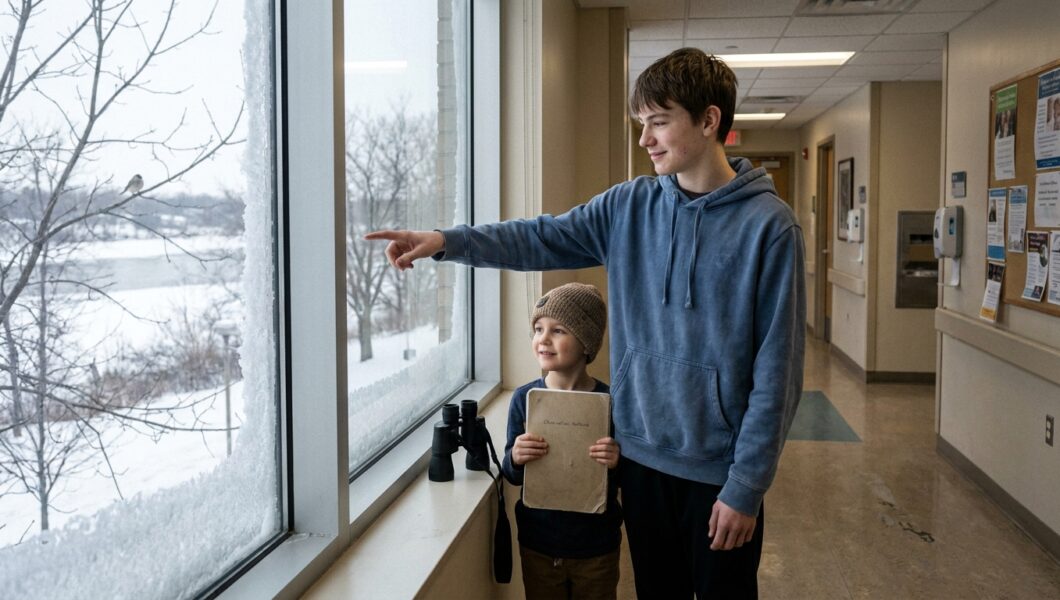
Then I saw him.
He was standing beside a small table in the common area.
Taller.
Much taller.
Hair falling into his eyes.
Blue hoodie again, though this one actually fit.
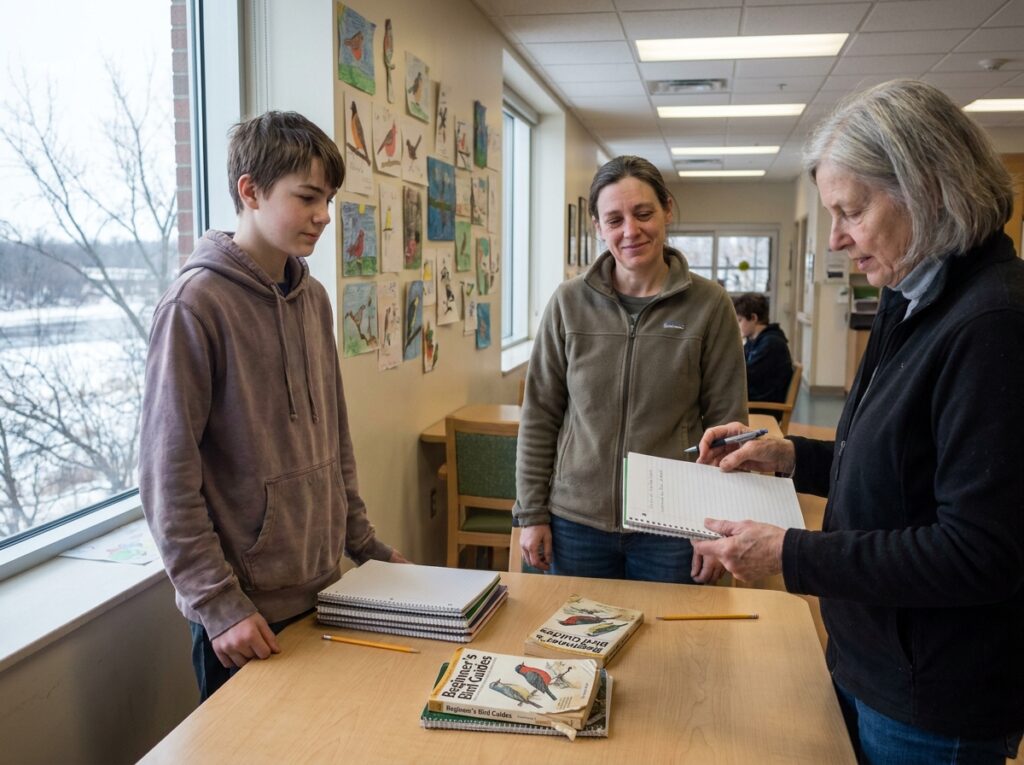
On the table were notebooks.
Dozens of them.
Plain ones.
Nothing expensive.
Each had a small sticker on the front.
OUTSIDE NOTES.
“What is all this?” I asked.
Ethan shrugged.
“It’s not a big deal.”
His mother immediately said, “It is absolutely a big deal.”
He gave her a look.
Claire ignored him.
Apparently Ethan had used birthday money, some money from a school fundraiser, and donations from family friends to put together simple observation kits for kids spending long stretches in the hospital.
Notebook.
Pencil.
A basic bird guide.
Nothing more.
No message about being brave.
No inspirational quote.
No pressure to find meaning in suffering.
Just a blank page.
I picked one up.
Inside the front cover, Ethan had written:
You don’t have to see an eagle.
Write down anything outside that reminds you the world is still moving.
That stopped me.
“That’s good,” I said.
He looked embarrassed.
“Maya basically said it first.”
“No,” Claire said quietly. “Maya gave you the idea. You figured out what to do with it.”
Ethan didn’t answer.
He looked toward the window.
That was the thing about him.
He still didn’t like being praised for something he thought should be ordinary.
The first kid to take one was a seven-year-old girl named Ruby.
I only know her first name because that’s what her mother later allowed us to use.
Ruby had been in the hospital for weeks.
She was small and serious and wore purple glasses.
At first, she wanted nothing to do with Ethan’s notebook.
Her mother picked one up.
Ruby pushed it away.
“I don’t like birds.”
Ethan nodded.
“Okay.”
Her mother looked apologetic.
Ethan wasn’t bothered.
“You don’t have to write birds.”
Ruby stared at him.
“What else?”
“Anything.”
“Like what?”
He pointed toward the window.
“Cars.”
She considered that.
“That’s boring.”
“Snowplows.”
Still nothing.
“People falling on ice.”
That got her.
A tiny smile.
“You can write that?”
“You can write whatever you want.”
Ruby took the notebook.
Later that afternoon, her first entry appeared on the board:
2:14 — man dropped his hat and had to chase it.
The next day:
8:32 — red truck.
Then:
11:06 — dog wearing boots.
Ethan loved that one.
Within a week, Ruby had filled four pages.
No eagles.
No profound symbolism.
Just proof that something was happening outside.
That was exactly the point.
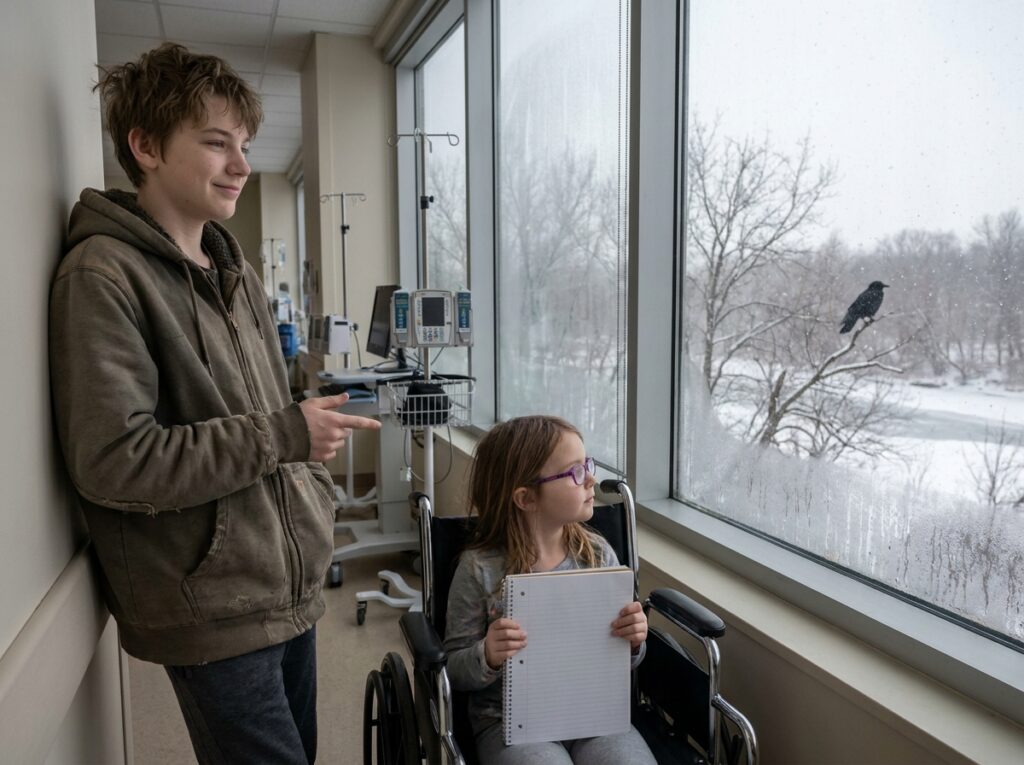
One afternoon, I found Ethan sitting near the old hallway window.
The same one where I’d first seen him years earlier.
Ruby was beside him.
She was too tired to stand, so one of the nurses had brought a chair.
They weren’t talking.
They were watching snow.
After several minutes, Ruby whispered:
“Nothing’s happening.”
Ethan said:
“Snow is happening.”
She rolled her eyes.
“You sound like a teacher.”
“That’s insulting.”
I smiled from down the hall.
Then a crow landed on a bare branch.
Ruby reached for her notebook.
“Crow.”
“Good.”
“Time?”
Ethan looked at the clock.
“3:41.”
Ruby wrote it down.
Then she said:
“It’s ugly.”
Ethan looked offended on behalf of the entire crow population.
“That’s rude.”
“It is.”
“Still counts.”
Ruby wrote:
3:41 — ugly crow.
Ethan added:
“Very unfair review.”
That was when I realized something had shifted.
He wasn’t the kid at the window anymore.
Not only.
He was becoming the person who stood there with somebody else.
Claire told me later that those visits affected Ethan more than she expected.
At home, he started talking about Maya differently.
Not less.
Differently.
For years, her memory had been connected tightly to hospitals.
Treatment.
Loss.
The photograph by the lake.
The eagle.
Now he also remembered dumb things.
The time she spilled grape soda on the couch and flipped the cushion.
The way she sang badly on purpose.
How she hated mayonnaise.
How she once convinced him that a loon call was a ghost.
“I think I forgot she was funny,” Ethan told me.
That sentence hurt.
Grief can do that.
It can freeze someone at the hardest part of their life.
You remember the hospital room so clearly that you temporarily lose the person who existed before it.
Claire understood immediately.
She went home and pulled out old videos.
Not memorial videos.
Ordinary ones.
Maya yelling because Ethan had hidden a rubber snake in her bed.
Maya dancing terribly in the kitchen.
Maya arguing with their father about whether cereal counted as dinner.
Ethan laughed until he cried.
Then cried until he laughed again.
A few weeks later, he brought one of those stories to Ruby.
“My sister used to cheat at Uno.”
Ruby looked shocked.
“Dead people cheated?”
Ethan laughed.
“Mine did.”
Her mother covered her mouth, trying not to laugh too loudly.
Ruby thought about it.
“My grandpa died.”
Ethan waited.
“He snored.”
“See?”
Ruby smiled.
“He snored really bad.”
They talked about that for ten minutes.
No one tried to make it deep.
No one needed to.
Sometimes grief becomes survivable again when the person you lost gets to be annoying.
Or funny.
Or messy.
Human.
That spring, the hospital volunteer coordinator asked whether Ethan wanted to help create something more permanent for families.
Not a program with his name.
He rejected that immediately.
No plaque either.
Also rejected.
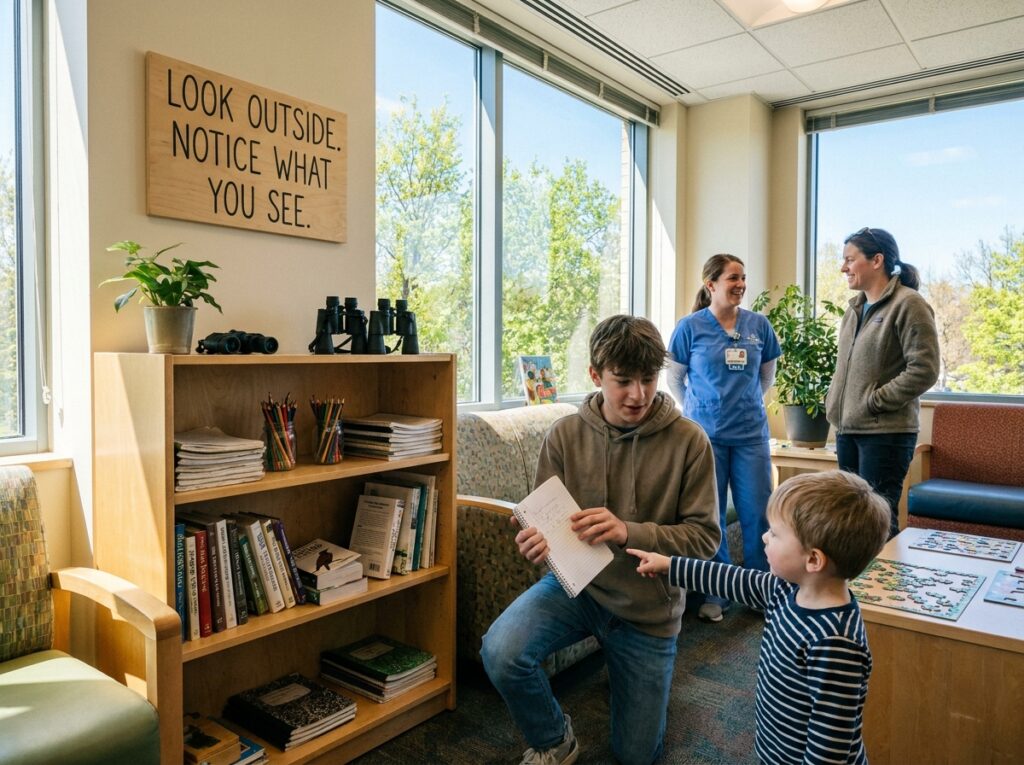
What they eventually created was simple.
A small shelf near the nature board.
Field guides.
Colored pencils.
Notebooks.
A laminated local bird sheet.
A few inexpensive binoculars managed by staff.
And a sign:
LOOK OUTSIDE.
WRITE DOWN WHAT YOU NOTICE.
IT DOESN’T HAVE TO MEAN ANYTHING.
That last line was Ethan’s.
I loved it.
Because people had spent years trying to turn the eagle into more than it was.
Visitors sometimes asked whether Ethan believed Maya was sending the bird.
He always gave the same answer.
“No.”
Then, if he was feeling patient:
“Maya taught me to look. That’s different.”
That distinction mattered to him.
It mattered to me too.
The eagle didn’t need to be supernatural to matter.
The river didn’t need to know Ethan’s story.
The snow didn’t fall for him.
Wildlife wasn’t performing grief therapy.
The outside world simply continued.
And sometimes that was enough.
The next November, Claire called my mother.
Not me.
Mom took tremendous pride in that.
“I’m apparently management now,” she told me.
Ethan wanted to go back to the river overlook on Maya’s anniversary.
The same place we’d met before.
My mother brought coffee.
Claire brought hot chocolate.
I brought doughnuts.
Ethan brought nothing.
No notebook.
I noticed immediately.
“Where is it?”
He knew what I meant.
“At home.”
“Retired?”
“Not exactly.”
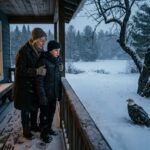
We stood along the railing.
Cold air.
Brown grass.
Bare cottonwoods.
The river dark and moving.
Ethan was fifteen now.
There was a steadiness in him I hadn’t seen when he was eleven.
Not because everything had turned out perfectly.
It hadn’t.
His medical life didn’t simply vanish.
There were still scans.
Still follow-ups.
Still fear around certain appointments.
Claire still went quiet before results.
Some things stay with families.
But fear no longer occupied every room.
We watched the sky.
At 7:26, a pair of geese crossed the river.
Mom announced the time automatically.
Ethan smiled.
“You’re still doing reports?”
“Of course.”
“Even though I don’t collect them?”
“They’re my reports now.”
He laughed.
At 7:49, an eagle appeared.
Far downstream.
White head visible when it banked.
Nobody spoke for a moment.
I looked at Ethan.
He wasn’t reaching for anything.
No pencil.
No phone.
He watched until it disappeared behind the trees.
Then Claire slipped her hand into his.
“What are you thinking?” she asked.
He shrugged.
“Maya would’ve complained that we’re freezing.”
Claire laughed.
“She absolutely would.”
“And then she’d refuse to leave.”
“Also true.”
That was their memorial.
Not a speech.
Not a sign.
Not pretending the bird carried a message.
Just remembering Maya accurately.
Cold.
Funny.
Stubborn.
Loved.
Before we left, Ethan took something from his coat pocket.
A single page.
It had been torn from the original notebook.
I recognized his handwriting.
BAD MORNING. EAGLE ANYWAY.
He handed it to Claire.
“What is this?”
“You keep the original notebook.”
“You don’t want it?”
“I want it.”
He paused.
“But I don’t need it every day anymore.”
Claire’s face crumpled.
Ethan hugged her before she could answer.
My mother and I looked very deliberately at the river.
Some moments belong to families.
Later, he explained.
The notebook had been a bridge.
From Maya.
To the hospital.
To the outside.
He didn’t want to throw it away.
But he didn’t want to feel responsible for documenting every beautiful thing forever.
That was important.
Grief had already taken enough from him.
It didn’t get to turn looking at birds into homework.
He put the notebook in a drawer at home with Maya’s photograph still tucked inside.
Some months he opened it.
Some months he didn’t.
And that was okay.
Meanwhile, the hospital shelf kept growing.
Families donated new notebooks.
One former patient sent colored pencils.
A retired birder volunteered occasionally through the hospital’s approved program.
Nurses added seasonal sighting sheets.
A teenager drew little cartoons of local birds.
The dinosaur remained on the board for an embarrassingly long time.
Still unconfirmed.
Then, one January morning, I got a photograph from Nurse Jamie.
Not of a patient.
Not of an eagle.
A notebook page.
The handwriting was large and uneven.
It said:
7:11 — nothing yet
Then:
7:18 — snow
Then:
7:26 — ambulance
Then:
7:40 — little bird on light pole
And at the bottom:
I thought outside was gone. It’s not.
I stared at that sentence for a long time.
I forwarded it to Ethan.
He didn’t answer for almost an hour.
Then:
Tell them the little bird counts.
That was all.
A week later, Ethan came to the hospital.
He stood near the shelf.
Ruby happened to be visiting for an appointment and saw him.
She was older now too.
No purple glasses anymore.
She walked over.
“You’re the eagle kid.”
Ethan groaned.
“I hate that name.”
“You are.”
“You wrote about a dog in boots.”
“That was important.”
They argued like siblings for five minutes.
Then a younger boy approached the shelf.
Maybe nine.
He picked up a notebook.
Looked at Ethan.
“Do I have to write every day?”
Ethan shook his head.
“No.”
“Do I have to see birds?”
“No.”
“What if nothing happens?”
Ethan thought about it.
Then said:
“Write that.”
The boy frowned.
“Write ‘nothing happened’?”
“Yeah.”
“Why?”
Ethan glanced toward the window.
“Because you looked.”
That may be the best explanation I’ve ever heard for the whole thing.
Years ago, I found an eleven-year-old boy standing at a hospital window waiting for an eagle.
I thought I was stopping for a bird.
I wasn’t.
I was stopping for a person.
Maya had taught Ethan to look beyond the room.
Ethan taught me.
My mother joined.
Nurses joined.
Security guards joined.
Kids joined.
Eventually, the act of noticing moved farther than any of us expected.
Not because an eagle saved anybody.
It didn’t.
Doctors treated Ethan.
Nurses cared for him.
His mother carried more than I will ever understand.
Medicine mattered.
Family mattered.
Luck mattered.
Loss remained loss.
The eagle was simply an eagle.
But a wild bird crossing a hospital window reminded a frightened boy that the hospital was not the whole world.
And sometimes a reminder is enough to help you make it through one more hour.
That is what I think kindness became in Ethan’s story.
Not rescue.
Attention.
Someone noticing the sky when you can’t.
Someone writing down the time.
Someone opening the blinds without saying anything.
Someone saving a place beside the window.
Someone handing the habit forward when they’re finally strong enough to leave.
The last time I asked Ethan whether he still looked for eagles, he said:
“Sometimes.”
Then he smiled.
“But now I notice other stuff too.”
I think Maya would have liked that.
Because maybe the lesson was never:
Keep looking for the eagle.
Maybe it was simply:
Keep looking.
No Comments