

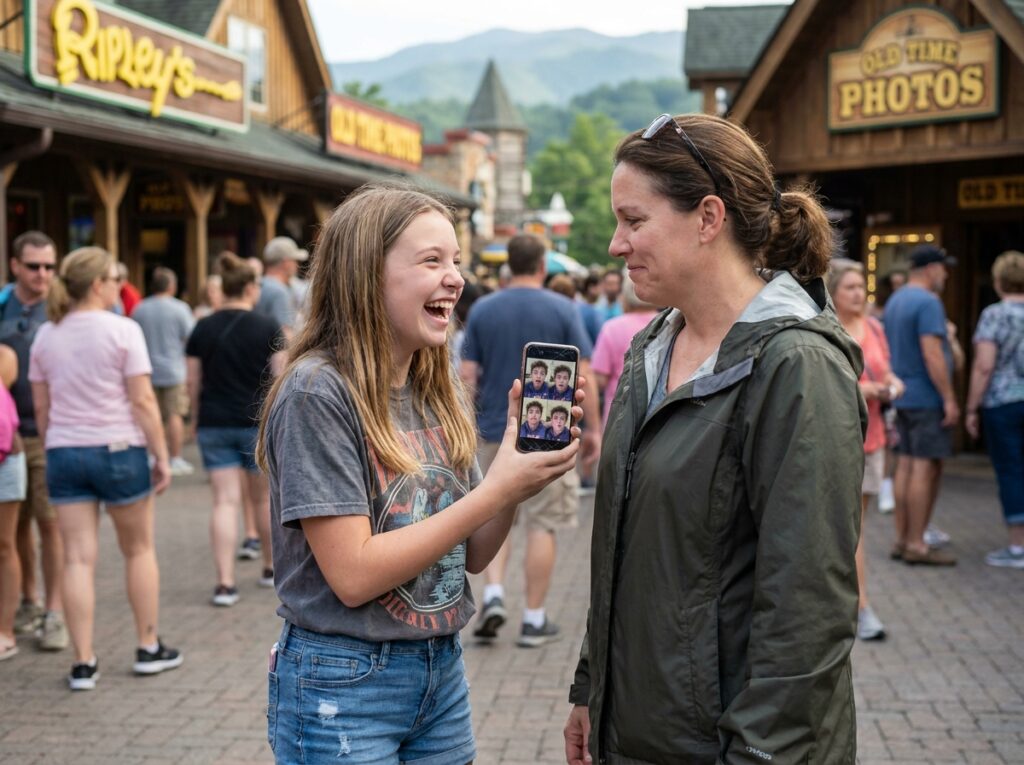
The first thing my daughter did when I finally handed her phone back was laugh.
Not a little laugh either.
The kind where your whole body folds forward and you can’t explain what’s funny because you’re trying to breathe.
“What?” I asked.
She held up the screen.
There were selfies.
Several of them.
A teenage boy making ridiculous faces into the camera.
One with his eyes crossed.
One with his mouth wide open.
One where he was giving a thumbs-up.
And one where he had apparently recruited another kid into the picture.
My daughter looked at me.
“I told you.”
I knew exactly what she meant.
She had told me someone would probably do the right thing.
I had told her not to count on it.
And there, staring back at me from her camera roll, was photographic evidence that my thirteen-year-old had been more hopeful about people than her mother.
I sighed.
“Do not enjoy this too much.”
She grinned.
“Oh, I am.”
We were standing outside Ripley’s, surrounded by tourists, strollers, souvenir bags, and the strange noise of a busy vacation town.
Twenty minutes earlier, I had been imagining a replacement phone bill.
Now I was studying the face of the kid who had apparently found it.
He looked young.
Maybe thirteen or fourteen.
Baseball cap.
T-shirt.
Big goofy smile.
No name.
No message.
Nothing that would tell us who he was.
Just selfies.
My daughter scrolled through them again.
“He’s funny.”
“He also took pictures on somebody else’s phone.”
“He returned it.”
“True.”
She looked up at me.
“I want to find him.”
That caught me off guard.
“To say thank you?”
“Yes.”
I agreed immediately.
Because by then, I wanted to thank him too.
Not just for the phone.
For the correction.
Back at the hotel that evening, my daughter posted one of the selfies with my permission.
We kept the message simple.
She wrote that she had accidentally left her phone at an exhibit, that somebody had turned it in, and that whoever the boy in the picture was, she wanted him to know he had made her day.
I added my own post.
I admitted something I wasn’t especially proud of.
That while we were searching, I had been lecturing my daughter.
Not just about responsibility.
That part was fair.
She did need to learn to keep track of something expensive.
I had also been lecturing her about people.
I had told her that someone had probably stolen it.
That people couldn’t be trusted.
That expecting honesty was naive.
And then a stranger proved me wrong.
I wrote:
“Whoever you are, thank you for returning my daughter’s phone. And thank you for giving me one more reason not to teach my child that expecting goodness from people is foolish.”
Then we went to dinner.
I assumed maybe a few people would share it.
Vacation-town Facebook groups love a lost-and-found story.
By the time we got back to the hotel, my phone was full of notifications.
Someone had shared the post into a local community group.
Then somebody else recognized the boy.
A comment appeared:
I think that’s my nephew.
Another person tagged a woman.
Then another.
Within maybe an hour, we had a name.
Ethan.
Fourteen years old.
He was visiting Tennessee with his family from North Carolina.
His mother commented under the post.
“That is definitely my child. I wish I could say the selfies surprise me.”
I laughed so hard I woke my husband, who had already fallen asleep watching television.
My daughter immediately typed:
THANK YOU ETHAN!!!
His mother responded:
“He said he found the phone sitting alone and waited around because he thought someone would come back. When nobody did, he took it to the desk.”
Then she added:
“I asked about the selfies. He said he wanted whoever lost it to know the person who found it was ‘not scary.’”
That one got me.
Not scary.
Fourteen years old, and somehow he had understood something I had forgotten.
Losing something valuable creates panic.
Finding it returned creates relief.
And apparently Ethan had decided a ridiculous face might make the whole thing feel less frightening afterward.
My daughter read the comment.
Then she looked at me.
“He knew I’d be worried.”
“Apparently.”
She smiled.
“He seems nice.”
“He does.”
Then came the part that made me cry.
Ethan’s mother wrote:
“He lost his wallet last year at a baseball tournament. Someone found it and mailed it back to us with every dollar still inside. He remembers that.”
There it was.
A chain.
Someone had once been honest with Ethan.
So when he got his chance, he was honest with someone else.
Maybe kindness works like that more often than we realize.
Not always as some huge, dramatic act.
Sometimes it’s just:
This happened to me.
Someone helped.
Now I know what to do.

The next day, our families arranged to meet.
Nothing elaborate.
We were both still on vacation.
We met near a public area before going our separate ways.
I recognized Ethan immediately.
Same baseball cap.
Same grin.
Only in person, he seemed shyer than the selfies suggested.
My daughter walked up first.
“Are you the selfie criminal?”
He laughed.
“Maybe.”
She held up her phone.
“You took, like, eight.”
“I got bored waiting.”
His mother apologized.
I told her there was nothing to apologize for.
Then I shook Ethan’s hand.
“Thank you.”
He shrugged in that teenage-boy way.
“No problem.”
“No. Really.”
He looked embarrassed.
So naturally I made it worse.
“I was in the middle of telling her nobody would turn that phone in.”
My daughter jumped in.
“She was giving a whole speech.”
Ethan laughed.
“I hate speeches.”
“Thank you,” my daughter said. “Finally somebody understands.”
Traitors.
All of them.
I asked Ethan why he didn’t just leave the phone where it was.
He answered like the question itself was strange.
“Because somebody would come looking for it.”
That was all.
Not:
Because I’m an exceptional person.
Not:
Because I wanted praise.
Not:
Because I expected a reward.
Somebody would come looking for it.
So he made sure it was somewhere they could find it.
His mother stood beside him smiling quietly.
I told her what I had written in my original post.
That she had done good with this one.
She got emotional.
Then she said something that changed the whole way I thought about the story.
“We remind him to do the right thing, sure. But kids are watching what everyone else does too.”
She told us about the wallet again.
About the stranger who returned it.
About coaches who had taught Ethan to clean up after games even when nobody was watching.
About teachers who expected honesty.
About grandparents who returned extra change when cashiers made mistakes.
“Parents matter,” she said. “But they’re not the only people raising kids.”
I thought about that for a long time.
Because we love to say children are watching.
Usually as a warning.
Watch what you say.
Watch what you do.
Don’t set a bad example.
But children are watching good things too.
They notice the person who holds a door.
The stranger who returns a wallet.
The teacher who admits a mistake.
The coach who helps clean up.
The tourist who finds a phone and walks it to the front desk.
Those things accumulate.
We just don’t always see the result immediately.
Sometimes the result is a fourteen-year-old taking ridiculous selfies and then turning a stranger’s phone in.
Before we left, I offered Ethan some money.
He refused.
I insisted.
His mother laughed.
“He’s not taking it.”
Ethan shook his head.
“I didn’t do anything.”
That sentence bothered me.
“You did.”
He shrugged.
“I just turned it in.”
Exactly.
That’s what made it matter.
He thought honesty was ordinary.
I hope he keeps thinking that.

We finished our vacation.
Dollywood.
Too much food.
Souvenir shops.
Photos in front of everything my daughter decided was “cute.”
And from that point forward, she guarded her phone like it contained nuclear codes.
Every ten minutes:
“Mom, look. Still have it.”
“Congratulations.”
“Location services on too.”
“Miracles happen.”
But something else had changed.
Me.
I started noticing how often strangers did the right thing.
At a restaurant, a woman chased another family halfway through the parking lot because they’d left a purse hanging on the back of a chair.
At a gas station, a man found cash near the register and handed it to the clerk.
At our hotel, somebody left a child’s stuffed bear at the front desk with a note describing where it had been found.
At an attraction, a teenage employee knelt down to help a crying little boy find his parents.
None of those things went viral.
Most never would.
That’s the problem with our understanding of humanity.
Bad behavior announces itself.
Good behavior is often quiet.
If someone steals a phone, everybody hears about it.
If someone returns one, the entire act might last thirty seconds and disappear.
If somebody scams a stranger, it becomes a warning story.
If somebody finds a wallet and mails it home untouched, maybe only two families ever know.
We collect evidence for distrust because distrust feels protective.
I was doing that with my daughter.
I thought I was teaching her realism.
What I was actually teaching was certainty.
Someone probably stole it.
You can’t trust people anymore.
That’s different from teaching her to be careful.
She absolutely needs to be careful.
She needs location services on.
She needs a lock screen.
She needs to stop setting a very expensive phone down because something shiny caught her attention.
Yes, she still had consequences.
Mom did not become completely soft because a stranger returned an iPhone.
But responsibility and cynicism are not the same lesson.
I can teach her:
Keep track of your belongings.
Without teaching:
People are bad.
I can teach:
Protect yourself.
Without teaching:
Expect the worst from everyone.
I can teach:
Trust thoughtfully.
Without teaching:
Trust nobody.
My daughter understood that distinction before I did.
A few months after our vacation, she came home from school carrying a little zippered wallet.
“Whose is that?”
“Not mine.”
She had found it beside the bleachers after practice.
There was money inside.
Twenty-three dollars.
A school ID.
Two gift cards.
For approximately one second, I almost said:
Take it to the office tomorrow.
Then I stopped.
“Nope. Let’s go now.”
The school office was technically closed, but the athletic director was still there.
We handed it over.
On the drive home, my daughter looked at me.
“You know what I’m going to say, right?”
“I absolutely do not.”
She grinned.
“Ethan.”
I laughed.
“Don’t start.”
“You were wrong.”
“I have admitted this.”
“Repeatedly?”
“Too repeatedly.”
She looked out the window smiling.
Then said:
“I bet that girl is freaking out.”
Probably.
I thought about Ethan waiting twenty minutes beside a phone because he assumed somebody would come back for it.
“She probably is.”
My daughter nodded.
“She’ll feel better tomorrow.”
That was the moment the story completed itself for me.
A stranger once returned Ethan’s wallet.
Ethan remembered.
Ethan returned my daughter’s phone.
My daughter remembered.
My daughter returned another girl’s wallet.
Nobody planned any of it.
No organization.
No campaign.
No assembly about kindness.
Just ordinary people carrying forward the way they had once been treated.
That’s more hopeful to me than any viral post.
Because it means the good thing doesn’t have to end with the thank-you.
It can become somebody else’s instinct.
Do this because somebody did it for me.
Months later, my daughter still had Ethan’s selfies.
I asked why she hadn’t deleted them.
She said:
“Because they’re part of the vacation.”
I looked through them again.
Crossed eyes.
Thumbs-up.
Goofy grin.
The face of a kid who could have walked away with an expensive phone and instead walked it to the desk.
One photo became my favorite.
Ethan isn’t even looking at the camera.
He’s glancing off to the side, like he’s watching for whoever might come back searching.
My daughter said:
“You’re making it emotional.”
“I am not.”
“You are.”
Maybe I was.
Because every time I see that photo, I remember myself walking through Ripley’s telling my daughter that people couldn’t be trusted anymore.
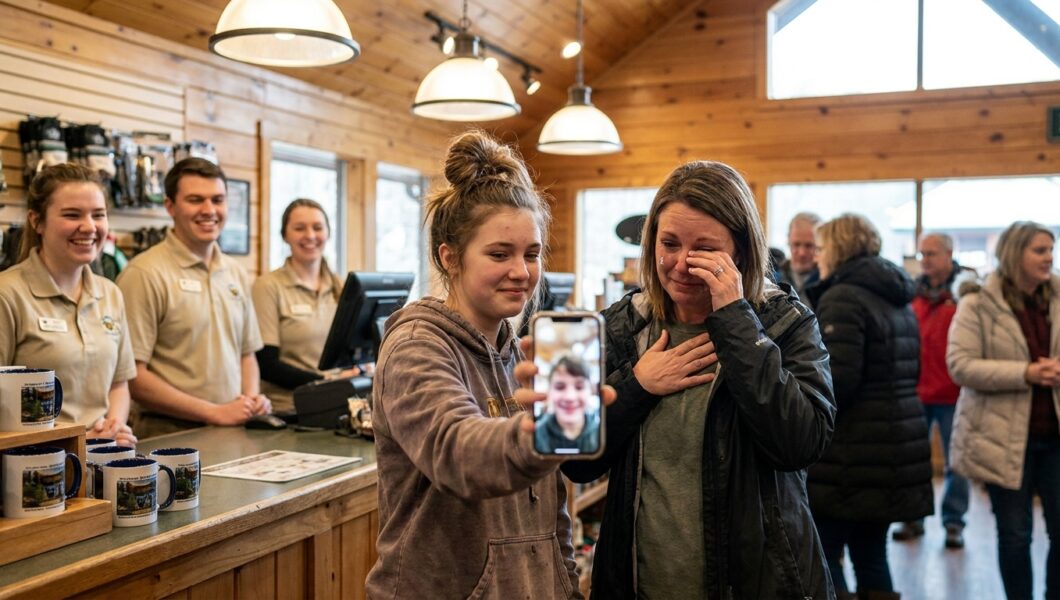
And I remember three staff members lighting up and saying:
“Yes! Somebody turned it in!”
There are certainly dishonest people in the world.
My daughter needs to know that.
There are selfish people.
Careless people.
People who take advantage.
Being hopeful does not mean pretending otherwise.
But there are also fourteen-year-old boys who find phones.
People who mail back wallets.
Staff members who protect lost belongings.
Kids who return twenty-three dollars instead of pocketing it.
And parents somewhere quietly raising children who think:
Of course I turned it in.
What else would I do?
Maybe we should tell those stories too.
Not because the world is perfect.
Because it isn’t.
But because every time we repeat only the worst things people do, we risk teaching our children that goodness is unusual.
Ethan reminded me it doesn’t have to be.
Sometimes integrity looks heroic.
Sometimes it looks like a teenager making a stupid face into a lost phone before walking it to the front desk.
And sometimes the greatest gift a stranger gives you isn’t the thing you thought you’d lost.
It’s evidence.
Evidence that your thirteen-year-old might still be right when she says:
“Mom, maybe somebody good found it.”



No Comments