

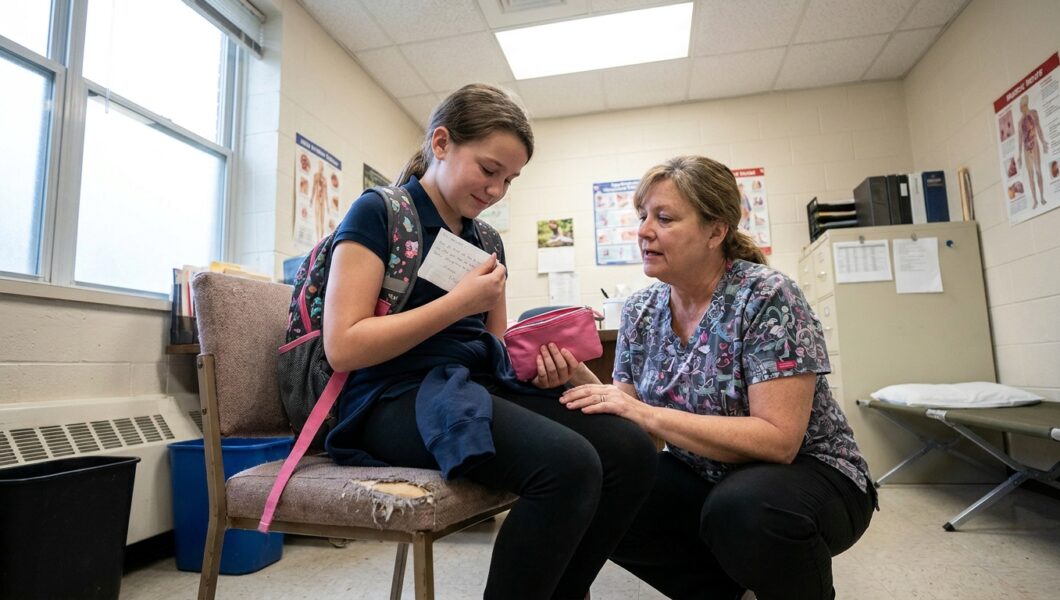
About three months after Claire’s first period at school, Mrs. Jenkins called me during my lunch break.
For one terrifying second, I thought something had happened to Claire again.
That’s what motherhood does.
Your phone rings from the school and your brain immediately skips every normal possibility.
“Is she okay?” I asked before Mrs. Jenkins could even finish saying hello.
She laughed gently.
“Claire is fine.”
I exhaled.
“Sorry.”
“No need. I called about the pouches.”
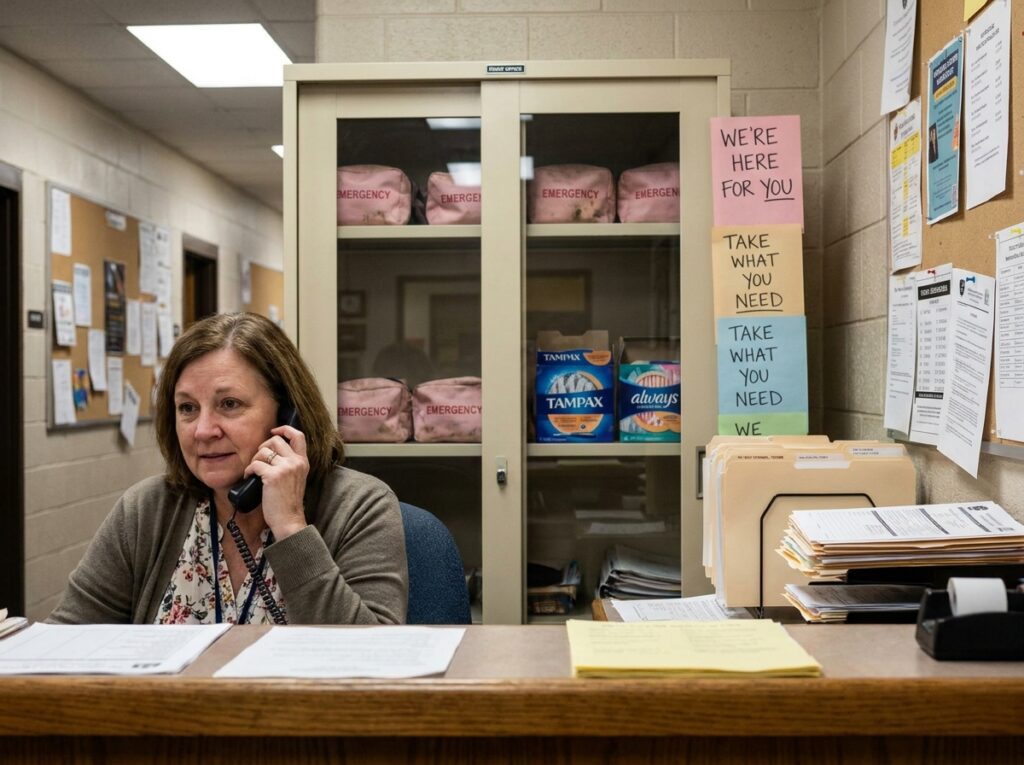
The little emergency period pouches had become part of the school by then.
Nothing fancy.
A small zip bag.
A pad.
Clean underwear.
Wipes.
Sometimes a chocolate.
And the note.
Take what you need.
If this is your first time, you are not alone.
You are okay.
I assumed Mrs. Jenkins was calling because they needed more supplies.
So I said, “How much do you need?”
She paused.
“That’s actually the problem.”
“What problem?”
“We’re running out.”
“Okay. I can bring some Friday.”
“No. I mean we’re running out constantly.”
I sat up straighter.
She explained that the baskets in the bathrooms were being used far more than anyone expected.
Not abused.
Used.
Girls were taking pads.
Taking underwear.
Taking pouches for emergencies.
Sometimes they were taking supplies home because they didn’t have enough there.
That part stopped me.
I had thought of the bags as something for a surprise first period.
A bad day.
An embarrassing moment.
I hadn’t thought much beyond that.
Mrs. Jenkins had.
“We’ve started noticing girls who come in almost every month asking for supplies,” she said.
My stomach tightened.
“Because they forget?”
“Some do.”
She hesitated.
“Some don’t have them.”
I went quiet.
She continued.
“There are families choosing between a lot of things.”
Gas.
Groceries.
Rent.
Medicine.
And apparently period products were one more thing people quietly struggled to afford.
I looked down at the half sandwich on my desk.
Three months earlier, I had twelve dollars in my bank account when Claire called me from the school bathroom.
I understood tight money.
I understood standing in a store doing mental arithmetic over things other people considered basic.
Still, I had never imagined my daughter having to ask a school secretary for a pad every month.
“Tell me what to buy,” I said.
Mrs. Jenkins laughed.
“I knew you’d say that.”
“I’m serious.”
“I know.”
Then she said, “But I think this might be bigger than you buying a few boxes.”
She was right.
That evening, I told Claire.
We were standing in the kitchen.
Owen was doing homework while eating cereal directly from the box.
Claire was making toast.
“The school keeps running out of supplies,” I said.
She turned.
“Pads?”
“Yeah.”
She frowned.
“Why?”
“Because some girls need more than one emergency pouch.”
She understood faster than I did.
“Oh.”
Then she got very quiet.
She looked down at the butter knife in her hand.
“Like they don’t have any at home?”
“Some of them might not.”
Claire stared at the counter.
Then she walked upstairs.
I thought I had upset her.
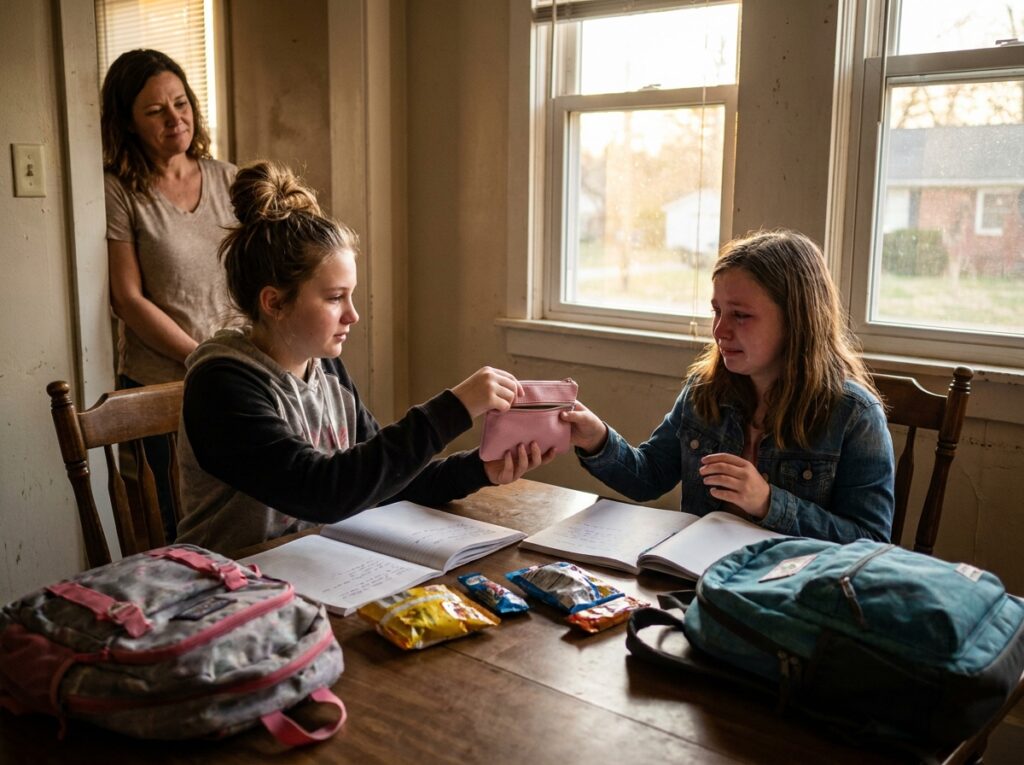
A minute later, she came back carrying a plastic grocery bag.
Inside were pads.
A lot of pads.
“What’s that?”
“My extras.”
“Claire.”
“I don’t need all of them.”
I looked inside.
This was the emergency stash I had built for her after her first period.
Bedroom drawer.
Bathroom cabinet.
Backpack.
Car.
Apparently I had been preparing her for menstruation during a natural disaster.
“You should keep what you need,” I said.
“I am.”
She separated several packages.
Then pushed the rest toward me.
“Take these.”
I looked at her.
She shrugged.
“Somebody gave me stuff when I needed it.”
There it was again.
The chain.
One woman helps a girl.
That girl helps another.
Only now it was growing.
The next morning I dropped the bag at the school office.
Mrs. Jenkins hugged Claire before she went to class.
Claire acted embarrassed.
I could tell she loved it.
That should have been the end of it.
It wasn’t.
A local pharmacy heard about the school program from one of the parents and donated several cases of products.
A church collected supplies.
Then a women’s running group filled the trunk of an SUV.
Then somebody contacted a local nonprofit that worked with families experiencing financial hardship.
Within weeks, the school had more than enough for emergency use.
So Mrs. Jenkins did something I admired.
She stopped thinking only about her school.
She called the district.
Other nurses were seeing the same need.
One elementary school had fifth-grade girls starting periods without supplies.
The high school had students regularly asking the nurse for products.
A counselor said some girls were missing part of the school day because they had bled through their clothes and didn’t have anything to change into.
That one made me angry.
Not at the girls.
At the fact that embarrassment and poverty could still quietly take a child out of class.
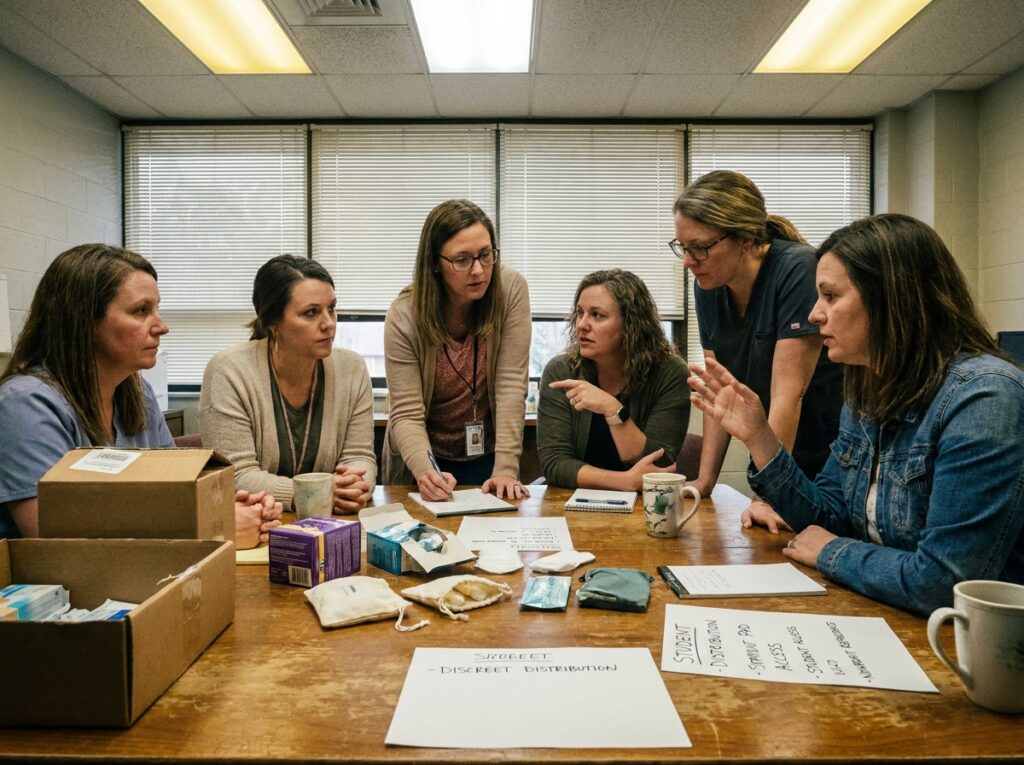
A meeting was organized.
I was invited because of the original post.
I nearly said no.
I was not an expert.
I worked at a hotel.
I forgot to thaw dinner.
I had once put my phone in the refrigerator while unloading groceries.
I did not belong in district meetings.
Mrs. Jenkins disagreed.
“You’re a parent.”
Apparently that qualified me.
So I went.
There were nurses.
Teachers.
Counselors.
Administrators.
A representative from the nonprofit.
And me.
We talked about practical things.
Privacy.
Accessibility.
Keeping supplies available without making girls ask in front of other students.
Appropriate product choices.
How to handle spare clothing.
How to make sure emergency support didn’t turn into shame.
One nurse said something I wrote down immediately.
“Dignity is part of the supply.”
That stayed with me.
Because she was right.
A pad handed to a scared child with an eye roll is not the same as a pad handed quietly with kindness.
The physical item matters.
The way you give it matters too.
The district eventually created a simple supply program.
Not because of me.
Not because of one viral Facebook post.
Because a lot of people had been quietly solving the same problem in separate buildings and finally started talking to one another.
Free menstrual products were placed in discreet, accessible locations.
Nurses kept backup clothing.
Counselors had emergency kits.
School offices stocked underwear in several sizes.
The notes stayed.
That surprised me.
I assumed somebody would eventually decide the handwritten messages were unnecessary.
Too sentimental.
Too informal.
Instead, the girls loved them.
Some took the notes.
Some left them.
Then something unexpected happened.
Girls started writing their own.
Mrs. Jenkins found the first one tucked into the basket one Monday morning.
It said:
I used one last month.
Leaving two today.
You’re going to be okay.
No name.
A week later another appeared.
I cried too. Nobody laughed at me.
Then:
Please don’t be embarrassed. We all get it.
Then:
If you need a sweatshirt, ask the nurse. She has them.
Then one that made Mrs. Jenkins call me immediately.
My mom can’t always afford these. Thank you for putting them here.
I had to sit down after reading that.
There are sentences that rearrange the way you see a problem.
That was one.
The supplies weren’t just saving girls from embarrassment.
For some of them, they were filling a gap at home nobody knew existed.
Claire started carrying extra supplies not just in her backpack.
She kept them in her soccer bag.
Her locker.
Even the little compartment in the car door.
One day I asked whether she was becoming overly prepared.
She said, “You started it.”
Fair.
Then, near the end of seventh grade, Claire came home unusually quiet.
She dropped her backpack beside the kitchen table.
“What happened?”
“Nothing.”
I gave her the mother look.
She sighed.
“There’s a new girl.”
“What about her?”
“Her name’s Jasmine.”
Claire explained that Jasmine had recently moved to the district.
She was shy.
Kept her head down.
Didn’t seem to have many friends.
During gym class, she realized she had started her period.
She whispered to Claire because Claire happened to be standing beside her.
“She was shaking,” Claire said.
That word hit me.
Shaking.
The same way Claire had described herself the year before.
“What did you do?”
“I told Coach.”
“And?”
“Coach gave her a pouch.”
Claire paused.
“But she was scared to go back into class.”
“Why?”
“She thought everybody knew.”
I understood.
That feeling is brutal at eleven or twelve.
You assume embarrassment has a spotlight.
Claire sat with her in the locker room.
She told Jasmine about the white shorts.
About calling me from the bathroom.
About Nurse Kelly.
About the leggings that were too short.
Then Claire said:
“I told her mine was way worse.”
I raised an eyebrow.
“Competitive menstruation?”
She rolled her eyes.
“Mom.”
“Sorry.”
Claire stayed with Jasmine until she stopped crying.
Then the two of them went back to class together.
That evening, Claire asked if Jasmine could come over Saturday.
They became friends.
Not instantly.
Not some dramatic movie friendship.
Just slowly.
Homework.
Soccer games.
Sleepovers.
TikTok dances I pretended not to understand.
Several months later, Jasmine’s mother came to pick her up.
She stood awkwardly at my door.
Then she said, “I wanted to thank Claire.”
“For what?”
She hesitated.
“Jasmine told me what happened at school.”
I smiled.
“Claire was glad she could help.”
The woman’s eyes filled.
Then she said quietly, “Things have been hard since we moved.”
I didn’t ask what kind of hard.
She didn’t owe me the details.
She continued.
“Those supplies at school help more than people probably realize.”
I nodded.
“I think we’re starting to realize.”
She hugged me.
Two mothers standing in a doorway, both pretending the moment wasn’t making us cry.
By the next school year, the pouches had changed.
The school stopped calling them First Day Kits because most girls using them weren’t having their first period.
Claire suggested a new name.
Just in Case.
Mrs. Jenkins loved it.
The bags were still simple.
Pads.
Sometimes tampons for older students where appropriate under school policy.
Underwear.
Wipes.
A small disposal bag.
And the note.
Always the note.
You are okay.
Take what you need.
No explanation required.
That last line became important.
No explanation required.
You didn’t have to prove financial hardship.
You didn’t have to explain why you forgot.
You didn’t have to say whether it was your first period or your fiftieth.
You needed something.
You took it.
I wish more kindness worked like that.
No courtroom.
No interrogation.
No making people perform embarrassment before we agree to help them.
Claire is fourteen now.
She has braces.
Strong opinions about my clothes.
And a level of sarcasm I assume is medically normal for teenagers.
The little girl who called me crying from a school bathroom feels both yesterday and a lifetime ago.
She still has the original pink pouch.
Empty now.
It sits in the back of her dresser.
The note from that first day is still folded inside.
Sometimes I wonder why she keeps it.
Then last month, I got my answer.
The school was collecting supplies before the new year.
Claire volunteered.
I went with her.
We sat at a long table in the cafeteria filling bags.
Pad.
Underwear.
Wipes.
Note.
Repeat.
There were maybe twenty people there.
Teachers.
Parents.
Students.
Nurse Kelly.
Coach Ramirez.
Mrs. Jenkins.
At one point, I looked down the table.
Claire was showing a fifth-grade girl how to fold the notes.
The girl asked:
“What do I write?”
Claire said:
“Whatever you would’ve wanted somebody to tell you if you were scared.”
The girl thought for a second.
Then she wrote:
Nothing bad is happening. Your body is just growing.
Claire read it.
“That’s perfect.”
I had to turn away.
Mrs. Jenkins caught me.
“You crying again?”
“I have allergies.”
“In August?”
“Very aggressive allergies.”
She laughed.
Then she pulled something from her pocket.
A folded note.
“You should see this.”
Someone had placed it in one of the bathroom baskets.
It said:
I took from this basket last year when my family was having a hard time.
Things are better now.
My mom bought these.
Thank you for not making me ask.
Attached were two unopened boxes of pads.
I read the note twice.
Then I handed it to Claire.
She read it.
Her face softened.
“That’s nice.”
That was all she said.
That’s nice.
Teenagers have a gift for reducing emotionally devastating moments to two words.
But I saw her fold the note carefully and give it back to Mrs. Jenkins.
That was when I understood what had actually spread from that first awful Tuesday.
It wasn’t the Facebook post.
It wasn’t the pink bag.
It wasn’t even the menstrual supplies.
It was permission.
Permission not to be ashamed.
Permission to need something.
Permission to accept help without explaining your entire life.
Permission to turn around later, if you can, and help somebody else.
There are girls in that school now who will never know Claire’s name.
They won’t know about the white shorts.
They won’t know I was standing behind a hotel front desk with twelve dollars in my bank account when she called me.
They won’t know Mrs. Jenkins said, “We’ve got her.”
They won’t know Coach Ramirez donated leggings from her office.
They won’t know I once cried so hard in a gas station parking lot that my eleven-year-old daughter had to reassure me.
Good.
They don’t need to know.
Kindness works best when the person receiving it doesn’t have to carry the history of it too.
They just need the basket to be full.
The door to be unlocked.
The adult to be calm.
The note to say:
You are okay.
Sometimes we imagine kindness as something huge.
Saving a life.
Writing a giant check.
Changing the world.
Most of the time, it isn’t.
Most of the time, it is spare underwear in a drawer.
A sweatshirt tied around a girl’s waist.
A secretary knocking before she opens the bathroom door.
A teacher saying, “This happens.”
A student sitting beside another student until her hands stop shaking.
And maybe, years later, two boxes of pads left anonymously beside a note that says:
Things are better now.
I used to think the worst part of Claire’s first period was that it happened at school while she was wearing white shorts.
Now I think maybe that terrible timing gave both of us something we didn’t know we needed.
Claire learned there was nothing shameful about asking for help.
I learned that being unable to reach your child immediately does not mean she is alone.
And somewhere along the way, a handful of women in a school office created a sentence that became much bigger than any of us expected.
We’ve got you.
Three words.
A sweatshirt.
A pouch.
A note.
That’s sometimes all it takes to change the way a girl remembers one of the hardest days of growing up.


No Comments