

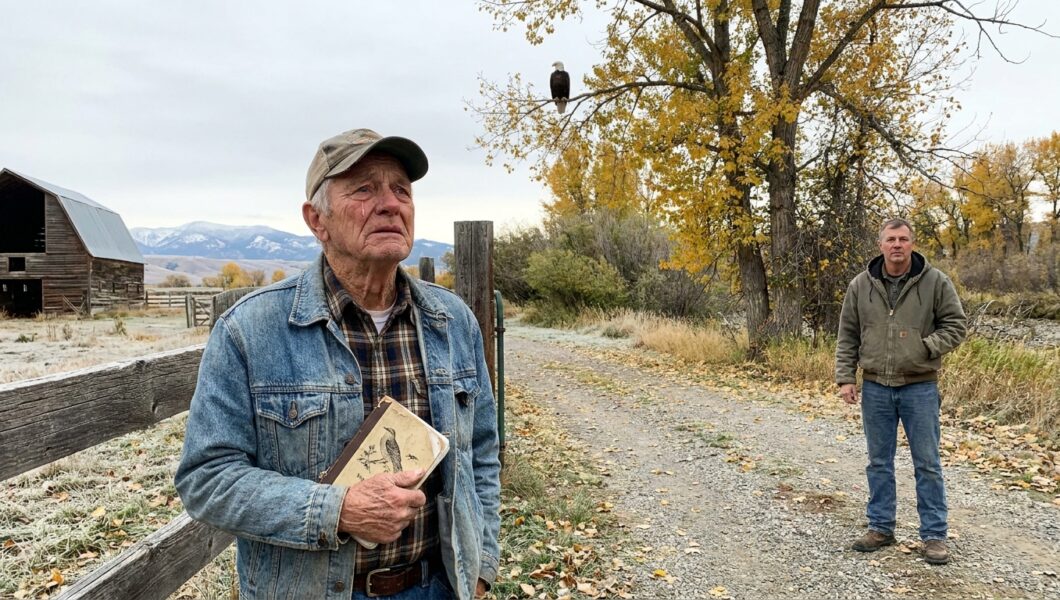
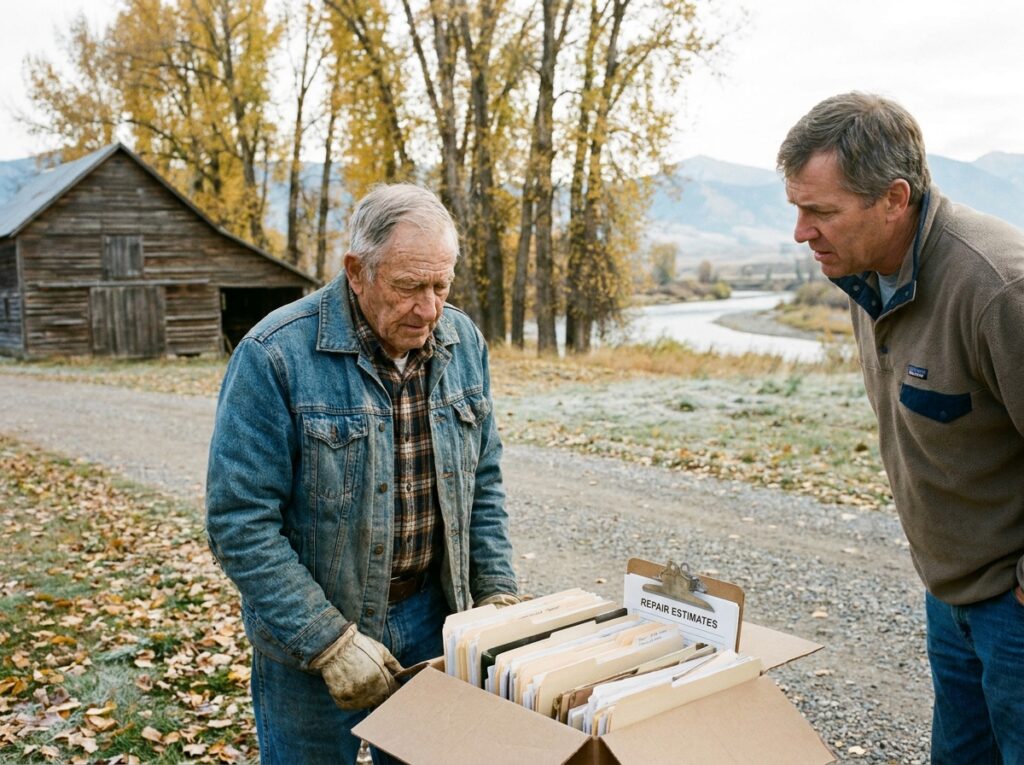
Three days after Frank wrote “Good morning. Not alone.” in Evelyn’s notebook, I found him standing in his driveway with a cardboard box at his feet.
It was just after nine.
The air had warmed enough to melt the frost from the sunny side of the fence, but the cottonwoods were still dropping yellow leaves across the yard.
“What’s all this?” I asked.
Frank nudged the box with the toe of his boot.
“Trouble.”
Inside were letters.
Property tax notices.
Repair estimates.
Insurance paperwork.
A bid from the developer who had been asking about the river frontage.
And, underneath all of it, a folder from the land conservation organization his daughter had contacted.
Frank folded his arms.
“I hate paperwork.”
“I know.”
“I especially hate paperwork that uses six pages to say one thing.”
“That sounds like paperwork.”
He gave me a look.
Then he picked up the conservation folder.
“I keep reading this and thinking I’m going to sign something I don’t understand.”
That was the first time I realized how scared he actually was.
Frank had spent most of his life fixing problems with his hands.
Broken fence?
Fix it.
Leaking roof?
Climb up there.
Frozen pipe?
Get a wrench.
But this was different.
This involved lawyers, property language, taxes, long-term commitments, and decisions that might outlive him.
He wasn’t afraid of losing the land only.
He was afraid of making the wrong choice with it.
“What do you want?” I asked.
He looked toward the old cottonwoods.
“That’s the problem.”
He rubbed the back of his neck.
“I know what Evelyn wanted.”
“And what do you want?”
Frank didn’t answer immediately.
Finally he said, “I want to stay here as long as I can.”
Then he looked at me.
“And I want those trees standing after I’m gone.”
There it was.
Simple.
Stay.
Protect.
Everything else was paperwork.
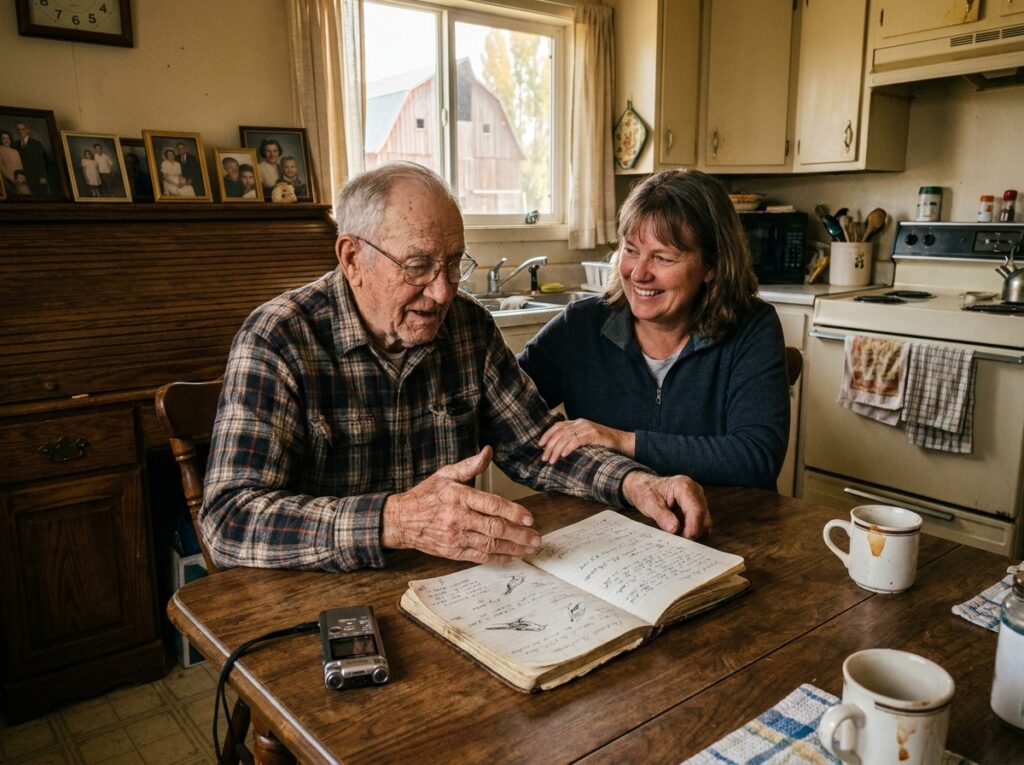
That afternoon, we sat at Frank’s kitchen table with his daughter, Claire.
She had driven in from Colorado again.
Frank’s son, Michael, joined by video call.
The conservation representative came too.
Nobody rushed him.
That mattered more than I can explain.
Every time Frank looked confused, the representative stopped.
Every time he had a question, she answered it plainly.
What would he still own?
What could he repair?
Could his children inherit the property?
What areas would be protected?
What restrictions might apply?
What would happen if he eventually had to sell?
They went through everything.
Then Frank asked the same questions again.
Nobody made him feel stupid.
By the end of the meeting, he didn’t sign anything.
He closed the folder.
“I need to think.”
The representative nodded.
“That’s exactly what you should do.”
After everyone left, Frank made coffee.
He stared out the kitchen window.
“You think I’m being difficult?”
“No.”
“Claire thinks I’m being difficult.”
“She thinks you’re being careful.”
He looked at me.
“You rehearsed that.”
“I did not.”
He almost smiled.
The truth was, I understood him.
Frank had spent more than forty years building a life on that property with Evelyn.
Every fence post had a story.
Every patch of ground seemed attached to something.
Their children had learned to ride bikes on the driveway.
Evelyn had planted lilacs near the porch.
One corner of the barn still had pencil marks where Frank measured the kids as they grew.
Selling part of the land wasn’t just a financial decision.
Neither was protecting it.
Both meant deciding what happened to a place filled with memory.
A week later, Claire came back.
This time she brought something unexpected.
A small digital recorder.
“What’s that?” Frank asked.
“You.”
He frowned.
Claire explained that she wanted to record him telling stories about the property.
Not for social media.
Not for publicity.
For the family.
Frank immediately refused.
“I’m not giving speeches.”
“You don’t have to.”
“I don’t like being recorded.”
“I know.”
“Then why’d you bring that thing?”
“Because you remember everything.”
Frank looked offended.
“I absolutely do not.”
Claire opened one of Evelyn’s bird notebooks.
“You remember where she saw the first eagle.”
Frank went quiet.
“You remember where Michael broke his arm.”
He pointed toward the barn.
“South side.”
“You remember where Mom planted the wildflowers.”
“Along the lower fence.”
“You remember where she wanted the trees left alone.”
Frank looked toward the window.
Claire lowered her voice.
“I want us to know those things too.”
That got him.
The first recording lasted eleven minutes.
Frank complained for six of them.
Then he forgot the recorder was there.
He told Claire about buying the place when the roof leaked and the barn leaned.
He told her how Evelyn cried the first time she saw the mountains from the kitchen window.
He told her about the first winter, when the pipes froze and they seriously considered moving.
They stayed.
Then came horses.
Children.
Vegetable gardens.
Bird notebooks.
Arguments.
Christmas mornings.
Funerals.
Forty-three years.
Soon, Claire started bringing the recorder every time she visited.
Michael joined when he could.
Sometimes I sat in.
Sometimes Mrs. Jensen did.
Frank eventually became suspicious if nobody was recording.
“You got that thing on?”
Claire would smile.
“Yes, Dad.”
“Good.”
Winter arrived before Frank made his decision.
Snow covered the riverbank.
The cottonwoods went bare.
The eagle sightings became less predictable.
Frank kept writing in Evelyn’s notebook anyway.
Some entries were only weather.
November 21. Snow before daylight.
December 3. Two deer by lower fence.
December 18. Hawk on the old post.
Then, on Christmas morning:
Kids here. Too much food. Evelyn would have complained, then eaten pie.
Claire showed me that entry later.
She was laughing and crying at the same time.
By January, Frank had reached a decision.
He called a family meeting.
This time, nobody had to convince him to talk.
“I’m not selling the river strip,” he said.
Claire nodded.
Michael stayed quiet.
Frank continued.
“But I’m also done pretending I can keep this place going alone.”
That sentence might have been harder for him than anything else.
He looked at his son.
“I need help with the bigger repairs.”
Then at Claire.
“I need you to keep helping with the bills.”
Claire smiled.
“Okay.”
“And if I get stubborn—”
Michael laughed from the screen.
“If?”
Frank ignored him.
“—you tell me.”
Then he held up the conservation folder.
“And I want to keep working on this.”
The final arrangement took months.
There were property assessments.
Habitat reviews.
Legal explanations.
Financial planning.
Changes to language Frank didn’t like.
More meetings.
At one point he threatened to throw the whole folder in the woodstove because someone used the phrase “perpetual restriction” without explaining it clearly enough.
But eventually, with his family involved and independent advice, Frank understood exactly what he was agreeing to.
The conservation arrangement protected the important river corridor and old cottonwoods from future development while allowing Frank to remain on the property and continue using the rest of the land within the agreed terms.
He signed in April.
Afterward, everyone expected him to say something meaningful.
Frank capped the pen.
“That was too many signatures.”
That was it.
We laughed.
Then he stood and walked outside.
We followed.
Spring was just beginning.
The river was high with snowmelt.
Small green buds were appearing on the cottonwoods.
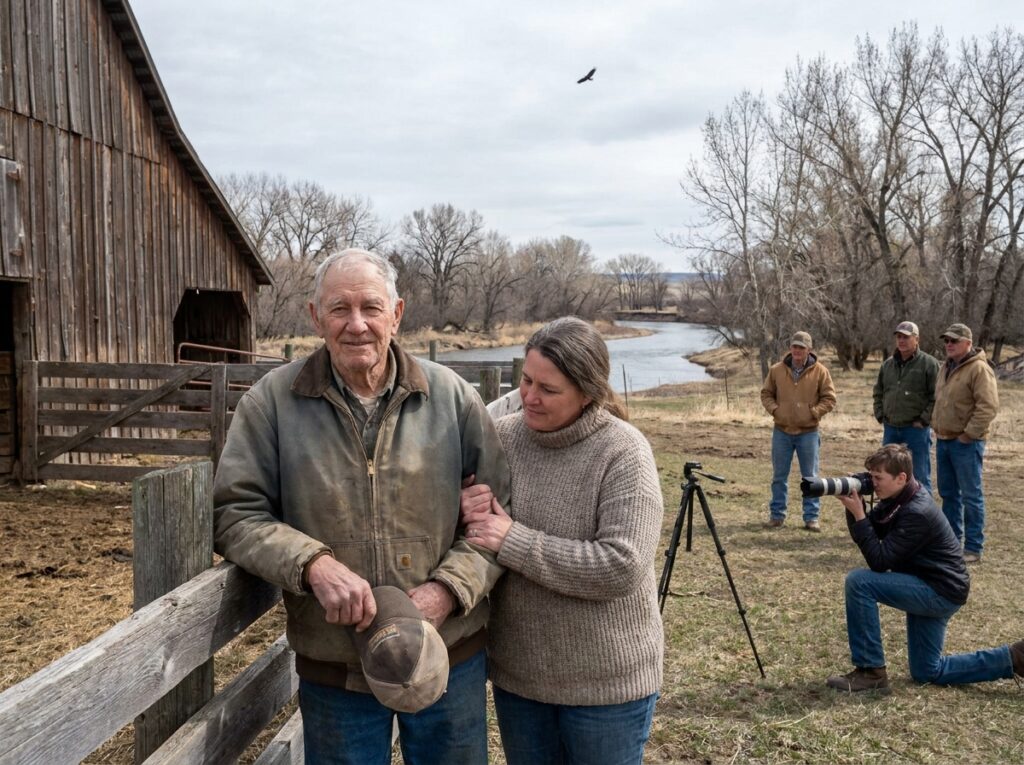
Frank stopped beside the fence.
For a while he didn’t speak.
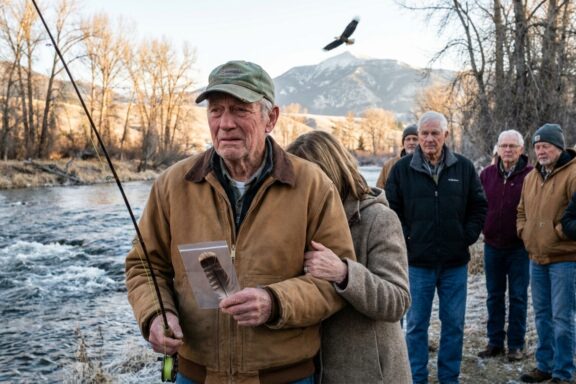
Then Claire took his arm.
“You okay?”
He nodded.
“I just wish she knew.”
Claire looked at him.
“She does.”
Frank gave her the same skeptical expression he gave everyone who said things he considered too sentimental.
Then something moved above us.
Mason saw it first.
“Eagle.”
High over the river, a bald eagle was riding the wind.
Frank looked up.
The bird circled once.
Then again.
Nobody moved closer.
Nobody shouted.
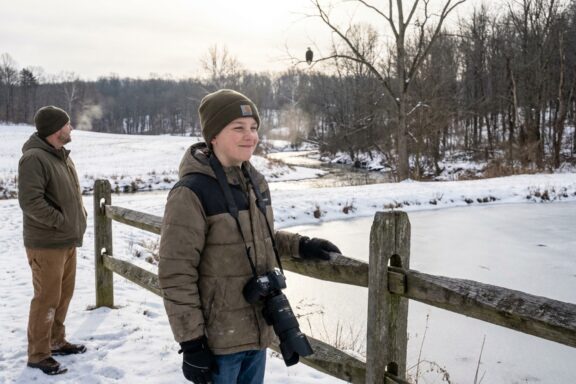
Mason didn’t even lift his camera at first.
Frank removed his cap.
“Show-off,” he muttered.
Claire laughed.
“What?”
“Your mother.”
That was the first time I heard him joke about Evelyn without sadness taking over immediately afterward.
It felt like a door opening.
The agreement solved one problem.
It didn’t solve everything.
Frank was still aging.
The house still needed work.
The barn still leaked in one corner when rain came from the west.
Property taxes still existed.
His knees still hurt.
And grief didn’t vanish because some papers got signed.
But something important changed.
Frank stopped acting like accepting help meant losing control.
When Michael came to repair a section of fencing, Frank let him.
Mostly.
When Claire organized automatic payments for a few bills, he stopped secretly paying them again by check.
Eventually.
When Mrs. Jensen brought dinner on Thursdays, Frank started making dessert.
Then one afternoon, he surprised all of us.
He invited Mason over.
Frank had been thinking about Evelyn’s notebooks.
There were decades of them.
Bird sightings.
Weather observations.
Sketches.
Notes about migration.
Some entries were probably useless.
Others might have value to local conservation or birding groups.
Frank wanted to preserve them.
So Mason helped scan the pages.
Claire created digital folders.
A local birding club offered guidance about how to organize the observations responsibly.
A wildlife biologist helped identify which records might actually be useful and which were simply personal.
Frank loved that distinction.
“Evelyn would be furious if somebody treated her grocery list like scientific data.”
One notebook contained both bird observations and a recipe for peach cobbler.
Another had three pages about an eagle sighting followed by a reminder:
Frank needs new socks.
He objected when we laughed.
“She was very organized.”
By summer, a small portion of Evelyn’s records had been copied for a local historical archive with the family’s permission.
The originals stayed with Frank.
That mattered to him.
They were still hers.
One Saturday, Claire brought all the grandchildren over.
Frank took them into the barn.
He showed them the cabinet.
He showed them the notebooks.
He showed them the cottonwood.
Then he told them the promise.
Not dramatically.
Not like a legend.
Just the truth.
“Your grandma wanted these old trees left alone if we could manage it.”
One of the younger grandchildren looked up.
“Because of the eagles?”
Frank nodded.
“And other things.”
“What other things?”
Frank thought about it.
“Because not everything needs to belong to us.”
I was standing near the barn door when he said that.
I wrote it down later because I didn’t want to forget.
By the next October, exactly one year after the morning Frank knocked on my door, he did it again.
8:09 this time.
I opened the door.
He stood there in the same denim jacket.
“You got shoes on?”
“Yes.”
“Good. You’re improving.”
“What is it?”
He pointed.
“Come look.”
We walked across the gravel.
The air smelled almost exactly the way it had the year before.
Cold leaves.
Woodsmoke.
Frost.
The mountains hidden beneath thin clouds.
And there, high in the cottonwood behind the barn, sat a bald eagle.
Frank stopped beside the fence.
For several seconds, neither of us said anything.
Then he smiled.
Not the broken smile from the year before.
A different one.
Still sad.
But fuller.
“Morning, Evie.”
The eagle stayed in the tree.
Frank took Evelyn’s notebook from inside his jacket.
He carried it more often now.
He opened to the next blank line.
October 18. Eagle in old cottonwood again.
Then he paused.
He looked at me.
“What?”
“Nothing.”
“You’re staring.”
“Just waiting to see what you write.”
He rolled his eyes.
Then added:
Daniel came over. Still not alone.
That nearly got me.
Nearly.
I blamed the cold.
Frank closed the notebook.
Then he said something I didn’t expect.
“I used to think keeping my promise meant I had to do everything myself.”
I looked at him.
He stared toward the trees.
“Turns out that would’ve been a pretty stupid way to lose the place.”
I laughed.
“So you’ve learned something?”
“Don’t get carried away.”
But he had.
So had I.
When we see older people holding tightly to homes, routines, land, objects, or traditions, it can be easy to call them stubborn.
Sometimes they are.
Frank certainly was.
But sometimes there is a story underneath that stubbornness.
A promise made beside a hospital bed.
A garden planted with someone who isn’t there anymore.
A tree that holds forty years of mornings.
A notebook in handwriting you would recognize anywhere.
That doesn’t mean every property can be saved.
It doesn’t mean every promise can be kept exactly as it was made.
Life is more complicated than that.
But people deserve the chance to explain what something means before everyone else starts deciding what should happen to it.
Frank didn’t need me to rescue him.
He needed me to listen.
Then his children listened.
His neighbors listened.
Professionals helped him understand his options.
And eventually a promise that had been sitting on one old man’s shoulders became something a family and community could help carry.
Frank still lives next door.
The barn still stands.
The cottonwoods still follow the river.
Evelyn’s binoculars remain beside the kitchen window.
And the notebooks now have a new handwriting mixed among hers.
Frank’s.
He still records the birds.
He records the weather.
Sometimes he writes about the neighbors.
Sometimes he writes about Evelyn.
And sometimes the entries are extremely practical.
June 4. Two eagles upriver. Daniel borrowed socket wrench again.
For the record, I returned it.
Mostly, though, I think about that first morning.
Frank knocked because he wanted me to see a bald eagle.
I thought I was walking outside to look at a bird.
Instead, I walked into a love story that had been continuing quietly for fourteen months after one person was gone.
A year later, it was still continuing.
Only now Frank wasn’t carrying it alone.
Maybe that’s what kindness does at its best.
It doesn’t replace the person someone lost.
It doesn’t erase grief.
It doesn’t promise that every hard problem has an easy solution.
It simply says:
Show me what matters.
Tell me why.
And if I can, I’ll stand beside you while you protect it.
The eagle eventually left the cottonwood that morning.
Frank watched until it disappeared over the river.
Then he tucked Evelyn’s notebook back into his jacket.
“Coffee?”
“Absolutely.”
We started toward the house.
Behind us, the old trees stood exactly where they had stood for decades.
Not because one stubborn old man had managed everything alone.
Because eventually, he let other people help him keep his word.
No Comments