

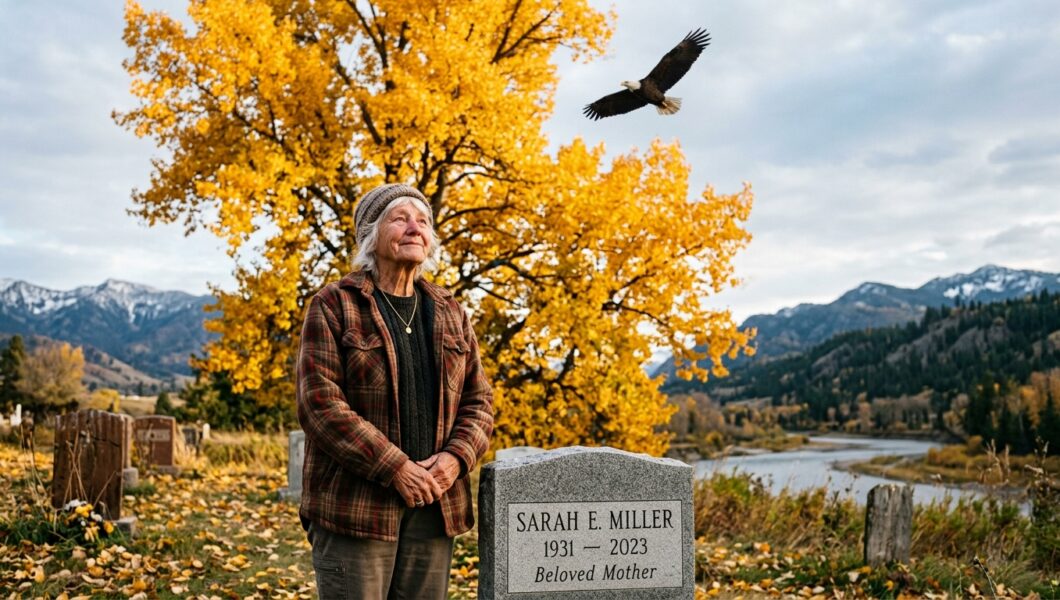
Margaret thought she understood the eagle by then.
She had spent years watching it return to the cemetery. She had watched it build its nest in the old cottonwood, watched young eagles take their first uncertain flights, and watched new generations appear above the river.
She had never tried to get closer.
She had never fed the birds.
She had never tried to turn the experience into something it wasn’t.
The eagle was wild, and Margaret respected that.
She simply loved knowing it was there.
But one spring morning, almost twelve years after Eleanor’s death, Margaret received a phone call that would make her look at the entire story differently.
It was from the caretaker of the cemetery.
He said they were cleaning out an old storage building on the property and had found several boxes of photographs and papers that appeared to belong to families who had been connected to the cemetery over the years.
“There’s a box with your mother’s name on it,” he told her.
Margaret stopped breathing for a second.
“My mother’s name?”
“Yes. Eleanor.”
Margaret hadn’t heard anyone say her mother’s name in that voice for years.
She drove to the cemetery that afternoon.
The old storage building stood behind a row of trees near the cemetery office. Inside were shelves covered with dust, old gardening equipment, broken benches, and cardboard boxes that looked as though nobody had touched them in decades.
The caretaker handed Margaret a small box.
Her mother’s name was written on the side in faded blue ink.
Margaret stared at it.
“I don’t understand.”
“Neither do I,” he said. “I thought you might know what it was.”
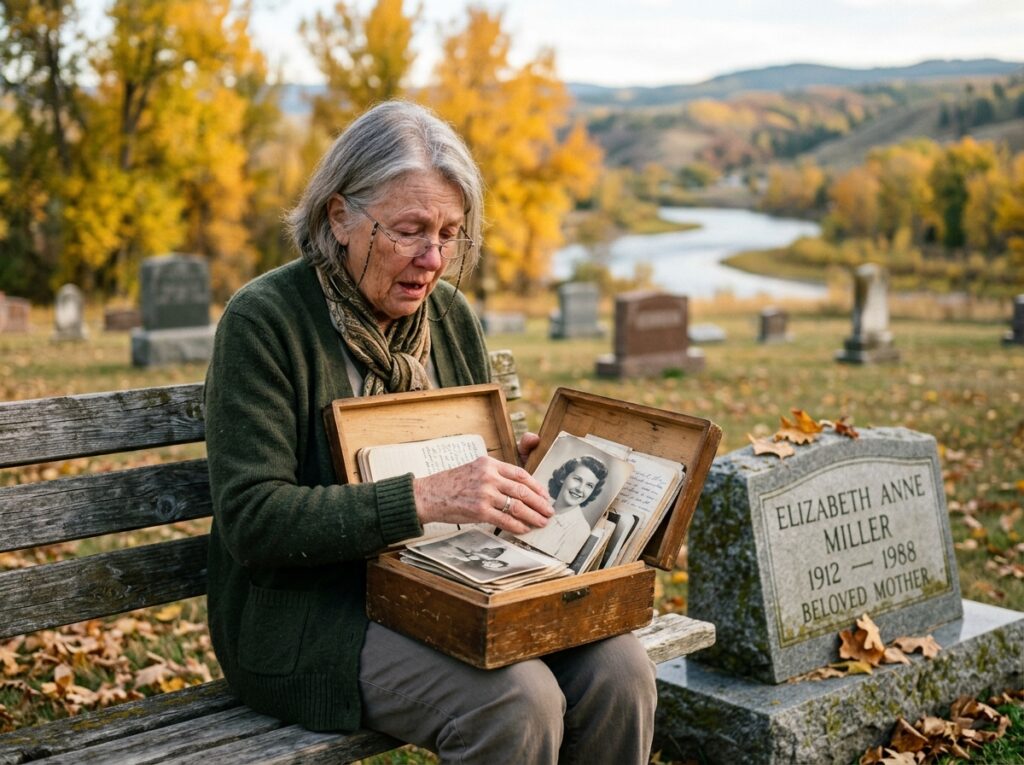
She carried the box outside and sat on the same wooden bench where she had spent so many Sundays talking to her mother.
For a few minutes, she couldn’t bring herself to open it.
Then she lifted the lid.
Inside were photographs.
Dozens of them.
Some showed Eleanor as a young woman.
Some showed her with Margaret’s father.
Others showed Margaret as a little girl standing beside the river.
Margaret smiled through tears.
She had never seen some of these photographs before.
There was one of Eleanor standing near the cemetery fence.
Another showed her sitting on a blanket beside the river.
Then Margaret found something that made her hands stop.
It was a photograph of Eleanor standing beneath the old cottonwood tree.
Margaret recognized the tree immediately.
The same tree where the eagle had eventually built its nest.
She turned the photograph over.
There was writing on the back.
Her mother’s handwriting.
Margaret read the words slowly.
“October 14. He came back today.”
She frowned.
Who was “he”?
She looked at the photograph again.
In the upper corner, barely visible between the branches, was the shape of an eagle.
Margaret stared at it.
Her heart began beating faster.
She reached deeper into the box.
There were more photographs.
Eleanor standing beside the river.
Eleanor looking toward the sky.
Eleanor holding Margaret’s hand.
And in several of them, an eagle appeared somewhere in the background.
Sometimes it was just a tiny dark shape.
Sometimes it was perched in a tree.
Margaret felt a strange chill.
She had always believed the eagle had appeared after her mother’s death.
But now she wasn’t sure.
She kept searching.
At the bottom of the box was a small notebook.
The cover was worn and faded.
Margaret recognized it immediately.
Her mother had kept notebooks everywhere.
Gardening notes.
Recipes.
Bird sightings.
Lists of things she wanted to remember.
Margaret opened the notebook.
The first pages contained names of birds and dates.
Then she found a familiar name.
“Bald eagle.”
Beside it was a date.
October 14.
Then another entry.
October 21.
Then another.
November 3.
Margaret’s hands began trembling.
Her mother had been watching the same eagle for years.
Maybe decades.
Margaret read every page.
Her mother had written about the eagle regularly.
Not obsessively.
Just little observations.
“Spotted him above the river.”
“Back again.”
“Two today.”
“Young one nearby.”
“Beautiful morning.”
The entries stretched across years.
Margaret turned page after page.
Then she found something that made her stop.
“Margaret saw him today.”
Her eyes filled with tears.
She remembered that day.
She must have been about eight years old.
Her mother had called her outside to look at an eagle.
Margaret had complained.
She had wanted to go play.
She had forgotten the moment almost completely.
Her mother hadn’t.
She had written about it.
Margaret laughed softly.
“Of course you did.”
She kept reading.
Then she found another entry.
“She doesn’t understand yet.”
Margaret wiped her eyes.
“What didn’t I understand?”
The next line answered her.
“That looking up is sometimes the easiest way to remember what matters.”
Margaret closed the notebook.
For several minutes, she simply sat there.
The cemetery was quiet.
Leaves moved gently in the trees.
The river could be heard in the distance.
Then she heard a familiar cry.
Margaret looked up.
The eagle was circling above the cemetery.
She laughed through her tears.
“Mom.”
The bird circled again.
Margaret looked down at the notebook.
Then back at the eagle.
For the first time, she realized something.
The eagle hadn’t entered her story after her mother’s death.
It had been part of her mother’s story long before that.
Maybe the bird wasn’t connected to Eleanor in any supernatural way.
Maybe there was no mystery.
Maybe Eleanor had simply loved the eagle, watched it, and returned to the same place again and again.
And perhaps that was even more meaningful.
Her mother hadn’t needed the bird to be a message.
She had simply loved being alive enough to notice it.
That afternoon, Margaret took the notebook home.
She read it again that night.
Then she found an envelope tucked inside the back cover.
There was only one sentence written on it.
“For Margaret, when she is old enough to understand.”
Margaret stared at the envelope for a long time.
Her mother had prepared it before she died.
Her hands shook as she opened it.
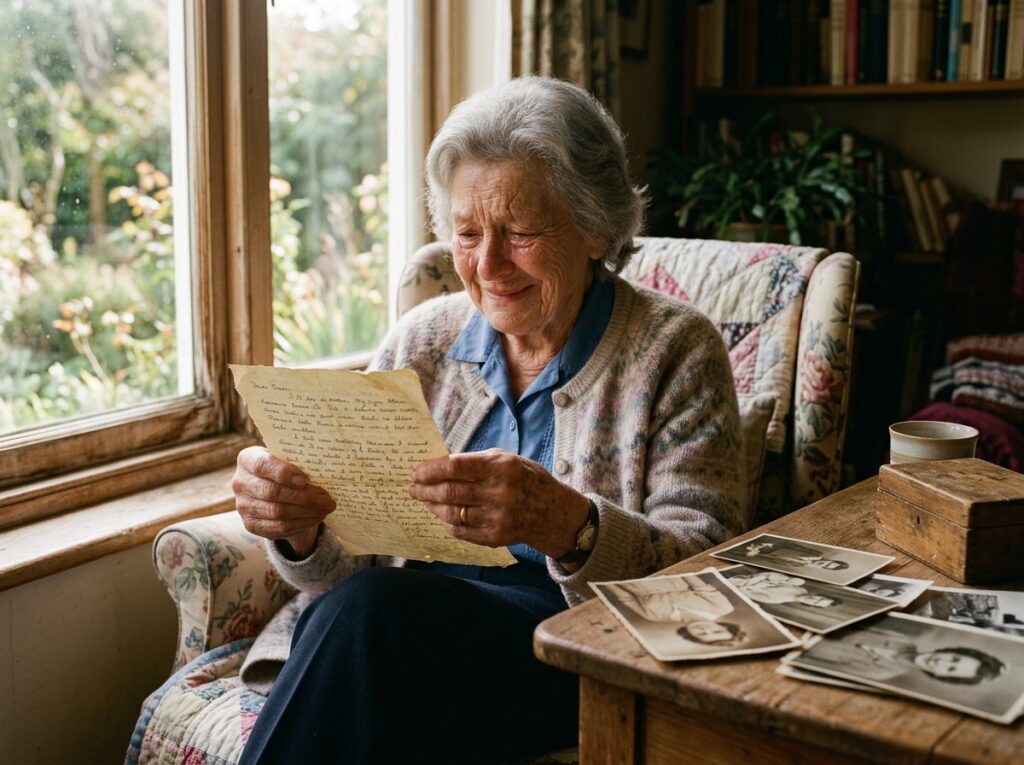
Inside was a letter.
Margaret recognized the handwriting immediately.
“My sweet Margaret,
If you’re reading this, I am probably no longer beside you.
I hope you are old enough by now to understand something I spent many years trying to teach you.
There will be days when you miss me so badly that the world feels empty.
Don’t be frightened by that feeling.
Grief is love with nowhere to go.
When that happens, go outside.
Find the river.
Listen to the trees.
Look at the birds.
Look up.
The world will not stop being beautiful simply because someone you love is gone.
And if you ever see an eagle above the river, remember that I probably saw it too.
Maybe not the same day.
Maybe not the same bird.
But I saw them.
And I was grateful.
I hope you will be too.”
Margaret couldn’t read anymore.
She pressed the letter against her chest and cried.
Not the desperate crying she had done after her mother’s funeral.
This was different.
It was softer.
It felt almost like relief.
She had spent years wondering whether the eagle had been some kind of sign.
Now she understood that it didn’t matter.
Her mother had already given her the answer.
Look up.
That was the message.
Not from the eagle.
From Eleanor.
The next morning, Margaret returned to the cemetery.
She brought the letter.
She sat beside her mother’s grave and placed it carefully on her lap.
The eagle was nowhere to be seen.
For once, she wasn’t disappointed.
She simply sat there.
She talked to her mother for almost an hour.
She told her about Michael.
She told her about the grandchildren.
She talked about the neighborhood.
She even laughed about the fact that she still couldn’t keep most houseplants alive.
“I know,” she said.
“I can hear you saying it.”
Then she looked toward the river.
An hour passed.
Nothing happened.
No eagle.
No dramatic moment.
Just wind through the cottonwoods.
Then, as Margaret stood to leave, a shadow passed across the grass.
She looked up.
The eagle was flying above her.
Margaret smiled.
She didn’t cry.
She simply whispered, “I know.”
The eagle disappeared beyond the trees.
Margaret picked up her mother’s letter and walked toward her car.
She felt lighter.
Not because she had stopped missing her mother.
She hadn’t.
She never would.
But she had finally understood that grief didn’t require her to spend the rest of her life staring at the empty space.
She could look at what remained.
The river.
The trees.
The birds.
The memories.
The people she loved.
The life her mother had wanted her to keep living.
Years earlier, Margaret had thought the eagle was teaching her how to remember.
Now she realized her mother had been teaching her all along.
The eagle was simply part of the lesson.
After that day, Margaret began carrying her mother’s notebook whenever she visited the cemetery.
She didn’t show it to everyone.
But occasionally, someone would ask about the eagle.
She would tell them the story.
Sometimes she would show them the photographs.
Sometimes she would read one small passage from the notebook.
And every time, she ended the same way.
“We don’t know what the eagle remembers.”
“But we know what my mother wanted me to remember.”
Look up.
The story eventually reached a local newspaper.
A reporter asked Margaret whether she believed the eagle was connected to her mother.
Margaret thought about the question.
“I believe my mother loved the eagle,” she said.
“That’s enough for me.”
The reporter asked whether she believed the eagle remembered her.
Margaret smiled.
“I don’t know.”
“Do you wish you knew?”
“No.”
The reporter looked surprised.
Margaret explained.
“If I knew for certain, maybe I’d spend all my time trying to prove it. I don’t need proof. I have something better.”
“What?”
“My mother’s words.”
The reporter wrote that down.
Margaret never saw the article.
She didn’t care about publicity.
She cared about the story.
Because the story wasn’t really about whether an eagle could remember a person.
It was about how people leave pieces of themselves behind.
My mother loved birds.
So Margaret learned to notice birds.
Eleanor loved the river.
So Margaret returned to the river.
Eleanor loved looking at the sky.
So Margaret learned to look up.
That was the inheritance.
Not money.
Not possessions.
Attention.
The ability to notice beauty.
The willingness to stop and appreciate something ordinary.
The courage to keep living after loss.
And perhaps that is one of the greatest gifts a parent can leave a child.
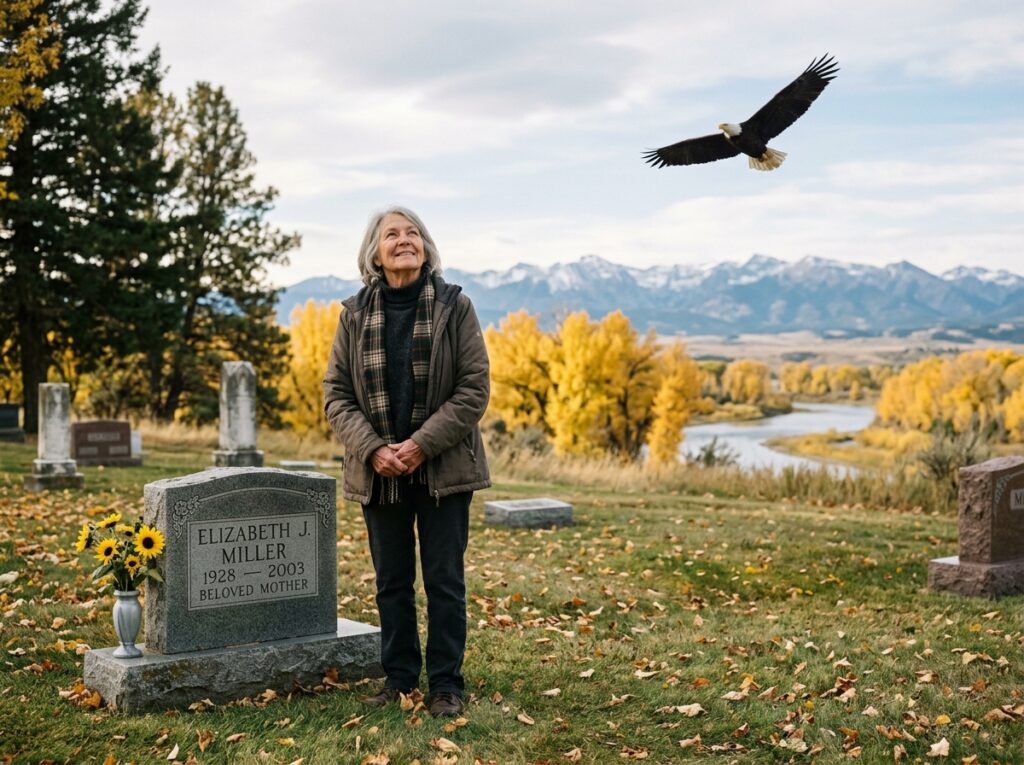
Margaret continued visiting the cemetery until she was well into her 80s.
She couldn’t walk as far as she once had.
Her nephew often drove her.
Sometimes he would help her to the bench.
Then he would leave her alone for a while.
One spring morning, they arrived earlier than usual.
The cottonwood trees were just beginning to show their first leaves.
Margaret sat down.
Her nephew noticed her looking toward the sky.
“You waiting for your friend?”
Margaret smiled.
“Maybe.”
They sat quietly.
Then an eagle appeared.
It flew low over the river before climbing toward the mountains.
Margaret watched it until it disappeared.
Her nephew smiled.
“Think that’s the same one?”
She laughed.
“After all these years?”
“I don’t know.”
“Neither do I.”
She paused.
“But I like to think every eagle I’ve seen brought me a little closer to remembering her.”
Her nephew nodded.
“She’d like that.”
Margaret looked at him.
“She would.”
Then she reached into her purse.
She pulled out the old photograph.
The one of Eleanor beneath the cottonwood.
She held it carefully.
“Look,” she said.
Her nephew leaned closer.
There, barely visible above the trees, was the eagle.
He smiled.
“I never noticed that before.”
“Neither did I.”
Margaret looked at the photograph.
“Funny, isn’t it?”
“What?”
“We spend so much time looking for signs that we miss what’s already in front of us.”
She put the photograph away.
Then she looked toward the sky.
The eagle was gone.
But Margaret smiled anyway.
She had finally learned that the important part wasn’t whether the bird returned.
It was that she had learned to look.
When she was young, her mother had called her outside and told her to look up.
Margaret had thought it was just about birds.
It wasn’t.
It was about life.
Look up when you’re hurting.
Look up when you’re afraid.
Look up when you think everything beautiful is gone.
Because sometimes beauty is still there.
Sometimes it is flying above you.
Sometimes it is growing beside you.
Sometimes it is hidden inside an old photograph.
Sometimes it is waiting inside a letter written decades earlier.
And sometimes it is simply the memory of someone who loved you enough to teach you how to notice the world.
Margaret never learned whether the eagle remembered her mother.
She never learned whether it was the same bird that had appeared beside the cemetery all those years ago.
And eventually, she stopped wanting to know.
The mystery became part of the beauty.
She knew only this:
Her mother had loved eagles.
Her mother had loved the river.
Her mother had loved the sky.
And after her mother was gone, Margaret had learned to love those things too.
Perhaps that’s what happens when someone we love leaves us.
They don’t disappear completely.
They become part of the way we see.
A song becomes their song.
A recipe becomes their recipe.
A certain tree becomes the tree they loved.
A bird in the sky becomes a reminder.
And one day, without realizing it, you find yourself doing something exactly the way they once did.
You stop.
You listen.
You look up.
Margaret kept the old letter and photograph in the small wooden box until the end of her life.
She never sold them.
She never displayed them.
She simply kept them safe.
When her grandchildren asked about the box, she would open it and tell them about Eleanor.
She would tell them about the river.
She would tell them about the eagle.
And before the story ended, she always pointed toward the sky.
“Your great-grandmother taught me something,” she would say.
“What?”
“Never forget to look up.”
The children would laugh.
Sometimes they would look immediately.
Sometimes they wouldn’t.
Margaret never forced them.
She knew they would understand someday.
Because some lessons need time.
Some memories need years before they become meaningful.
And some words don’t reveal their true meaning until the person who said them is gone.
For Margaret, those two simple words had taken a lifetime to understand.
Look up.
The first time she heard them, she was a little girl who wanted to go play.
The last time she truly understood them, she was an old woman sitting beside her mother’s grave.
Between those two moments was a lifetime of love, loss, memories, and eagles.
And perhaps that was the real gift.
Not that an eagle returned.
Not that a feather appeared.
Not that nature gave her a sign.
The gift was that her mother had taught her to notice beauty before she was gone.
So when grief came, Margaret still knew where to look.
She looked at the river.
She looked at the trees.
She looked at the changing seasons.
And whenever she saw an eagle crossing the sky, she smiled.
Because she knew that somewhere in that moment, she was doing exactly what her mother had wanted.
She was looking up.

No Comments