

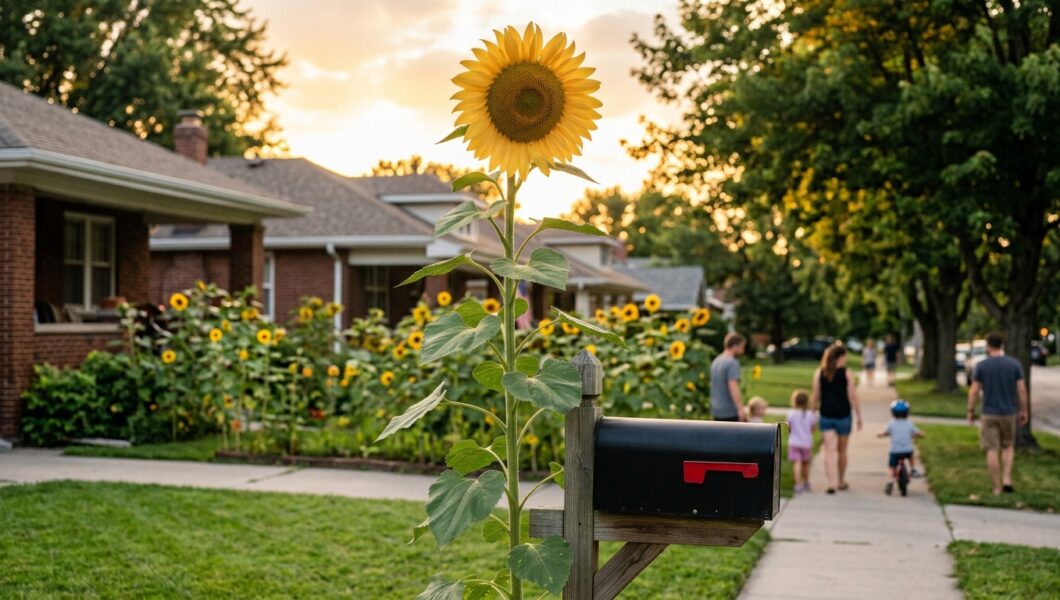
I thought the story of the sunflower had ended when the last seeds were collected.
I was wrong.
The first sunflower had already changed my life in ways I never expected. It had introduced me to Maria. It had given strangers a reason to stop at my mailbox. It had filled a notebook with memories from people I barely knew. And eventually, it had spread across the neighborhood in hundreds of bright yellow blooms.
But I didn’t realize how far that little seed had traveled until one ordinary Saturday morning.
I was walking through the neighborhood with a cup of coffee when I heard a little girl calling to someone.
“Look! It’s one of the sunflower house flowers!”
I turned around.
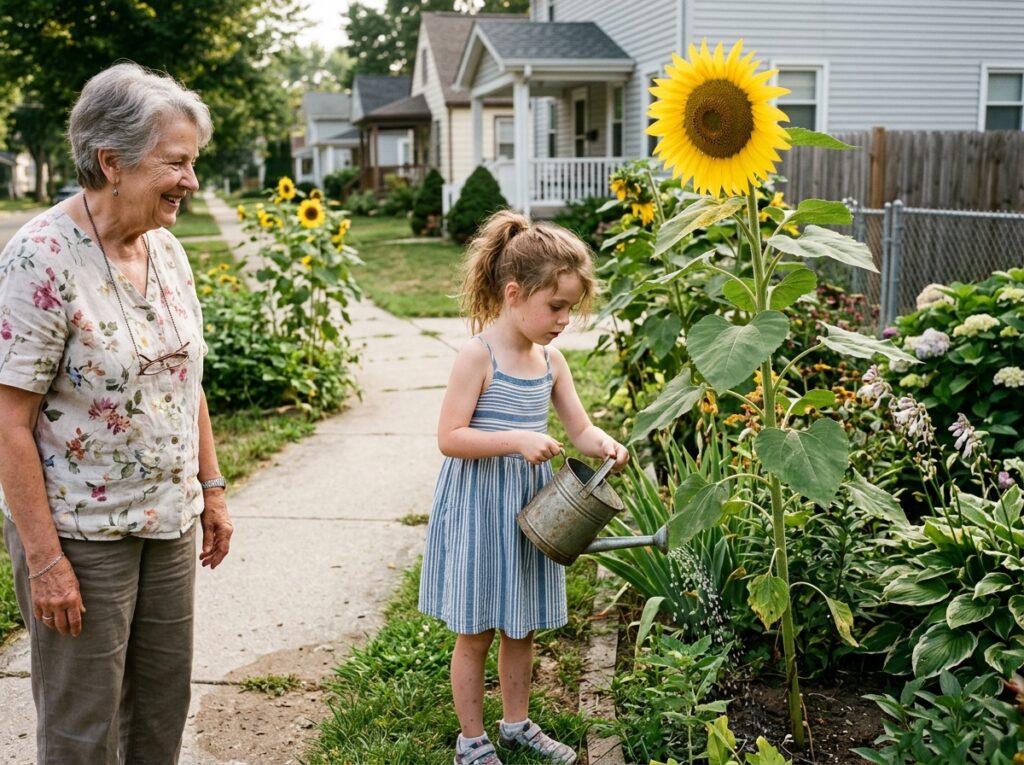
A young girl, probably seven or eight years old, was standing beside a tall sunflower near the sidewalk. She was holding a small watering can with both hands.
Her mother was nearby, taking a photograph.
I smiled.
“That’s a beautiful one.”
The girl looked at me proudly.
“My grandma gave me the seeds.”
“Really?”
She nodded.
“They came from the sunflower house.”
I laughed.
“Well, then you’d better take good care of it.”
She looked at the flower seriously.
“I will.”
Then she carefully poured water around its base.
I kept walking, but something about that moment stayed with me.
The original sunflower had been planted almost ten years earlier.
At the time, it was just one seed.
Now there were children who had never even seen the original flower growing beside my mailbox, yet they were planting its descendants in their own yards.
The thought made me stop.
I turned around and walked back toward the girl.
“Do you know where your grandma got those seeds?”
She pointed toward a house several doors away.
“From Mrs. Maria.”
I smiled again.
Of course.
Maria had been one of the first people who stopped to photograph the original sunflower.
Now her family was passing the seeds along.
That afternoon, I called Maria.
“Do you still have some of the original seeds?”
She laughed.
“I think half the neighborhood has them.”
She wasn’t exaggerating.
Over the years, the seeds had traveled farther than any of us could have imagined.
Someone had given them to a cousin in another part of Omaha.
A family had taken a handful with them when they moved to another state.
A teacher had brought some into her classroom.
A woman who had visited during Sunflower Day had taken several home and planted them in her community garden.
The flower was no longer really mine.
I realized that it had never been mine.
The moment I put that seed into the ground, I had started something I couldn’t control.
And perhaps that was the most beautiful part.
People had taken something small and made it their own.
One family planted sunflowers beside their driveway because their elderly father loved them.
Another family planted them around the mailbox after their daughter had finished cancer treatment, wanting something cheerful outside the house.
A retired teacher planted them along her fence because she said the flowers reminded her of summers when her children were young.
A widower planted three every spring.
He told me they were his wife’s favorite flowers.
“I keep thinking she’ll somehow know they’re still blooming,” he said.
I didn’t know what to say.
So I simply stood beside him.
Sometimes you don’t need to say anything.
The sunflower tradition had become something bigger than gardening.
It had become a collection of little reasons people had to remember, hope, celebrate, or simply smile.
One evening, Maria called me with an idea.
“We should collect the stories.”
“What stories?”
“The stories behind the flowers.”
At first, I wasn’t sure what she meant.
Then she explained.
Every year, hundreds of people planted seeds from the original sunflower. But most of us only knew where the flowers were.
We didn’t know why people planted them.
So Maria suggested creating a second notebook.
Not just a book of comments.
A book of stories.
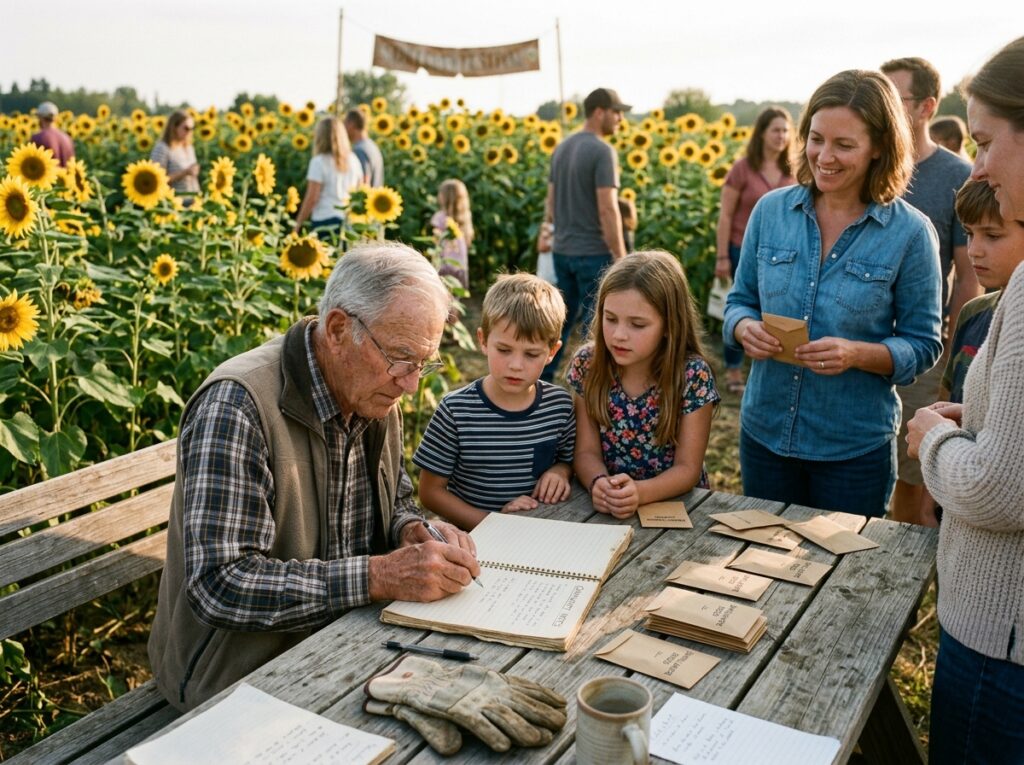
We placed it at the entrance to the park during Sunflower Day.
A simple handwritten sign said:
“Tell us why you planted yours.”
At first, people hesitated.
Then one person wrote something.
Then another.
By the end of the afternoon, pages were filled.
One man wrote about planting a sunflower after losing his brother.
A young mother wrote that her daughter had been afraid to go outside after a difficult year, but watering the flower became something she looked forward to every morning.
A teenager wrote that she had never spoken to her elderly neighbor before the sunflowers gave them something to talk about.
Someone simply wrote:
“I didn’t have a reason. I just thought it was pretty.”
I smiled when I read that one.
That was probably the closest to my original reason of all.
I hadn’t planted the first sunflower because I wanted to build a community.
I hadn’t planted it because I had some grand vision.
I planted it because the seed was free.
And I wondered how many beautiful things in life begin that way.
Without a plan.
Without a goal.
Without anyone realizing what they are starting.
That evening, I sat on a bench in the park after everyone had gone home.
The sunflowers were still standing.
Hundreds of them moved gently in the breeze.
I thought about the first one.
The tiny green sprout I had almost ignored.
The flower that eventually grew taller than me.
The little boy who thought it might be the biggest sunflower in the world.
Maria showing photographs to her mother.
The elderly man telling stories from his childhood.
The notebook filling with messages.
The first Sunflower Day.
And now this.
A community full of flowers carrying pieces of people’s lives.
I realized something that evening.
We often think impact has to be dramatic.
We imagine that changing someone’s life requires a huge act of generosity, an important decision, or some extraordinary moment.
But sometimes impact is much quieter.
Sometimes it is planting a flower.
Sometimes it is leaving a kind note in a notebook.
Sometimes it is stopping to talk to someone who looks lonely.
Sometimes it is giving a neighbor five seeds.
You may never know where that small kindness goes.
A few weeks later, I received a letter.
It was from a woman who had attended one of the Sunflower Day events several years earlier.
I didn’t recognize her name.
She explained that she had been going through an extremely difficult period in her life.
She had recently moved to Omaha and didn’t know anyone.
She felt isolated.
Then one afternoon, she saw a group of children standing around a giant sunflower.
She stopped to look.
Someone invited her to take a seed.
She planted it outside her apartment.
She wrote that the flower became part of her daily routine.
She watered it.
She watched it grow.
She eventually started talking with other people who had planted sunflowers.
Those conversations led to friendships.
Those friendships helped her feel at home.
At the bottom of the letter, she wrote something that I will never forget.
“That flower didn’t fix my life. But it reminded me that I was still part of the world.”
I read that sentence several times.
Then I put the letter down and looked out my window.
There was a sunflower growing near the mailbox.
For a moment, I was back where this whole thing started.
One free packet.
One seed.
One Saturday morning.
I never planted it expecting anything.
And yet, somehow, it had become part of hundreds of people’s lives.
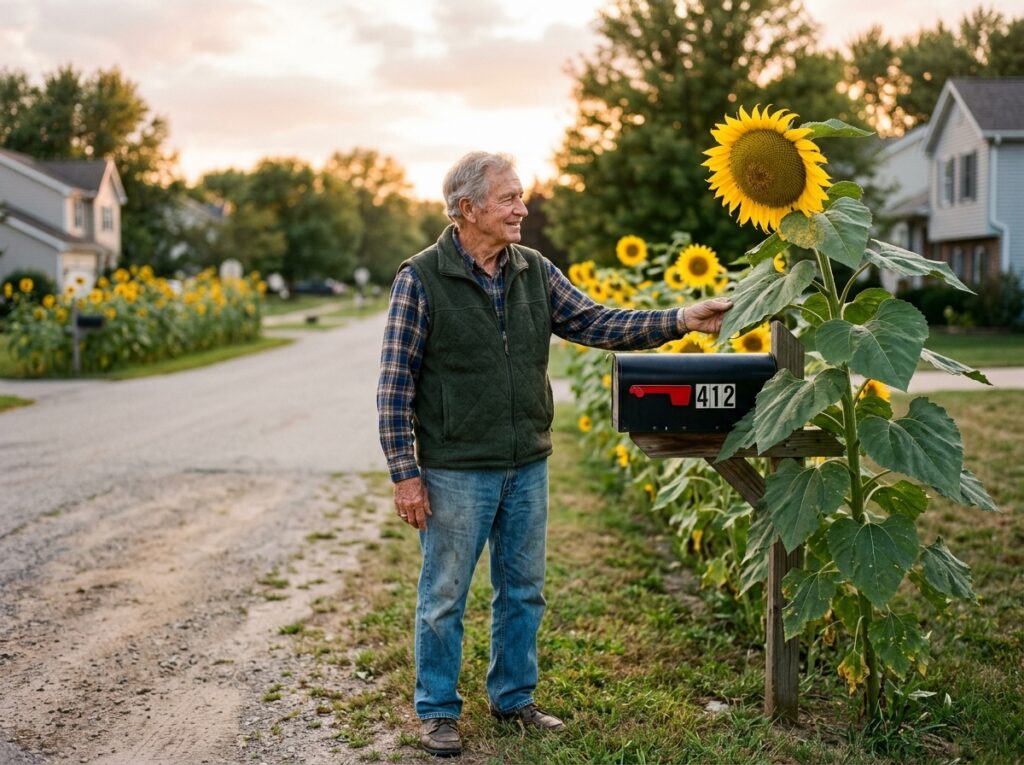
The following spring, something happened that made me understand just how much the tradition had grown.
A local elementary school contacted me.
A teacher wanted to know if I would speak to her students about the sunflower.
I almost laughed.
“I’m not really a gardener,” I told her.
She said, “That’s actually why we want you.”
So I went.
There were about thirty children sitting on the floor of the classroom.
The teacher asked me to explain how the sunflower started.
I told them the truth.
I bought a magazine.
The seed was free.
I almost threw it away.
The children laughed.
Then one little boy raised his hand.
“Did you know it would become this big?”
“No.”
“Did you plan it?”
“No.”
“Did you know everyone would plant them?”
“No.”
He thought about that.
Then he asked, “So how did you make it happen?”
I smiled.
“I didn’t.”
The classroom became quiet.
“The sunflower grew because I planted it. But everything that happened afterward was because other people decided to keep it going.”
The teacher nodded.
I looked at those children.
“That’s how good things work sometimes.”
One child can share a seed.
Another can plant it.
Someone else can save the next generation of seeds.
Another person can give those seeds away.
And eventually, something that began with one tiny decision can become part of an entire community.
After the talk, the children each received a seed.
I watched them carefully place the tiny envelopes into their backpacks.
One girl came over before leaving.
“Can I plant mine at home?”
“Of course.”
“Can I give some of the seeds to my friend later?”
“That’s exactly what you should do.”
She smiled.
Then she ran back to her classmates.
I stood there watching them leave.
And I thought about how many times in life we underestimate small beginnings.
We think the things we do today need to produce immediate results.
We want to know exactly where something is going.
We want guarantees.
But nature doesn’t work that way.
You put a seed into dark soil.
For days, nothing appears to happen.
Then one morning, there is a tiny green shoot.
You water it.
You wait.
You protect it.
You give it sunlight.
And eventually, something appears that you could never have seen when you first buried that seed.
Maybe people are a little like that too.
A kind word may sit quietly inside someone’s memory for years.
A small gesture may give someone hope when you don’t even realize they need it.
A conversation may become a friendship.
A friendship may become a community.
And a community can become something that continues long after the person who started it is gone.
I still don’t consider myself much of a gardener.
I forget to water plants.
I still occasionally walk past something growing in my yard and realize I haven’t paid attention to it in days.
But I have learned to respect seeds.
Especially small ones.
Because now I know you never really know what you’re planting.
Today, the neighborhood still celebrates Sunflower Day.
Every year, the park fills with yellow.
Children bring flowers they grew themselves.
Older neighbors share seeds.
Families take photographs.
People who once didn’t know each other now greet one another like old friends.
And somewhere in the crowd, there is always a little envelope being handed from one person to another.
Inside are a few tiny seeds.
Nothing special to look at.
Just small, ordinary seeds.
But everyone knows the story behind them.
They came from the first sunflower.
The one planted beside a mailbox because the packet was free.
Sometimes I stand at the edge of the park and watch everyone.
And I think about that Saturday morning years ago.
If I had cleaned out that kitchen drawer a little differently, maybe I would have thrown the packet away.
If I had been too busy that morning, maybe I wouldn’t have planted it.
If the seed hadn’t grown, none of this would have happened.
So many things had to happen by chance.
But perhaps that’s what makes it beautiful.
We don’t always get to choose the size of the beginning.
We only get to decide whether we will plant it.
A smile.
A conversation.
A flower.
A seed.
A small act of kindness.
You may never see the full result.
You may never know how far it travels.
But somewhere, someday, someone may be standing beside a sunflower that began with something you did.
And they may have no idea where it came from.
That’s okay.
Not everything meaningful needs your name attached to it.
Sometimes the greatest things we leave behind are the things that continue growing after we’ve stopped paying attention.
And every spring, when I see those first green shoots appearing across the neighborhood, I remember the lesson that little free seed taught me.
You never really know what might grow.
So plant something good.
Then give it time.
And if you’re lucky, one day you’ll look around and realize it didn’t just grow.
It spread.


No Comments