

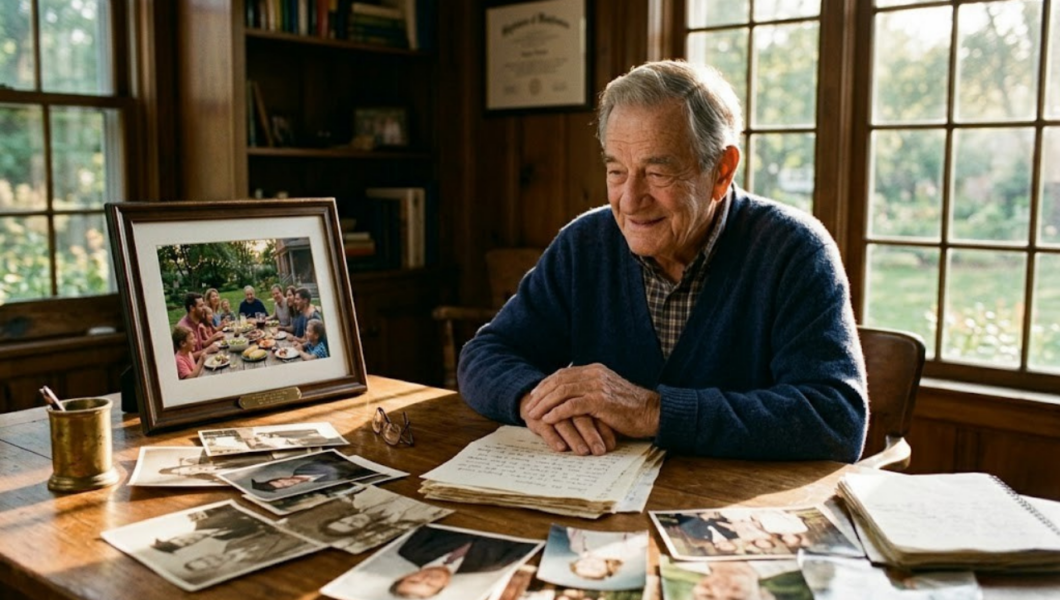
For a while after Kevin left the diner, I just sat there.
My coffee had gone cold.
The waitress came by twice asking if I wanted a refill, and both times I nodded without really hearing her. My hands stayed wrapped around that business card he had left behind.
Kevin Roberts Engineering.
Thirty-eight years.
Thirty-eight years of carrying guilt that had suddenly vanished in the space of an hour.
You would think relief feels light.
It doesn’t.
Not at first.
At first, it feels almost painful.
Like carrying a heavy backpack for decades and then having someone cut the straps without warning. Your shoulders don’t know what to do with the absence.
I drove home in silence that afternoon.
No radio.
No news.
Just the sound of tires humming against pavement and memories moving through my mind.
I kept seeing Kevin at seventeen.
Sitting in the chair across from my office desk.
Nervously twisting his hands.
Trying to choose between his future and his family.
Back then, I thought I was helping him make an impossible decision.
For decades afterward, I convinced myself I’d ruined his life.
Now I wasn’t sure I understood life at all.
Because somehow the story I’d been telling myself for nearly forty years wasn’t the real story.
Not even close.
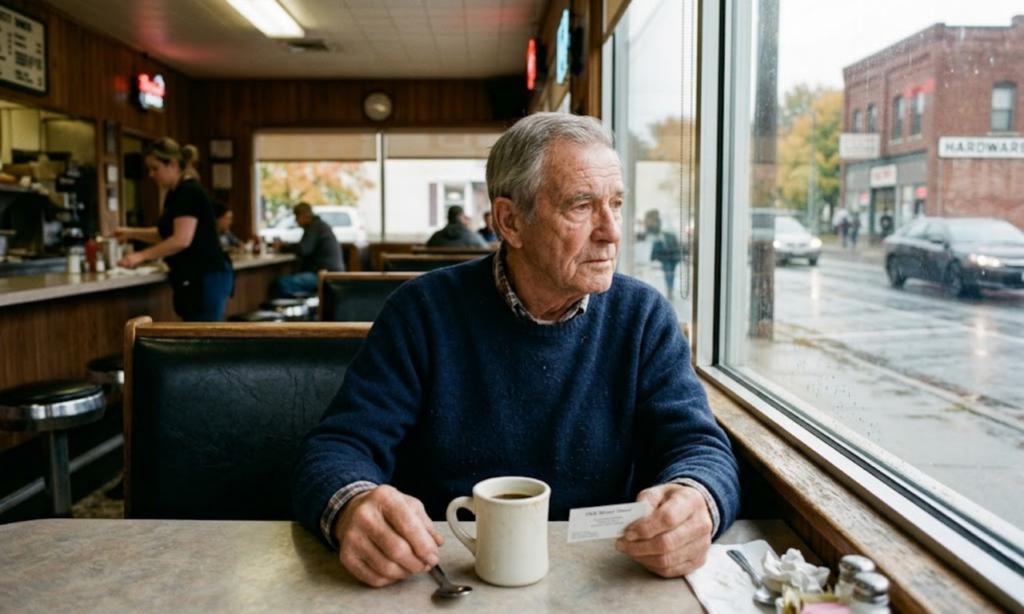
That night I pulled an old cardboard box from the top shelf of my closet.
My wife, Margaret, had been gone for six years by then, and after she died, I never found much reason to organize things.
The box contained old photographs, retirement papers, newspaper clippings, and dozens of letters from former students.
Teachers save strange things.
Guidance counselors save even stranger things.
Near the bottom was a yearbook from 1987.
The cover was worn.
The pages smelled faintly of dust and age.
I sat at the kitchen table and turned slowly through the photographs.
There he was.
Kevin Roberts.
Seventeen years old.
Dark hair.
Serious eyes.
The same expression he still carried decades later.
I stared at the picture for a long time.
Then I noticed something I had never paid attention to before.
Under his senior portrait, he’d chosen a quote.
“Success is not measured by where you begin, but by how many people rise because you were here.”
I read it three times.
Then four.
My vision blurred.
Because somehow that boy had become exactly the man he promised to be.
Not through MIT.
Not through the path anyone expected.
But through sacrifice.
Through persistence.
Through love.
And through refusing to let disappointment define him.
I wondered how many people would never know his story.
How many would see only a construction worker and never realize they were looking at someone who had quietly changed generations.
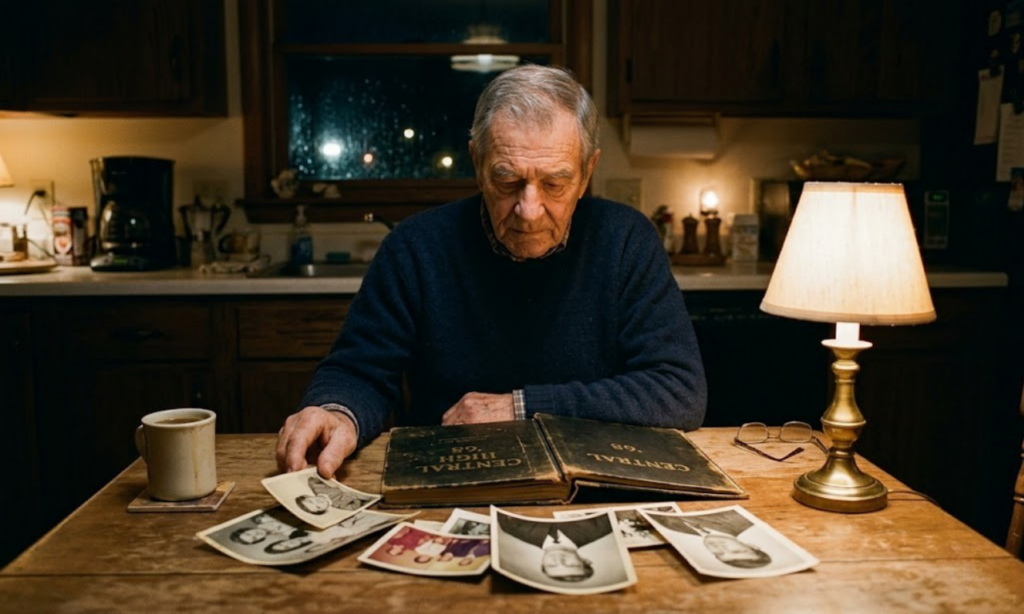
Three weeks later, a letter arrived.
Actual paper.
Actual handwriting.
No emails.
No text messages.
Just a white envelope with my name written carefully across the front.
I recognized the handwriting immediately.
Kevin.
Inside was a folded note and several photographs.
The note began simply.
Mr. Thomas,
I forgot to tell you something at the diner.
That sentence alone made me smile.
Some things never change.
Students are still remembering one last thing after the conversation is over.
I kept reading.
You spent thirty-eight years believing you made the wrong choice. But I want you to know something. After I left your office in 1987, I went home and told my mother what you’d said.
She cried.
Not because she wanted me to stay.
Because she thought I was going to leave feeling guilty.
You gave her peace too.
I stopped reading for a moment.
That possibility had never even crossed my mind.
All those years I’d been focused on Kevin.
I’d never considered his mother.
The woman sitting beside her husband after a devastating stroke.
The woman trying to keep a farm alive while watching her family unravel.
The woman carrying fears no parent should ever have to carry.
One conversation had reached farther than I realized.
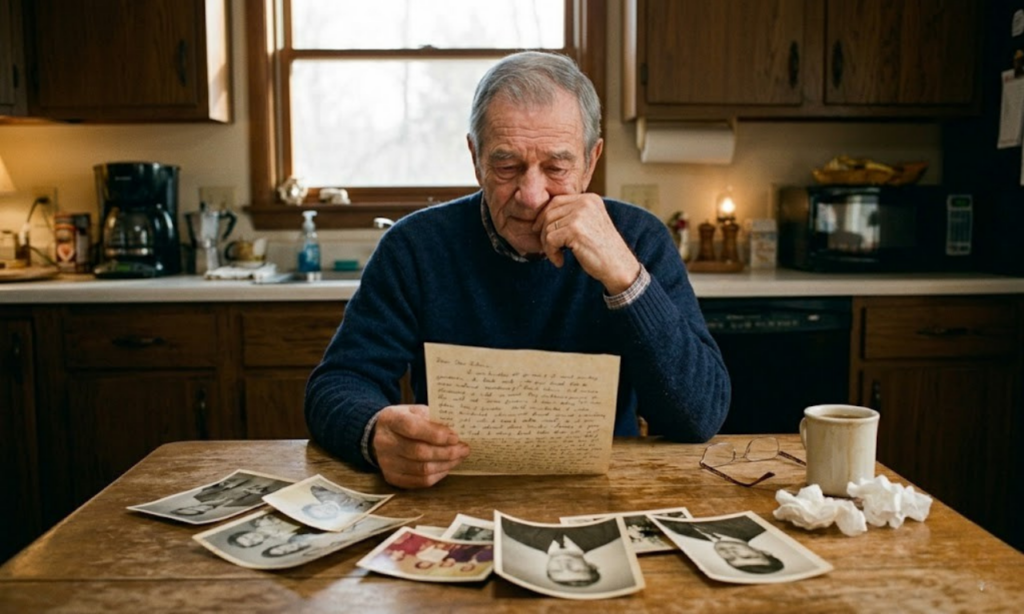
The photographs told the rest of the story.
Marcus standing beside a laboratory prototype.
Tyler speaking at a technology conference.
Shauna in a white research coat, smiling beside equipment I couldn’t begin to understand.
Then there was one final photograph.
The one that stopped me completely.
It showed Kevin sitting at a backyard picnic table.
Around him were his children.
Their spouses.
Several grandchildren.
Everyone laughing.
Everyone together.
The picture wasn’t posed.
Nobody was looking at the camera.
It was real life caught in motion.
The back of the photograph contained a handwritten note.
This is what your advice built.
Not a career.
A family.
I set the picture down carefully.
Then I cried harder than I had cried in years.
Not because I was sad.
Because I finally understood something.
For most of my life, I measured success the way schools measure success.
Degrees.
Universities.
Job titles.
Achievements.
Prestige.
Those things matter.
They absolutely matter.
But they are not the whole story.
Sometimes the most important thing a person creates isn’t listed on a résumé.
Sometimes it’s a family.
Sometimes it’s resilience.
Sometimes it’s three children who go on to change the world because their father chose to stay alive long enough to raise them.

A month later, Kevin invited me to Shauna’s dissertation defense.
At first I declined.
I felt awkward.
Like I didn’t belong.
Then he called personally.
“Mr. Thomas,” he said, “there wouldn’t be a dissertation defense without you.”
So I went.
The university campus felt enormous.
Full of young people carrying backpacks and rushing between buildings.
I suddenly felt every one of my seventy-four years.
The presentation itself lasted nearly two hours.
Most of it went completely over my head.
Medical terminology.
Research data.
Statistical models.
Things I couldn’t pretend to understand.
But I understood one thing.
When Shauna spoke about helping future stroke patients and their families, her voice carried the same quiet determination her father had carried into my office nearly four decades earlier.
Afterward, people gathered to congratulate her.
Eventually she made her way over to me.
“You’re Mr. Thomas.”
I nodded.
She smiled.
“My dad talks about you all the time.”
I laughed.
“I hope only the good stories.”
She shook her head.
“He says you saved his life.”
For a moment, neither of us spoke.
Then she reached forward and hugged me.
A complete stranger.
Yet somehow not a stranger at all.
Because standing there, surrounded by generations of consequences neither of us could have predicted, I realized something beautiful.
We rarely get to see the endings of the stories we help begin.
Teachers don’t.
Parents don’t.
Counselors don’t.
Most of the time we plant seeds and walk away.
We never know what grows.
But every now and then, if we’re incredibly lucky, life pulls back the curtain.
And lets us see the harvest.
These days the photographs stay framed on my bookshelf.
Visitors ask about them sometimes.
I tell them the story.
Not because it makes me look wise.
If anything, it reminds me how little we actually know.
A decision that looked like failure became the foundation of a family.
A sacrifice that looked tragic became the beginning of purpose.
A conversation I spent thirty-eight years regretting became one of the most meaningful moments of another person’s life.
The truth is, none of us can see far enough ahead to understand the full impact of our choices.
We only get pieces.
Fragments.
Moments.
The rest unfolds long after we’re gone.
Kevin thought he lost MIT.
Instead, he gained a life.
I thought I destroyed a future.
Instead, I helped preserve one.
And somewhere today, because Kevin stayed alive, because he raised his children, because Shauna pursued her research, another family may someday hear better news in a hospital room.
That’s bigger than MIT.
Bigger than regret.
Bigger than anything I imagined when a quiet seventeen-year-old walked into my office in the spring of 1987.
And every time I look at those photographs now, I think the same thing.
Sometimes the future we mourn never existed.
And sometimes the future we never imagined turns out to be far more beautiful.
No Comments