

The morning after Rosie’s fiftieth birthday party, I found her sitting at the kitchen table long before anyone else was awake.
Sunlight spilled through the curtains, catching the glitter still clinging to the edge of her birthday card. The tiara from the night before sat carefully beside her cereal bowl, placed there with the kind of reverence some people reserve for family heirlooms.
She looked up when I entered.
“Best birthday ever,” she said.
Then she smiled and went back to eating her toast.
Something about that moment stayed with me.
Maybe because the party had been so loud, so joyful, so full of people who loved her.
And now there we were.
Just the two of us.
An ordinary Tuesday morning.
The dishes still needed washing.
The dog still needed feeding.
The trash still had to go out.
Life had returned to normal.
Yet somehow, everything felt different.
Because for the first time since our mother’s death, I realized Rosie wasn’t simply surviving her grief anymore.
She was beginning to build a life around it.
Grief is strange.
Most people expect it to move in a straight line.
First sadness.
Then healing.
Then acceptance.
But that isn’t how it worked for Rosie.
Some days she seemed completely at peace.
She would laugh at television shows, help me fold laundry, dance around the living room when her favorite songs came on.
Then without warning, something small would pull her backward.
A smell.
A photograph.
A familiar recipe.
One afternoon I found her standing in front of the pantry staring at a can of tomato soup.
Just staring.
For several minutes.
When I asked what was wrong, tears immediately filled her eyes.
“Mommy made this when I was sick.”
That was all.
Not a dramatic breakdown.
Not a crisis.
Just a simple memory that arrived without permission.
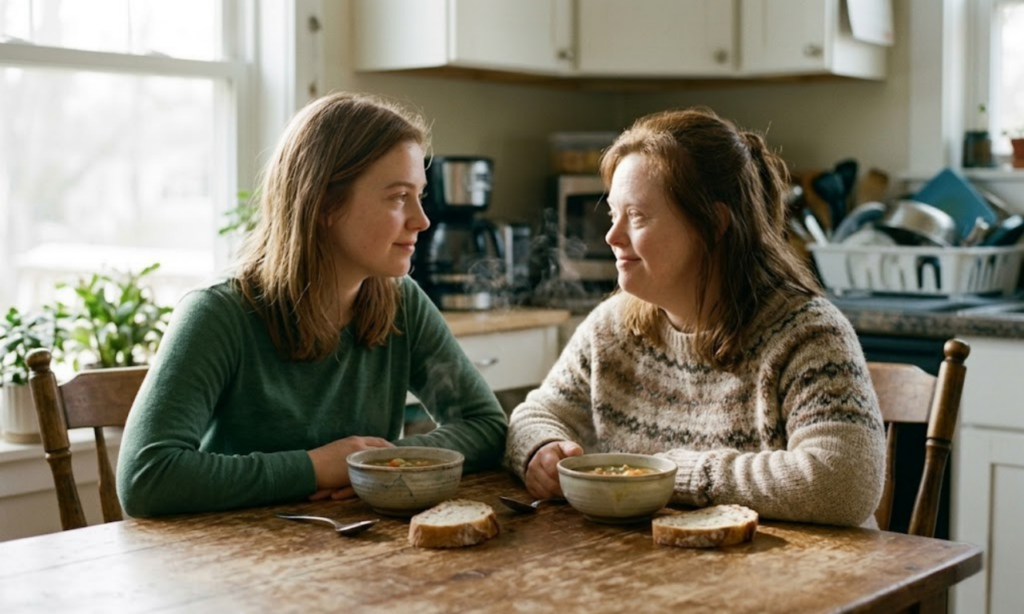
We sat together at the kitchen table and ate tomato soup for lunch.
Halfway through the meal, she smiled.
“Mommy would like this.”
I smiled too.
“Yes,” I said. “I think she would.”
Those moments taught me something important.
Healing doesn’t mean forgetting.
Sometimes healing means learning how to carry memories without letting them crush you.
Rosie was learning.
And in many ways, so was I.
Several months after the birthday party, something unexpected happened.
Rosie asked if she could visit the church again.
For over a year she had refused.
Every invitation was met with the same answer.
“No. Mommy there.”
What she meant was simple.
The church held too many memories.
Too many reminders.
Too many empty spaces.
But one Sunday morning she walked into my bedroom while I was getting ready and said, “I think Jesus wants me to come back.”
I almost dropped my hairbrush.
“Are you sure?”
She nodded.
“I miss my friends.”
The drive there felt longer than usual.
Rosie sat quietly beside me, hands folded tightly in her lap.
When we pulled into the parking lot, she froze.
For a moment, I thought she might change her mind.
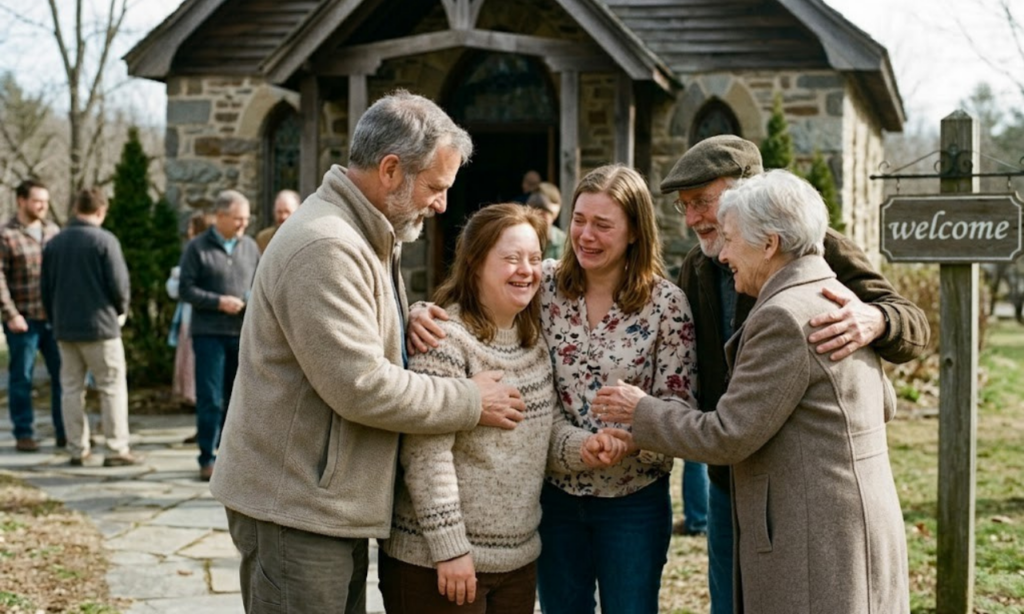
Then one of the church ladies spotted her.
“Rosie!”
The woman hurried across the lot and wrapped her in the biggest hug imaginable.
Others followed.
Then more.
By the time we reached the front doors, Rosie was surrounded by people who had missed her terribly.
People who remembered every birthday.
Every Christmas pageant.
Every volunteer project.
People who never saw her as different.
Only as Rosie.
When the service ended, she stood near the altar for a long moment.
Looking up.
Smiling softly.
Later, on the drive home, she turned toward me.
“Mommy knows I came.”
It wasn’t a question.
It was certainty.
And somehow, hearing her say it brought me peace too.
Life settled into a rhythm after that.
Not perfect.
Not easy.
Just steady.
Rosie became part of every corner of our household.
She learned where everything belonged.
She knew exactly when garbage day was.
She reminded me about appointments I had forgotten.
She somehow managed to notice every missing remote control before anyone else.
Visitors adored her.
Children gravitated toward her.
Even the neighborhood dogs seemed determined to stop and say hello whenever she was outside.
One evening my grandson asked me a question.
“Grandma, who’s taking care of Rosie?”
The answer came faster than I expected.
“We all are.”
Because it was true.
Yes, Rosie lived with me.
But she belonged to all of us.
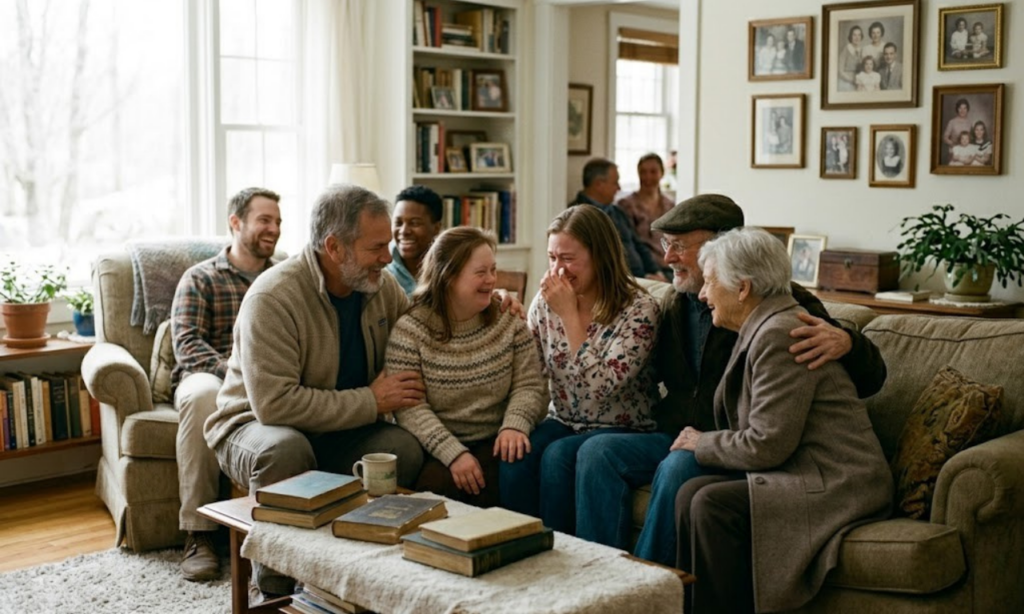
My children called her.
My siblings visited.
Neighbors checked on her.
Church friends included her.
Love had expanded around her like a protective circle.
And maybe that was the real answer to the question people always ask.
What happens when parents are gone?
Ideally, community steps in.
Family steps in.
Love steps in.
Not because someone has to.
Because someone chooses to.
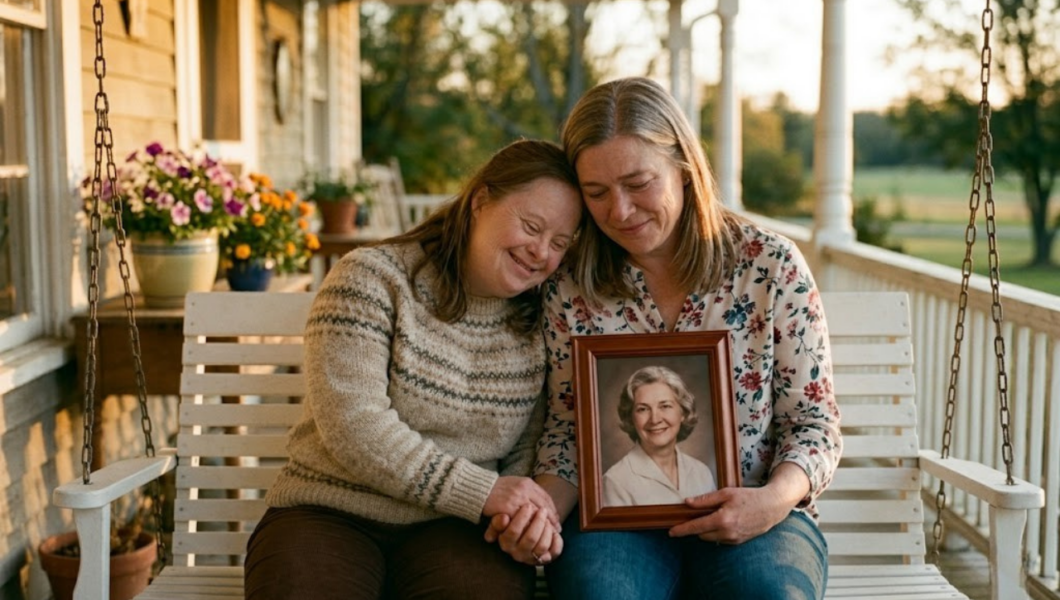
A few weeks ago, I found Rosie sitting on the porch swing at sunset.
She was holding an old photograph of our mother.
One of her favorites.
The edges had become worn from being handled so often.
I sat beside her.
For a while, neither of us spoke.
Then she pointed to the photograph.
“Mommy loved me.”
It wasn’t really a statement.
It was a memory she needed to hear out loud.
“She absolutely did.”
Rosie nodded.
Then she surprised me.
“And you love me too.”
The simplicity of it nearly broke me.
Because she was right.
Not out of obligation.
Not out of duty.
Not because of paperwork or guardianship documents or court orders.
I loved her because she was my sister.
Because she always had been.
Because family isn’t defined by convenience.
It’s defined by presence.
Showing up.
Staying.
Choosing one another again and again.
As the sun slipped lower, Rosie leaned her head against my shoulder.
The same way she used to lean against our mother.
And for the first time in a very long while, neither of us felt like something was missing.
People still ask me what happens to adults with Down syndrome when their parents can no longer care for them.
I understand why.
It’s a question rooted in fear.
In uncertainty.
In love.
But when I think about Rosie, I no longer think about guardianship forms or legal arrangements first.
I think about birthday parties.
Church hugs.
Kitchen conversations.
Tomato soup on difficult afternoons.
Porch swings at sunset.
I think about a little girl who was once expected to live her life in an institution.
A woman who grew into the heart of a family.
A sister who taught all of us that a meaningful life cannot be measured by independence alone.
Sometimes it is measured by connection.
By belonging.
By knowing there will always be a place where someone is waiting for you.
And every evening, when Rosie walks through the house making sure everyone is home before she goes to bed, I am reminded of something my mother understood the day she refused to sign those papers in that hospital room.
The world saw limitations.
She saw her daughter.
Fifty years later, that choice still echoes through every room of our home.
Because in the end, Rosie never became someone else’s responsibility.
She remained exactly what she had always been.
Our sister.
And when the time came, she didn’t get sent away.
She came home.

No Comments