

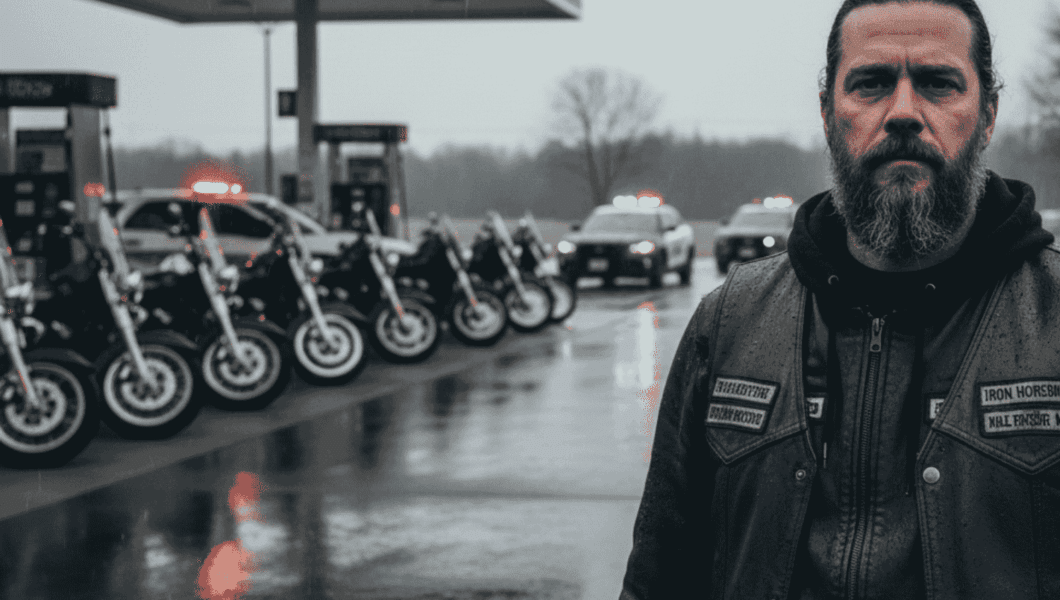
They thought a biker gang was kidnapping a teenage girl in broad daylight, but I was the only one who knew the truth, and it was worse than anyone could imagine.
I watched it unfold from the cab of my old Ford truck, parked two pumps away like I’d done a thousand times before on charity ride mornings. The air smelled like gasoline and cold wind. The sky had that washed-out gray Kentucky gets when winter is deciding whether to stay.
The girl couldn’t have been more than fifteen.
She stumbled barefoot across the concrete like her body had forgotten how to walk normally. Mascara streaked down her cheeks in thick black rivers, and her dress was torn in a way that didn’t look like an accident. It looked like escape. She collapsed beside pump three and folded in on herself, sobbing like her ribs were trying to break open.
Nobody else saw the black sedan that had screeched away moments earlier.
Nobody else saw her fling herself out of that moving car before it vanished down Route 42 like a thing that didn’t want witnesses.
What everyone did see was forty-seven leather-clad bikers rolling into the Chevron at the worst possible time.
Thunder Road MC. My brothers.
And that morning, I wasn’t wearing my cut. No helmet, no vest, no patch. My Harley was in the shop, so I’d driven the truck like some regular old man. The kind people don’t look twice at. The kind of man you assume wouldn’t know anything about motorcycles or trouble.
The kind of man who can witness a storm and stay invisible.
Big John saw her first. At seventy-one he’s still built like a wall, shoulders wide, arms thick with old strength and old scars. He shut off his bike and swung down with that slow steadiness older men get, like their bodies have learned not to waste motion.
He walked toward the girl with his hands raised.
“Miss?” he said, voice low. “You okay?”
She jerked back hard, pressing herself against the pump like the metal could protect her. Her lips trembled.
“Please don’t hurt me,” she whispered. “Please. I won’t tell anyone anything.”
Something snapped inside my chest at those words.
Not because she said it.
Because she said it like she meant it.
The crew dismounted behind Big John, but not like movies. Nobody rushed her. Nobody loomed. They moved the way we do when we see fear and we know we can’t outrun it for someone, only soften its edges.
Tank, our road captain, pulled off his heavy leather jacket even though it was forty degrees and laid it on the ground near her feet. Then he took three steps back, palms open.
“That’s yours if you want it,” he said, gentle as you can be when you’re built like a freight train. “Nobody here’s gonna touch you unless you say so.”
The girl snatched the jacket like it was the first safe thing she’d held in her life. It swallowed her whole.
Then the brothers did what we always do when a kid is overwhelmed at a toy drive, or when an anxious elderly woman gets crowded during a food distribution.
They turned outward.
A circle around her, backs to the girl, faces toward the world.
A human wall.
From where I sat, I could see the attendant inside the station staring with big eyes. He grabbed the phone with shaking hands, jabbing at the keypad like he was calling the end of the world.
I saw his lips through the glass.
“Biker gang kidnapping a girl.”
And my gut tightened, because I knew exactly what would happen next.
Not because cops are evil.
Because the story writes itself when people are already afraid.
I grabbed my phone, already dialing before the first siren even arrived. I didn’t call 911. Somebody else already had. I called Tank’s personal number, even though he was twenty feet away.
He answered on the second ring.
“Patch?” he said.
“Sirens,” I told him. “Coming fast.”
There was a pause. He understood. We all did.
“Copy,” he said. “Hold.”
I watched the girl shrink further into herself. Her shoulders hunched inside Tank’s jacket like she wanted to disappear under it. I could see her hands shaking as she clutched the leather.
Big John stayed close but not too close, his posture calm, like a grandfather waiting in a hospital lobby. He didn’t crowd her. He just made sure his body was between her and the highway.
That’s when my eyes caught a detail that made my skin go cold.
The girl’s left wrist.
There was a thin, red ring around it, raw and angry like she’d been yanked by something tight. Not a bracelet mark. Not jewelry. It looked like restraint.
She kept rubbing at it like it burned.
Whatever happened in that black sedan wasn’t a misunderstanding.
It wasn’t a boyfriend fight.
It was something she’d been trained to fear.
I stepped out of the truck. The cold hit my face hard. I walked slowly toward the scene like I belonged there, because I did, even without my cut.
The girl looked up briefly and flinched, then looked away again. Her gaze stayed low like she’d been taught that eye contact causes punishment.
“Hey,” I said softly, keeping my distance. “You did the right thing. You got out.”
She blinked. The smallest crack in her sobbing.
Tank glanced at me without turning his head fully. A quick look that said: read her, not the crowd.
Then the first cruiser arrived.
It came into the parking lot with lights flashing, tires cutting hard. The officer stepped out already wound tight, hand near his holster. Behind him, another cruiser. Then another.
A small crowd began to form.
A man filling up his minivan. A couple in a pickup. Someone with a phone held up like a weapon. People love filming fear. They love getting close enough to danger to feel alive without actually risking anything.
The first cop shouted.
“Everybody back! Hands where I can see them!”
The brothers didn’t argue. Forty-seven hands went up in a wave, palms open, like we were training for it.
Because we were.
Big John stepped back slowly. Tank did the same. Nobody moved too fast. Nobody tried to explain with too many words. You don’t win against panic by giving it more noise.
The girl made a small sound in her throat.
Not a cry. More like a broken breath.
The officer pointed at Tank.
“Step away from the girl!”
Tank took a step back.
The girl whimpered and grabbed the jacket tighter.
The officer looked at the circle of bikers and didn’t see the wall.
He saw a cage.
“Is she being held against her will?” he shouted.
And that’s when the girl did something that turned the whole air electric.
She didn’t say yes.
She didn’t say no.
She whispered, barely audible, to the leather wall around her.
“He’ll kill me,” she said.
My stomach dropped.
The cop didn’t hear. The crowd didn’t hear. The phones didn’t catch it.
But I did.
And Tank did.
Big John’s jaw clenched.
Tank spoke calmly, voice raised enough to carry without sounding like a threat.
“Officer,” he said, “she’s not with us. She ran to us.”
The officer barked back, “Then why is she wrapped in your jacket?”
Tank hesitated.
Because the truth is hard to explain in ten seconds to a man holding a gun.
“Because she’s freezing,” Tank replied. “And because she asked.”
The officer’s eyes narrowed like he didn’t like that answer.
And then the second officer said the sentence that made my chest burn.
“Could be trafficking,” he muttered, loud enough for others to hear.
I took two steps forward, hands up.
“Officer,” I said, “I saw her jump out of a black sedan.”
Both cops snapped their attention to me like I’d just appeared out of thin air.
“Who are you?” the first officer demanded.
“Name’s Clay,” I said. “I was in my truck when it happened.”
“What’s your relationship to them?” he asked.
I almost laughed. Not because it was funny. Because it was predictable.
I pointed at my gray beard. My worn boots. The Ford behind me.
“None that you can prove at a glance,” I said evenly. “But I’m telling you what I saw.”
The officer hesitated.
He didn’t want to believe the biker scene was wrong. He wanted the simple story. The clean headline.
But my words landed like a pebble thrown into a pond.
Ripples.
“Black sedan,” the second officer repeated. “Make? Model?”
“Dark,” I said. “Tinted windows. Fast.”
A third cruiser arrived. A supervisor, judging by the way he walked. Older, slower. More tired.
He took in the scene in three seconds. The girl shaking. The bikers with hands up. The crowd filming. The tension ready to snap.
He raised his voice.
“Everybody hold position,” he said. “No sudden moves.”
Then he looked straight at the girl.
“Sweetheart,” he said, softer. “Are you hurt?”
The girl didn’t answer.
Her eyes stayed fixed on the road.
Not on the officers.
Not on the bikers.
On Route 42.
Like she was waiting for something to come back.
That’s when I knew. The sedan didn’t just drop her.
It would return for her.
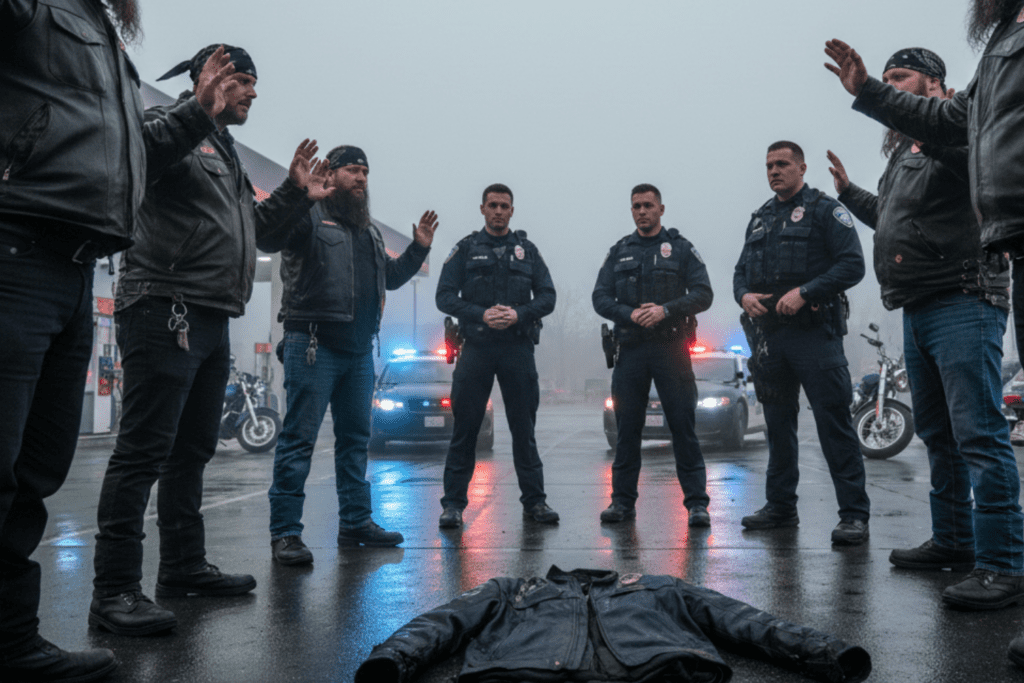
The supervisor signaled two officers toward the girl with slow hands, the way you approach a frightened animal. One officer carried a thermal blanket. Another had a radio pressed to his shoulder.
When they moved in, Big John shifted his stance slightly. Not threatening. Just protective. The kind of shift a man makes when he’s watched too many people get hurt.
The supervisor noticed.
His gaze sharpened.
But he didn’t escalate.
He looked at Big John and spoke like a man trying to keep the lid on a boiling pot.
“Sir,” he said, “I appreciate you stepping back.”
Big John nodded once. “We’re not here for trouble.”
The girl finally lifted her head.
Her face was pale. Her eyes swollen from crying. Her mascara was smeared so badly it looked like bruising from a distance. There was blood on one knee, fresh against her skin.
She looked at the officer holding the thermal blanket like it was a trap.
He knelt carefully.
“Can I help you?” he asked.
The girl stared at him for a long moment.
Then she whispered, “If I talk, he’ll come.”
The officer froze.
The supervisor stepped closer.
“Who’s he?” the supervisor asked.
The girl’s throat worked like she was swallowing glass.
She glanced at the bikers behind her, then back at the supervisor.
She didn’t trust uniforms.
She barely trusted air.
But she trusted the circle.
And that alone told the truth louder than any statement.
“He’s my mom’s boyfriend,” she whispered.
Something shifted in the supervisor’s face.
Not anger.
Understanding.
He nodded slowly. “Okay,” he said. “Okay. We’re going to keep you safe.”
The girl’s eyes flicked to his holster like she didn’t believe safety could come from that.
I watched the brothers.
Tank’s face hardened, not with violence, but with restraint. Big John’s hands curled and uncurling like he was fighting his own instincts.
We’ve seen pain before. We’ve seen it in men who came back from war with something missing. We’ve seen it in kids at charity drives who flinch when you lift a hand. We’ve seen it in women hiding bruises under makeup while they smile at a grocery store cashier.
Some of us grew up inside it.
The girl whispered one more thing, almost too quiet to hear.
“He has friends,” she said.
The supervisor’s radio crackled. Another officer returned from the store with the attendant, who looked like he wanted to disappear.
“Sir,” the officer said to the supervisor, “the attendant says he called it in as a kidnapping.”
The supervisor didn’t snap at him.
He just turned and stared at the attendant until the attendant looked down at his shoes.
Then the supervisor said, very calmly, “You made an assumption.”
The attendant swallowed. “It looked like…”
“I know,” the supervisor cut in. “And now we’re going to deal with what it really is.”
He turned back to the girl.
“What’s your name?” he asked.
She hesitated.
Then said it.
“Emma.”
The second she spoke her name, Tank stepped back another full step, giving her space, like he understood something sacred had happened. A name spoken out loud is a kind of reclamation.
The supervisor nodded.
“Emma,” he said, “I’m going to have an officer take you to the station. We’ll call Child Services. We’ll call medical. You’re not going back there today.”
Emma’s eyes filled, not with relief, but with fear.
“You don’t understand,” she whispered. “He’s going to come.”
The supervisor was about to answer when the sound came.
A squeal of tires, too close.
A black sedan cutting into the parking lot like it owned the ground.
My whole body went cold.
It came fast, then stopped hard near the edge of the lot. Tinted windows. Dark body. Exactly what I saw earlier.
Emma’s breath left her like a punched-out candle.
“That’s him,” she said.
The supervisor’s hand went up.
Officers moved. Radios lit up with noise. People filming suddenly realized the danger might actually touch them, and they backed up fast.
The sedan’s driver-side window cracked down.
A man leaned out, smiling like he was late for nothing.
His smile didn’t belong in that moment.
That’s what made it terrifying.
“Emma!” he shouted, voice full of fake concern. “Baby, what are you doing? Come on, you’re scaring everybody.”
Emma flinched.
I saw the way her whole face changed, like her body had learned terror as a reflex.
The supervisor stepped forward. “Sir,” he said. “Turn off the engine.”
The man ignored him and spoke directly to Emma. “Get in the car,” he said, still smiling. “Right now.”
Big John took one step forward.
Just one.
And the man’s smile slipped when he saw the old biker in leather.
The man’s eyes hardened.
This wasn’t a family moment anymore. It was possession challenged.
“Officer,” the man said loudly, “these people are threatening my daughter.”
Emma made a small sound.
“No,” she whispered.
Tank’s voice was low, controlled. “That ain’t her father.”
The supervisor raised his hand again. “Sir,” he said, “step out of the vehicle.”
The man laughed.
He shifted into gear.
And for one split second, I thought he was going to ram through us.
But he didn’t. He swerved hard, tires squealing, and shot out of the lot.
Emma collapsed into sobs.
The supervisor turned to his officers.
“Go,” he snapped. “Now.”
Two cruisers peeled out in pursuit.
And the Chevron parking lot, which ten minutes ago was a place for coffee and charity photos, had become a crime scene.
The crowd stopped filming.
They watched.
Because suddenly the worst story wasn’t the bikers.
It was the black sedan.
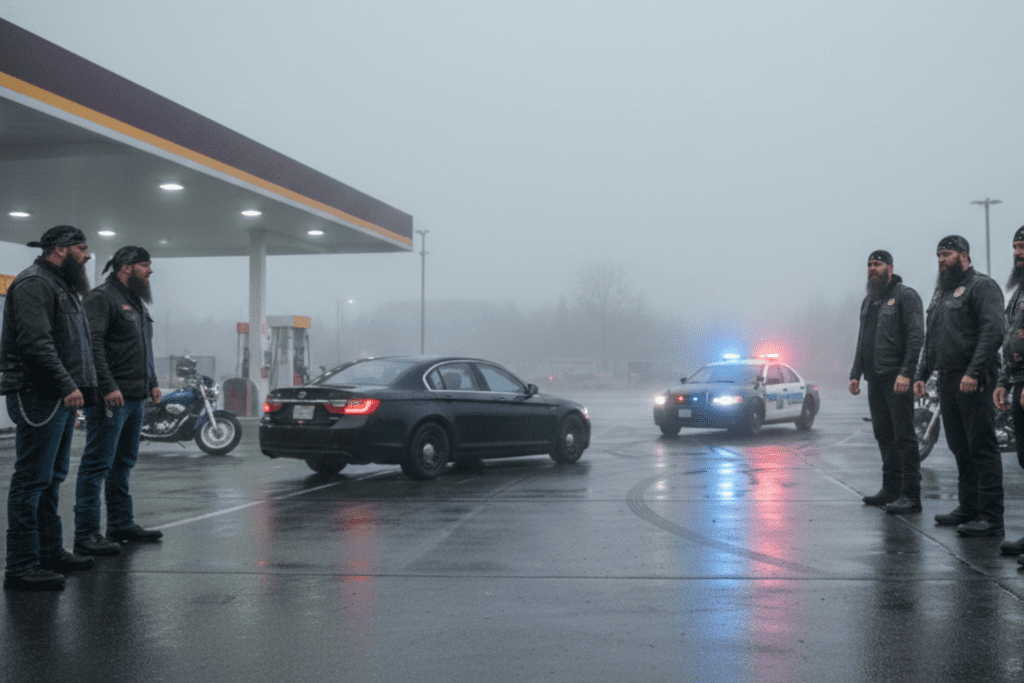
The supervisor looked at Tank, then Big John, then me.
His voice softened.
“You all did the right thing,” he said.
Tank nodded once. “We weren’t gonna leave her.”
The supervisor’s eyes were tired. “Somebody almost did,” he said, and we all knew he meant more than the attendant.
Emma sat on the ground wrapped in Tank’s jacket and the thermal blanket. An officer crouched beside her, speaking quietly.
I walked back to my truck slowly, because my knees were trembling and I didn’t want anyone to see it. I sat in the driver’s seat and rested my forehead against the steering wheel.
I’ve seen people get rescued before.
That wasn’t what this felt like.
This felt like a child had been handed to chance and luck and the timing of forty-seven motorcycles rolling in at just the right minute.
If we’d been five minutes later, she’d be gone.
If we’d been five minutes earlier, she might never have jumped out of that sedan.
If the attendant had called in a kidnapping faster, the police might have come in hotter, guns up, and the whole thing could have gone sideways.
One wrong move.
One frightened officer.
One loud biker.
One scream.
And Emma could have become a headline instead of a human.
The supervisor came back to Emma after a while, phone pressed to his ear. When he hung up, he knelt in front of her.
“We have Child Services on the way,” he told her. “We’re taking you somewhere safe.”
Emma didn’t look convinced.
“I don’t have anyone,” she whispered.
The supervisor’s eyes flicked toward the brothers behind her.
Big John was standing still as a statue, hands clasped in front of him like he was in church.
Tank stepped forward one half-step and stopped, respecting her space.
Emma looked at Tank’s jacket around her shoulders.
Then she whispered, “Can I keep this for a minute?”
Tank nodded. “As long as you need.”
A few minutes later, a CPS vehicle arrived. A woman stepped out with a clipboard and a careful face. She looked at Emma, then at the bikers, then at the police.
She was trying to understand the story the way the world likes to understand stories.
Quickly.
Neatly.
She walked toward Emma.
“Hi,” she said softly. “I’m Dana. I’m here to help you.”
Emma didn’t answer.
Dana glanced at the officer. “Can I speak to her alone?”
The officer nodded.
Tank began to step back.
Emma’s hand shot out and grabbed his jacket sleeve.
Tank froze.
Emma’s grip was desperate.
“Don’t leave,” she whispered.
Tank’s face tightened. Not with anger. With heartbreak.
Dana noticed. She softened slightly.
“It’s okay,” Dana said to Emma. “He can stay nearby. You’re in control.”
Emma released her grip by inches, like letting go was painful.
That moment told me everything.
She didn’t just need rescue.
She needed proof that safety could exist without taking something from her.
Later, the supervisor walked over to the brothers and spoke quietly.
“Look,” he said, “I’m going to need statements from a few of you.”
Tank nodded. “You got it.”
Big John nodded too.
Then the supervisor turned to me.
“And you,” he said. “You saw the sedan first.”
I nodded once. “Yeah.”
He paused. “You’re not wearing colors.”
I stared at him.
He hesitated, then said, almost respectfully, “Thank you.”
I didn’t respond. Not because I didn’t appreciate it.
Because gratitude doesn’t fix what Emma carried.
And it doesn’t erase the fact that our first instinct as a community was to fear the men protecting her instead of the man hunting her.
After CPS drove away with Emma, Tank’s jacket still around her shoulders, the brothers stood in a loose line watching the road like we were waiting for something else to come back.
Big John finally spoke, voice low.
“She grabbed his sleeve,” he said.
Tank nodded. “Yeah.”
Big John exhaled. “That tells you what kind of home she ran from.”
Nobody answered.
We didn’t need to.
I got back into my truck after giving my statement. My hands smelled like steering wheel rubber and cold rain. I sat there for a long time before starting the engine.
Not because I didn’t know where to go.
Because I couldn’t stop thinking about the moment the black sedan returned.
The confidence in that man’s face.
The entitlement.
The belief that he could walk into a parking lot full of cops and bikers and still try to reclaim her like stolen property.
That wasn’t a man afraid of consequences.
That was a man protected by the silence people keep.
And I realized something that stayed heavy in my chest.
Emma didn’t just escape her abuser.
She escaped everyone who knew and did nothing.
The car. The dress. The bruises under makeup. The terror in her voice.
None of that happens in a vacuum.
Somebody always knows.
People just decide it’s not their business.
Until it becomes a spectacle at a Chevron pump.
I went home that afternoon and couldn’t eat.
My wife asked what happened. I told her, in pieces, because telling it straight felt like swallowing nails.
When I finished, she stared at me with wet eyes and said something simple.
“You were there.”
I nodded.
That was the thing.
For once, the right people were there.
That night, our club group chat lit up. People sharing screenshots. The same people who would’ve avoided us at a red light posting about “bikers saving a girl.”
Some called us heroes.
Some called us thugs.
Some still insisted it looked like kidnapping.
The internet always needs a villain. If it can’t find the real one, it makes a convenient one.
Tank messaged me privately.
“You okay?” he asked.
I stared at the phone for a long time before responding.
“No,” I typed back. “But I will be.”
He replied immediately.
“Good. Cause she asked about you.”
My chest tightened.
“She did?” I typed.
“Yeah,” he wrote. “She asked who the old guy was in the truck who talked like he wasn’t scared.”
I sat there in the dark living room, phone glowing in my hand, feeling something strange.
Not pride.
Responsibility.
Because I knew this story wasn’t over.
Not for her.
Not for us.
Not for that black sedan and the man behind the wheel.
If he came back to the gas station like that, in daylight, in public, then he’d come back again in some other way.
And if Emma had been brave enough to jump from that car, she was brave enough to speak if the right people didn’t abandon her.
I slept maybe two hours.
At 6:30 AM, my phone rang.
Unknown number.
I answered.
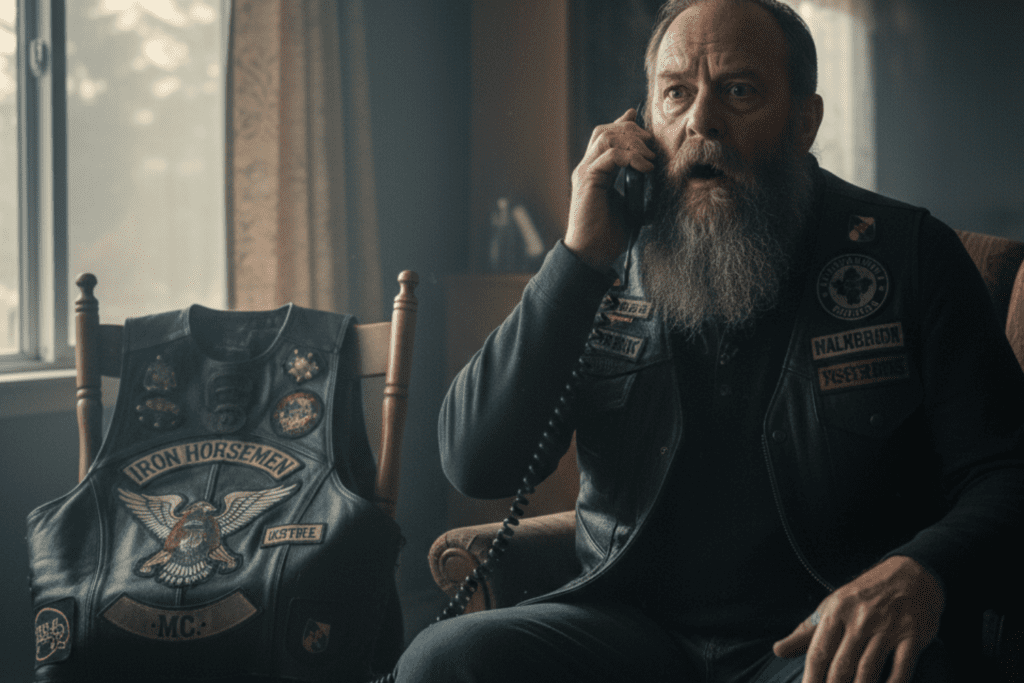
“This is Detective Harmon,” a man’s voice said. “Are you Clay Riker?”
“Yes.”
“We caught the sedan,” he said.
My heart slammed hard.
“And?” I asked.
The detective exhaled.
“Sir,” he said, “this is bigger than we thought.”
I stood up slowly, bare feet on cold floorboards.
“What do you mean?” I asked.
The detective paused, and when he spoke again his voice was different.
Less routine.
More careful.
“The girl’s name is Emma, yes,” he said. “But she’s not the only one.”
I closed my eyes.
He continued. “We found two more girls connected to the same man.”
I felt my stomach drop.
The detective said one more sentence, quiet but sharp enough to cut.
“And they’re terrified of biker gangs too, because that’s what he told them to be afraid of.”
I hung up and sat down hard.
Because that’s how monsters survive.
They don’t just hurt people.
They poison the idea of help.
They make victims afraid of the very hands that might pull them out.
And suddenly, the misunderstanding at the Chevron didn’t feel like an accident.
It felt like part of the design.
Two days later, Thunder Road MC rode again.
Not for charity.
For presence.
Not to threaten.
To remind the town we were still here.
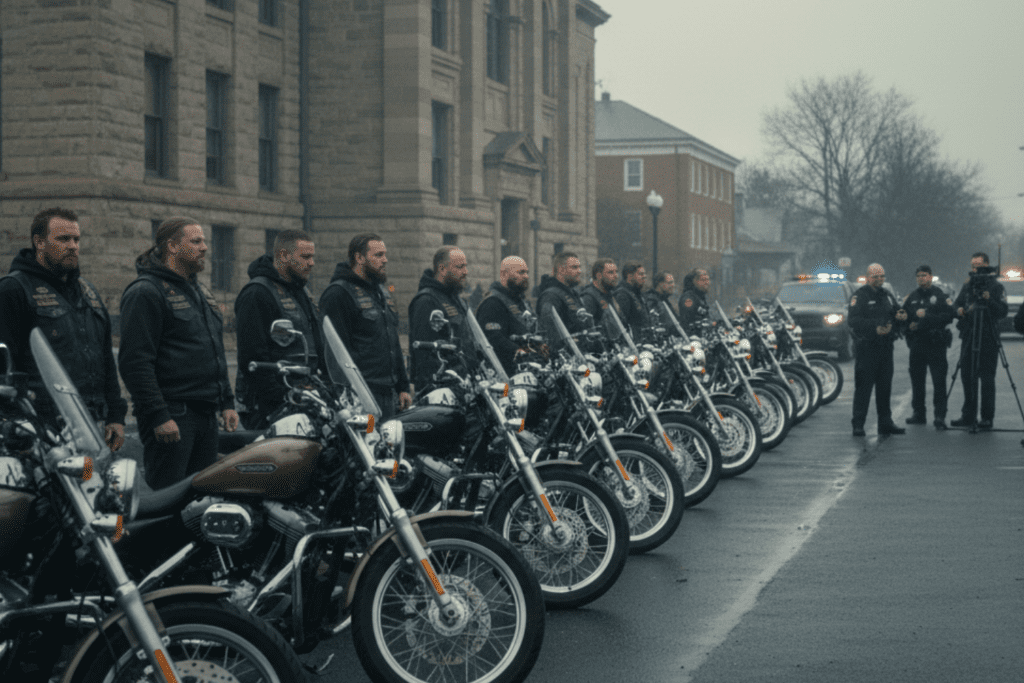
We parked at the courthouse in clean formation, engines off, boots on pavement, hands visible. The same way we’d done at the gas station. Calm. Controlled. A wall of bodies around something fragile.
Reporters came.
Phones came.
Judgment came.
But so did something else.
Other women.
Not young girls. Adult women.
Some with bruises fading under makeup. Some with eyes that flinched when a car door slammed. Some who walked up slowly like they were testing whether they were allowed to be seen.
They didn’t speak to the police first.
They spoke to us.
To Tank.
To Big John.
To the old faces that didn’t laugh when they spoke.
One woman handed Tank a folded paper with shaking hands.
“It’s his license plate number,” she whispered.
Tank didn’t ask questions. He didn’t press her. He just nodded and said, “Thank you.”
And then he handed the paper to the detective standing nearby.
That’s what we did that week.
We didn’t hunt.
We didn’t fight.
We stood still long enough for truth to come close.
Sometimes protection looks like motion.
Sometimes it looks like refusing to leave.
By the end of the week, Emma was in placement.
Not perfect. Not magical. But safe enough for now.
Tank’s jacket was returned to him clean, folded, with a note inside.
Three words in careful handwriting.
Thank you. I’m here.
I stared at that note when Tank showed me. It wasn’t sentimental. It wasn’t sweet.
It was survival.
And it made me realize something I didn’t want to admit.
Emma didn’t just need saving from a man.
She needed saving from the story the town wanted to tell about her.
The one where she was reckless.
The one where she was dramatic.
The one where she “ran away.”
She didn’t run away.
She escaped.
And she did it in front of forty-seven men the town already decided were dangerous.
Which means she chose danger over death.
I wish the world could understand what kind of courage that is.
No Comments