
To the teenage boy at the skate park,
I don’t know your name, so I’m going to call you Jayden.
You looked about fifteen, maybe sixteen, and I’m guessing you’ve had enough adults talk at you in your life to last a while. So I’m not writing this like a lecture, and I’m not writing it to make you sound like a hero in some movie.
I’m writing it because what you did mattered more than you probably realized.
My daughter’s name is Ava.
She’s little, and right now she’s in that careful stage where she watches the world before she steps into it. Like she needs to measure the room first. Like she has learned that some spaces are for her and some aren’t, even when no one says it out loud.
She has been talking about skateboarding for months. Not once or twice. The kind of talking that comes with watching videos, pointing things out in stores, asking questions while brushing her teeth, and trying to copy foot placement on the carpet in the living room.
If I’m honest, part of her wanted the board.
But part of her wanted proof that she was allowed to want it.
Because somewhere along the way, she picked up the idea that skateboarding belonged to boys.
No one sat her down and said it like a rule. No one had to. Kids collect those messages like lint. They gather it from pictures, from jokes, from who gets encouraged, from who gets laughed at. They pick it up from the way the world sorts hobbies into little labeled boxes.
So when she told me she wanted to skateboard, she also told me like she was testing me.
“Do you think I can do it?”
I told her yes, and I meant it. I told her skateboarding isn’t for boys or for girls. It’s for anyone who’s willing to fall down a few times and get back up.
She smiled.
But I could see it. She was still unsure.
Confidence is a strange thing. It doesn’t always arrive just because someone says the right words.
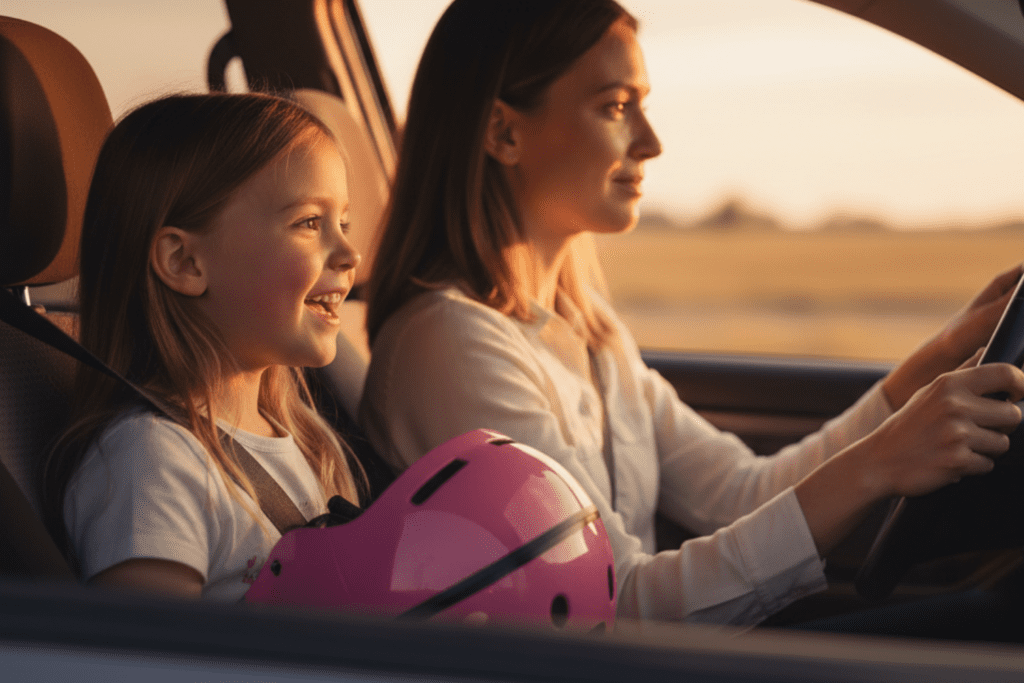
So when we finally went to the skate park, she was excited all the way there. She held her helmet in her lap like it was something important. Like it had weight. She kept asking how long we could stay. She even told me what trick she wanted to learn first, even though she didn’t know the names of any tricks yet.
She was imagining herself as someone brave.
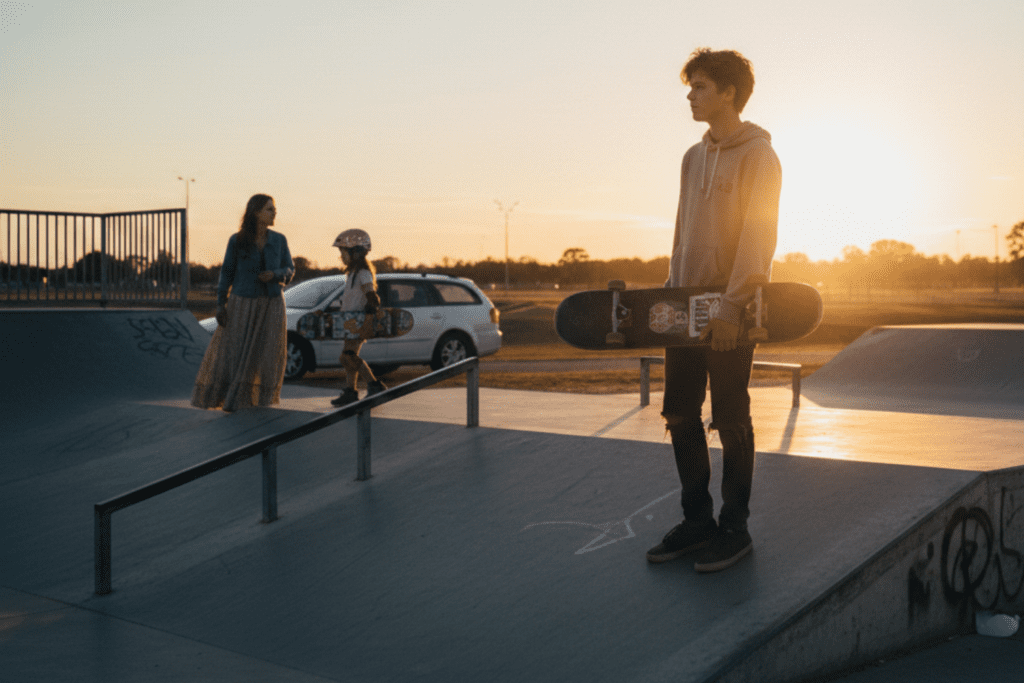
Then we turned the corner and saw the park.
It was full of older boys.
Not little kids wobbling on scooters. Not families strolling by. It was teenagers. Fast. Loud wheels. Boards clacking. That sharp scrape of metal on rails. The kind of sound that makes the whole place feel alive.
The park belonged to motion. It belonged to speed and confidence and people who already knew where they were going.
Ava’s body language changed in one second.
Her excitement slid right off her face like someone dimmed a light. Her shoulders lifted and tightened. She slowed down, then took a half-step behind me.
“Mom,” she said quietly, “it’s full of older boys.”
And I understood what she was really saying.
She wasn’t just describing the scene.
She was asking if she still had permission to be there.
I had my own feelings too, and I’m not proud of all of them.
Part of me wanted to turn around and leave.
Not because I thought you all were bad kids, but because I didn’t want to become “that mom.” The one who has to raise her voice and defend space. The one who has to do the tight smile while her heart races. The one who has to confront teenage boys who might roll their eyes, laugh, film her, turn it into something she never wanted it to be.
I didn’t want my daughter’s first skate park memory to be me arguing with teenagers.
But I also didn’t want her to learn the lesson that if a place feels intimidating, she should shrink herself until she fits somewhere else.
So I took a breath and looked down at her.
“So what?” I said, keeping my voice calm. “They don’t own the skate park.”
She looked up at me like she wasn’t sure I meant it.
I meant it.
Ava walked forward anyway. Not a bold march. Not a dramatic moment. Just a cautious, determined little walk, like someone stepping onto a stage for the first time. She put her helmet on. She set her board down at the edge of the ramp.
Then she looked at the slope like it was a cliff.
She swallowed.
Around us, you and your friends were flying by, rolling past her, cruising like you’d done it a thousand times. And Ava, with her tiny board and her brand-new pads, tried.
She went down the ramp and wobbled. Her feet weren’t quite right. Her balance wasn’t there yet. She made it down once, then tried again, and her board slid out from under her in a way that made my stomach tighten.
She didn’t cry.
But I saw her pride take a hit.
It’s a specific kind of pain, the one kids don’t always show with tears. It shows up as stiff posture. As a quick glance around to see who noticed. As that quiet decision kids make when they’re figuring out whether it’s safer to pretend they never cared.
She tried again.
Two or three runs. That was it.
Then she came to a stop at the edge and stood there too still, gripping the board like she might let go of it if she relaxed.
And that’s when you walked over.
I saw you moving toward her, and my brain went straight into protective mode. Mom-armor. It snapped into place without permission.
I was already building the speech in my mind, the one I didn’t want to give but would give instantly if I needed to.
She’s allowed to be here.
She’s not bothering anyone.
She has as much right to learn as you have to practice.
You got close enough to speak and started with, “Hey, excuse me…”
And I braced myself.
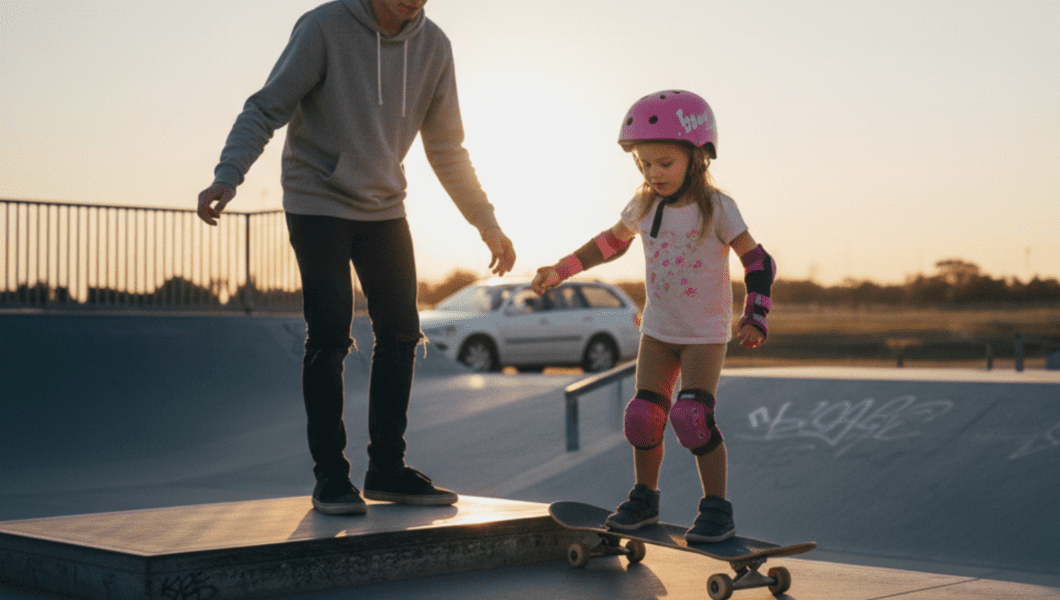
Then you said, “Your feet are wrong. Can I help you?”
Just like that.
Not rude.
Not mocking.
Not loud.
Direct. Normal. Helpful.
Ava looked at you like she wasn’t sure if what she heard was real. Then she glanced at me. I nodded, because I could tell instantly you were being sincere.
You weren’t filming. You weren’t performing. You weren’t trying to impress anyone. You were just offering help like it was the most natural thing in the world.
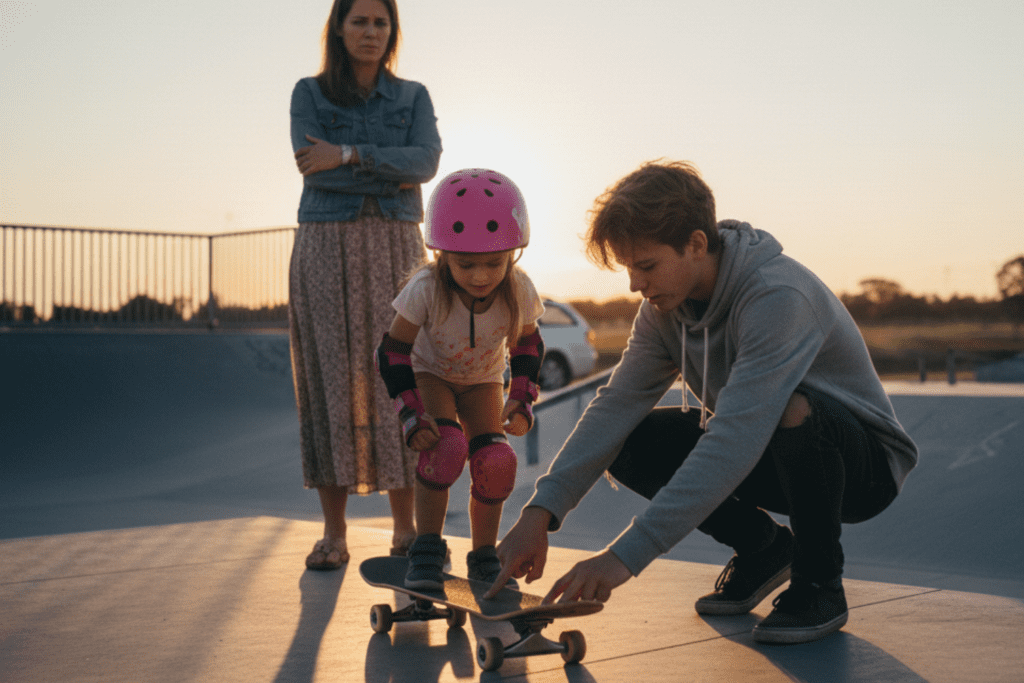
You crouched down, pointed at the board, and showed her where her feet should go.
You explained it in a way she could understand without talking to her like she was a baby. You told her how to place her front foot. How to shift her weight. How to keep her knees soft instead of locking them.
You didn’t drown her in terms.
You spoke like you wanted her to get it.
And then you did something that surprised me more than all of it.
She listened.
Adults can explain things to kids all day and get nothing but a blank stare. But you had her full attention. Maybe because you were part of the world she was trying to enter. Your words felt like a key. Like permission.
You stayed with her.
Not for five minutes. Not just one quick tip so you could feel good about yourself.
You stayed almost an hour.
I stood off to the side, trying not to hover and trying not to look like I was about to cry for no reason. I watched you hold her hand when she stepped on the board. I watched you steady her when she tipped. When she fell, you helped her back up like falling wasn’t embarrassing. Like it was simply part of learning.
At one point I heard you tell her to stay away from the rails for now so she wouldn’t get hurt.
You didn’t say it bossy. You said it like you cared if she went home safe.
And Ava kept trying.
She did more runs in that hour than she’d done all month in our driveway, because the missing piece wasn’t strength or coordination.
It was comfort.
It was belonging.
It was the feeling that she wasn’t intruding.
That she didn’t have to “earn” the right to exist in that space.
[IMAGE PLACEMENT 3]
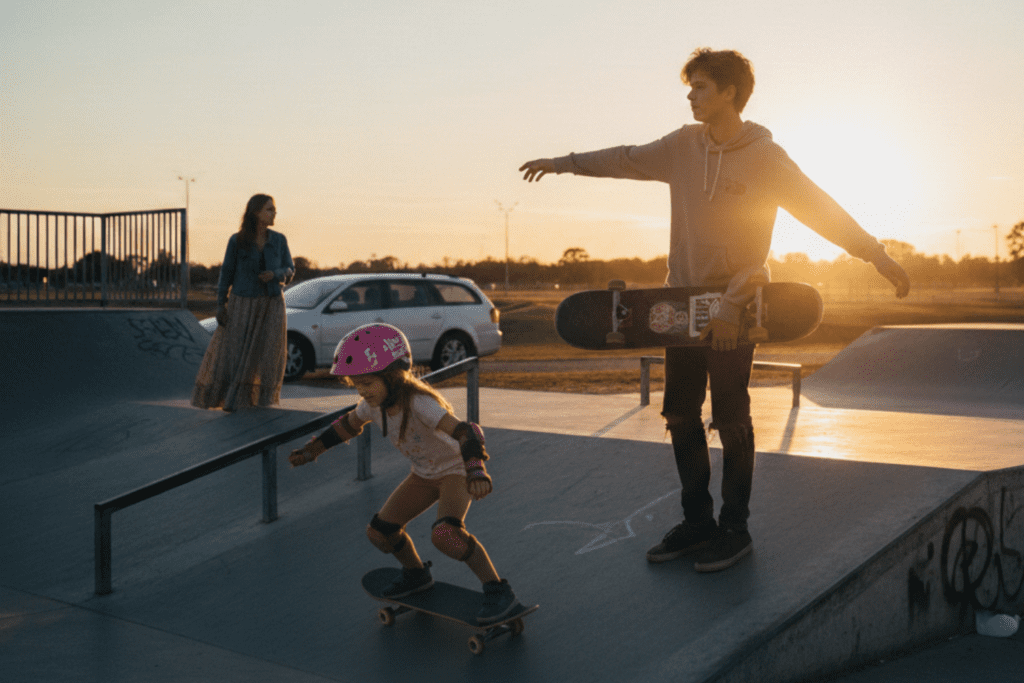
Cinematic, ultra-realistic documentary-style image of the girl rolling down a small ramp with concentration, knees bent correctly. The teenage boy stands nearby ready to catch her if she falls, focused and patient. The mother watches from the side with a softened expression. Natural light, realistic motion blur, no text, no watermark.
By the time we were leaving, her cheeks were pink, her hair stuck to her forehead, and her smile was so big her face looked different.
She walked out of that skate park taller than she walked in.
In the car, she talked the whole way home.
Not just about skateboarding, but about you.
She repeated things you’d said like they were important. Like she was storing them. She kept saying, “He showed me how,” and “He said if I bend my knees it’s easier,” and “He told me to watch where I’m going, not my feet.”
Then she said something that made my hands grip the steering wheel tighter.
“Mom,” she said softly, “I think I can do it.”
That’s what you gave her.
Not just an hour of tips.
Not just a nicer afternoon.
You gave her a memory where she walked into a place she was scared of and instead of being pushed out, she was welcomed in.
I don’t know what your life looks like outside that skate park. I don’t know what you carry, what you worry about, what people expect from you. I only know that in one ordinary moment, you chose kindness.
And that choice landed inside a little girl’s heart in a way that’s going to stick.
So thank you, Jayden.
Thank you for being the kind of older kid who makes the world feel safer for the kids coming up behind you.
Thank you for showing my daughter that confidence doesn’t have to be loud, and belonging doesn’t have to be earned through toughness.
Sometimes it shows up through a simple question.
“Can I help you?”
Ava left with pride in her chest and a new belief in herself.
And I left reminded that the community we hope for isn’t built by speeches. It’s built by small moments offered freely to someone who needed them.
Wherever life takes you, I hope you keep that part of you.
The part that noticed.
The part that helped.
The part that made room.
From a grateful mom,
Marissa
Some moments change a child quietly.
This was one of them.


No Comments