

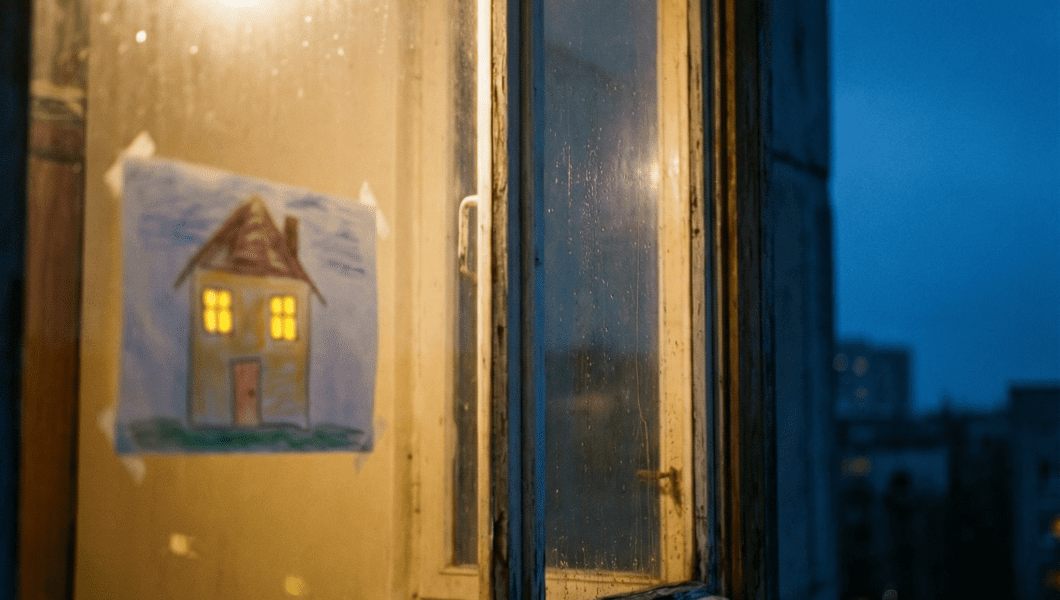
I didn’t know how loud silence could be until that winter.
Not the kind of silence people romanticize. Not peaceful. Not calm.
The kind that lives in cheap walls and thin windows. The kind that settles in the corners of a one-room apartment like dust you can’t fully wipe away. The kind that makes an eleven-year-old listen too hard for things that might go wrong.
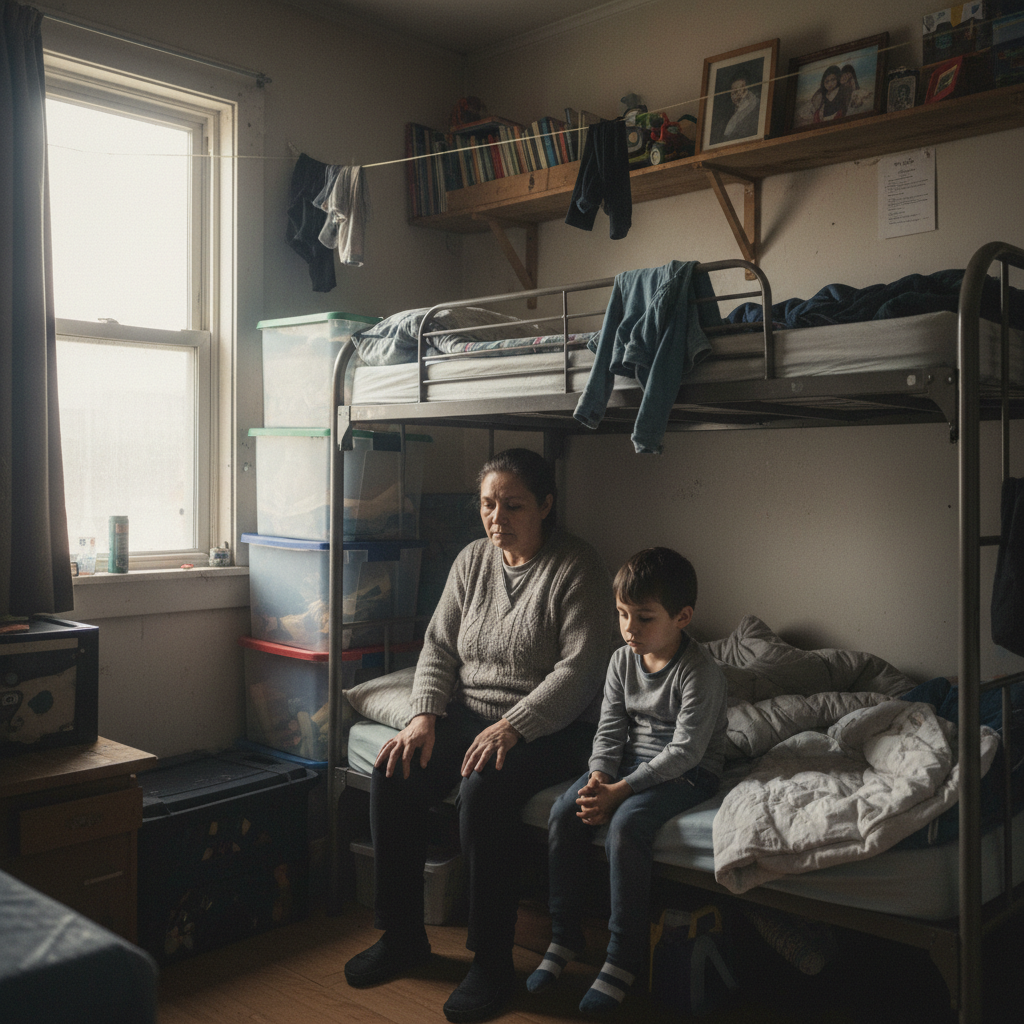
After the bunk bed arrived, the apartment felt different in a way my body understood before my brain did. The ceiling didn’t feel so close. The air didn’t feel so heavy. The room had height now. A small shape of safety built out of dark wood, fresh mattresses, and a curtain made from someone’s leftover fabric.
That first night, I didn’t fall asleep right away. My brain didn’t trust it.
I lay on the bottom bunk with my hands folded on my stomach, listening for the old problems. I kept expecting to hear the hiss of the air mattress dying again, like a snake in the dark. I kept waiting for Sophie to roll onto cold concrete and start crying in that half-sleep way she did when she was uncomfortable but didn’t know how to explain it.
But the mattress held me. It didn’t give up. It didn’t sigh. It just stayed.
And Sophie… Sophie whispered through the wooden slats.
“Leo?”
“Yeah?”
“I feel like I’m on a ship,” she said.
“A ship?”
“Like… up high.” Her voice carried something I hadn’t heard in a long time. Wonder. “Can you still hear me?”
I smiled into the darkness. “I can hear you.”
“Okay,” she whispered. Like that answered everything.
She rolled over once. The bunk didn’t creak much. There was no thud of a knee hitting the floor. No cold shock.
After a few minutes, I heard her breathing slow down. Even. Safe.
I stayed awake a little longer because it felt strange, being allowed to stay awake without doing anything useful. Without planning. Without counting. Without listening for footsteps outside the door.
For the first time in months, I let my eyes close without keeping a piece of myself standing guard.
And I slept.

The next morning, Mom didn’t rush out right away.
Usually she came home like a ghost, still wearing the warehouse air in her clothes. Cardboard dust. Exhaustion. That cold smell of night. She would check on Sophie first, then look at me, and her eyes would do that thing where they’d ask a hundred questions without saying any of them.
Then she’d leave again.
But that morning, she stood with one hand on the bunk bed ladder like she didn’t trust it to be real. Like she thought she might blink and it would disappear.
Sophie was still asleep, sprawled out on the top bunk, one leg hanging off like she’d conquered something in the night.
Mom stared up at her.
“She hasn’t slept like that in forever,” Mom whispered.
It wasn’t a compliment. It sounded like grief. Like relief that had been stuck for too long and didn’t know how to come out gently.
“I called,” I told her quietly.
Mom’s head snapped toward me. “You called who?”
I swallowed. My throat went dry the way it did before school presentations.
“911,” I admitted.
The words dropped between us like something fragile. Like a plate you can’t afford to break.
Her face tightened. Not anger. Something worse. Fear. A mother’s fear that she’d failed so loudly that even strangers heard it.
“Oh, Leo…” Her voice cracked just a little. “Baby, no…”
I shook my head fast, before she could sink into it. “I didn’t say you did anything wrong.”
She pressed her fingers to her lips, like she was holding back sound.
“I just,” I said, softer now, “I didn’t know who else to call.”
Mom sat on the edge of the bottom bunk. The mattress dipped under her weight. It was the first time I’d ever seen her sit down without immediately preparing to stand again.
Her hands were rough from the boxes. Little cuts on the knuckles. Her fingernails always looked tired.
“I’m sorry,” she said.
I didn’t answer. Not because I didn’t forgive her. But because something in me didn’t want her apology. I didn’t want her to carry more guilt than she already did.
So I did something I hadn’t done in a long time. I leaned into her.
She wrapped her arms around me, and her body shook once. Just once. Then she held still again, like she was trying not to scare me with her pain.
I stayed there until my chest felt quiet.
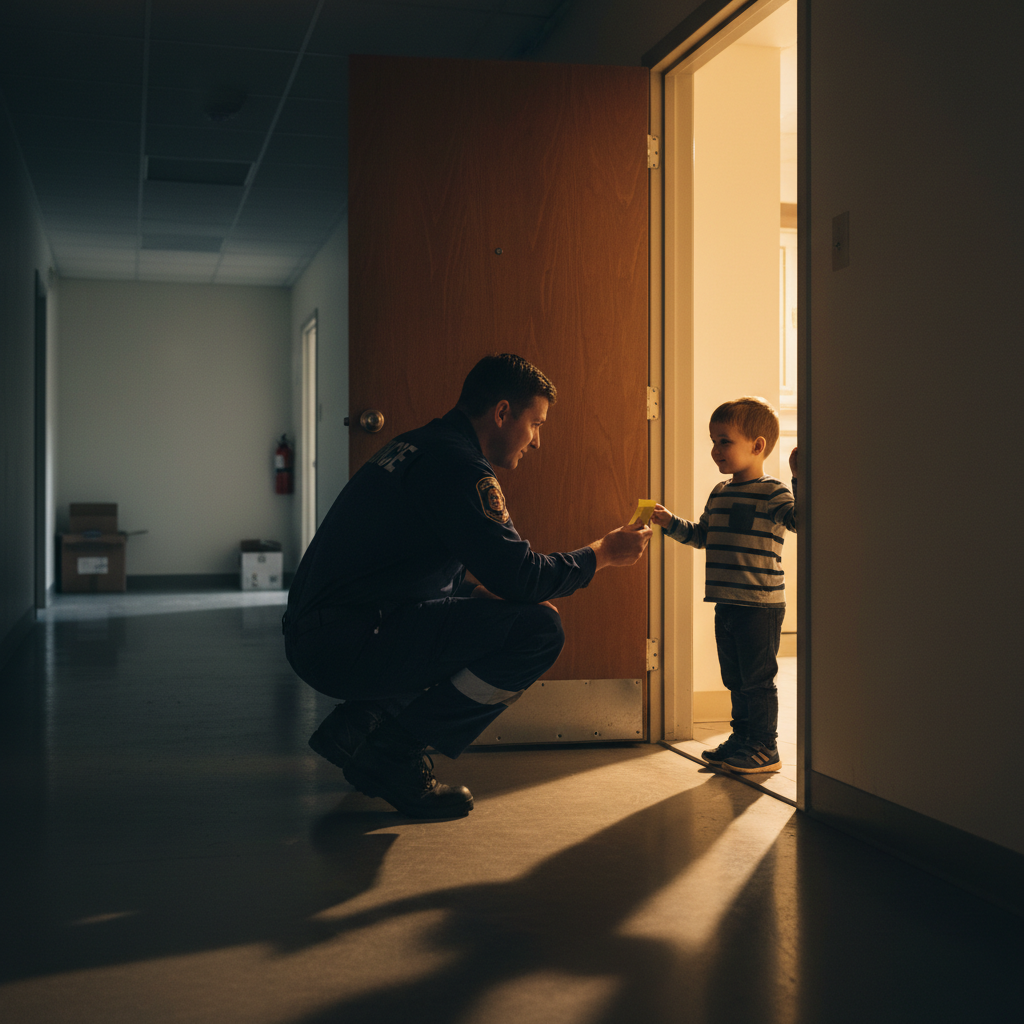
Marcus and Sarah came back a few days later, just like the sticky note promised.
Not with a fire truck this time. Not with the dramatic kind of help. They came like people who meant it. Like people who understood that a rescue isn’t a one-time event.
Marcus knocked softly again, the same polite knock that didn’t accuse the door.
Tap-tap-tap.
Mom opened it. She looked like she’d been bracing herself, but when she saw them, her shoulders dropped.
“Hi,” Sarah said, smiling gently. “We just wanted to check in.”
Mom blinked fast. “I don’t… I don’t know what to say.”
“You don’t have to say anything,” Marcus replied. “We’re just here.”
They stepped inside. Marcus took off his boots again, even though the floor was still stained and peeling and not worth being polite to. It wasn’t about the floor. I knew that now. It was about us.
Sarah crouched near the bunk bed and looked up. “How’s the captain up there?”
Sophie popped her head over the edge of the top bunk, hair messy. “I’m the captain!” she announced proudly.
Sarah laughed softly. “I can tell.”
Marcus turned to Mom. “We can talk for a minute?”
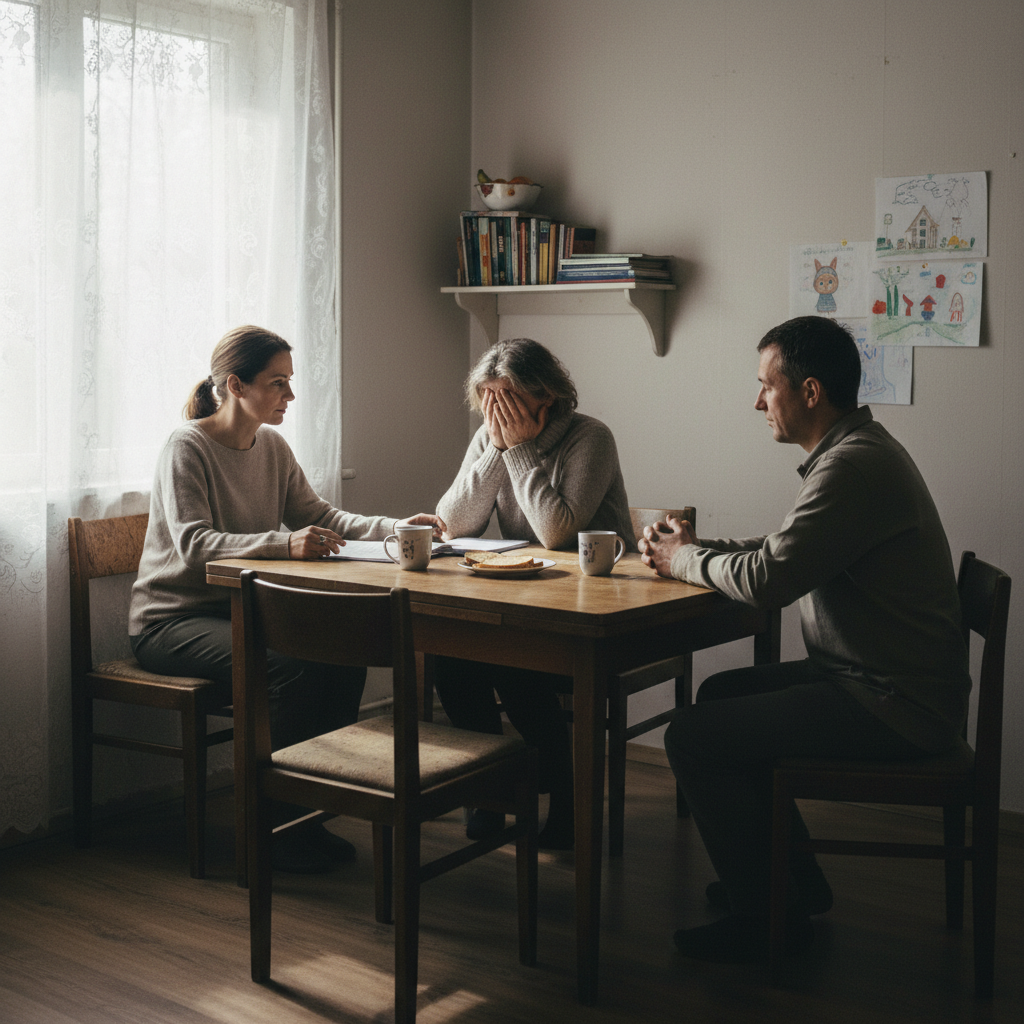
Mom nodded, and I saw her do something new. She didn’t pretend everything was okay. She didn’t say she had it handled. She simply nodded and sat down at the card table.
I stayed near the bunk bed, pretending I wasn’t listening while my stomach twisted.
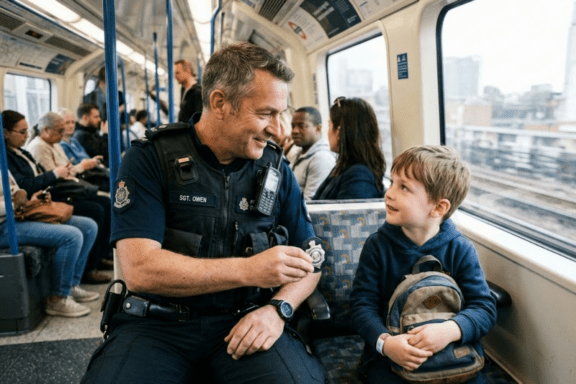
Marcus spoke gently. Not like a police officer. Not like a boss. Like a human.
“Your son’s been holding a lot,” he said.
Mom’s eyes filled instantly. “He shouldn’t have to.”
“No,” Marcus agreed. “He shouldn’t.”
Sarah slid a paper across the table. “We can connect you with an emergency assistance program that helps with rent support, heating assistance, and food resources. We can also help you apply for a more stable housing option.”
Mom stared down at the paper. Her hands trembled.
“I work,” she said, like she needed them to understand she wasn’t lazy. “I work all the time.”
“We know,” Marcus said. “This isn’t about you not working. This is about a system that keeps moving the finish line.”
Mom’s face crumpled for a second, like she’d been holding herself upright with string and it finally snapped.
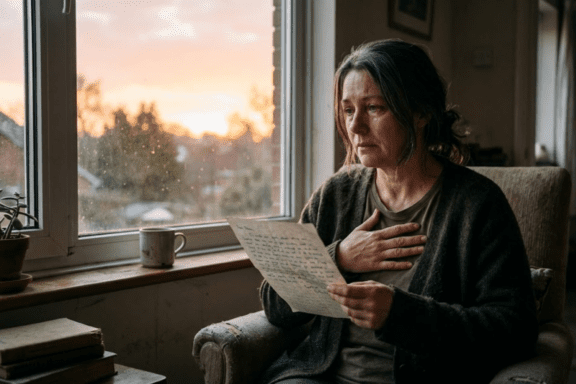
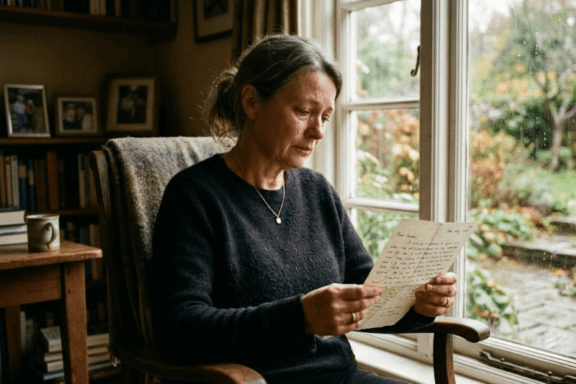
She covered her eyes with her hands and cried silently, shoulders shaking.
I hated that I could hear it. I also hated that part of me felt relieved she was finally letting herself do it.
Marcus didn’t rush her. Sarah didn’t hover. They just sat there and waited like crying wasn’t an emergency, like it was allowed.
That was another lesson. Sometimes helping someone isn’t fixing something. Sometimes it’s simply letting them break without punishing them for it.
After that day, things didn’t magically become easier. We didn’t suddenly move into a bright house with clean floors and enough bedrooms. The fridge still groaned. The bathroom fan still rattled like it might fall out of the ceiling.
But the apartment didn’t feel like a secret anymore.
People knew our names now. Not in a gossip way. In a human way.
Ms. Alvarez from the library dropped by once a week to ask if the hotspot was working and if I’d turned in my homework. She never made it feel like charity. She treated it like normal. Like helping a kid get internet was as basic as lending a book.
Mrs. Petrova started waving at Mom in the hallway. Still grumpy. Still stern. But the yelling stopped. One afternoon she knocked and handed Sophie a small knitted hat with a fuzzy pompom like she’d made it by accident.
Sophie put it on immediately and ran around the apartment yelling, “I’m fancy! I’m fancy!”
Mom laughed. A real laugh. The kind that surprises you when you haven’t heard it in a while.
School changed for me too. I started lifting my hand again. Not because the lessons got easier, but because my brain wasn’t spending all night protecting my sister from the cold.
When the teacher asked us to draw “home,” I drew the same thing I always drew.
A house. Dark sky. Big yellow windows.
But this time I drew a porch light, too.
The toughest part came in a place I didn’t expect.
The hardest part wasn’t the cold floor or the empty cupboards or the nights where the world felt too big for our tiny apartment.
The hardest part was letting myself be a kid again.
It sounds stupid, but it’s true.
Being “the only grown-up” had become my identity. It made me feel important. Necessary. It made the fear feel useful.
When people start helping you, you have to face the part of you that became attached to suffering.
Because suffering, at least, is familiar. It’s predictable.
Help feels like a trick at first. Like it could disappear.
One afternoon, I came home and found Mom sitting on the bottom bunk.
Just sitting.
Not crying. Not collapsed. Just… sitting quietly, looking at the astronaut sleeping bag folded neatly at the foot of the bed.
I stood in the doorway, confused. “What’s wrong?”
Mom looked up at me. “Nothing.”
That made my stomach drop, because “nothing” was never nothing.
She patted the mattress beside her. I sat.
Mom took a slow breath. “I used to have a bed like this,” she said. “When I was a kid.”
I waited.
“It was my grandmother’s,” she continued. “She wasn’t warm, not exactly, but she fed us. And she made sure we had somewhere soft to land.”
Mom’s voice thinned. “I promised myself you’d never have to live like I did.”
I didn’t know what to say.
So I did what Marcus did. I didn’t rush it. I just sat with her.
Mom reached out and smoothed the fabric of the sleeping bag like it was sacred. “I hate that you had to be brave,” she whispered.
I stared at my hands. My fingers looked older than they should.
“I don’t want to be brave,” I said quietly.
Mom nodded. “I know.”
That was the first time she ever said she knew. Not “You are brave,” not “You’ll be fine,” not “You’re strong.”
Just… I know.
It made me feel held. Like for once, she was the grown-up in the room again.
Two weeks later, Mom got a call that changed her face.
She held the phone like it was heavier than it should be. Her eyes flicked toward me like she wasn’t sure if I could handle good news.
I could.
“Leo,” she said after hanging up, voice shaking, “we got approved.”
“For what?”
“The housing transfer,” she said. “It’s not fancy. But it’s two bedrooms.”
I stared at her, not understanding the words right away.
Two bedrooms meant a door. A room. A place for Sophie that wasn’t just a corner of the same space where Mom cried and I counted.
Sophie squealed and climbed down from the top bunk so fast she almost slipped. “Do I still get a top bunk?” she demanded.
Mom laughed, tears in her eyes again. “We’ll see.”
I didn’t celebrate like people do in movies. I didn’t jump or scream. I just sat down because my knees went weak.
That night, I lay under the astronaut sleeping bag and stared at the ceiling.
It hit me then that help isn’t a moment.
It’s a chain.
One person says yes. Another person joins. Someone brings pillows. Someone brings wood. Someone brings Wi-Fi. Someone brings a hat with a pompom. Someone fills out forms with your mom. Someone makes a phone call. Someone pushes the system a little harder than it expects.
And suddenly a kid who was growing up too fast gets to slow down.
On the last night in the old apartment, Marcus came by again.
Just him this time.
He knocked softly. Tap-tap-tap.
I opened the door, and he smiled. “Hey, Leo.”
“Hey,” I said.
He looked around the room like he was taking a photograph with his eyes. The bunk bed. The curtain. The yellow window drawings taped to the wall.
“You ready?” he asked.
I hesitated. “I think so.”
Marcus nodded. He reached into his pocket and pulled out a new sticky note.
He didn’t place it on the fridge this time.
He handed it to me.
It said: You’re not the only grown-up anymore.
My throat tightened.
“Do you,” I began, then stopped. I didn’t know how to ask without sounding childish.
Marcus tilted his head. “Do I what?”
“Do you… do you do this a lot?” I asked.
He smiled, but not like it was funny. Like it mattered. “We try,” he said. “Not always fast enough. Not always perfectly. But yes. We try.”
I looked down at the note again. “Why?”
Marcus took a slow breath, thinking carefully. “Because one day,” he said, “I was a kid who needed someone to knock softly.”
That was all he said.
And that was enough.
We moved on a Saturday morning.
The new place smelled like fresh paint and cleaning supplies. It wasn’t perfect. The carpets were thin. The kitchen was small. But there were two doors. Two rooms. Two spaces.
Sophie ran from room to room like she was testing reality. “This one is mine!” she shouted, flinging her rabbit onto the bed.
Mom stood in the doorway, one hand pressed to her chest, like she was trying to keep her heart from falling out.
I walked to my room and stood there.
There was a window. A real one. Not stuck shut. Not cracked.
Outside, the world looked normal. Kids riding bikes. A woman carrying groceries. A dog pulling a leash.
It was the first time in a long time that I felt like our life might be allowed to be normal too.
That night, we didn’t eat much. We sat on the floor with takeout because the table hadn’t arrived yet. Sophie fell asleep early in her own bed, tucked in like a person who belonged somewhere.
Mom sat beside me in the living room, rubbing her thumb over a cardboard cut on her hand.
I looked at her and realized she seemed younger.
Not because her life got easy. It didn’t.
But because she wasn’t alone in it anymore.
“I’m proud of you,” Mom said quietly.
I stared ahead. “For what?”
“For calling,” she said. “For not pretending you could do everything.”
I swallowed. “I didn’t want you to get in trouble.”
Mom leaned closer. “You didn’t get me in trouble. You got us help.”
I didn’t answer. My throat wouldn’t let me.
The next evening, after the boxes were mostly unpacked, I taped one of my drawings to the wall near the kitchen.
A house with big yellow windows.
And one porch light glowing.

I still think about that 2:07 a.m. call sometimes.
I think about how I almost didn’t make it. Not because I was dying, but because I was disappearing into responsibility. I was becoming a tiny adult in an oversized world.
The dispatcher could have laughed. Could have scolded me. Could have told me to stop wasting time.
Instead, she transferred me to someone who knew what the call really meant.
Someone heard the truth behind my words: I’m not okay, but I don’t know how to say it properly.
I learned something important that winter.
A crisis isn’t always a siren.
Sometimes it’s a child whispering into a cracked phone while his sister sleeps on an old coat.
Safety isn’t always loud either.
Sometimes it sounds like a soft knock at the door. Tap-tap-tap. Like a question.
Sometimes it looks like a man taking his shoes off in a home that doesn’t look like much. Like he’s saying, without words, that you deserve respect anyway.
And sometimes, help is simply someone asking a question nobody ever asked you before:
What would make tonight easier?
I don’t know what kind of adult I’ll be. I don’t know what kind of life we’ll have. I only know that when the floor was winning, people showed up and stopped it.
Not with speeches.
With pillows. With wood. With a hotspot. With a curtain. With a sticky note that became law in my heart.
And that, more than anything, is what I carry.


No Comments