

You don’t forget the sound of a child’s voice asking for death.
Not in combat, not in prison, not in forty-two years of riding steel and asphalt. That voice doesn’t fade. It wedges itself into the part of you that still wakes up before dawn even when you don’t have to. It follows you into quiet rooms. It shows up in the space between heartbeats.
“Please take me to heaven,” she said.
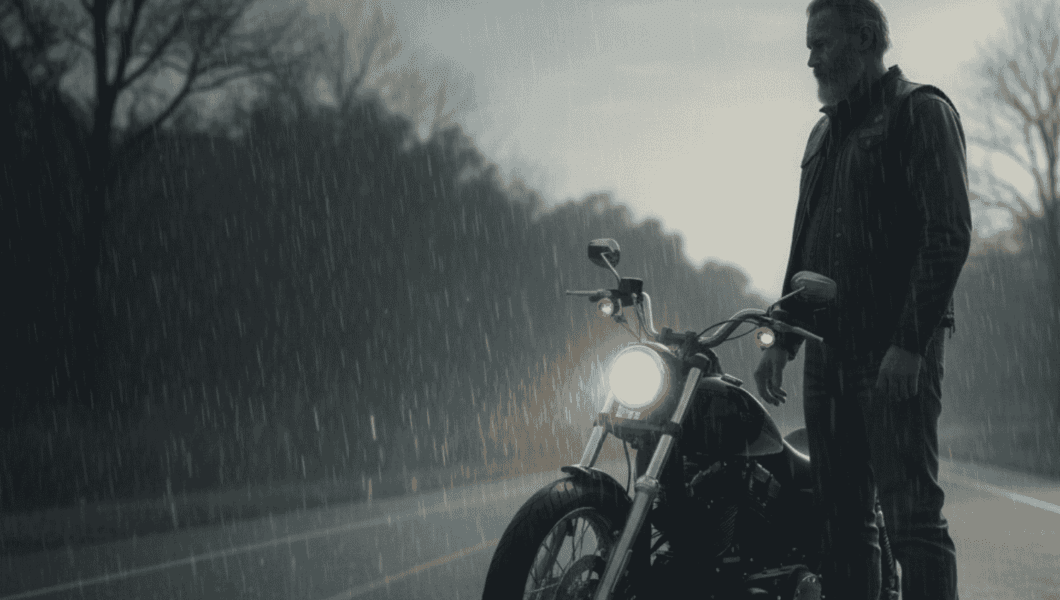
It was 3:00 AM on a deserted stretch of Highway 14. Freezing rain came in sideways, sharp as gravel. My Harley idled on the shoulder, that familiar low cough of an engine that has outlived better men. I’d pulled over to adjust my glove when my headlight caught her.
Barefoot.
Soaked.
A little girl no older than four or five, standing in the glare like she’d been placed there on purpose. She wore a Disney princess nightgown plastered to her small frame. Her lips were blue. Her hair clung to her cheeks in wet ropes. In her arms, she held a teddy bear that looked older than she was, threadbare and damp, squeezed tight like it was the only thing on earth that couldn’t leave her.
She didn’t wave or cry out.
She stared at me the way people stare when they’ve already decided nothing good is coming.
And then she said it again, quieter, like she was trying to be polite.
“Please take me to heaven where Mommy is.”
I killed the engine so fast the sudden silence felt violent.
Rain hammered my helmet. My boots hit wet gravel as I stepped off the bike. I remember thinking how small she was, how wrong the world looked with a child alone on a highway at that hour. The road should have been empty. Children should have been sleeping. A night like that shouldn’t have held anything but truckers and exhaustion.
I crouched slowly, keeping my hands open.
“Sweetheart,” I said, and my voice didn’t sound like mine. “What are you doing out here?”
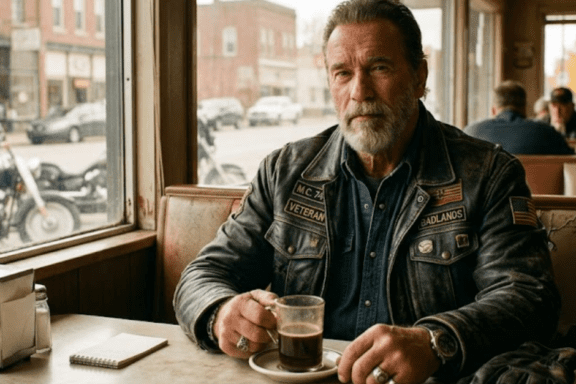
She studied my leather vest. The patches. The wet beard. The hard lines that life gives a man who’s seen too much. For a second I thought she might run.
Instead she whispered, “I can’t go home. Daddy hurt me again. Mommy went to heaven. I want to go too.”
Her words came out steady, like she’d practiced them. Like she’d said them into a pillow in the dark until they stopped shaking.
I didn’t ask her where she lived. I didn’t ask her why she was out there alone. I didn’t ask the hundred questions that were screaming in my mind.
A child like that doesn’t need questions first.
She needs warmth.
She needs a grown-up who doesn’t flinch.
I shrugged off my jacket and wrapped it around her shoulders. The leather swallowed her, hung down to her calves. She smelled like smoke and cold and fear. That’s not poetry. That’s real. That’s what it was.
When she grabbed my jacket, her fingers trembled, then tightened like she was afraid even that could be taken away.
I told her my name. She told me hers.
“Lily,” she whispered. “But Daddy calls me ‘mistake.’”
That’s when she lifted her nightgown just enough to show me the burns.
Cigarette burns.
Fresh.
Little circles patterned on pale skin like someone had treated her body like an ashtray. I felt something inside me go very quiet, the way a room goes quiet right before something breaks.
But what nearly put me on my knees was her back.
Three words carved into her skin, jagged and raw, as if written by an angry hand with a knife.
“Nobody wants you.”
My vision tunneled. A taste like metal filled my mouth. I forced myself to breathe through my nose so I wouldn’t scare her with whatever sound was trying to climb up my throat.
Lily watched my face carefully, like she’d learned to read men the way sailors read storms.
“Am I in trouble?” she asked.
I shook my head so hard my helmet strap tugged.
“No,” I said. “No, baby. Not you.”
A pair of headlights cut through the rain behind us.
An engine roar, deeper than mine.
A truck.
Coming fast.
And the second Lily saw that light, her whole body stiffened like a wire pulled tight.
“That’s him,” she whispered.
The words didn’t sound dramatic. They sounded final.
I stood and put myself between her and the road, feet planted on wet gravel. The freezing rain slid down my face. My hands clenched and unclenched, not because I wanted a fight, but because my body didn’t know what else to do with the rage.
The lifted pickup drifted onto the shoulder like it belonged there.
The passenger window rolled down.
A man leaned out, face half-lit by the dash, eyes narrow and hungry.
“You,” he called.
Not her name. Not “sweetheart.”
Just you.
He looked at my Harley, then at my vest, then back at me. I watched his expression flicker. He recognized the patch. He measured the risk.
Then his mouth curled anyway.
“Mind your business,” he said. “My kid ran off. I’m taking her home.”
Kid. Like she was property.
I kept my voice level, because men like him live for reactions. They feed on noise.
“She asked me to take her to heaven,” I said.
His face twitched. “She lies,” he snapped. “She’s dramatic.”
Dramatic. Like pain is theater.
I pulled my phone out slowly, keeping it visible.
“I’m calling 911,” I said.
His smile died. He leaned forward like he might come out of that truck, then hesitated when he noticed headlights in the far distance. A car approaching. A witness arriving.
He spat out, “You don’t know what you’re doing.”
Then he slammed it into gear and tore back onto the highway, vanishing into the storm.
Lily folded into my side like she’d been cut loose from a rope.
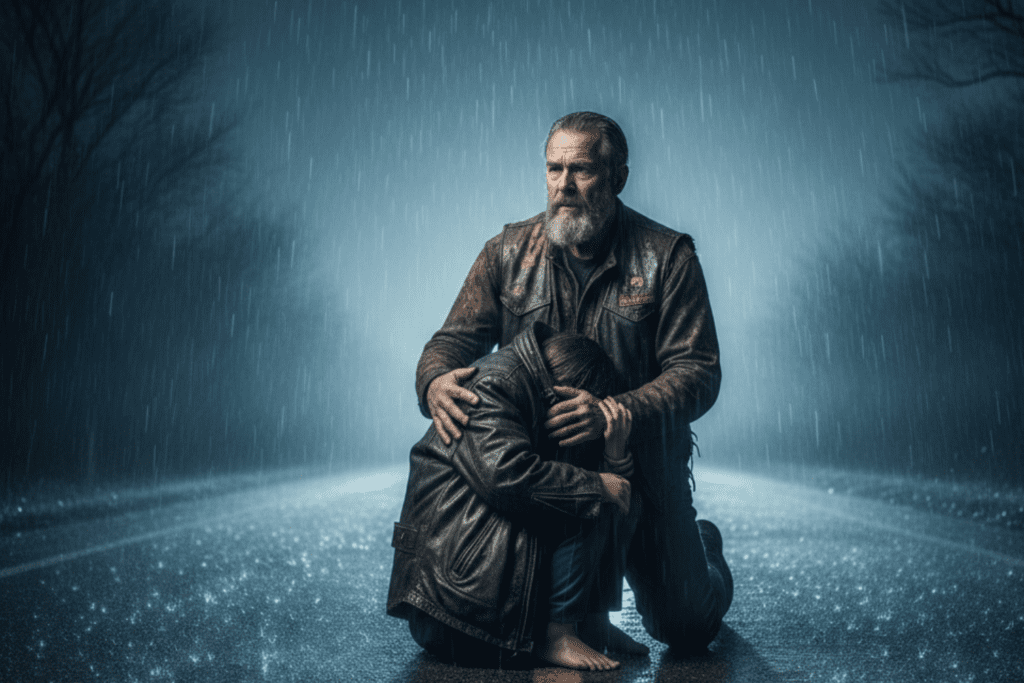
I crouched again, rain dripping off my beard, and wiped her cheek with my thumb.
“Are you taking me to heaven?” she asked, voice small.
I felt my chest split in two.
“No,” I whispered. “Not tonight.”
“Then where?” she asked.
I looked down the empty road and told her the only truth that mattered.
“Somewhere safe,” I said. “Somewhere he can’t reach you.”
Her lip trembled. “Promise?”
I nodded. “I swear on my life.”
When the dispatcher answered, her voice sounded too awake for that hour. Like she’d been holding the world together all night from a chair and a headset.
“911, what’s your emergency?”
I gave the location. Highway marker. Nearest milepost. Direction of travel. My voice went into a tone I hadn’t used in years, the tone that comes back when chaos shows up.
“A child,” I said. “Female. Approximately five. Barefoot. Hypothermia risk. Injuries consistent with abuse. Suspect is in a lifted pickup, just fled northbound.”
There was a pause.
Not disbelief. Calculation.
“Stay on the line,” she said.
Lily’s teeth were chattering now. I guided her toward the bike. I tried to shield her from the wind with my body while still watching the road.
“What’s that sound?” she whispered.
“Just my bike cooling down,” I told her.
She stared at the Harley like it might be dangerous. Like everything in her life had taught her to distrust power.
“It’s loud,” she said.
“Yeah,” I admitted. “But it’s on your side tonight.”
That earned me the smallest shift in her face, like she almost believed it.
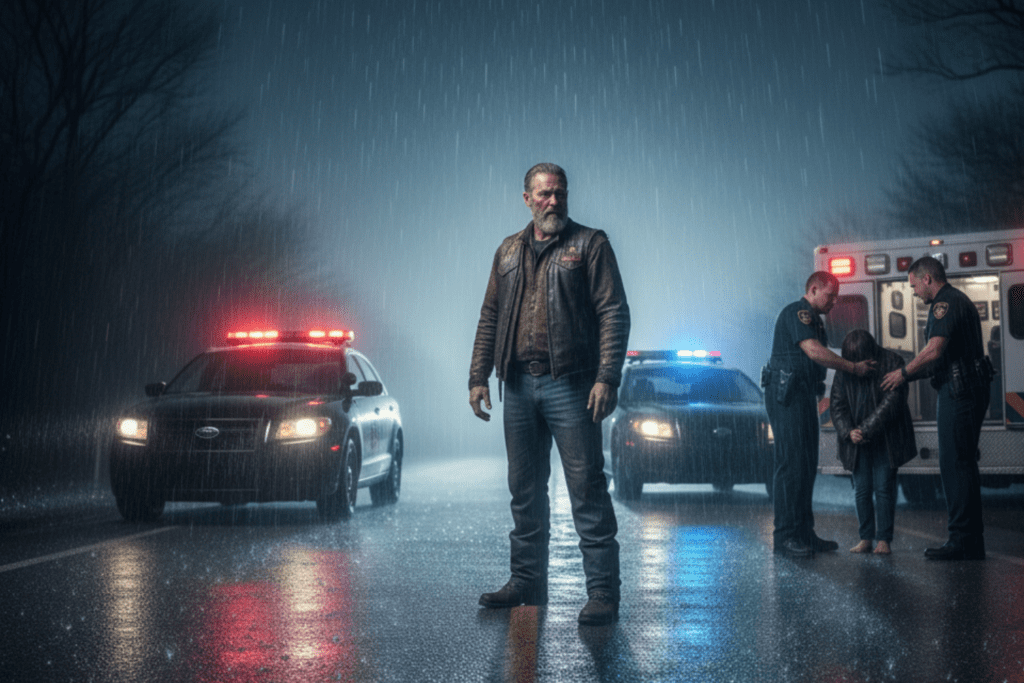
Red and blue lights appeared fifteen minutes later, smearing across rain like wet paint.
A cruiser stopped hard behind us. Then another. Then an ambulance.
Two deputies stepped out with their collars up, hands near their belts, eyes on me. Not on Lily first.
On me.
They saw the patches. The Harley. The beard. The wet leather. The way my shoulders are built from old fights and older work.
A younger deputy called out, “Step away from the child.”
I didn’t argue. I raised my hands and stepped back.
Lily clutched my jacket tighter, looking frightened, not of me, but of the sudden officialness. She’d probably met authority before. Kids like her meet authority in the worst moments.
A paramedic approached Lily gently, crouching.
“Hey, sweetheart,” she said, voice soft. “My name’s Jenna. I’m going to help you warm up, okay?”
Lily didn’t answer. She looked past the paramedic at me like she was asking permission.
I nodded, slow.
“It’s okay,” I told her. “Let them help.”
The deputies questioned me while the paramedics wrapped Lily in a foil blanket. They didn’t write my words down at first. They wrote my name. They asked where I was going. They asked why I stopped. They asked if I knew her. They asked if I had drugs. They asked if I had weapons.
I understood. I did.
This is how the world works now. It doesn’t trust men who look like me. Sometimes it shouldn’t. I’ve known plenty of men in clubs who deserved prison more than patches.
But that night, the questioning felt like a blade against something already raw.
Because while they were measuring me, Lily was still shivering. Still bruised. Still carved up by a man who was already speeding away into the dark.
I watched Lily’s little hands tremble beneath the thermal blanket. One of the paramedics offered her a cup of warm liquid. She held it with both hands like it could save her.
My phone buzzed with the dispatcher still on the line. I hadn’t even realized I was still connected.
The older deputy finally looked at Lily, then at me, then at the rain-soaked road behind.
“You said cigarette burns,” he murmured, quieter now.
I nodded once. “And worse.”
His jaw worked.
He walked to the ambulance, spoke to the paramedics, then returned with a different posture. Less suspicion. More urgency. The world shifting into the right gear, too late as always.
“Okay,” he said. “We need her statement.”
My chest tightened.
“She’s five,” I said. “She doesn’t need to tell her story in a ditch at 3 AM.”
He hesitated, then nodded.
Lily’s eyes drooped in exhaustion. The adrenaline was leaving her body, and that’s when kids crash. That’s when they look smallest.
They loaded her into the ambulance. A deputy told me to follow to the station for a statement. The younger deputy still watched me like I might vanish.
As they closed the ambulance doors, Lily looked out through the window.
Her face was pale. Her eyelashes clumped with rain.
She lifted a small hand and pressed it to the glass.
It wasn’t a wave.
It was a question.
Are you leaving too?
I stepped closer until the paramedic opened the door a crack.
“I’m right here,” I told Lily. “I’m not going anywhere.”
She blinked slowly, then nodded.
The ambulance pulled away.
And I stood on the shoulder with rain running down my back like cold regret, realizing something I hadn’t expected.
Saving her from the highway was the easy part.
Now came the part where the world would decide whether she deserved saving.
At the station, they put me in a small interview room that smelled like old coffee and disinfectant. The kind of room where people lie. The kind of room where people confess. The kind of room built to make time feel slower than it is.
A detective came in with tired eyes.
He didn’t offer his hand. He offered a recorder.
“State your name.”
I did.
He looked over paperwork. “You got a record.”
I nodded. “Yes.”
He didn’t say what for. He didn’t need to. Men like me carry our histories in plain sight.
“What’s your relationship to the child?”
“None.”
“Then why’d you stop?”
I leaned back in my chair and stared at him like he’d asked why I breathe.
“Because she was barefoot in freezing rain on Highway 14 at 3 AM asking me to take her to heaven,” I said.
The detective paused.
His eyes flickered, the smallest crack in professional distance.
He cleared his throat. “Tell me what you saw.”
So I told him.
I told him about the burns. About the words carved into her skin. About the truck. About the driver’s face. About Lily’s voice turning flat when she said, “That’s him.”
When I finished, the detective sat in silence for a moment.
“You realize how this sounds,” he said carefully.
“I realize how it looks,” I replied. “That’s why I called you.”
He nodded once, like that mattered.
Then he said something that made my blood turn cold.
“We found her address.”
I sat still.
“And?” I asked.
The detective glanced at the file. “Her mother’s deceased. There’s a boyfriend. He claims she ran off after ‘throwing a fit.’”
I gripped the chair arms.
“And the burns?” I asked.
The detective swallowed. “He claims she’s clumsy. Says she ‘gets into things.’”
I laughed once, sharp, not because it was funny, but because it wasn’t.
I leaned forward. “You know what he did.”
The detective didn’t deny it.
But he didn’t confirm it either.
That’s the problem with systems. They have rules. Rules make things neat. Rules make things slow. Rules make monsters comfortable.
“Where is Lily now?” I asked.
The detective said, “Hospital. We called CPS. A caseworker’s on the way.”
I exhaled hard.
CPS.
A word that can mean rescue, or it can mean paperwork.
I drove to the hospital in my soaked clothes, hands aching from the cold, the Harley roaring under me like a heartbeat refusing to stop.
When I arrived, they wouldn’t let me see her.
Not at first.
A nurse at the desk looked at my vest, then at my face.
“Family only,” she said.
“I’m not family,” I answered quietly. “I’m the reason she’s alive.”
She hesitated, then softened. “Sir, I’m sorry. But rules.”
The detective had warned me. He’d said it plainly on the drive over.
“People will look at you like you’re the danger,” he’d said. “Because you’re easy to label.”
He was right.
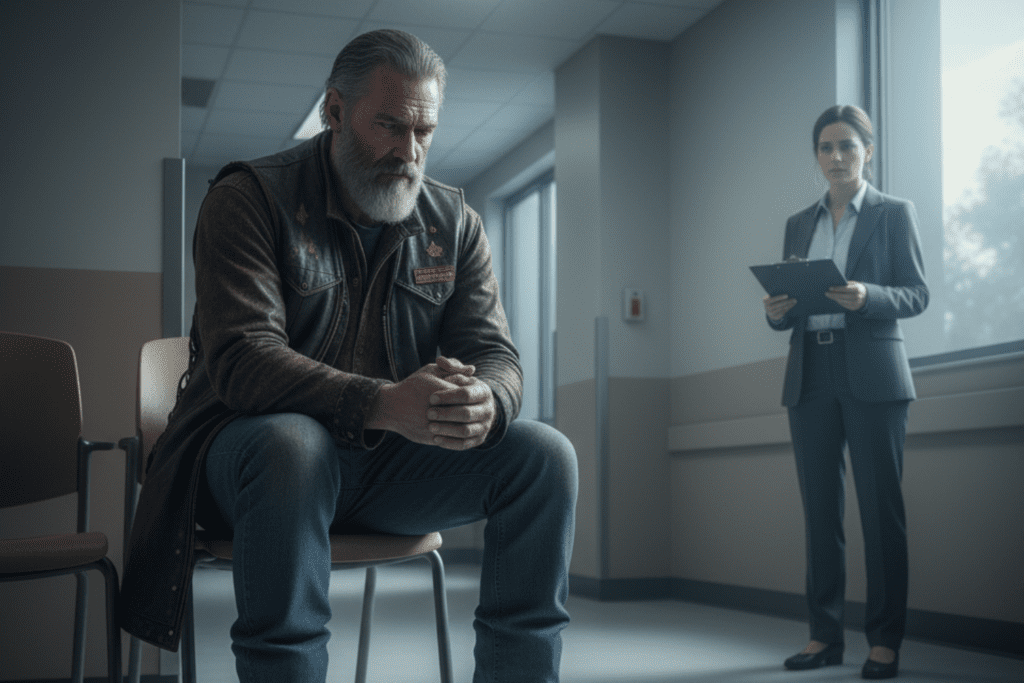
I sat in a plastic chair under fluorescent lights, listening to the hospital at night. Carts rolling. Machines beeping. Quiet crying behind curtains. It felt like a different kind of battlefield.
Around 5:40 AM, a woman in a blazer and tired shoes walked up holding a clipboard.
“Mr. Carter?” she asked.
I nodded.
“I’m Dawn,” she said. “CPS.”
I watched her face. She was trying not to judge me, but she was trying hard.
“Can you tell me what happened?” she asked.
So I told her again.
I spoke slower this time. Less anger. More detail. Because I knew what this was. This wasn’t just a conversation. This was the moment a stranger decided whether my help was allowed to count.
Dawn listened. She didn’t interrupt. She didn’t soften her eyes, either. She did what caseworkers do when they’re holding too many tragedies at once.
When I mentioned the carving on Lily’s back, something in Dawn’s expression changed. Not shock. Recognition.
She’d seen it before.
When I finished, she exhaled. “We’re working on an emergency removal.”
“Good,” I said.
Then I added, “He’ll come for her.”
Dawn looked at me sharply.
“He already did,” I said. “He hunted her on the highway like she was property. He’s not done.”
Dawn’s lips tightened. She nodded once.
That was the first time all night someone in authority looked at me like I wasn’t the problem.
She stood. “I’ll see what I can do.”
Before she walked away, I asked the question I had been holding back.
“Can I see her?” I said.
Dawn hesitated.
Then she said, quietly, “If she asks for you.”
I nodded.
It was fair.
It was also the worst feeling I’ve ever had. Waiting for a child to ask permission to trust you.
I didn’t sleep.
I watched the hospital morning begin. Staff switching shifts. The smell of coffee getting stronger. Daylight creeping into corners.
At 7:12 AM, a nurse finally walked toward me.
“Mr. Carter?”
I stood up too fast, my joints arguing.
“She’s asking for you,” the nurse said, softer.
My throat tightened so hard it hurt.
The nurse led me down a hallway into a small room. Before she opened the door, she paused.
“Please,” she said quietly. “Be gentle. She’s… she’s been through a lot.”
I looked at her. “So have I,” I replied, then softened my voice. “But I understand.”
The nurse opened the door.
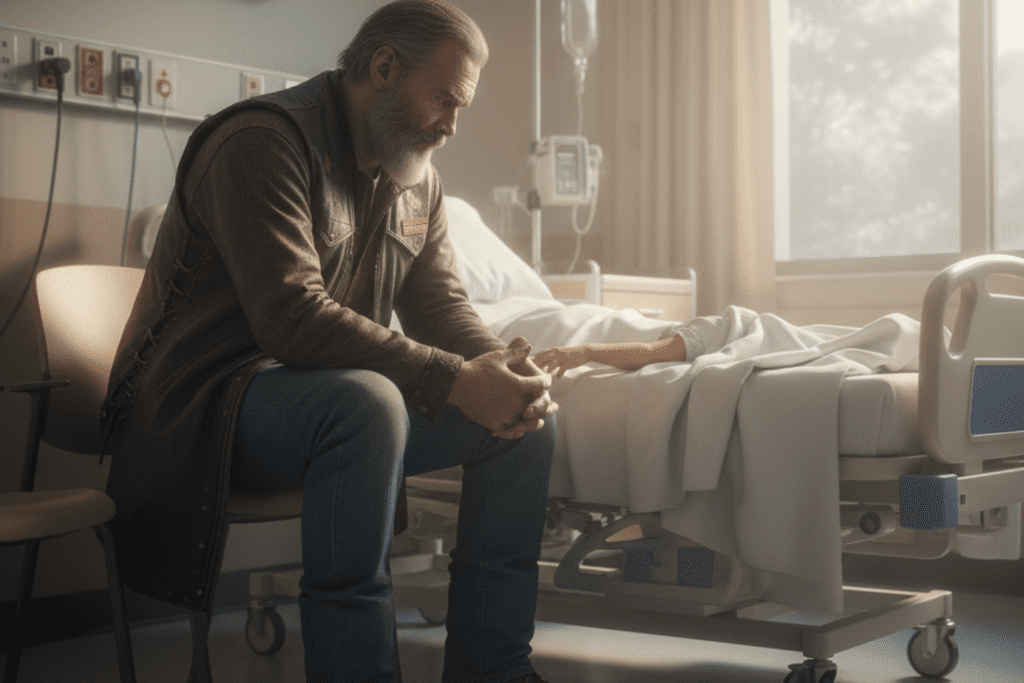
Lily was in a hospital bed that looked too big for her. Her skin was clean now, but the marks remained. Bandages covered parts of her arms. Her hair was damp, brushed back.
The teddy bear sat beside her, still wet in places, like they couldn’t fully wash the night off it.
She turned her head slowly when I entered.
Her eyes found me immediately.
“You came,” she whispered.
I stepped closer, careful. I didn’t touch her. I didn’t assume. I sat in the chair beside her bed, hands visible on my knees, letting her set the pace.
“I promised,” I said.
She stared at my vest. Then at my hands.
“Are you a bad guy?” she asked.
The question landed like a punch.
I took a breath. I didn’t lie. I didn’t pretend to be clean.
“I’ve done bad things,” I told her. “But I’m not going to hurt you.”
She studied me like she was reading a book page by page.
Then she asked, “Do you know heaven?”
I swallowed.
Because I understood what she meant. I understood what she’d been asking on Highway 14.
“I know it’s supposed to be safe,” I said.
She nodded, satisfied with that.
A long pause stretched.
Then Lily whispered something that made my hands go cold.
“He said if I tell, he’ll make me go to heaven.”
My jaw tightened. I fought to keep my face calm.
“He lied,” I said.
Lily blinked. “He doesn’t lie.”
My chest broke a little.
That’s what monsters do. They train children to believe their power is law.
I leaned in slightly, voice low. “Lily,” I said, “I’m going to tell you something true. He can’t reach you here.”
She held my gaze.
“And if he tries,” I added, “there are people who will stop him.”
“Who?” she asked.
I didn’t say the police. I didn’t say CPS. Because she didn’t trust those words yet.
So I said the only word she’d already seen with her own eyes.
“Me.”
She stared at me a long moment.
Then her little hand slid across the sheet, reaching.
Not fully.
Halfway.
A question in motion.
I placed my hand on the bed near hers, close enough that she could pull away if she wanted.
She didn’t pull away.
She rested her fingers lightly on my knuckles.
The touch was small.
But it was heavier than anything I’ve ever lifted.
By late morning, the man was in custody.
I found out from the detective. He called my phone while I was still sitting in Lily’s room, humming softly because Lily asked me to. She said my voice sounded like a motorcycle but in a good way.
The detective’s voice came through like gravel.
“We got him,” he said.
I closed my eyes.
Lily watched my face.
“He’s not coming,” I told her gently.
She didn’t celebrate. She didn’t smile.
She just blinked slowly, like her body was trying to understand relief.
That afternoon, Dawn came back with paperwork.
Emergency placement. Temporary shelter. Medical hold.
Words. Forms. Signatures.
I watched her explain things carefully to Lily, using soft language. Lily nodded when she was supposed to nod. She answered yes and no like a child who has learned being agreeable is safer.
When Dawn finished, she pulled me aside into the hallway.
“I want to be honest with you,” Dawn said. “This is going to be a long process.”
I nodded.
“She’s going to need stability,” she continued. “Therapy. Foster placement. Court hearings.”
I nodded again.
Dawn hesitated. Then she said, “And you need to understand something too. You did the right thing. But people… will have questions.”
I looked at her. “About my bike?”
“About you,” she said. “About why you were there. About why she trusts you.”
I felt anger flare up, then settle.
“I don’t care,” I said. “They can question me all they want.”
Dawn’s voice softened. “Some of them will want to make you the story.”
I stared down the hallway toward Lily’s room.
“Then they don’t know what story is,” I said quietly.
Because the story wasn’t me.
It never was.
The story was a child who stood barefoot in freezing rain and asked a stranger to take her to heaven because she thought death was safer than home.
That’s the story.
Everything else is noise.
On my way out, Lily asked to see my bike.
The hospital staff didn’t like it. Dawn didn’t love it. The detective raised an eyebrow.
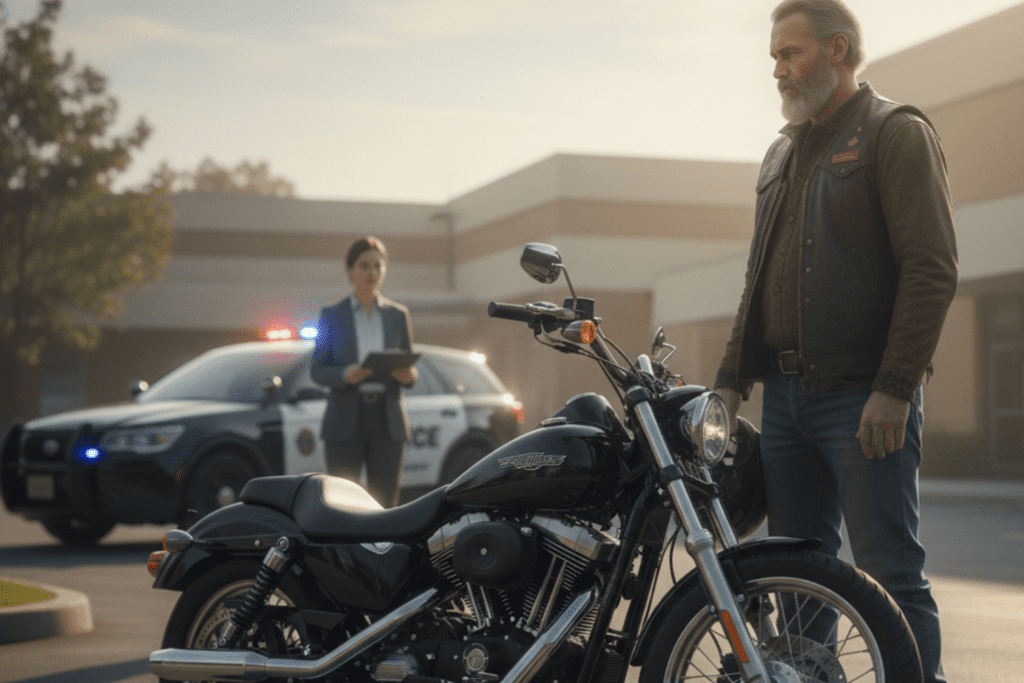
But Lily stood in the parking lot wrapped in a blanket, staring at my Harley like it was an animal that might bite.
I didn’t start it. I didn’t rev it.
I simply crouched beside her.
“This thing is loud,” I told her. “But loud doesn’t always mean dangerous.”
Lily looked at me.
Then at the Harley again.
Then she said, almost shyly, “Can I touch it?”
I nodded.
She reached out and placed her tiny hand on the gas tank, fingers splayed. She held it there like she was feeling proof under her palm.
Then she whispered, “It’s warm.”
“Yeah,” I said. “It’s been running all night.”
She nodded as if that made sense.
A minute later Dawn walked her back inside.
Before Lily disappeared through the sliding doors, she turned around.
“Hey,” she called softly.
I stepped closer.
Lily looked at me like she was trying to be brave.
“Don’t go to heaven,” she said.
It hit me so hard I couldn’t breathe right.
“I won’t,” I promised.
She nodded once, serious, then let Dawn lead her inside.
I stood there in the parking lot, rain finally gone, morning sun making everything look normal again, like the world hadn’t almost swallowed a child on Highway 14.
The detective walked up beside me.
“You should go home,” he said.
I nodded. But I didn’t move.
I kept seeing her lips. Blue with cold. Her eyes too old. That teddy bear clutched like a lifeline.
I kept hearing her say it.
Please take me to heaven.
I used to think hell was a place.
Now I know it can be a house.
And heaven, sometimes, is just a stranger who stops in the rain.
No Comments