

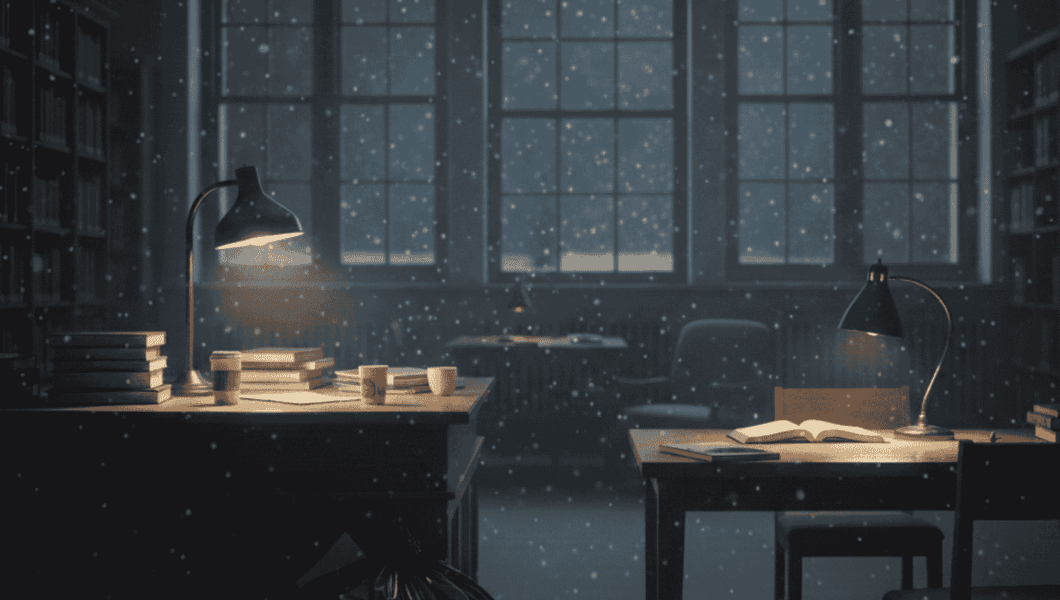
At 11:46 PM, I was standing alone in the library with a trash bag in my hand, pulling printed screenshots off the tables like they were dead leaves.
They were everywhere.
Folded, crumpled, coffee-stained. Some had been gripped so hard the ink bled at the edges. A few were left behind like evidence. Like whoever brought them had finally realized, too late, that they didn’t want to carry them anymore.
The overhead lights were already off. Only the desk lamp at circulation glowed, casting a warm circle over the returns bin and the stack of books I’d set aside for reshelving. The rest of the library sat in that blue-gray quiet that comes after a storm.
I should’ve gone home.
My feet hurt. My shoulders were tight. My throat felt scraped raw from answering questions with the kind of calm that costs you later.
But I didn’t move. I kept cleaning slowly, not because the library needed it, but because I needed the motion. Because if I stopped moving, the adrenaline would drain out of my body all at once and leave behind only the shaking.
When I finally locked the front doors, I stood there with my forehead against the glass. Snow had started falling again. The flakes floated down through the lamplight like ash.
Outside, the parking lot was empty. No matching t-shirts. No phones held up like weapons. No angry voices.
Inside, the only sound was the soft click of the lock turning and the distant hum of the HVAC unit.
It felt like the building itself exhaled.
I walked back toward the reading nook, past the shelves where my hands had placed books so carefully for years, books that had saved students I’ll never fully know, books that had been blamed for everything adults didn’t want to look at directly.
And there, under the lamp, sat the last proof of tonight’s miracle.
A chair slightly pulled out.
A book left open face-down, not damaged, just paused.
Tyler’s sketchbook resting on the table like a heart someone finally put down.
I touched the edge of it with my fingertips, then stopped. It wasn’t mine to touch. It wasn’t even mine to understand fully. It was enough to have witnessed it.
I turned off the lamp.
The library went dark.
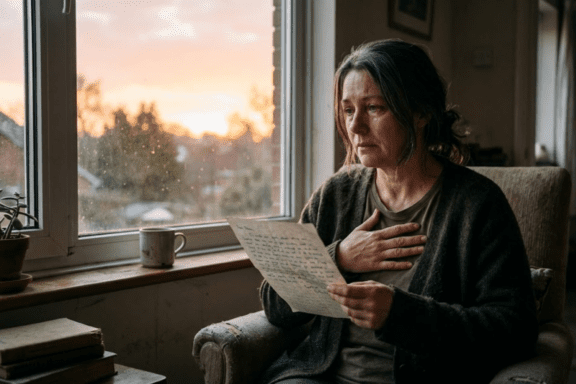
At home, I didn’t make dinner. I didn’t turn on the TV. I didn’t even take off my cardigan right away.
I stood in my kitchen the way some people stand in front of an open refrigerator, staring into cold light, not looking for food, just looking for something to numb them.
Eventually, I made tea. Chamomile. The kind people recommend when they don’t know what else to say.
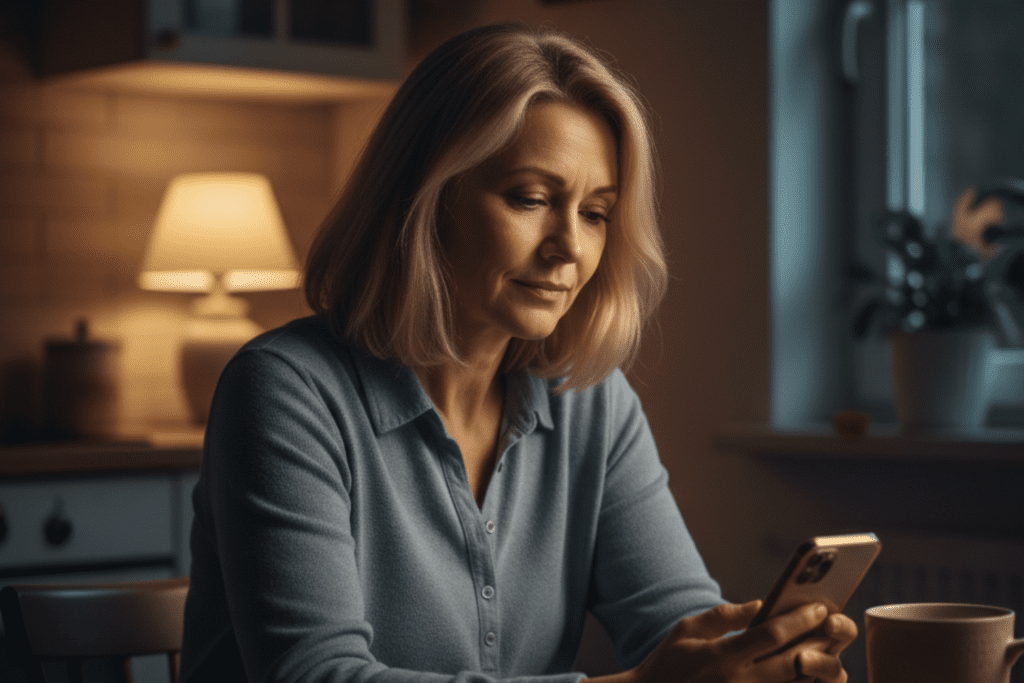
I carried the mug to my table and sat down.
My phone buzzed.
I expected another message full of rage. Another “we know where you live.” Another “you should be ashamed.” Another sentence full of typos and certainty.
Instead, it was a Facebook message request.
From Karen Fields.
No profile picture of herself this time. Just a dim photo of Tyler in a baseball cap, the kind parents choose when they want the world to see their child as simple and safe.
The message was short.
Thank you for not humiliating us.
I stared at it so long the tea went cold.
Humiliating us.
Not humiliating her. Not humiliating Tyler.
Us.
There was something in that word that made my chest tighten. The sound of a person who’d been living in “me” and “mine,” suddenly forced to admit she had dragged her child into her fear.
I set my phone down face-up, waiting for the rest of the message.
More buzzes came a minute later.
Tyler didn’t talk much when he got home.
He went straight to his room.
He’s drawing right now. For the first time in months.
Then one more.
I didn’t know he was that sad, Ms. Peggy.
It was the first time she called me that. Not “the librarian.” Not “that woman.” Not “Margaret Miller,” like I was a court document.
Ms. Peggy.
The name students use when they’re asking for help without making it a big deal.
I didn’t reply immediately.
I sat there with my hands around the mug, feeling my pulse in my fingertips.
If I answered too quickly, it would feel like a performance. If I answered too late, it would feel like punishment.
So I waited until my breathing felt normal again.
Then I typed:
You did something brave tonight. You stayed.
It took her five minutes to answer.
I stayed because he looked like he was drowning and I finally saw it.
I read that line twice.
Some parents spend years training themselves not to see what hurts their child, because seeing it means admitting they can’t control it. That love doesn’t always fix. That sometimes it just witnesses.
I typed again, slowly.
If you want, we can set up a time for you to meet with our school counselor. Quietly. No announcements. No drama.
Her response came almost instantly.
Yes.
Then, as if her thumb moved faster than her pride could stop it:
Also… I’m scared. I feel like everyone thinks I’m stupid.
I didn’t know Karen Fields well. We weren’t friends. We didn’t share recipes. We didn’t chat at football games.
But I understood what she meant.
When you become the villain in the story you wrote yourself, you don’t know where to put your face.
I typed:
People aren’t talking about you right now. They’re thinking about their own kids. Their own fear. Their own helplessness.
That was partly true.
And partly mercy.
The next morning, my principal called me into his office.
He didn’t look angry. He looked older than he had on Monday. Like stress had reached up and tugged at his face overnight.
“Peggy,” he said, rubbing his forehead, “we have… a situation.”
I waited.
“The board is getting calls,” he continued. “Not just from them. From everyone. People who are furious at Karen. People who are furious at us. People who want us to ‘stand our ground’ and people who want us to ‘clean house.’”
I nodded. I’d expected that. In small towns, nothing stays one thing for long. It becomes a rope in a tug-of-war.
He slid a paper toward me.
A formal complaint.
Book challenge forms. Multiple.
Karen’s name was on the top one.
My throat tightened.
“She filed it anyway?” I asked quietly.
My principal hesitated. “Not exactly.”
I looked closer.
There were notes written in the margins. Messy handwriting. Corrections. Words crossed out and rewritten like someone was fighting with their own mind.
At the bottom, in the section that asked the complainant to specify exactly what they wanted done, Karen had written:
I do not want the book removed.
I want better communication.
I want a meeting to understand selection policies.
I blinked.
It wasn’t nothing. It wasn’t perfect. But it wasn’t the guillotine either.
I felt something shift inside me, a small click of recognition.
Karen Fields didn’t walk into the library intending to soften. She intended to win.
But then her son asked for a book about feeling stuck, and the whole room turned into something else.
A room full of adults, suddenly confronted with the quiet truth that children are not political props. They are not symbols. They are humans.
“You handled last night well,” my principal said. “I want you to know that.”
I swallowed. “Thank you.”
He leaned forward. “But Peggy… this isn’t over.”
“I know,” I replied.
He paused. “Do you want security present for the next meeting?”
I looked down at the complaint forms again. At Karen’s messy handwriting. At the proof of a person changing in real time, not because she was shamed into it, but because her child cracked her open.
“Yes,” I said. “Just in case.”
Then I added, softer: “But I don’t think we’ll need it.”
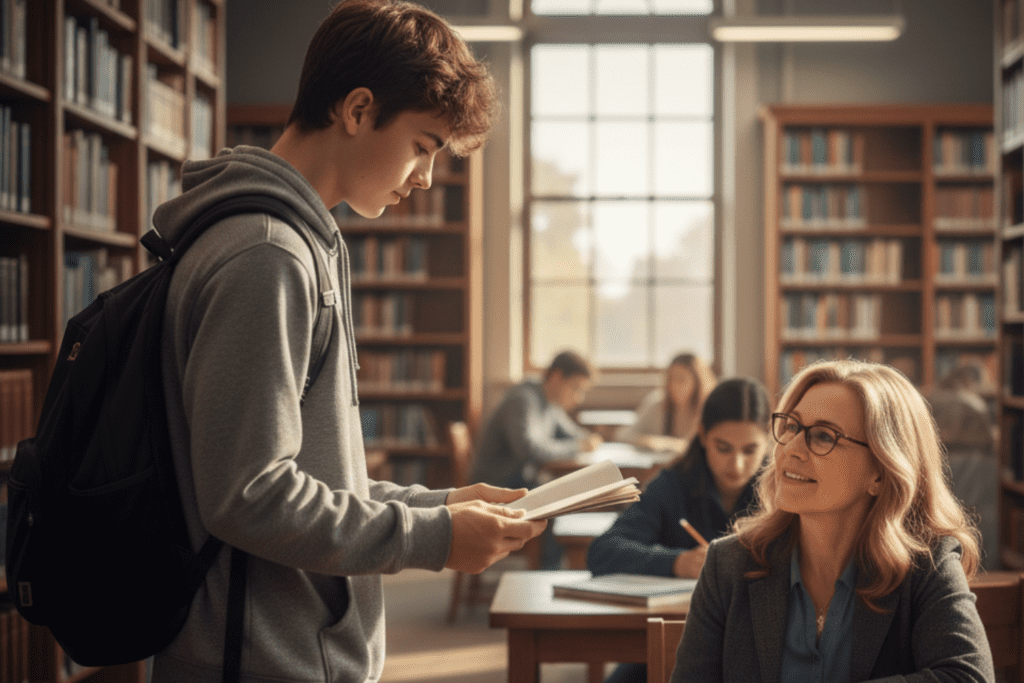
At 2:30 PM, Tyler appeared in the library.
Alone.
I didn’t see him enter. I only noticed him when I felt that quiet shift in the room, like the air recognized someone fragile.
He stood near the graphic novels, hands tucked into his hoodie pocket.
His sketchbook was under his arm.
He didn’t speak right away. He just looked at the shelves like he didn’t trust them not to disappear.
I approached slowly.
“Hi, Tyler,” I said.
His eyes flicked toward me, then down again. “Hi.”
“Are you okay being here?” I asked. “No one’s going to bother you.”
Tyler nodded. “Mom said I could come during her lunch.”
I wanted to say something kind and wise. Something librarian-like.
Instead, I said what was true.
“I’m glad you’re here.”
He swallowed. “I… I didn’t know it would be like that last night.”
“No one did,” I said.
He shifted his sketchbook. “I thought people were going to yell more.”
“So did I,” I admitted.
That seemed to surprise him. Adults aren’t supposed to admit fear. Adults are supposed to be furniture.
Tyler hesitated, then pulled out the same graphic novel I’d handed him the night before.
He held it out to me like it was evidence.
“I finished it,” he said.
“And?” I asked.
He shrugged slightly. “It was… it was quiet.”
“Yes,” I said. “It is.”
He nodded. Then he said, barely audible: “It made my head feel less loud.”
My throat tightened again, but I didn’t let it show.
“That’s what books do sometimes,” I told him. “They don’t fix your life. They just sit with you in it.”
Tyler stood there a moment longer. Then, almost as if the words fell out by accident:
“I think my mom is scared of me being sad.”
“I know,” I said gently.
He looked at me, finally, really looked at me. “Are you scared?”
I didn’t answer right away. The truth mattered.
“I’m not scared of you,” I said. “I’m scared of people not listening to you.”
Tyler nodded once like that made sense.
Then he surprised me.
He opened his sketchbook and turned it toward me.
A drawing of the library.
Not the whole building. Just the reading lamp. The chair. A book open on the table. Two silhouettes sitting side by side in the circle of light.
No faces. Just presence.
I didn’t praise it like a teacher. I didn’t make it inspirational.
I just said: “That’s exactly what it felt like.”
Tyler’s shoulders dropped. Relief. Like being seen didn’t hurt as much as he expected.
Karen came in the next day.
No matching shirt. No entourage. No phone held out like a weapon.
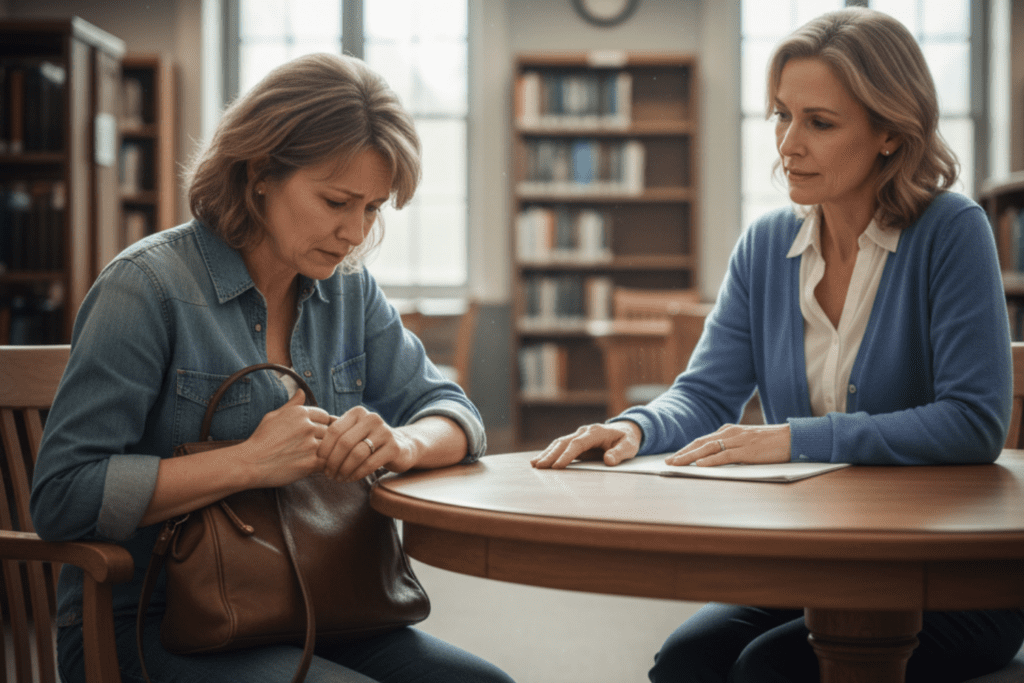
Just Karen, walking slowly, hands clenched around her purse strap like she wasn’t sure what she was allowed to be now.
I met her at the circulation desk.
She didn’t look at the shelves. She looked at me.
“Hi,” she said.
“Hi,” I replied.
Karen inhaled. “I don’t think I slept.”
“I didn’t either,” I said.
A laugh escaped her, small and strained. The first real human sound I’d heard from her in two days.
She looked down, then back up. “I watched that video again,” she said.
I waited.
“And I’m… embarrassed.”
I didn’t say You should be. I didn’t say You did this.
I simply nodded, letting her have the dignity of naming her own regret.
Karen leaned closer. “I got caught up. I really did.”
“It happens,” I said quietly.
She blinked fast. “No,” she corrected. “It happens to other people. I thought I was smarter than that.”
That struck closer to truth. People like Karen rarely imagine themselves as followers. They imagine themselves as leaders.
Karen exhaled through her nose. “Tyler,” she said, like the word itself was heavy, “he asked me last month if I’d ever been scared in my own head.”
My hands went still.
“And I told him to stop talking like that,” she continued, voice cracking. “I told him he was being dramatic.”
She swallowed hard. “He didn’t say anything after that. Not like that.”
I nodded slowly. That’s what children do. They learn where not to place their truth.
Karen’s eyes filled. “I thought I was protecting him. But I think I was protecting myself.”
I didn’t interrupt. Sometimes a confession needs air.
Then she whispered: “Is it too late to fix it?”
“No,” I said. “But it might take time.”
She nodded, accepting the cost.
We sat down at one of the round tables, the kind we use for book fairs. Karen stared at the quilt above the reading nook, the one that makes people feel safer without knowing why.
“Can I ask you something?” she said.
“Of course.”
“What do you do,” she asked, voice small now, “when you don’t understand your own child anymore?”
I watched her hands. She’d bitten one nail down to the quick.
“You don’t try to understand everything,” I said. “You try to stay close. You try to stay curious. You ask questions instead of giving verdicts.”
Karen nodded, tears falling now, silent.
Then she asked: “Will you still let Tyler come here?”
That one hurt. Not because it was cruel, but because it proved how afraid she was of being cast out.
“This is his library,” I told her. “He belongs here.”
Karen pressed her lips together, the way people do when they’re trying to keep from collapsing in public.
She stood up.
At the door, she paused.
“I’m sorry,” she said, finally meeting my eyes.
I nodded. “I know.”
Then she left.
And for the first time since 3:17 PM yesterday, my heart unclenched just a little.
That evening, a new post appeared in the parents’ group.
Not from Karen.
From someone else. Another leader. Another person hungry for conflict.
They posted a screenshot of Karen’s complaint form and wrote:
LOOK. She’s backpedaling now. Don’t let them fool you. They’re still poisoning our kids.
Under it, someone tagged Karen repeatedly. Like a dog called to a fight.
I watched the comments start rolling in again, faster than anyone could stop them.
And I waited.
Because I suspected something.
At 8:11 PM, Karen commented.
It wasn’t long.
It wasn’t polished.
It wasn’t PR.
It was just human.
She wrote:
I went to the library with my son. I looked at the full books. Not screenshots. And I saw something in him I’ve been missing. If you want to talk, go ask Ms. Peggy questions. She answered every one of mine respectfully. My son is reading again. That matters more than my pride.
I sat there in my kitchen, phone glowing in my hand, shocked by the courage of it.
It takes a particular kind of bravery to step into a crowd you helped build and tell them you were wrong.
The comments didn’t magically turn kind.
Some people praised her. Some attacked her. A few called her names that made my stomach turn.
But she didn’t delete it.
She left it there.
A small lit match in a dark room.
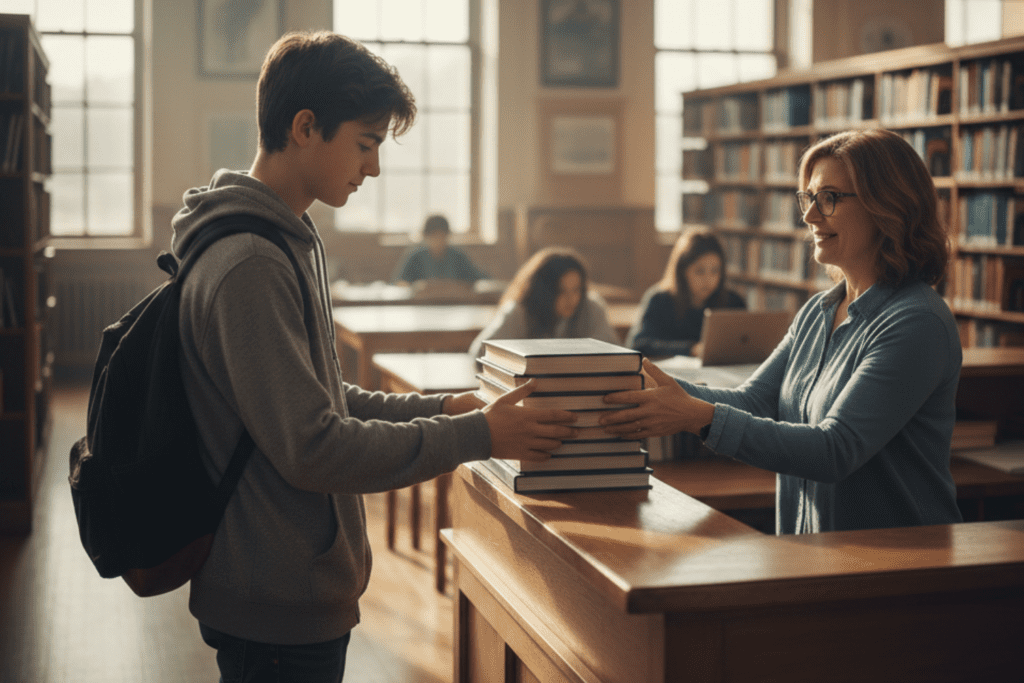
The next morning, Tyler checked out two more graphic novels.
He didn’t look at the checkout screen like he expected an alarm. He didn’t whisper. He didn’t apologize for wanting a story.
He smiled at me briefly when I handed him his receipt.
That was all.
But it was enough.
Because I realized something I had forgotten.
Libraries aren’t only for books.
They are for second chances.
Not the dramatic kind. Not the kind with speeches and viral redemption.
The smaller kind.
The kind where someone sits down beside their child and finally stays.
People will still call me names.
They’ll still post screenshots ripped from context and act like they’ve caught the world in a net. They’ll still demand silence and call it morality.
I can’t control that.
What I can control is this.
I can keep the shelves open.
I can keep answering questions.
I can keep making space for kids like Tyler, kids whose heads are full of static and who need a story that doesn’t punish them for existing.
And when fear comes back around, loud and certain, I can remember what happened under that reading lamp.
A mother sitting down.
A boy turning pages.
And a room full of adults realizing, too late, that the real danger wasn’t a book.
It was the hunger to burn bridges instead of crossing them.

No Comments