

The first thing I noticed was the sound.
Not the engines.
Not the shouting.
Not even Mrs. Chen’s voice cracking into panic the way it did when her authority stopped working.
It was the sound of the building itself reacting.
Golden Years Care Facility had its own kind of silence, the slow institutional hush of a place where people are managed more than they are lived with. Even the TVs were kept low. Even the laughter felt supervised. The halls always smelled like bleach and microwaved vegetables, and the lights were always too bright, like the building was trying to disinfect time itself.
But when those motorcycles arrived, the air changed.
The windows trembled in their frames.
A few residents on the first floor looked up as if they’d heard thunder. One of the aides dropped a tray of cups. The intercom crackled and then went quiet again, like the front desk didn’t even know what to announce.
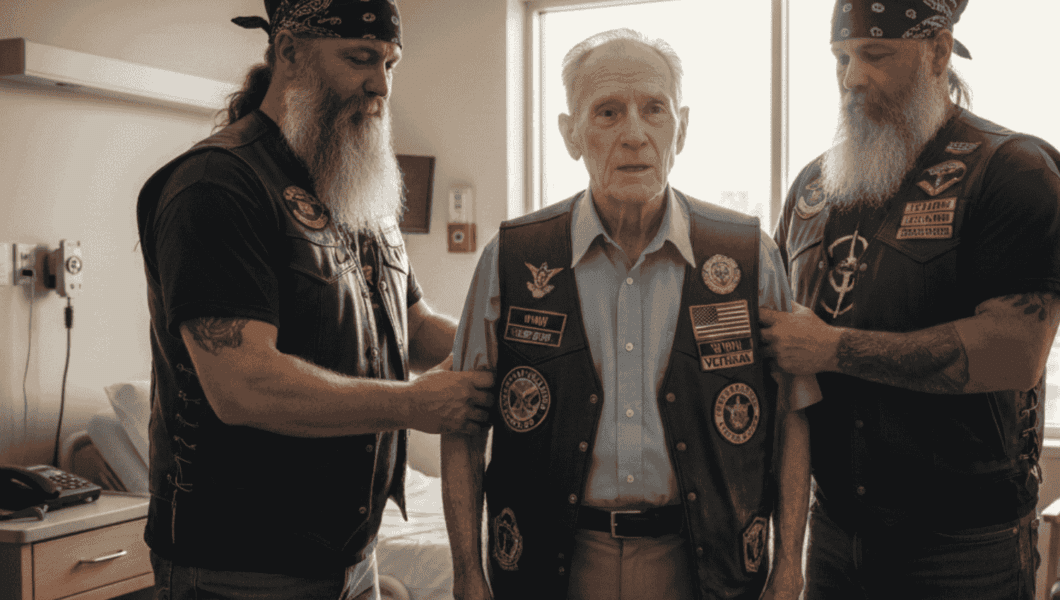
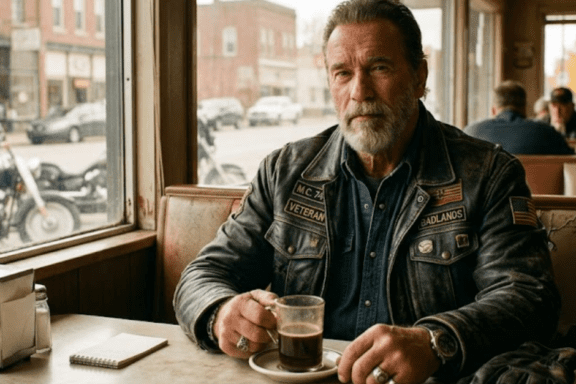
Up in Room 247, Harold sat with his old vest draped across his shoulders, fingers gripping the leather so tightly his knuckles were pale.
He was crying, but not in that lost, embarrassed way I’d seen in the past year. Not in the way people cry when they feel small.
This was different.
This was recognition.
This was a man being returned to himself.
Mike stood beside him, one hand on the wheelchair handle, the other resting lightly on Harold’s shoulder as if the touch was a promise: we’re here, and we’re staying.
Mrs. Chen hovered in the doorway, face pinched and furious, a woman watching her perfect system slip out of her hands.
“This is not happening,” she hissed. “This is a facility. He is under care.”
Mike turned his head slowly.
He didn’t move aggressively. He didn’t raise his voice.
That was the frightening part.
He spoke like someone who had already decided how this would end.
“Lady,” he said, calm as stone, “he’s under captivity.”
Security was still in the hallway, shifting their weight like men who thought they were supposed to be brave but weren’t sure what bravery looked like here. Their uniforms suddenly seemed flimsy. Their radios useless. They were trained for petty arguments and confused residents trying to wander outside.
They weren’t trained for a brotherhood.
They weren’t trained for hundreds of people arriving with purpose.
Harold’s breathing grew rough. I stepped forward instinctively and checked his pulse at the wrist.
Fast, but steady.
His eyes were clearer than I’d seen in months.
He looked at me, then at the vest, then toward the window where the sound was growing, the low thunder multiplying like a storm rolling in.
“Nancy,” he said.
“Yes, Harold.”
He swallowed, lips trembling. “Help me… stand.”
My heart clenched.
For three years he’d barely asked for anything. Not because he didn’t need it, but because he’d learned it didn’t matter. Needs were inconveniences here. Needs were something to be medicated.
But now he was asking.
And you don’t ignore a man asking to stand at the moment his life returns to him.
I nodded. “Okay. Slow.”
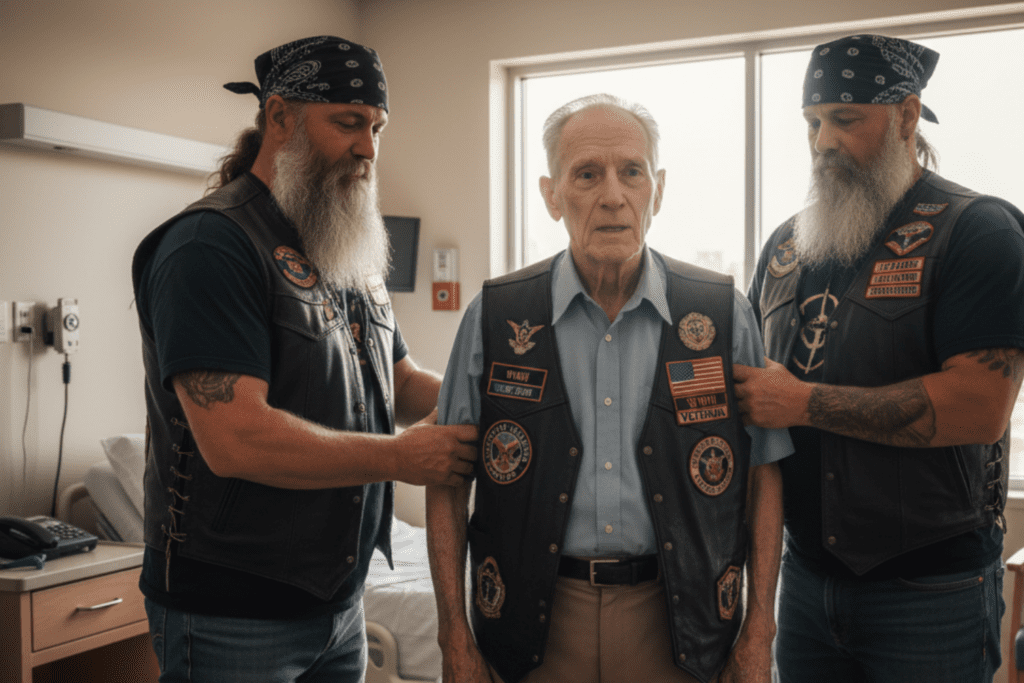
Mike stepped back to give me space, and two other bikers entered without being told. Not the loud ones. Not the ones hungry for confrontation. These men moved like veterans. Controlled. Respectful. They lowered themselves to Harold’s level and offered their arms like rails.
Harold braced his hands on the wheelchair arms, grimacing as he pushed.
His knees shook.
His body trembled with the effort.
Then, inch by inch, he rose.
His old vest slid into place on his chest like it belonged there. Like it had been waiting for him to fill it again.
When he fully stood, he swayed.
I tightened my grip, ready to catch him.
But he didn’t collapse.
He steadied.
And in that moment I saw it.
Not the frail man.
Not the patient.
Not the chart number.
I saw the founder.
I saw a man who had led others once.
Harold lifted his chin and looked toward the door.
“Now,” he whispered, almost to himself. “Now… I can face them.”
When we rolled him into the hallway, it was like the building held its breath.
Residents peered out from cracked doors.
One woman, tiny and bent, pressed her hand to her mouth as if she couldn’t believe what she was seeing. A man with oxygen tubing stared down the hall, eyes wide. An aide whispered, “Oh my God,” like she’d just watched history walk out of a room.
Mrs. Chen followed behind us, still trying to keep her voice sharp enough to control everything.
“This is illegal,” she kept saying. “You cannot remove a resident without authorization. His family—”
Harold turned his head slightly.
His voice wasn’t loud. It didn’t need to be.
“My family,” he said, quiet as gravel, “left me here to rot.”
The hallway went still.
Even Mrs. Chen shut her mouth, like she hadn’t expected the old man to speak like a man again.
We reached the elevator.
The bikers filled it without crowding Harold, bodies forming a protective shape around him. I stepped in beside the wheelchair, pressing the button for the first floor.
As the doors closed, the sound of engines hit again, deeper now, closer, like a heart beating beneath the ground.
I felt the vibration through my shoes.
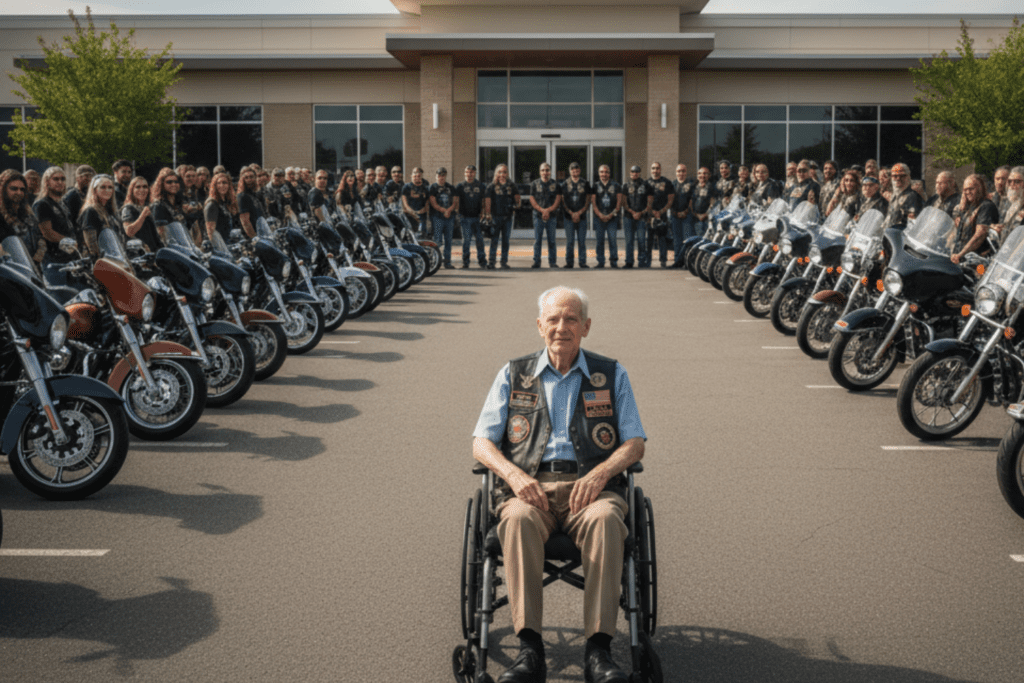
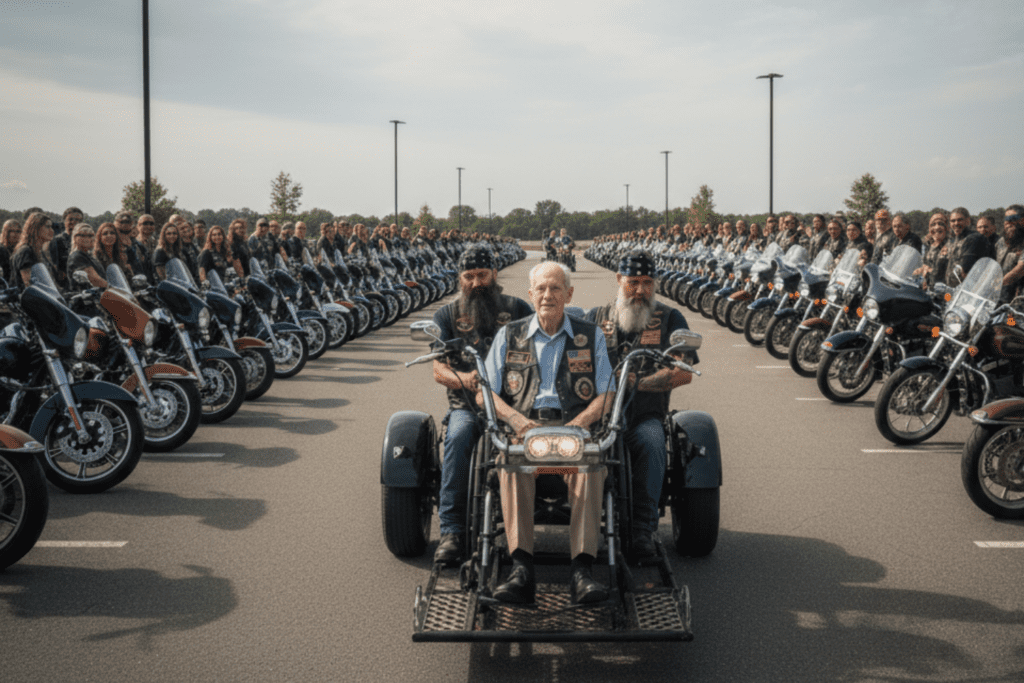
When the elevator doors opened into the lobby, the light from outside poured in through the glass entrance and caught on chrome parked in rows beyond the front doors.
More than rows.
A sea.
Motorcycles lined up like soldiers.
Not sloppy. Not chaotic.
Organized.
As if this was a mission.
As if this was a rescue.
And in the middle of it all, the forty who came first stood in formation, their faces solemn, their vests like flags.
Behind the reception desk, Claire stood frozen, tears slipping down her cheeks.
She looked at me as if to ask if she should run.
I shook my head slightly.
No.
This wasn’t danger.
This was something else.
Something the facility had never learned how to handle.
Loyalty.
The sliding doors opened.
Cold air rushed in, carrying the sharp scent of gasoline, wet leather, and wind.
A biker stepped forward and removed his helmet.
Then another.
Then another.
One by one, helmets came off like hats at a funeral.
A wave of respect so quiet and deliberate it made my throat ache.
The crowd parted as Mike wheeled Harold forward.
And then Harold saw them fully.
Hundreds of faces.
Old men with gray beards and softened bellies who looked like they’d once been unstoppable. Younger men with scarred knuckles. Women with braids and hard eyes and tenderness written beneath it. People from different states, different decades, different lives.
All wearing the same patch.
All bearing the same flame.
All looking at one man like he was the reason they existed.
Harold’s lower lip trembled.
“My God,” he whispered.
Mike leaned down near his ear. “Say the word, Pops.”
Harold swallowed. His hands gripped the arms of the chair like he was steadying himself against the weight of being remembered.
Then he lifted his chin.
And he raised his fist.
Not high, not dramatic.
Just enough.
A signal.
A recognition.
A greeting.
The lot erupted in one sound.
Not cheering.
Not yelling.
A roar.
A low, unified rumble of engines starting all at once, like thunder rolling across the mountains.
Every window in Golden Years shook.
Every resident watching from upstairs gasped.
And Harold…
Harold smiled.
It wasn’t big.
It wasn’t flashy.
It was the kind of smile you see when a starving man finally tastes something warm.
Mrs. Chen tried one last time.
She stepped forward, shoulders squared, voice rising.
“This is a medical facility! You can’t intimidate staff and take residents—”
Mike turned, slow.
“Ma’am,” he said, “the only intimidation in this building happened before we arrived.”
Mrs. Chen’s face flushed.
She pointed at Harold. “He has dementia. He doesn’t understand what’s going on.”
Harold looked at her.
He didn’t blink.
Then he did something I’ll never forget.
He reached up and turned his head slightly toward the crowd of riders.
“Devil’s Horsemen,” he called out.
His voice wasn’t strong, but it carried.
It carried because the parking lot went silent to receive it.
“We got a nurse here,” he continued, “who believed me when nobody else did.”
I felt my breath catch.
Hundreds of faces turned toward me.
I suddenly remembered I was still in scrubs. Still wearing my badge. Still standing under the weight of my own impulsive rebellion.
Harold lifted a frail hand toward me like a knight tapping a sword to a shoulder.
“She didn’t treat me like a problem,” he said. “She treated me like a man.”
The silence deepened.
Then Mike spoke, loud enough for everyone.
“Nurse Nancy,” he said, “step forward.”
My legs moved before my mind caught up.
I stepped onto the sidewalk, feeling everyone watching, and something in me wanted to shrink the way I always did in staff meetings when Mrs. Chen got mean.
But Harold was watching.
Harold was waiting.
I straightened.
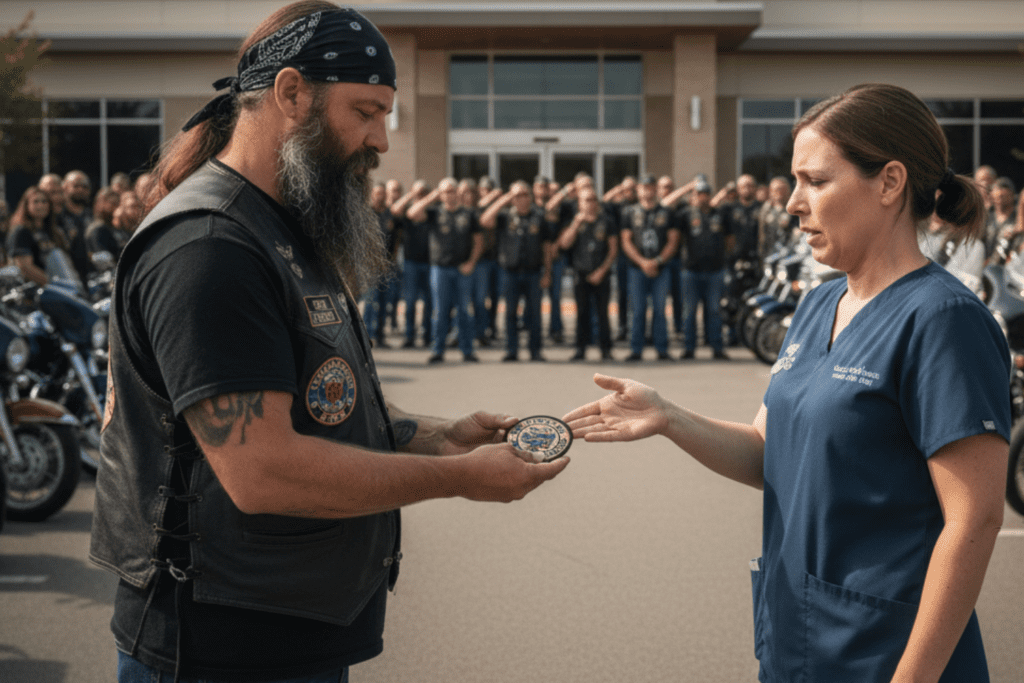
Mike reached into his vest pocket and pulled out a patch.
A small one.
Not the full back piece. Not the big emblem.
But a clean embroidered square that read:
HONORARY HORSEMAN
My mouth went dry.
Mike held it out.
“For the one who held the line,” he said simply.
I stared at it like it might vanish if I looked away.
I had worked six years in that facility. I had done CPR. I had cleaned wounds. I had held hands while people died. I had watched residents get forgotten like furniture.
No one had ever thanked me like that.
I reached out and took it with shaking fingers.
The riders didn’t clap.
They didn’t make a show.
They did something quieter and stronger.
They lifted their fists.
One by one.
A wave.
A salute.
And I knew I would never forget it as long as I lived.
Behind me, Mrs. Chen stood rigid with rage and humiliation, but her voice had disappeared. Her control had evaporated.
Because she wasn’t up against paperwork.
She was up against memory.
She was up against brotherhood.
She was up against a life that refused to be erased.
The EMTs arrived ten minutes later.
Not because the bikers called them.
Because I did.
I wasn’t going to let adrenaline turn Harold’s rescue into his funeral.
Harold’s heart needed monitoring. His blood pressure needed checking. His body had been dormant too long in that chair. Even freedom can shock an old system.
The paramedic approached carefully, eyes flicking to the bikes, to the vests, to the sheer number of riders.
Then he looked at Harold.
Something in his face softened.
“Mr. Morrison?” he asked.
Harold nodded slowly.
“We’re just going to check you out, sir.”
Harold’s eyes narrowed a little. “Am I… in trouble?”
The paramedic shook his head quickly. “No, sir. Not at all.”
Harold exhaled.
I watched the paramedics do their work. Professional. Calm. Quick.
And while they checked Harold, the riders didn’t hover. They stayed back. They gave him space. They gave him respect.
Which told me everything.
These weren’t criminals.
These were men and women who understood rank in a way society forgets.
You don’t crowd a founder.
You guard him.
After the assessment, the paramedic nodded to me.
“He’s stable,” he said quietly. “But he needs follow-up care somewhere else. Somewhere with… better oversight.”
His eyes flicked toward the building.
I understood.
So did he.
Golden Years had been getting away with too much for too long.
Not because nobody cared.
Because nobody had the strength to push back.
Harold did now.
And he wasn’t alone.
An hour later, Harold left the facility for the last time.
Not through a back door.
Not in an ambulance.
Not with shame.
He rolled out the front entrance like a man leaving prison, the sun on his face, his old vest on his shoulders, his brothers lined up on both sides like an honor guard.
Someone put a helmet on his lap.
A woman rider, maybe in her forties, leaned down and kissed Harold’s forehead.
“You’re home now, Pops,” she whispered.
Harold closed his eyes.
A tear slid down his cheek, caught in the wrinkles like it belonged there.
And then the engines started.
The sound hit like a wave.
Not chaos.
Not recklessness.
A procession.
They escorted him out of that lot like a king, like a commander, like the founder he always was.
I watched them go with my hands clenched at my sides.
And only when the last bike disappeared beyond the trees did my body remember to shake.
I was suddenly very aware that I’d just told my boss off in front of half the town.
I was suddenly aware I might not have a job tomorrow.
I was suddenly aware the facility could sue me, report me, smear me.
Claire stepped beside me.
“I saw what you did,” she whispered. “I saw everything.”
I looked at her.
Her eyes were wet.
She swallowed. “We all did.”
It was then I realized the real earthquake wasn’t the motorcycles.
It was what they exposed.
They didn’t just come for Harold.
They came with light.
And once light hits certain corners, it doesn’t go away quietly.
That night, I didn’t sleep.
My phone buzzed nonstop.
People texting. Calling. Asking. Whispering about lawsuits. About media. About police.
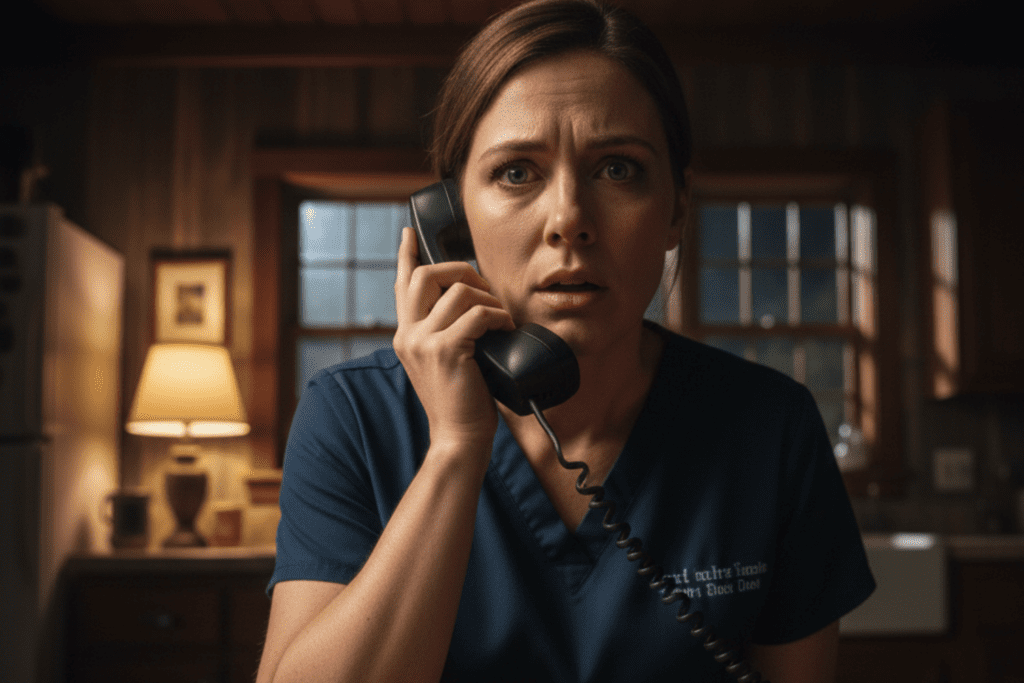
Around midnight, an unknown number called me.
I answered with my heart in my throat.
“Nancy?” a deep voice said.
It was Mike.
“Pops asked for you,” he said. “He wants to talk.”
My eyes filled instantly, and I hated myself for it.
“Is he okay?” I asked.
“He’s better than okay,” Mike replied. “He’s… awake. Like we haven’t seen in years.”
There was a pause.
Then Mike softened his voice.
“And Nancy,” he added, “whatever happens to you with that facility… you won’t face it alone.”
My throat tightened. “I don’t want trouble,” I whispered.
“I know,” he said. “Neither do we.”
Another pause.
Then the words that landed like a hand on my shoulder.
“But we’re not afraid of it anymore.”
Mike transferred the call.
I heard breathing on the other end. Slow, old breathing.
Then Harold’s voice.
“Nancy,” he said. “You still there?”
“I’m here,” I whispered.
Harold cleared his throat. “I didn’t get to tell you something.”
“Yes you did,” I said. “You told me everything.”
“No,” he replied. “Not today.”
I listened.
Harold’s voice trembled slightly, but it was clear.
“Today… you gave me my name back.”
I closed my eyes.
“I want you to know,” he said, “that I didn’t forget who was kind to me.”
Silence stretched, thick and full.
Then he added, softer, like a secret.
“And the truth about why my kids left me… isn’t what you think.”
My stomach dropped.
I stood very still.
“Harold?” I said.
He inhaled.
Then he spoke one sentence that made my whole body go cold.
“They didn’t leave me because I wouldn’t sign the house.”
He paused.
“They left me because they were afraid of what I was going to tell the police.”
The line went quiet except for his breathing.
And in that moment, I understood something.
This story wasn’t just about a veteran being rescued.
It was about a truth that had been buried.
And those bikes hadn’t just brought brotherhood.
They’d brought consequences.

No Comments