

I did not wake up the next morning feeling fixed.
The alarm went off at 6:15 and my first thought was to roll over, to pretend I had never made a promise on a balcony the night before. The room was still gray with early light. The city outside my window sounded half-asleep. For a moment, everything in me wanted to sink back into the mattress and disappear into the familiar numbness.
Then Buster nudged my arm.
He does this thing when he needs to go out where he presses his nose against me and waits, patient and trusting, as if he believes the world will respond simply because he asked. His tail made a soft thump against the bed.
I sat up.
The envelope on my counter was gone. In its place was a small pile of torn paper. I had not imagined last night. I had not imagined the porch or the soda or the hand that felt like it had held more years than I could understand. I had not imagined a neighbor who saw through me without asking for anything in return.
I clipped on Buster’s leash. We stepped into the hallway, which smelled faintly of cleaning solution and someone’s burnt toast. My feet felt heavy. My chest still held that familiar ache, the one that had followed me for months. But there was something else now too. A direction.
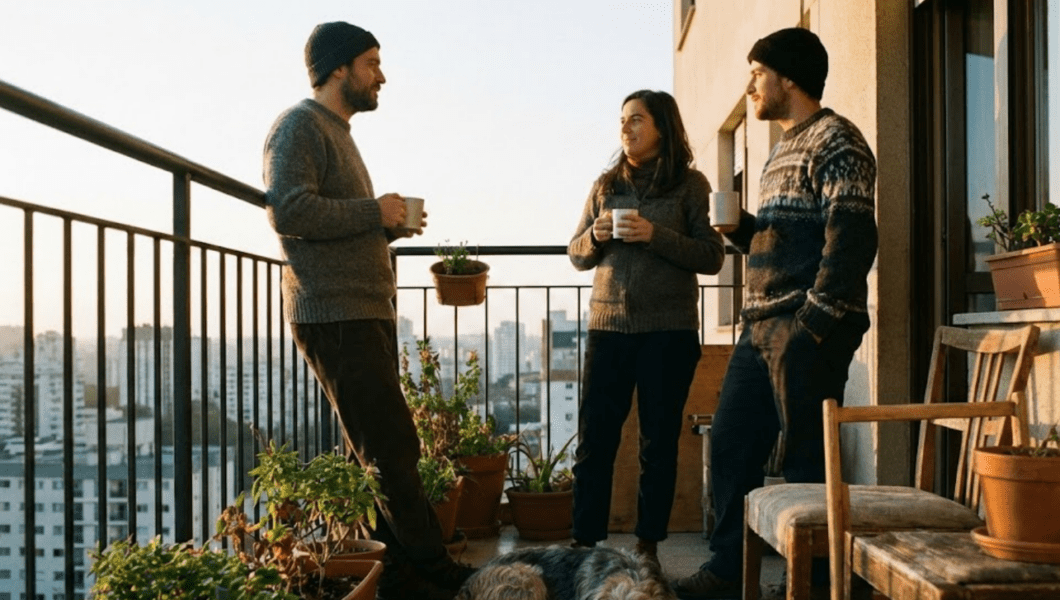
When we reached the balcony, Mr. Earl was already there.
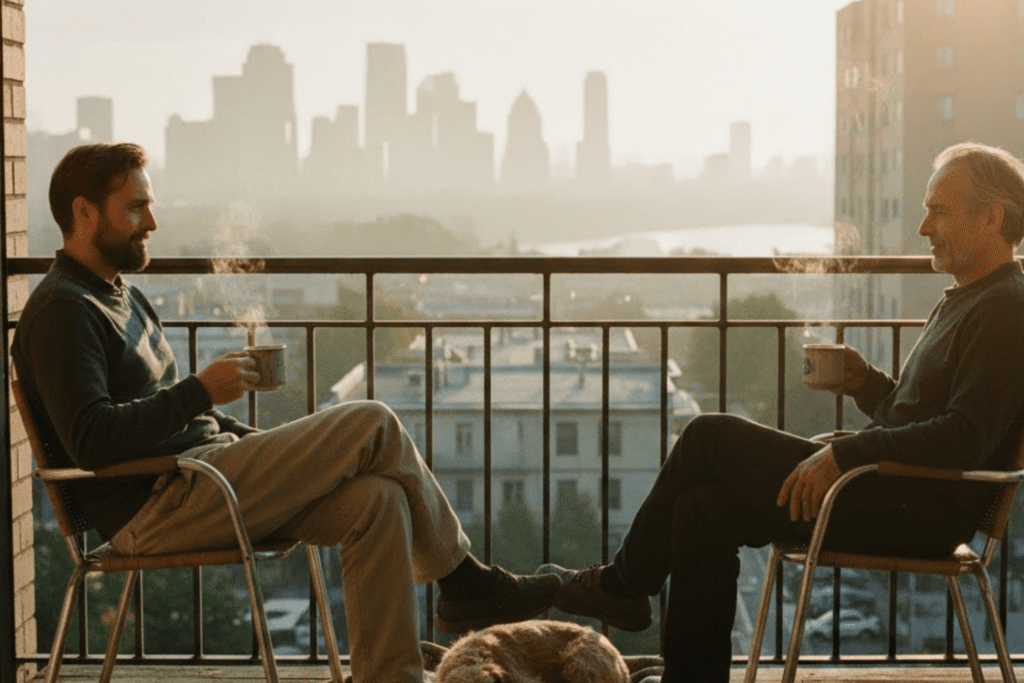
He sat in his folding chair, baseball cap pulled low, steam rising from a chipped mug that read WORLD’S OKAYEST DAD. He did not look surprised to see me. He simply nodded, as if this was the most ordinary thing in the world.
“You’re on time,” he said.
I was not. I was two minutes early.
We did not talk much that first morning. We watched the city come alive in pieces. A bus coughed at the corner. Someone across the street raised a garage door. Light crept up the glass of the building opposite us. Buster sat between us, ears perked, taking in every sound as if he were cataloging the day.
The coffee was strong and unpretentious. It tasted like something that had been made the same way for decades.
When it was time for me to go, Mr. Earl held up one finger.
“One thing,” he said.
I searched my mind. My instinct was to offer something big, something that proved the morning meant something. But nothing dramatic had happened. The city had not changed. My bank account had not miraculously grown.
“The sun,” I said finally. “It looks… different from up here.”
He nodded. “That’ll do.”
I went to work after that. Or what I called work, which was really a rotating schedule of deliveries, errands, and whatever app happened to be paying a few dollars more that day. The streets were the same. The noise was the same. People were still rushing past one another with eyes fixed on screens. Nothing had softened just because I had sat on a balcony at dawn.
And yet, every few hours, I caught myself thinking about 6:30 the next morning.
Not in a dramatic way. Not as a lifeline or a revelation. Just as something that existed. A point in the day that was not about money or performance or pretending.
When I returned in the afternoon, Mr. Earl was still there. Buster launched himself into his lap as if they had known each other for years.
“You come back tomorrow,” Mr. Earl said, not as a question.
“I will,” I said.
That night, I cooked for the first time in days. It was nothing special. Pasta from a box. Jarred sauce. But the act of standing at the stove, of stirring something warm, felt almost ceremonial. Like I was rehearsing for a version of myself I had not met yet.
I slept better than I had in weeks.
The days did not become easier all at once. Some mornings I arrived on the balcony already tired. Some afternoons I came back with nothing good to report except that I had made it through.
Mr. Earl never pushed for more.
“Tell me one thing,” he would say. “Doesn’t have to be big.”
So I told him small things.
A woman at a coffee shop who wrote my name correctly on the cup for once. A delivery where someone thanked me and meant it. A song on the radio that reminded me of my sister. A stretch of sidewalk where the trees had finally started to bud.
Sometimes my one thing was simply that Buster had chased a pigeon and lost.
Mr. Earl listened the way people used to listen, with his whole body. He did not glance at a phone. He did not interrupt. He nodded when something landed and stayed quiet when it did not.
On the fourth morning, he asked me about my family.
“My sister and I grew up in a small town,” I said. “She’s two years older. Left the minute she could. I followed as soon as I had the chance. We thought the city would make us into something.”
“And did it?” he asked.
“It made us busy,” I said. “I don’t know about anything else.”
He smiled at that. Not unkindly. More like someone who had heard the same story told in different voices for a long time.
He told me about Betty then.
Not in a speech. Just in fragments, like memories that had softened around the edges.
She worked at the post office for thirty-two years. She liked crossword puzzles and hated cilantro. She could not cook to save her life but made a peach cobbler that everyone pretended was the best thing they had ever tasted because they loved her.
“After she passed,” he said, staring out at the street, “I kept thinking if I stayed inside long enough, the quiet would swallow me whole. That’s why I sit out here. I don’t need much. Just proof the world is still moving.”
I thought about the balcony again. About porches. About how strange it was that a piece of concrete with a metal railing had become the most human place in my life.
The first real change came on a Wednesday.
I had finished a delivery near a small bookstore that was closing. A handwritten sign in the window read: LAST WEEK. I stood there longer than I meant to. Books had been the one thing I never regretted spending money on, even when I had none.
Inside, the owner was packing boxes.
“You hiring?” I asked, half as a joke.
She looked up. “Part-time,” she said. “Two days a week. Pay isn’t great.”
I almost laughed. Nothing in my life paid great. But something about the smell of paper and dust and the way the shelves curved around the room made my chest feel lighter.
“I can start tomorrow,” I said.
She handed me a pen.
When I told Mr. Earl that afternoon, he did not clap or celebrate. He nodded once, as if this outcome had always been possible.
“That’s a place with a front porch,” he said.
“What?”
“A bookstore,” he said. “People wander in. They linger. They talk. That’s a porch.”
The next morning, I wore the only button-down shirt I owned. It had a coffee stain on the cuff that I could not quite get out, but I folded my sleeves so it did not show.
At 6:30, we drank our coffee.
“One thing,” he said.
“I might have found a porch,” I said.
He smiled.
The bookstore did not change my life in the way movies promise. I still had bills. I still checked my bank app too often. But for a few hours twice a week, I stood behind a counter that did not feel like a trap. People asked for recommendations. They told me what they were going through in the casual way strangers do when they are holding a book that reminds them of something.
One woman bought a novel and then came back twenty minutes later to tell me it was exactly what she needed that day.
I carried that back to the balcony like a secret.

There were still mornings when the old weight returned.
Days when the news felt unbearable. When I watched people argue online about things that felt so far from the reality of trying to survive. When I scrolled past images of friends who seemed to be “winning” at a life I could barely afford to participate in.
On one of those mornings, I arrived late.
Not by much. Three minutes. But Mr. Earl noticed.
“You okay?” he asked.
I wanted to lie. The old habit rose automatically.
“Yeah,” I said.
He did not respond. He simply waited.
The truth spilled out in pieces. How tired I still was. How some nights the quiet in my apartment felt too loud. How I worried that this fragile sense of balance could disappear as quickly as it had appeared.
He listened.
“You know what you did that night?” he said when I finished.
“I almost walked away from everything,” I said.
“No,” he said gently. “You knocked on a door.”
I looked at him.
“That’s not quitting,” he said. “That’s asking for help. This country taught you that being strong means doing it alone. That’s a lie. Strong is saying, ‘I can’t carry this by myself.’”
We sat in that for a while.
“I don’t have answers for your debt or the price of gas,” he said. “But I can tell you this. You show up here every morning. You show up for that dog. You show up for a bookstore two days a week. That’s not nothing. That’s a life being built out of small pieces.”
I did not feel suddenly cured. I felt seen.
As the weeks went on, other people began to appear.
A woman from the third floor who walked her cat in a stroller and waved shyly at first, then stopped to say hello. A college kid who lived in 5A and started bringing his coffee out with him, sitting on the opposite end of the balcony like he was testing the idea of being part of something.
No one announced that this was now a community. It just… happened.
One morning, the woman with the stroller asked if we knew a good mechanic. Mr. Earl gave her a name. The college kid asked about the bookstore. I told him where it was.
The balcony began to feel less like a waiting room and more like what Mr. Earl had described.
A porch.
I called my sister one night and told her about it.
“You made friends with a seventy-something neighbor who drinks coffee at dawn?” she said.
“Something like that.”
She was quiet for a moment. “I’m glad you’re not alone.”
So was I.
There were still hard days.
Days when I did the math and it did not work. Days when I felt like I was sprinting just to stay in place. Days when the noise of the world pressed in again and the old exhaustion whispered that nothing really changed.
But there was always the next morning.
Always 6:30.
Always a chair waiting.
Always a dog who believed I would come back.
One Friday, I arrived with nothing good to report. The bookstore had cut my hours. A client had canceled. I stared at my cup like it held the answer.
“One thing,” Mr. Earl said.
“I don’t have one today,” I said.
He took a sip of his coffee.
“You made it here,” he said. “That counts.”
I nodded, surprised by how much that mattered.

I am not writing this as someone who has everything figured out.
I still live in the same apartment. I still juggle work. I still feel the weight of a system that does not care how hard you try.
But I am writing this as someone who knows, now, that isolation lies.
It told me I was alone in a city of millions. It told me that asking for help was weakness. It told me that if I disappeared, the numbers would add up better.
What it did not count on was a man on a balcony with a radio, a chipped mug, and the courage to look at a stranger and say, “Sit down.”
What it did not count on was a dog who knew the difference between being left behind and being walked into the next day.
What it did not count on was a porch.
If you are reading this and you recognize the noise and the exhaustion and the silence that feels too big for one apartment, I cannot promise you solutions. I do not have a map out of the mess we are all in.
But I can tell you this.
There is someone within ten feet of you who might be waiting for you to knock.
There is a place, however small, where you can sit for a minute and be seen.
There is a morning that does not have to be a threat.
I will be on the balcony at 6:30.
You can sit with us.
No Comments