

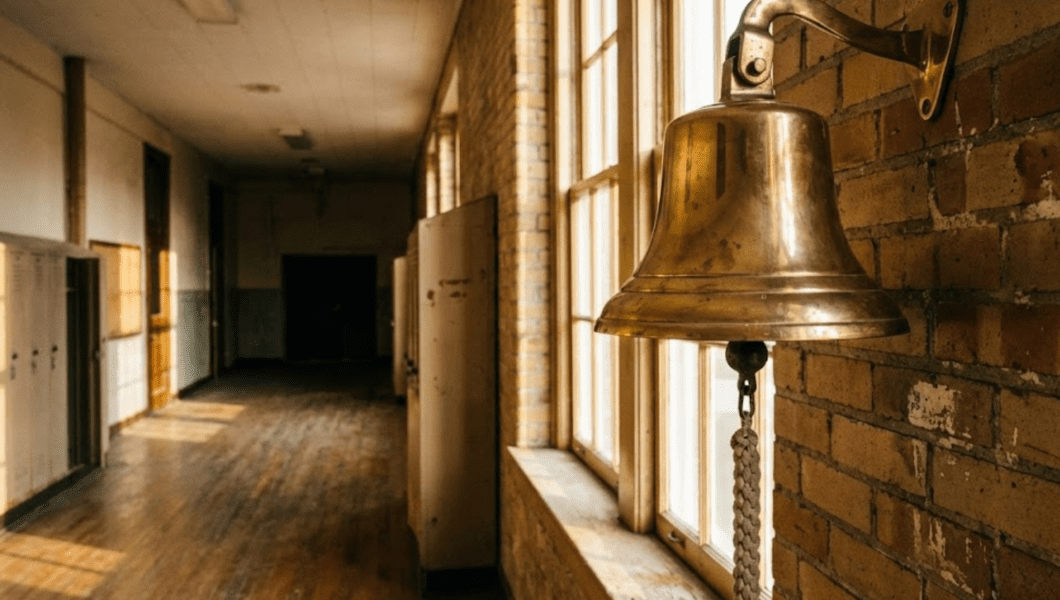
The year after Mr. Brooks retired, the bell never missed a Friday.
At first, Dr. Grant worried the ritual might fade without him. Traditions built around one person often do. They become stories people tell fondly while quietly letting them disappear. But that didn’t happen at Riverside Elementary.
If anything, the bell sounded more deliberate.
Teachers set phone alarms for 3:44. Classroom doors opened a little earlier. Conversations softened as the minute approached, as if the building itself were leaning in to listen.
Sometimes the chime came from the front office. Sometimes from the science wing. Once, the art teacher rang it while still wearing a paint-splattered apron. No matter who pulled the rope, the sound carried the same weight.
It still meant the same thing.
You made it.
Then came March.
It started with a staff meeting that ran too long, filled with budget discussions and district mandates that landed like stones on already tired shoulders. Test scores were down. Funding uncertain. Two teachers had submitted resignation letters the week before.
By Friday afternoon, the building felt brittle, like one more push might cause something to crack.
Dr. Grant noticed it in the little things. The way voices were quieter in the hallway. The way a normally cheerful second-grade teacher stared at her computer screen long after dismissal, unmoving. The guidance counselor wiping her eyes in the restroom and pretending it was allergies.
At 3:44, fewer doors opened than usual.
Some teachers kept working, heads down, as if acknowledging the ritual might expose how exhausted they really were.
Dr. Grant stepped into the hallway anyway.
The brass bell hung where it always had, polished from years of handling. Sunlight from the front windows caught its edge, turning it briefly gold.
She reached for the rope.
For a moment, she hesitated.
Not because she doubted the tradition. Because she wondered if one chime was enough for a week like this.
Then she pulled.
The bell rang, clear and steady, filling the corridor.
A few doors opened. A few shoulders dropped. Someone exhaled loudly, the sound echoing down the hall like air escaping a tire.
But as the vibration faded, the heaviness remained.
Dr. Grant turned to go back to her office.
And then she heard footsteps behind her.
“Wait,” a voice said.
It was Mrs. Alvarez, the second-grade teacher who had been staring at her computer earlier. She walked slowly, eyes red but determined.
“May I?” she asked, gesturing toward the bell.
Dr. Grant stepped aside.
Mrs. Alvarez took the rope in both hands, closed her eyes for a second, and pulled.
The bell rang again.
Not louder. Not longer. Just another clear chime, following the first like an echo that had chosen to exist.
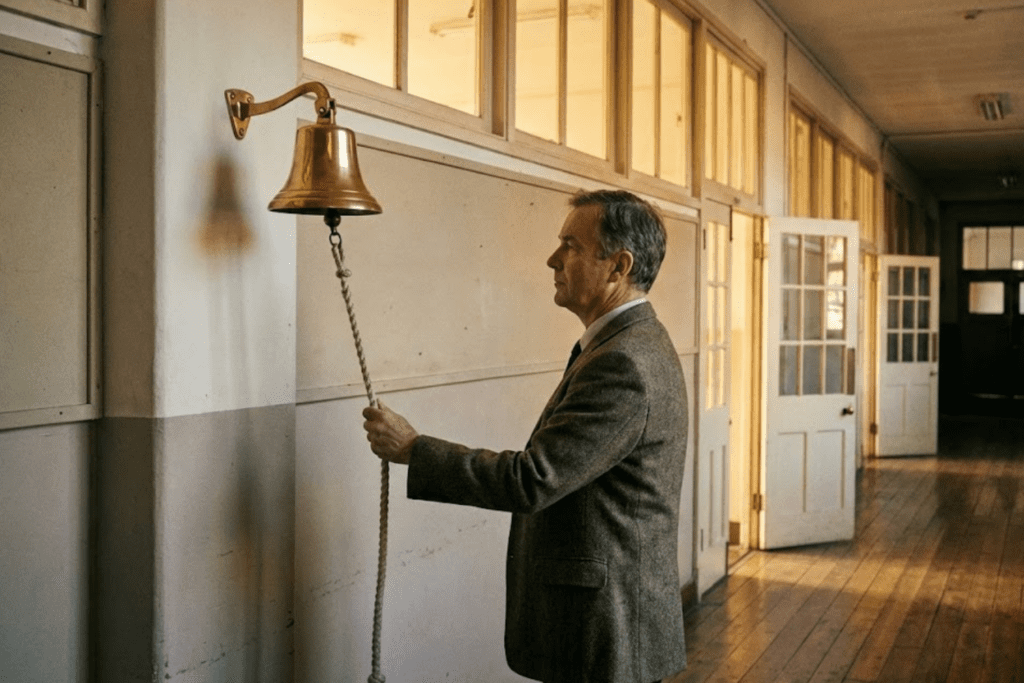
This time, more doors opened.
A third-grade teacher leaned against her doorway, hand pressed to her chest. The music teacher wiped her face openly, no longer pretending she was fine. Down the hall, a substitute paused mid-step, looking confused but strangely moved.
Mrs. Alvarez let go of the rope and turned toward Dr. Grant.
“My husband left last month,” she said quietly. “I haven’t told the kids. Or most of the staff. I just… needed to hear it twice today.”
Dr. Grant didn’t know what to say that wouldn’t sound inadequate.
So she did what Mr. Brooks had done all those years ago. She stood there and let the moment exist without trying to fix it.
By Monday, word had spread in the gentle way important things do at schools. Not gossip. Not spectacle. Just understanding.
No one made a big announcement.
But something shifted.
Teachers lingered longer in the halls between classes. Someone started leaving a small basket of granola bars in the lounge with a handwritten note that said “For hard days.” The art teacher put up a bulletin board where staff could pin anonymous thank-you notes to each other.
None of it was coordinated.
All of it mattered.
Two weeks later, another difficult Friday arrived. A student had been hospitalized. A beloved teaching assistant announced she was moving away. Rain hammered the windows all afternoon, turning the building gray and restless.
At 3:44, the hallway filled quietly.
Not packed. Just… present.
Dr. Grant noticed something new. Teachers weren’t waiting near the bell alone. They stood beside one another, shoulders almost touching, like people gathering around a small fire.
When the clock clicked to 3:45, the librarian stepped forward and rang it.
One chime.
As it faded, she stepped back without a word.
Then the guidance counselor stepped forward.
Another chime.
Then the music teacher.
Another.
No one had planned it. No one had signaled. They simply kept taking turns, each ring spaced just far enough apart to let the sound settle before the next one began.
The hallway filled with overlapping waves of tone, each one gentle but insistent.
Not chaotic.
Communal.
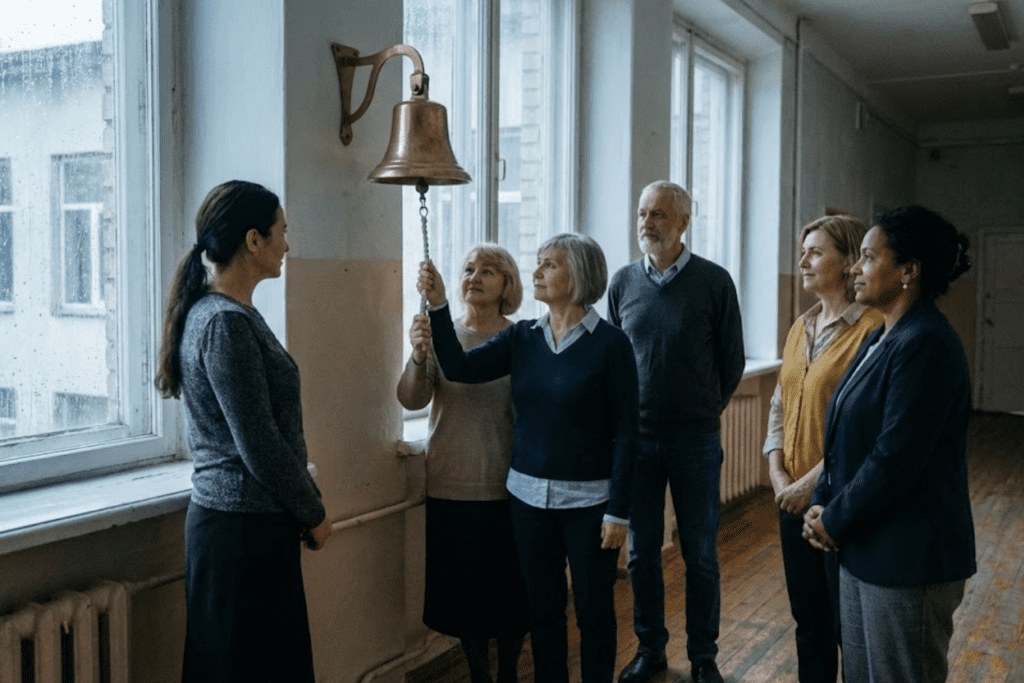
Dr. Grant felt her throat tighten as she watched.
What had started as one man’s private promise had become something larger than any single person could hold.
When the final chime faded, no one rushed away.
They stood there for a moment longer, breathing in the silence that followed, as if it had substance.
Then someone said, “See you Monday.”
Another voice answered, “Take care of yourself.”
Doors closed. Lights clicked off. The building emptied slowly, but not with the defeated energy of earlier weeks.
More like release.
That evening, Dr. Grant called Mr. Brooks.
“I think the bell has grown,” she told him.
He chuckled softly. “Good.”
“They rang it six times today.”
A pause.
“Well,” he said, “some weeks take more surviving than others.”
Dr. Grant smiled, though he couldn’t see it.
“You should come visit sometime,” she added. “They’d like that.”
Another pause, longer this time.
“Maybe,” he said. “But I don’t need to. Sounds like they’ve got it.”
Spring brought lighter days and open windows. The sound of children laughing on the playground drifted through the halls again, bright and uncomplicated. Test scores improved slightly. Funding worries eased, at least temporarily.
The bell kept ringing.
Sometimes once.
Sometimes twice.
Once, after a particularly joyful week that included a school play and a surprise snow day, it rang only briefly, almost playfully, as if acknowledging that survival isn’t always about hardship.
Then, on the last Friday of the school year, something unexpected happened.
Students were still in the building for end-of-year celebrations. Parents filled the halls. Balloons bumped against ceilings. Laughter echoed off lockers.
At 3:44, the crowd didn’t disperse.
Teachers exchanged uncertain glances. Should the bell ring with children present? The ritual had always belonged to the staff, a quiet acknowledgment of adult effort rarely visible to students.
Dr. Grant stepped forward.
She pulled the rope.
The bell rang, cutting cleanly through the noise.
Conversations paused mid-sentence. Children looked around, puzzled. A few clapped reflexively, thinking it signaled something celebratory.
Before the sound faded, a small hand tugged on Dr. Grant’s sleeve.
It was a fifth-grade boy, backpack half zipped, eyes wide.
“Does that mean school’s over?” he asked.
Dr. Grant crouched to his level.
“It means the teachers made it through the year,” she said.
He considered that seriously, glancing down the hall at the adults who had spent months guiding him.
“Can we say thank you?” he asked.
She blinked, caught off guard.
Before she could answer, he cupped his hands around his mouth.
“Thank you!” he shouted.
Other children picked it up instantly, voices overlapping in a spontaneous chorus.
“Thank you!”
“Thanks, teachers!”
“Have a good summer!”
The hallway filled with sound again, but this time it was directed outward, not inward.
Several teachers covered their mouths, tears spilling freely now. One leaned against the wall, laughing and crying at the same time.

Later that evening, after the building emptied and the last paper decorations were taken down, Dr. Grant walked the silent halls alone.
She stopped beneath the bell.
For a moment, she imagined all the hands that had pulled that rope over the years. Mr. Brooks’s steady grip. Sarah Whitman’s tearful laughter. Mrs. Alvarez’s quiet plea for strength. Dozens of others she would never know about.
She rang it once more.
The sound echoed through empty corridors, softer without bodies to absorb it, but still clear.
“You made it,” she whispered to the building itself.
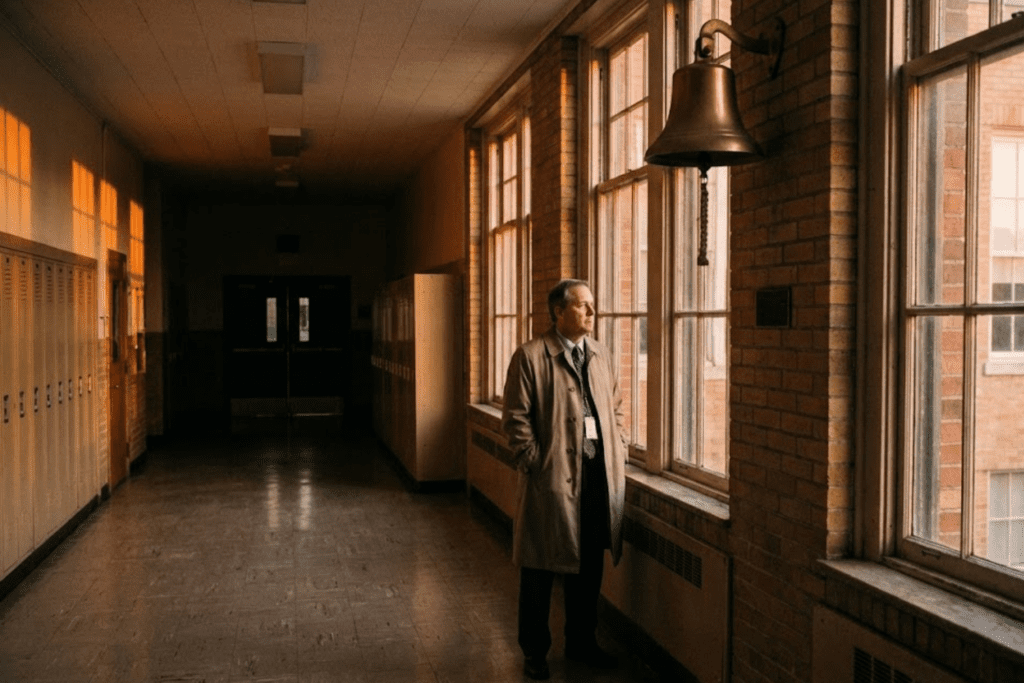
Years later, new teachers would arrive who had never met Mr. Brooks. They would hear the bell their first Friday and wonder briefly about it, just as Dr. Grant once had.
Someone would tell them the story.
Or maybe not.
Because by then, the meaning would be felt more than explained.
On particularly hard days, a teacher might ring it early, just once, to remind themselves that time still moves forward. On joyful Fridays, someone might ring it with a light touch, smiling as the sound carried down the hall.
No policy required.
No committee formed.
Just a shared understanding that invisible work deserves visible acknowledgment, even if only for a single note in an empty corridor.
The bell was never really about endings.
It wasn’t dismissal or celebration or tradition for tradition’s sake.
It was a pause.
A breath.
A reminder that effort counts even when results aren’t immediate, even when no one outside the building sees what it costs to show up every day.
One chime.
You made it through this week.
Another.
You don’t have to carry it alone.
And sometimes, when the world outside feels loud and relentless, that simple permission is the difference between burning out and beginning again.




No Comments