

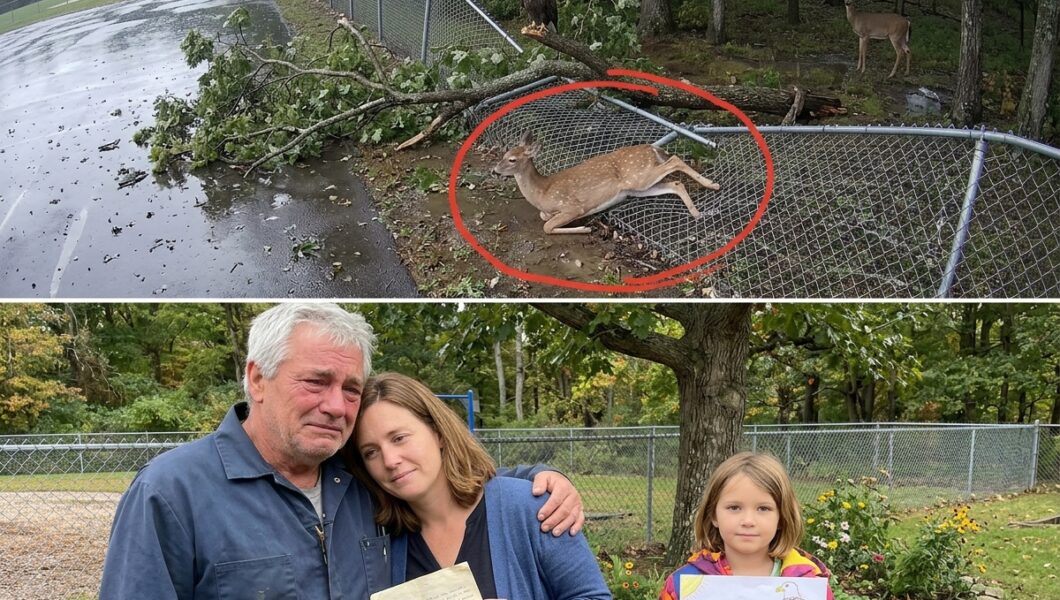
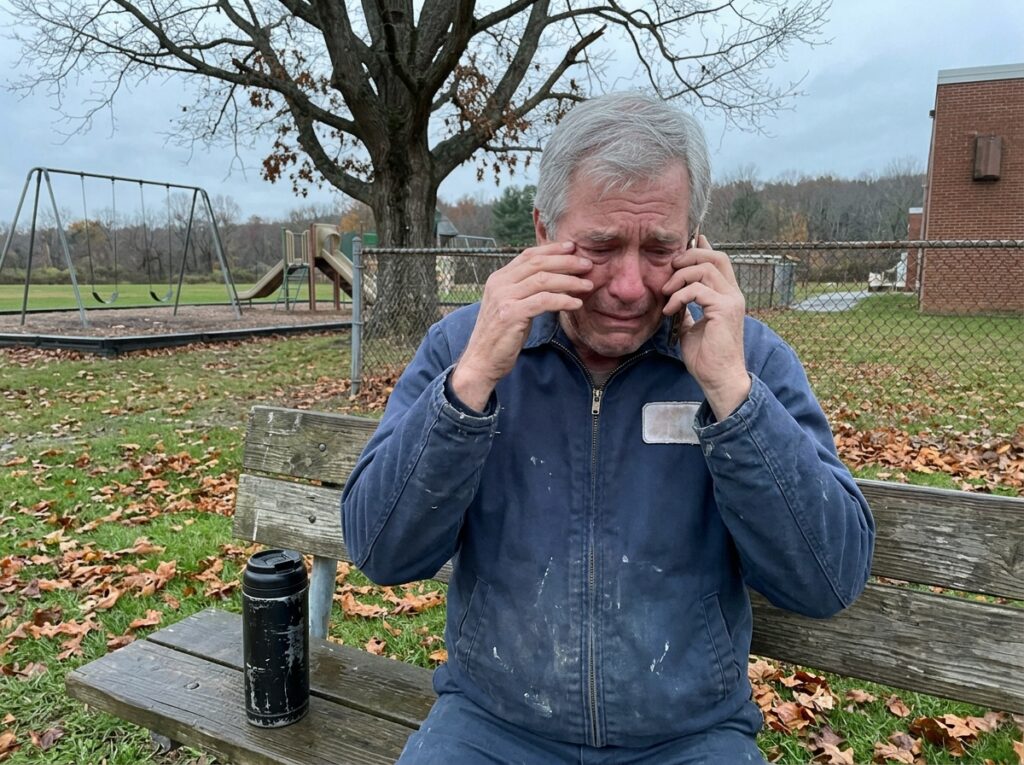
Walter Bennett sat motionless on the wooden bench beside Millbrook Elementary School’s playground. His daughter Hannah was crying on the telephone, and for the first time in twenty-seven years, the secret he had carried alone was no longer his to protect.
“Dad,” Hannah whispered, “Mom knew everything.”
Walter closed his eyes.
The evening breeze moved through the damaged oak tree above him. Beyond the playground fence, the Pennsylvania woods stood quiet beneath a pale October sky.
“What did she tell you, sweetheart?”
Hannah took a shaky breath.
“She told me why you never left Millbrook Elementary. Why you turned down better jobs. Why you kept working here even when we barely had enough money.”
Walter lowered his head.
He had spent years telling Hannah that he stayed because the school needed him.
That was partly true.
But there was another reason.
A reason connected to the final promise he had made to his wife, Elizabeth, before she died.
“Hannah,” he whispered, “where did you find the letter?”
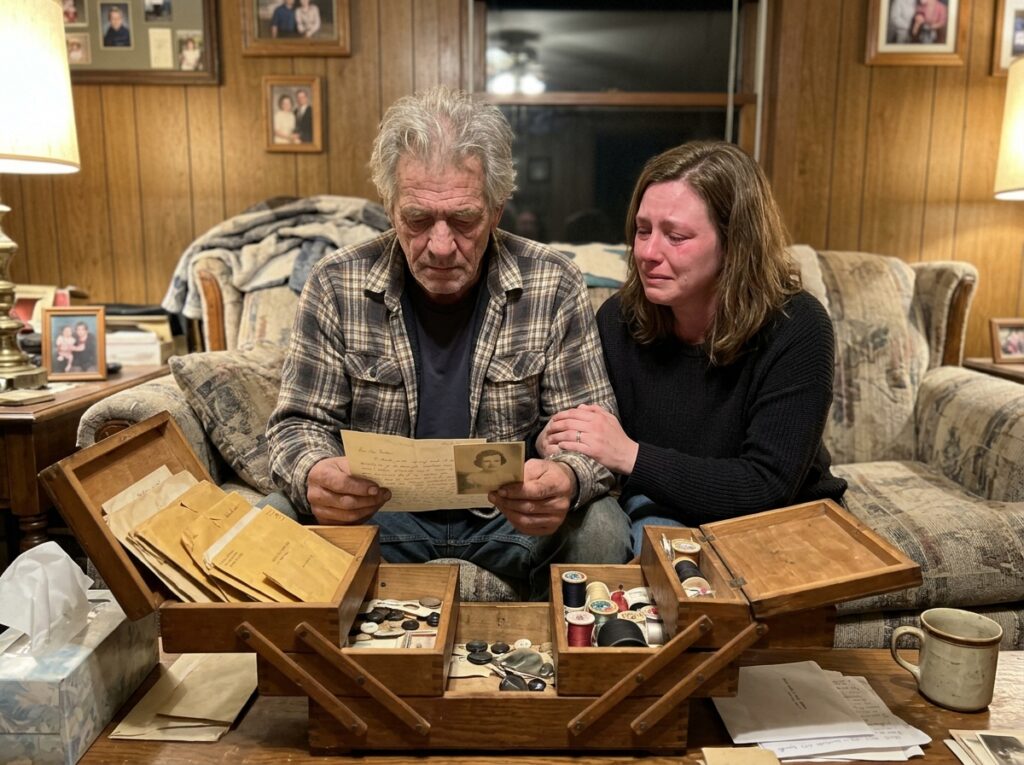
“In Mom’s old sewing box. I was going through the things you gave me when I moved. There was an envelope hidden beneath the lining.”
Walter pressed his hand against his forehead.
He remembered that sewing box.
Elizabeth used to keep buttons, needles, and small pieces of fabric inside it. She had repaired Hannah’s school uniforms at the kitchen table while Walter worked late shifts.
He hadn’t opened it since her funeral.
“Read it to me,” he whispered.
Hannah unfolded the letter.
“Dear Hannah,
If you’re reading this, you’re probably old enough to understand things that were difficult to explain when you were little.
Your father is going to make mistakes. He will miss things he desperately wants to attend. There will be school concerts, birthday parties, and ordinary afternoons when you wish he could be home.
Please don’t mistake his absence for a lack of love.
Your father is staying at Millbrook Elementary because he made me a promise.
And because, years ago, someone at that school saved our family when we had nowhere else to turn.”
Walter’s eyes filled with tears.
He remembered that day.
It had happened twenty-seven years earlier, when Hannah was still a toddler.
Elizabeth had been seriously ill, and Walter had recently lost his construction job after the company closed.
They were behind on rent.
Their savings were nearly gone.
Walter had spent weeks applying for work.
Every rejection made him feel smaller.
Then, one rainy afternoon, he visited Millbrook Elementary to ask whether the school needed maintenance help.
The principal at the time was a woman named Dorothy Whitman.
She listened as Walter explained his situation.
He had experience repairing buildings, operating maintenance equipment, and working long hours.
But he had no recent school employment history.
Dorothy studied his application.
Then she asked a question Walter never forgot.
“Mr. Bennett, do you need a job, or do you need someone to give you a chance?”
Walter had lowered his eyes.
“Both, ma’am.”
Dorothy hired him.
The salary wasn’t large.
But the job provided steady income, benefits, and a schedule he could build his family’s life around.
And when Elizabeth’s health worsened, Dorothy helped Walter arrange time off for hospital appointments.
She never made him feel ashamed.
She never treated his family’s hardship as a personal failure.
One afternoon, after Elizabeth returned home from the hospital, Dorothy visited their small house carrying groceries.
Walter had tried to refuse.
Dorothy smiled.
“Mr. Bennett, you’ve spent your life fixing things for other people. Let somebody help fix a few things for you.”
Elizabeth began crying.
Walter never forgot those words.
Hannah continued reading.
“Your father told me he wanted to repay Mrs. Whitman’s kindness.
I told him that kindness isn’t a debt you can settle with money.
You repay it by passing it on.
So when another school offers him more money, or when he feels that cleaning hallways isn’t important work, remind him that the children walking through those doors deserve someone who notices when they’re frightened, hungry, lonely, or hurt.
Your father has always noticed people other folks overlook.
That’s one of the reasons I married him.
And if I am not here to remind him, I hope you will.”
Walter covered his face.
For twenty-seven years, he had remembered Elizabeth’s words.
But he had never known she had written them down for Hannah.
His daughter stopped reading.
“Dad?”
Walter struggled to answer.
“I’m here.”
“Why didn’t you tell me?”
He stared toward the playground.
“Because I didn’t want you growing up feeling like you owed anybody anything.”
Hannah began crying.
“I thought you loved that school more than you loved me.”
Walter closed his eyes.
The words hurt because he knew she had believed them for years.
“Oh, sweetheart.”
“I remember waiting for you at my graduation. I kept looking toward the doors.”
Walter wiped his cheeks.
“I remember too.”
“You weren’t there.”
“No.”
“Why?”
Walter looked toward the old oak tree.
He had never told her the full story.
On the morning of Hannah’s graduation, a severe plumbing failure had flooded part of the elementary school’s kitchen and two classrooms.
The maintenance contractor was delayed.
Walter had been preparing to leave when a teacher discovered water spreading toward an electrical storage area.
The principal asked him to remain until the building was made safe.
Walter stayed.
He shut off the water, helped isolate the affected area, and waited for the emergency repair crew.
By the time he reached the graduation venue, the ceremony had ended.
He had stood outside the building holding a small bouquet of flowers, watching families leave with their children.
Then he went home.
Hannah hadn’t spoken to him for three days.
“I should have called you,” Walter whispered. “I should have found a way to explain. And I should have made sure someone else could take over so I could be there.”
Hannah was quiet.
Walter continued.
“I thought being a good father meant making sure you had food, a home, and everything you needed. I didn’t understand that sometimes what you needed most was me sitting in the audience.”
Hannah began crying harder.
“I just wanted you there, Dad.”
“I know, sweetheart.”
He looked down at his trembling hands.
“And I’m sorry.”
For the first time, he didn’t defend himself.
He didn’t explain that he had worked double shifts.
He didn’t remind her how difficult life had been after Elizabeth died.
He simply listened.
Because his daughter had waited a long time to be heard.
Hannah took a slow breath.
“There’s more in the letter.”
Walter nodded.
“Go on.”
She continued.
“One day, Hannah, your father may grow tired of being the person everyone calls when something breaks.
If that happens, remind him that the most important things he has ever repaired were never doors or windows.
They were moments when someone needed to feel safe.
But please remind him of something else too.
He must never become so busy helping the world that he forgets the little girl waiting for him at home.”
Walter began sobbing.
Elizabeth had understood him better than he understood himself.
She had known his greatest strength.
And his greatest weakness.
He wanted to help everyone.
But sometimes he forgot that the people closest to him needed his time just as much as strangers needed his kindness.
Hannah whispered, “Mom wanted you to stay at the school. But she wanted you to come home to me too.”
Walter nodded through his tears.
“Yes, sweetheart. She did.”
For several minutes, neither spoke.
Then Hannah asked something Walter hadn’t expected.
“Dad, can I come visit?”
Walter sat upright.
“What?”
“I want to come home.”
His eyes filled again.
“Of course.”
“I want to see the school. And I want to meet the little girl who gave you that drawing.”
Walter laughed through his tears.
“Her name’s Sophie.”
Hannah smiled.
“Then I’d like to meet Sophie.”
Walter looked toward the woods.
For the first time in eight months, his daughter was coming home.
Three days later, Hannah arrived in Millbrook.
Walter waited outside the small train station holding a bouquet of yellow flowers.
He had bought the same kind for her graduation twenty years earlier.
When Hannah stepped onto the platform, she stopped.
Her father looked older than she remembered.
His hair was almost completely silver.
His shoulders had become slightly rounded.
And his hands showed the wear of twenty-seven years repairing classrooms, carrying supplies, and working through winter mornings.
“Dad?”
Walter smiled nervously.
“Hello, sweetheart.”
Hannah walked toward him.
Then she wrapped her arms around his neck.
Walter held her tightly.
For a long time, neither spoke.
Then Hannah whispered, “I missed you.”
Walter closed his eyes.
“I missed you too.”
They spent that evening talking.
Not about the deer.
Not about the school.
But about their lives.
Hannah told him about her work, her friends, and the ordinary things she had stopped sharing because she assumed he was too busy.
Walter told her about his quiet evenings, his morning coffee, and how often he had picked up the telephone only to put it down again.
They laughed about old family holidays.
They cried when they remembered Elizabeth.
And when Hannah asked why he had never remarried, Walter smiled sadly.
“Your mother set a pretty high standard.”
Hannah laughed through her tears.
“She really did.”
The following morning, Walter took Hannah to Millbrook Elementary.
Principal Elaine Carter greeted her warmly.
“So you’re Hannah.”
Hannah smiled.
“I am.”
Elaine looked toward Walter.
“Your father talks about you more than you know.”
Hannah turned toward him.
Walter looked embarrassed.
“Well, she’s my girl.”
Elaine led them toward the playground.
The damaged fence had been replaced.
The fallen branches had been removed.
And the school had begun creating a small wildlife-friendly garden beside the tree line.
Several students were helping plant native flowers under their teacher’s supervision.
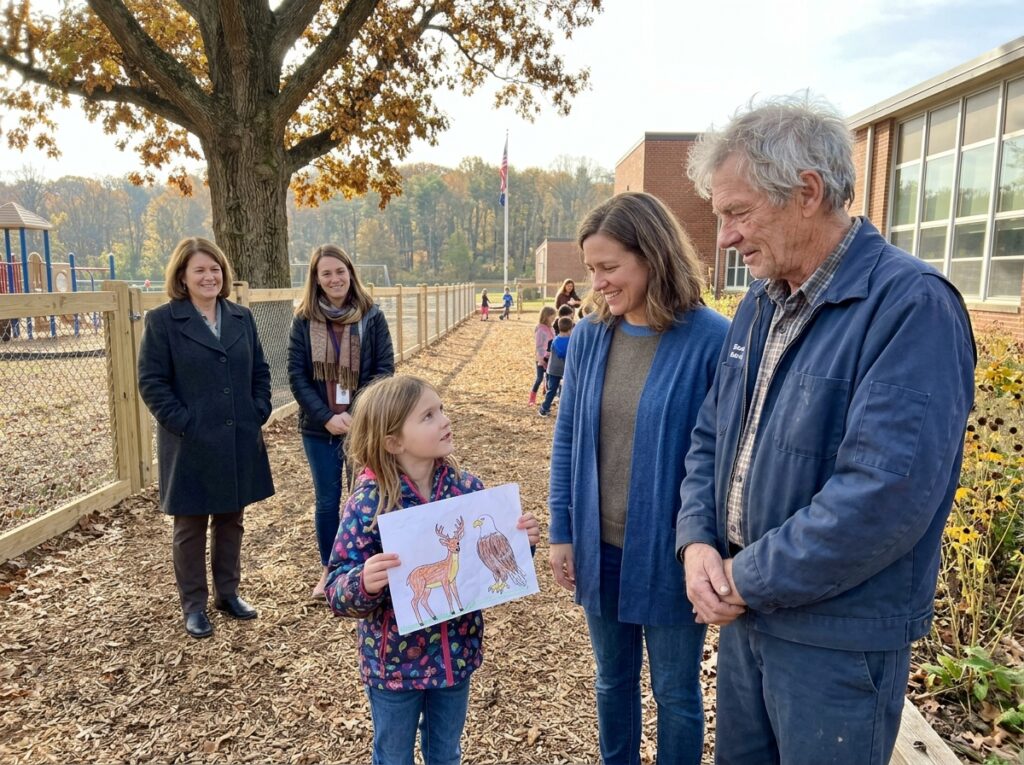
Sophie Miller spotted Walter.
“Mr. Bennett!”
She ran toward him.
Walter knelt.
“Good morning, Sophie.”
The little girl looked at Hannah.
“Who’s that?”
Walter smiled.
“This is my daughter.”
Sophie’s eyes widened.
“You have a daughter?”
Hannah laughed.
“Apparently.”
Sophie looked delighted.
“Your dad saved a baby deer.”
Walter shook his head.
“I called the people who saved it.”
Sophie crossed her arms.
“But you noticed it.”
Hannah looked at her father.
For years, she had seen him as the man who missed important moments.
Now she was beginning to understand how many small moments he had spent helping others.
But she also knew that understanding his kindness didn’t erase the years they had lost.
Both things could be true.
Her father had helped people.
And she had needed him.
She reached for his hand.
Walter squeezed it gently.
Later that morning, the wildlife rehabilitation center called with an update.
The young deer was recovering well.
Its injured leg had improved, and the rehabilitation team was assessing whether it could safely return to suitable habitat near where it had been found.
Walter shared the news with the school.
The children cheered.
Sophie clapped her hands.
“Will its mommy be there?”
Walter looked toward the woods.
“I hope so, sweetheart. But we can’t promise.”
The rehabilitators explained that the fawn’s age, condition, and the circumstances of its rescue would determine the safest release plan.
They would not force a reunion or place the animal somewhere unsafe simply to create a memorable moment.
Walter understood.
He wanted the little deer to survive.
That mattered more than a perfect ending.
Over the following weeks, Walter and Hannah began speaking more regularly.
They called every Sunday.
Sometimes they talked for an hour.
Sometimes only ten minutes.
But Walter stopped waiting for his daughter to call first.
He also began making changes at work.
After speaking with Principal Carter, he helped create a maintenance coverage plan so that emergencies wouldn’t always depend on him alone.
A younger maintenance employee began training alongside him.
Walter taught him how to check the heating systems, repair classroom doors, and prepare the building before the children arrived.
But he also taught him something less obvious.
“Always look around before you start working,” Walter said one morning.
The younger man frowned.
“What am I looking for?”
Walter smiled.
“Anything that doesn’t belong. A broken latch. A frightened child. An animal caught somewhere it shouldn’t be.”
He paused.
“Sometimes the most important part of this job is noticing.”
The younger man nodded.
Walter looked toward the playground.
He had spent twenty-seven years believing that being dependable meant never stepping away.
Now he understood that true dependability also meant teaching others to help.
It meant making room for family.
And it meant accepting that he couldn’t fix everything by himself.
One afternoon in November, the wildlife rehabilitation center contacted the school again.
The fawn had recovered sufficiently for release.
Its leg was functioning normally, and the rehabilitators had selected a suitable wooded area near the original rescue location.
Because the animal was wild and easily stressed, the release would be handled quietly by trained personnel.
Walter was invited to observe from a safe distance with Hannah and a small number of school representatives.
He agreed.
The children would receive an update afterward rather than attending the release.
On the morning of the release, the air was cold and clear.
Walter stood beside Hannah near the edge of the woodland.
Principal Carter waited a short distance away.
The wildlife team carefully positioned the transport crate in a sheltered area.
Then they opened the door.
For several seconds, nothing happened.
Walter held his breath.
The young deer stepped forward.
Its ears moved.
Its nose lifted toward the cold morning air.
Then it took another step.
And another.
Walter watched carefully.
The hind leg that had once been trapped beneath the playground fence now carried the animal’s weight.
The fawn paused near the tree line.
Then it moved into the woods.
Walter smiled through his tears.
“Look at that.”
Hannah squeezed his hand.
“It’s walking, Dad.”
He nodded.
“Yes, sweetheart.”
The deer disappeared among the trees.
The wildlife team watched for several minutes to ensure the release had proceeded safely.
Then, just as they began preparing to leave, movement appeared farther inside the woodland.
An adult white-tailed deer stepped between two trees.
It paused.
Its ears turned toward the clearing.
Walter froze.
“Is that the mother?”
One rehabilitator looked through binoculars.
“It could be an adult deer from the same area,” she said. “We can’t identify her from here.”
Walter nodded.
He understood.
The animal stood quietly for a moment.
Then it moved deeper into the woods.
Walter watched until it disappeared.
He didn’t know whether the two deer would find each other.
He didn’t know what the next winter would bring.
But the young deer was free.
And that was enough.
Hannah looked toward him.
“Dad?”
“Yes?”
“Do you remember what Mom wrote?”
Walter smiled faintly.
“Which part?”
“About helping the ones who can’t ask.”
Walter nodded.
Hannah looked toward the woods.
“I think she would’ve been proud of you.”
Walter began crying.
He turned toward his daughter.
“And I think she’d be proud of you too.”
Hannah hugged him.
For a long time, they stood together beneath the Pennsylvania trees.
A father and daughter who had spent years misunderstanding each other.
A man who had tried to repay kindness by giving everything he had.
And a woman who was finally learning that her father’s love had always been there, even when his choices had hurt her.
They couldn’t recover every missed birthday.
They couldn’t return to Hannah’s graduation.
And they couldn’t bring Elizabeth back.
But they could stop allowing those losses to decide the rest of their lives.
When they returned to the school, Sophie was waiting near the entrance.
“Mr. Bennett!”
Walter smiled.
“Hello, sweetheart.”
“Did the baby deer go home?”
Walter knelt beside her.
“It went back to the woods.”
Sophie grinned.
“Did it run?”
Walter nodded.
“It walked out on its own, and it looked strong.”
Sophie clapped her hands.
Then she reached into her backpack and removed another drawing.
This one showed a young deer standing beneath an oak tree.
Beside it stood a larger deer.
And above them, a bald eagle flew across the sky.
At the bottom, Sophie had written:
“Sometimes helping means giving someone a chance to go home.”
Walter stared at the words.
Then he looked toward Hannah.
His daughter was smiling through her tears.
He carefully folded the drawing.
“That’s a beautiful thought, Sophie.”
The little girl smiled.
“My mom helped me spell it.”
Walter laughed.
“Tell her she did a wonderful job.”
That evening, Walter returned to his farmhouse with Hannah.
They prepared dinner together.
Hannah made Elizabeth’s favorite chicken soup.
Walter burned the bread.
They laughed so hard that Hannah had to sit down.
Afterward, they opened the old sewing box.
Inside were photographs, buttons, handwritten recipes, and letters Elizabeth had saved.
Hannah found a picture of herself as a little girl sitting on Walter’s shoulders outside Millbrook Elementary.
She held it up.
“Remember this?”
Walter smiled.
“You were terrified of the big slide.”
Hannah laughed.
“And you promised to catch me.”
Walter nodded.
“I did.”
She looked at the photograph for a long moment.
Then she whispered, “You always tried, Dad.”
Walter’s eyes filled.
“Sometimes trying wasn’t enough.”
Hannah reached for his hand.
“I know.”
He looked down.
“But I’m here now.”
She smiled.
“That’s what matters.”
Later that night, after Hannah went to bed, Walter sat beside the kitchen window.
He looked toward the dark outline of the woods.
He thought about the mother deer returning again and again to the trapped fawn.
He thought about Elizabeth’s letter.
And he thought about the years he had spent trying to be strong enough for everyone.
For twenty-seven years, Walter had believed that keeping his promise meant never leaving the school that had saved his family.
Now he understood that Elizabeth had wanted something more.
She wanted him to carry kindness forward.
But she also wanted him to come home.
Walter reached into his shirt pocket and removed Sophie’s first drawing.
“Thank you for seeing the ones who can’t ask for help.”
He placed it beside Elizabeth’s photograph.
Then he looked toward Hannah’s bedroom.
For the first time in years, his daughter was sleeping beneath his roof.
And tomorrow morning, he wouldn’t have to rush away before she woke.
Principal Carter had approved his first full week of vacation in nearly a decade.
Walter smiled.
He would make breakfast.
He would listen to Hannah talk.
And if she wanted to spend the afternoon walking through the woods, he would go with her.
Because sometimes the most important thing a person can do isn’t saving someone from danger.
Sometimes it’s simply being there.
Walter switched off the kitchen light.
Before going upstairs, he paused beside Elizabeth’s photograph.
“I kept my promise, sweetheart,” he whispered.
Then he smiled through his tears.
“And I think I’m finally learning the rest of it.”
Outside, the old oak tree stood quietly beneath the Pennsylvania stars.
Somewhere beyond the school playground, a young deer was finding its way through the woods.
And inside a small farmhouse, a father and daughter were finding their way back to each other.
The End.
This is a fictional kindness and wildlife rescue story created for emotional storytelling.

No Comments