

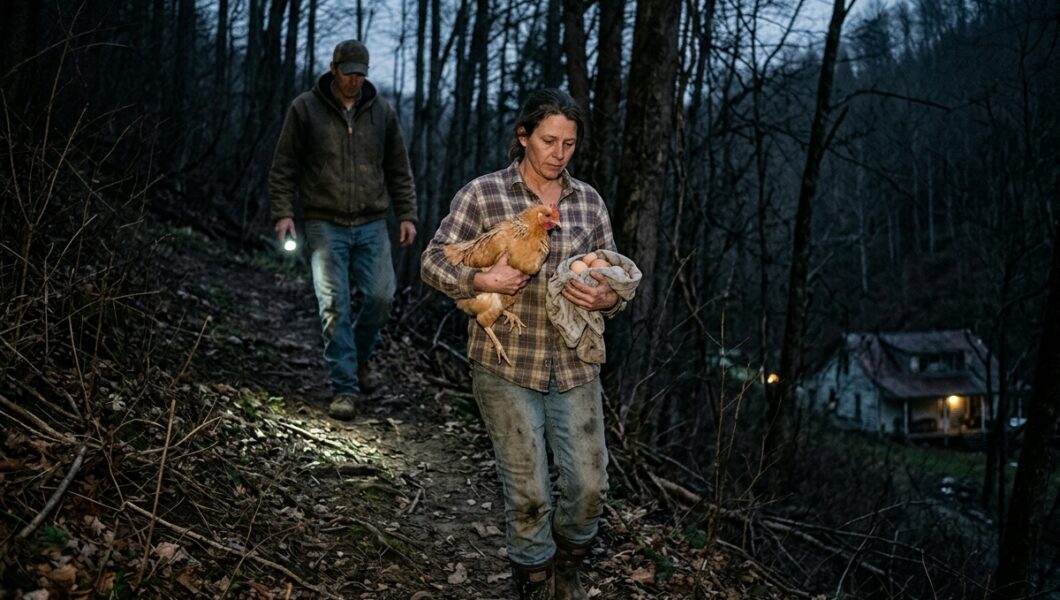
I did not understand when I was young that some lessons do not arrive as lessons at all. Nobody sits you down and tells you, “Pay attention now, because one day this will matter.” Sometimes they come disguised as an ordinary night in an old house, a frightened animal somewhere up a dark hillside, and a mother pulling on her boots because something she loves needs her.
Years later, when I think about Mama, I realize how many of those lessons I carried without even knowing it.
The little buff hen was one of them.
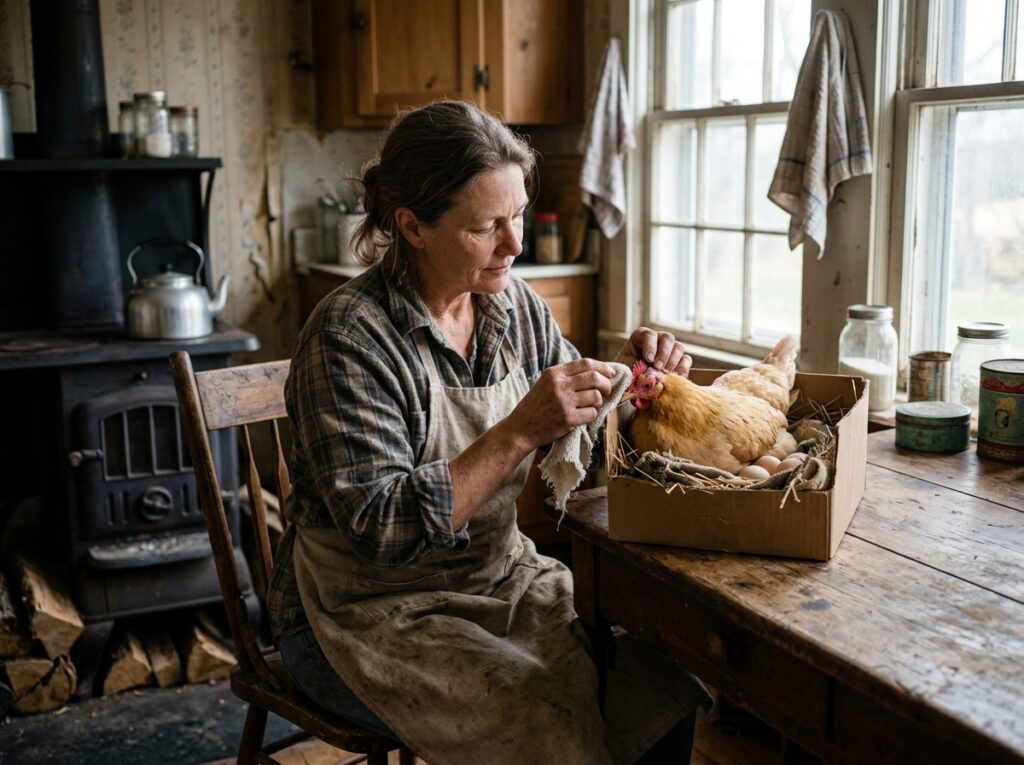
I can still picture that cardboard box beside the wood stove. I can still see the old rags Mama had folded underneath her, the little pile of eggs tucked close beneath her warm body, and those bare patches on her head where feathers had been torn away. The hen looked exhausted. She looked frightened. But she was still trying to protect those eggs even after everything she had been through.
And Mama never once treated her like she was foolish for getting herself into trouble.
She never said, “I told you so.”
She never complained about having to get out of bed in the middle of the night.
She never asked why that stubborn little bird had chosen such a dangerous place to build her nest.
She simply saw something hurting and decided it was her job to help.
That was Mama.
The next morning, I woke before sunrise.
For a few seconds, I forgot about the hen. Then I heard a soft clucking sound from the kitchen and remembered everything. I climbed out of bed and padded down the hallway in my socks.
Mama was already up.
She was sitting beside the cardboard box with a cup of coffee in one hand and a clean cloth in the other. The first gray light of morning was coming through the kitchen window, and she was checking the hen’s wounds again.
The bird lifted her head when I walked in.
“Morning, girl,” Mama whispered.
The hen gave one quiet cluck.
I remember asking Mama if she was going to be alright.
Mama looked down at her for a moment before answering.
“She has a good chance,” she said. “She just needs time.”
Then she reached into the box and gently touched one of the eggs.
“And she needs to know she is safe now.”
I did not think much about those words at the time.
I think I do now.
There is a difference between being alive and feeling safe.
Mama seemed to understand that difference better than anybody I have ever known.
You could feed somebody and still leave them afraid.
You could give somebody a roof and still leave them feeling alone.
But Mama believed that when something had been hurt, you did not just patch the wound. You stayed nearby long enough for the frightened thing to believe the danger had actually passed.
That little hen stayed in that box for several days.
Daddy built a small enclosure inside the henhouse so she could recover without being bothered by the other birds. Mama checked on her every morning and every evening. She changed the rags, cleaned the wounds, made sure she was eating, and talked to her in that same soft voice she used with us when we were sick.
And slowly, the hen changed.
The shaking stopped.
She began eating normally.
The raw places on her head started to heal.
Then one morning, Mama opened the little enclosure and stepped back.
The hen walked out.
She looked around the henhouse as if she were inspecting a place she had been away from for a hundred years. Then she scratched at the dirt, found something interesting, and started pecking.
Mama laughed.
“There she is,” she said. “Bossy as ever.”
Daddy leaned against the doorway and smiled.
“Guess getting half eaten did not teach her anything.”
Mama looked at him.
“No,” she said. “It just taught her that she can survive it.”
I remember those words because they seemed funny at the time.
Now they seem important.
Maybe that is what surviving hard things really means.
It does not mean you never become afraid again.
It does not mean you never remember the claws.
It means you eventually find the courage to scratch at the dirt again.
You eat again.
You walk outside again.
You trust the morning again.
And sometimes, you even become bossy again.
The hen eventually went back to laying eggs.
She never returned to that wild laurel bush on the hillside, though. Mama made sure of that.
She moved her nest to a safer corner of the henhouse and kept a close eye on her.
For a while, I thought Mama was simply protecting the hen.
Years later, I realized the hen had changed Mama too.
Because after that night, I started noticing things I had never paid attention to before.
I noticed how Mama always checked the locks twice before bed.
I noticed how she counted heads whenever we went somewhere crowded.
I noticed how she could hear one of us coughing from the other end of the house.
I noticed how she never really slept when one of us was sick.
She would lie down, but some part of her stayed awake.
Listening.
Waiting.
Ready.
Even when we were grown, that part of her never disappeared.
When I moved away from home, Mama still called to make sure I had arrived safely. If I did not answer, she would call again. Then again.
I used to tease her about it.
“Mama, I am grown.”
“I know.”
“I can take care of myself.”
“I know.”
“Then why do you keep calling?”
There would be a pause.
Then she would say, “Because I am your mama.”
That was usually the end of the conversation.
There was no arguing with that.
Years passed.
The valley changed.
Some of the old houses were fixed up. Some were torn down. The road became busier. People who had lived there all their lives moved away, and people who had never known the valley began building houses on land where we used to walk.
But some things stayed the same.
The hills still leaned close.
The nights were still dark.
And Mama still worried about everybody.
Then came the years when I began noticing that she was getting older.
It happened so slowly that I almost missed it.
Her hair became more gray.
Her hands became thinner.
She took a little longer getting up from the kitchen chair.
The woman who had once climbed a muddy hillside in the middle of the night without thinking twice began pausing at the bottom of the porch steps before walking down them.
I hated noticing those things.
Because in my mind, Mama was supposed to stay exactly as she had been.
Boots by the door.
Flashlight on the dresser.
Hands ready.
Heart stronger than anything the world could throw at it.
But time does not ask permission.
One afternoon, I was visiting her when I found her sitting on the porch watching the chickens.
There were fewer of them by then.
The old hen was long gone.
So were most of the chickens I remembered from childhood.
Mama had a blanket over her lap, and she was watching the younger birds scratch around in the yard.
I sat beside her.
For a while, neither of us said anything.
Then she pointed toward one small hen near the fence.
“That one reminds me of your old buff girl.”
I smiled.
“The one that nearly got herself killed?”
Mama laughed.
“That is the one.”
We sat there remembering.
I told her I still remembered that night.
She looked at me.
“You remember that?”
“I remember everything.”
She looked back toward the chickens.
“Funny what children remember.”
“I remember you carrying her inside.”
Mama smiled.
“She was stubborn.”
“So were you.”
She laughed again.
“Still am.”
I reached over and took her hand.
Her hands were different now.
Those same hands had once lifted sacks of feed, scrubbed floors, washed dishes, held babies, dressed wounds, worked gardens, carried groceries, and climbed hills in the dark.
Now they rested quietly in mine.
And suddenly I understood something that had taken me decades to understand.
Mama had spent her whole life believing she was supposed to be the strong one.
But even the strongest mother eventually needs somewhere safe to rest.
I squeezed her hand.
She squeezed mine back.
Neither of us said anything about it.
We did not have to.
The older I get, the more I think about how often mothers disappear inside the things they do for everyone else.
People remember the meals.
They remember the clean clothes.
They remember the rides to school.
They remember the birthday cakes and Christmas mornings.
But they do not always remember the nights.
The silent prayers.
The unpaid bills.
The worries carried alone.
The times a mother sits awake listening for a car in the driveway.
The times she says she is fine because she knows everybody else needs her to be fine.
The times she takes a deep breath before walking into a room where somebody she loves is hurting.
Those are the scratches nobody sees.
Those are the feathers that never grow back quite the same.
And maybe that is why I still think about that little buff hen.
Because she taught me something about Mama before I was old enough to understand Mama herself.
Love is not always soft.
Sometimes love looks like standing between danger and something fragile.
Sometimes it looks like getting out of bed when you are exhausted.
Sometimes it looks like driving through the night.
Sometimes it looks like sitting beside a hospital bed.
Sometimes it looks like saying no when everybody else says yes.
Sometimes it looks like holding somebody together while your own heart is falling apart.
And sometimes love is simply staying.
Staying when things are difficult.
Staying when you are scared.
Staying when you do not know what tomorrow will bring.
Staying because somebody you love is depending on you.
I have had my own children now long enough to know what Mama must have felt all those years ago.
There are nights when I walk through the house checking doors even though I already checked them.
There are nights when I listen for breathing.
There are mornings when I wake up worried about something that has not even happened.
And every now and then, I catch myself saying something Mama used to say.
Then I smile.
Because I realize that somehow, without ever sitting me down for a lesson, she passed that part of herself to me.
The mother hen became another mother hen.
And perhaps that is how these things survive.
Not through grand speeches.
Not through money.
Not through things handed down in boxes.
But through small acts of love repeated so many times that they become part of who we are.
A flashlight picked up in the dark.
A blanket pulled over tired shoulders.
A hand placed on a feverish forehead.
A plate of food left warm on the stove.
A phone call asking, “Did you get home?”
A quiet prayer whispered when nobody else is listening.
A mother walking toward the thing everybody else is afraid of.
I wish I could go back to that night in the valley sometimes.
Not to change anything.
Just to stand in that hallway again.
To watch the flashlight moving up the hill.
To see Mama and Daddy disappear into the trees.
To feel that old fear in my stomach.
And then to watch the screen door open.
To see Mama carrying that battered little hen against her chest.
To see those eggs tucked safely inside her old work shirt.
To hear Mama whisper, “It is alright now.”
Because now I understand that she was not only talking to the hen.
Maybe she was talking to all of us.
Maybe that was the promise she had been making her entire life.
It is alright now.
You are safe.
I am here.
And if something comes for you, it will have to come through me first.
That little hen eventually disappeared from my childhood the way so many things do.
The house changed.
The valley changed.
The people changed.
Time carried almost everything forward.
But that night stayed.
It stayed because sometimes one small moment contains an entire lifetime.
A wounded hen.
A pile of fragile eggs.
A mother who refused to leave her behind.
And a child watching from the doorway, unknowingly learning what love looks like.
So when I think of Mama now, I do not only remember her laugh.
I remember her boots.
I remember her flashlight.
I remember her tired hands.
I remember the way she never seemed to notice how much she was carrying.
And most of all, I remember the lesson that little hen gave me.
There are people in this world who spend their entire lives standing between the ones they love and whatever might hurt them.
They do not always call themselves brave.
They may not even realize how much they have sacrificed.
They simply see their nest.
They see the little lives underneath their wings.
And they stay.
Mother hens, right?
Whether they have feathers or not.
And if you were lucky enough to have one of those mothers, you may not have understood her when you were young.
You may have thought she worried too much.
You may have thought she asked too many questions.
You may have wished she would loosen her grip and let you go.
But one day, if you are lucky, you look back and realize what she was really saying all along.
Go ahead.
Grow up.
Go live your life.
Fly as far as you need to.
But if the world ever gets too dark, if something ever comes clawing through the night, remember this.
You still have a place to come home to.
And somebody who will turn on the light.
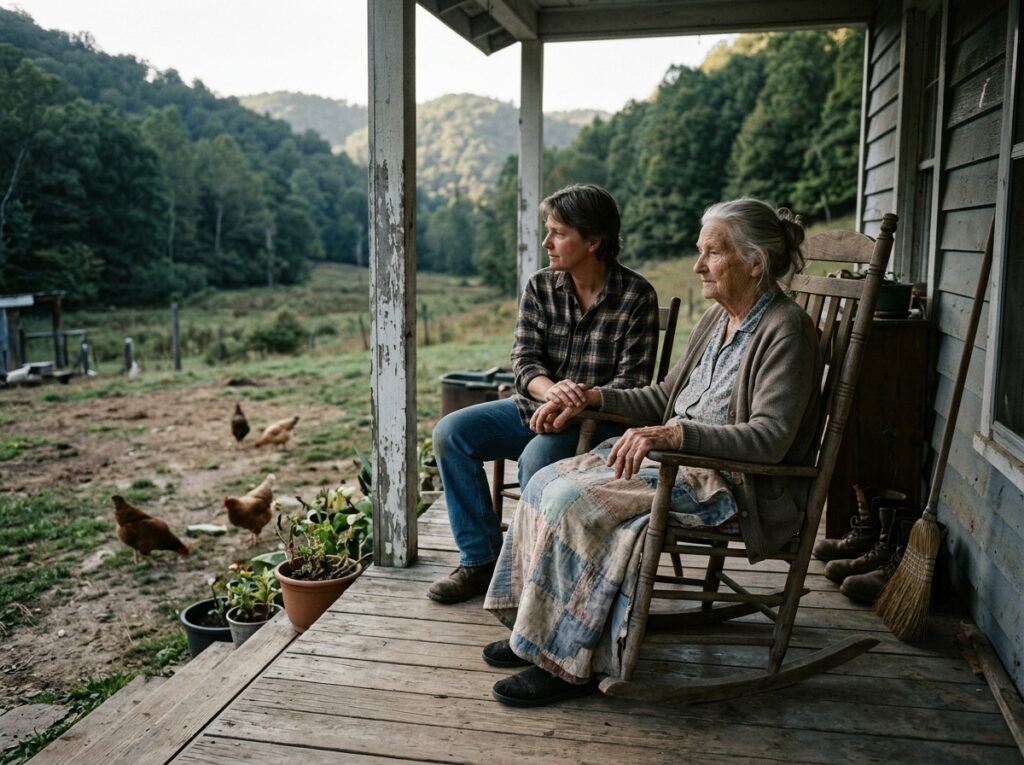
The mother looked toward the chickens, then smiled.
“That old girl was something else,” she said.
I smiled too.
“She was.”
Mama leaned back in her chair.
For a moment, neither of us spoke.
The chickens scratched at the dirt.
A breeze moved through the trees.
Somewhere beyond the yard, a bird called from the woods.
And for just a second, I was a child again, standing barefoot on a cool kitchen floor, watching a flashlight move through the darkness toward something small and frightened.
Only now I understood what I had been watching.
I had been watching love come home.
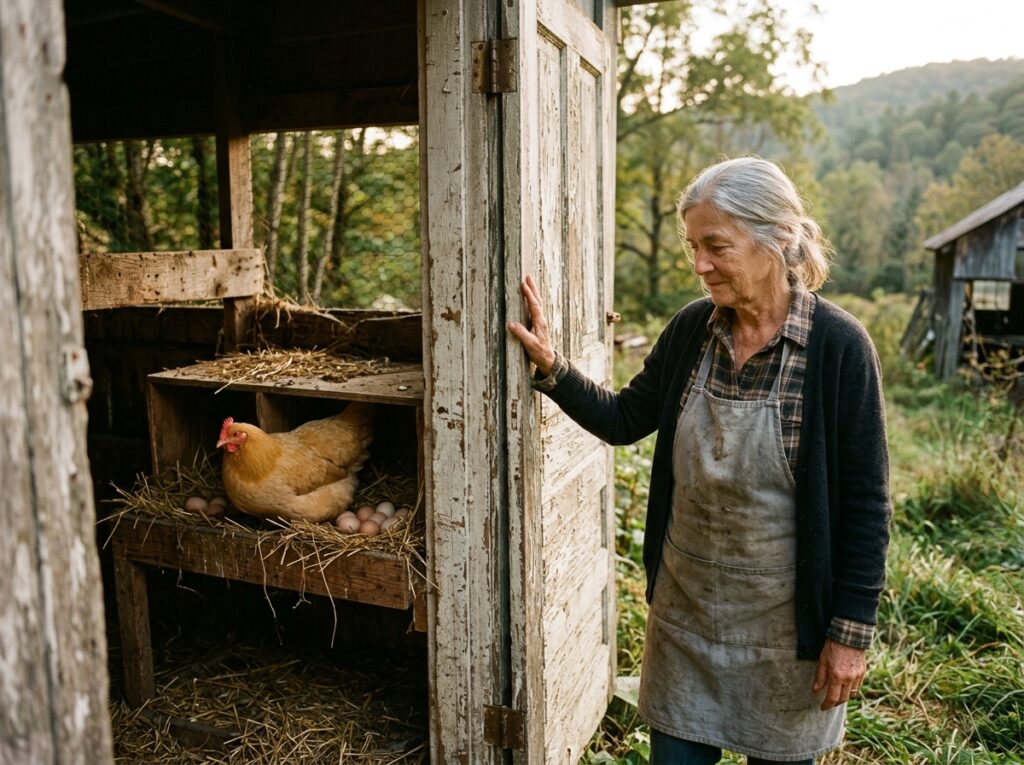
And maybe that is what all of us are looking for, whether we admit it or not.
Somewhere safe.
Someone who stays.
Someone who sees the frightened thing inside us and does not ask why we were too stubborn to run.
Someone who simply opens the door, reaches down, and says, “Come on. You are safe now.”
I have learned that the people who love us most are not always the people who make the biggest promises.
Sometimes they are the ones who quietly keep showing up.
The ones who answer the phone.
The ones who wait up.
The ones who bring soup.
The ones who sit beside the bed.
The ones who remember how you take your coffee.
The ones who notice when your voice sounds different.
The ones who would drive through a storm in the middle of the night because somewhere, far away, one of their children needs them.
Those are the mother hens.
They may never wear a cape.
They may never receive an award.
Most people may never know how many battles they fought in silence.
But their children know.
And sometimes, years later, their children finally understand.
I know I do.
That little buff hen taught me about my mother.
My mother taught me about love.
And life eventually taught me that the greatest kind of love is not the kind that promises you will never be hurt.
It is the kind that promises you will never have to face the hurt alone.
So if there is a mother hen in your life, tell her.
Tell her before another day passes.
Tell her you remember.
Tell her you noticed.
Tell her that all those little things she thought nobody saw were the things that shaped you.
Because someday, you may find yourself sitting beside a child of your own, listening to the sounds of the night, feeling that familiar worry rise in your chest.
And you will finally understand.
The nest was never about keeping you trapped.
It was about keeping you safe long enough to learn how to fly.
And even after you fly away, some mothers never stop watching the sky.
They just stand there quietly.
Waiting.
Hoping.
Praying.
And loving you from wherever they are.
Mother hens, right?
Whether they have feathers or not.
No Comments