

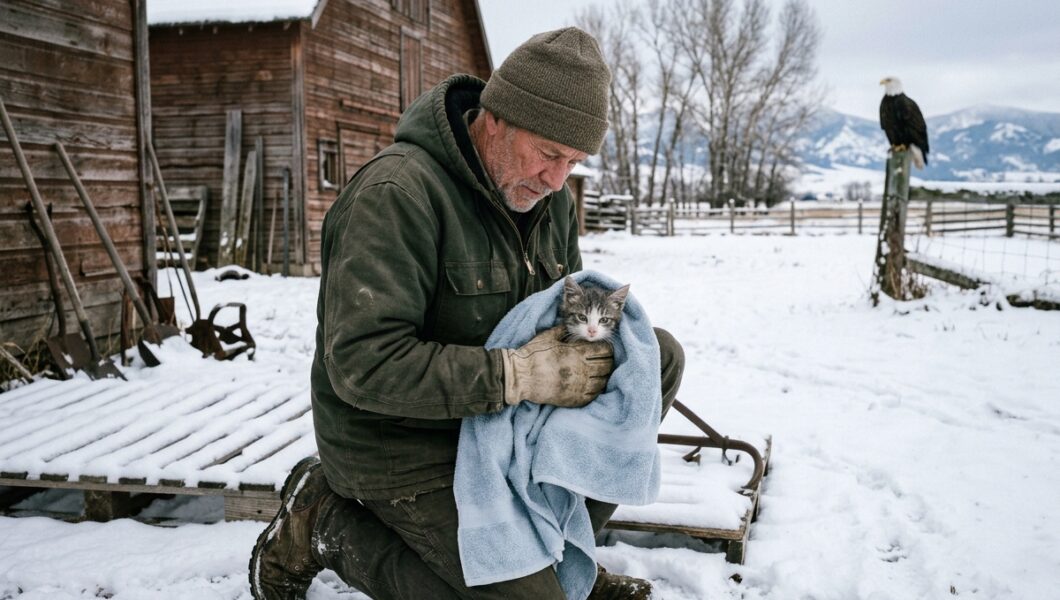
The morning after Snowdrop came home, 67-year-old Walter Hayes woke before sunrise, as he had done for nearly forty years.
But something about that morning felt different.
For the first time in three years, the quiet farmhouse no longer felt quite so empty. A tiny gray-and-white kitten was sleeping in a soft bed near the kitchen radiator, her paws tucked beneath her body and her breathing steady.
Walter stood in the doorway for a moment, watching her.
“Still here, little girl?” he whispered.
Snowdrop opened one eye, gave a barely audible meow, and went back to sleep.
Walter smiled before reaching for his coffee.
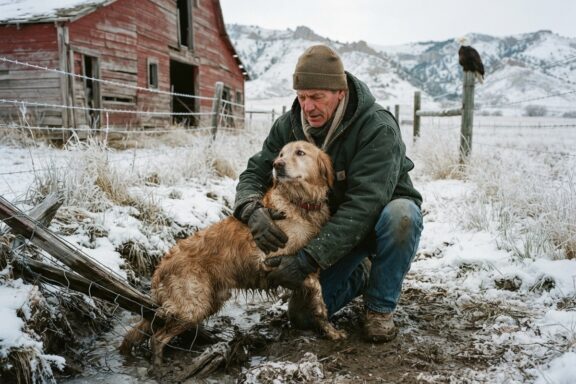
Outside, December had left the farm buried beneath another layer of snow. The old barn stood against the pale morning sky, its weathered boards darkened by the cold. Beyond it, the wooden fence stretched toward the distant tree line.
Walter glanced through the window.
The eagle was nowhere to be seen.
He had grown accustomed to its visits over the previous week, although he still could not explain why it repeatedly landed near the same section of fence. He had considered the possibility that it was hunting, following a familiar route, or simply resting between movements across the property.
But the discovery beneath the pallet had changed how he remembered those mornings.
He had found a living creature in a place where he might never have thought to look.
And now that little creature was sleeping inside his home.
After breakfast, Walter decided to review the barn security camera footage one more time.
He wanted to see exactly what had happened during the hours before he found Snowdrop. Perhaps there had been something he had missed.
He sat at the small desk near the kitchen, opened the recording system, and selected the previous night’s footage.
The first few minutes showed nothing unusual.
Snow moved across the yard in thin sheets whenever the wind strengthened. The barn door shifted slightly in its frame. A few distant shapes moved near the creek.
Then, at 5:48 AM, the eagle appeared.
Walter leaned closer to the screen.
The bird landed on the same wooden fence where he had seen it so many times before.
It remained there for nearly four minutes.
Then it turned its head toward the barn.
Walter paused the recording.
He remembered that angle.
It was almost exactly the direction of the old pallet.
He resumed the footage.
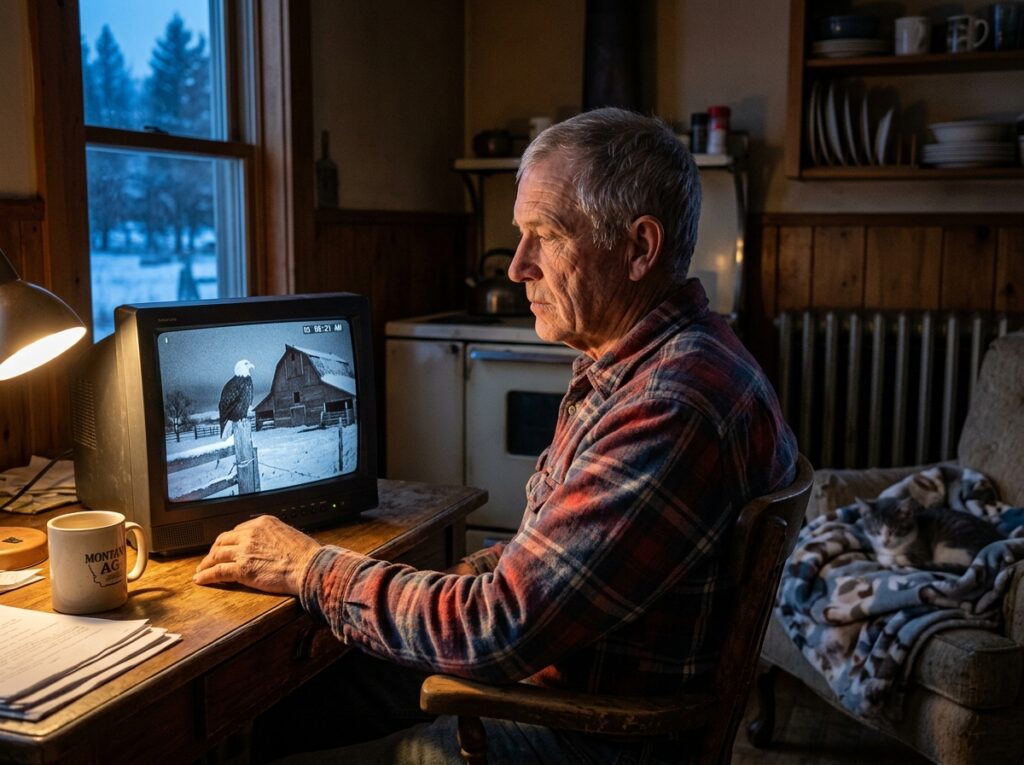
The eagle moved along the fence, stopped, and looked toward the ground. A few seconds later, it spread its wings and flew down into the snow-covered yard.
Walter expected it to leave.
Instead, the bird landed near the barn entrance.
It stood there briefly before walking several steps toward the pallet.
Walter’s breathing slowed.
The camera was too far away to show exactly what the eagle could see beneath the boards. The pallet blocked much of the view, and the image was grainy in the low morning light.
Still, the bird’s attention appeared fixed on that particular corner.
Then something unexpected happened.
The eagle suddenly lifted its head.
It looked toward the farmhouse.
Walter stopped the footage again.
He stared at the screen.
For a moment, he wondered whether the bird had noticed movement behind the kitchen window.
He replayed the few seconds.
The eagle remained still, its body angled toward the house. After several seconds, it turned away and returned to the fence.
Walter continued watching.
At 6:12 AM, the bird flew toward the distant tree line.
It did not return during the remainder of the recording.
Walter sat quietly.
He knew that wildlife did not always behave in ways humans could easily interpret. An eagle might investigate a sound, search for food, or simply react to something beyond the camera’s view.
There was no way to prove that it had been responding to the kitten.
But the sequence left him thinking.
He leaned back in his chair and looked toward the kitchen.
Snowdrop was still asleep.
Walter remembered the faint sound beneath the pallet, the two tiny eyes reflecting his flashlight, and the way the kitten had barely moved when he first reached for her.
He had come within a few feet of walking past that spot without noticing anything.
If he had stayed inside that morning, the outcome might have been very different.
He saved the recording.
Then he called the veterinary clinic to ask how Snowdrop had spent the night.
The technician told him that she was eating small meals, staying warm, and showing encouraging signs of recovery. She still needed careful monitoring, but her condition had improved considerably.
Walter thanked her and hung up.
He looked at the camera screen once more.
“Well, whoever brought us together,” he said quietly, “I’m glad I went outside.”
The next several days became a gentle routine.
Walter continued checking the farm before breakfast, but now he returned to the house with something to look forward to.
Snowdrop had begun exploring.
At first, she stayed close to the radiator. Then she discovered the kitchen doorway, the old rug beside the stove, and the warm patch of sunlight that appeared near the window in the afternoon.
She was still small enough to fit comfortably in Walter’s two hands.
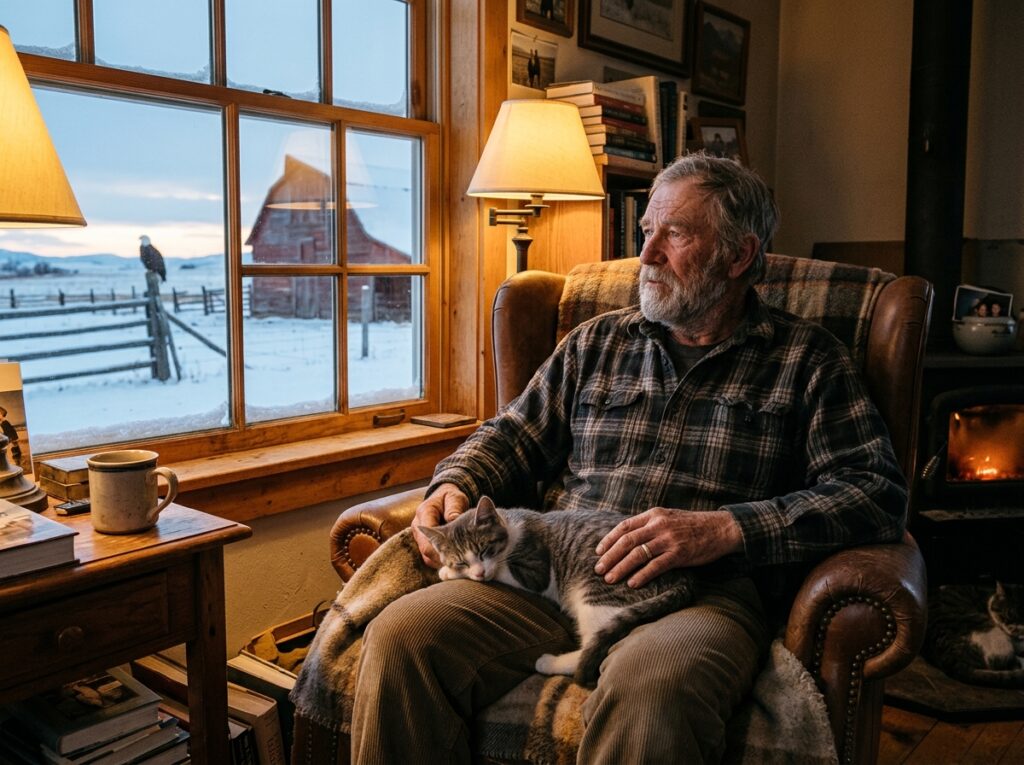
Sometimes she followed him as he moved around the farmhouse, stopping every few steps to inspect something new. Other times, she climbed onto his lap and fell asleep before he had finished his coffee.
Walter found himself talking to her throughout the day.
He told her about the weather, the repairs waiting in the barn, and the years when his wife had filled the house with music.
He had not realized how much he missed those ordinary conversations until he began having them again.
One afternoon, while Snowdrop slept beside him, Walter opened an old photograph album.
There were pictures of his wife standing near the garden, photographs of the farm before the barn roof was repaired, and one image of a small orange kitten they had rescued many years earlier.
His wife had wanted to name that kitten Snowdrop.
Walter had forgotten the name until the veterinary clinic handed him the adoption papers.
He looked down at the gray-and-white kitten curled against his sweater.
“Your namesake would have been a little bigger than you,” he told her.
Snowdrop stretched one paw.
Walter laughed.
For the first time in a long while, remembering his wife did not leave him feeling only the weight of her absence. It also brought back the warmth of the life they had shared.
Meanwhile, the eagle continued appearing around the property.
Sometimes Walter saw it near the creek. Once, it perched high in a tree beyond the pasture. On another morning, it crossed the field without stopping.
He never tried to approach it.
He understood that the bird belonged in the wild and that its behavior did not need to be explained through human feelings.
Still, he kept the barn camera recordings.
A few days later, his neighbor, Margaret, stopped by with a container of homemade soup.
She had heard about the kitten and wanted to see her.
When Walter showed her Snowdrop sleeping near the radiator, Margaret placed a hand over her mouth.
“Oh, Walter. She’s so little.”
“Vet says she’s getting stronger.”
Margaret smiled and sat beside him.
Walter then showed her the footage of the eagle.
They watched the bird land on the fence, move toward the barn, and look toward the farmhouse.
Margaret replayed the final moments.
“Do you think it was trying to get your attention?”
Walter considered the question.
“I don’t know. I really don’t.”
“But it kept coming back.”
“That it did.”
Margaret looked at the screen.
“Maybe it noticed something moving under there.”
“Maybe.”
Walter paused.
“Or maybe it was just doing what eagles do, and I happened to notice it at the right time.”
Margaret nodded.
Neither of them tried to settle the question.
They did not need to.
The important thing was that Snowdrop was alive, warm, and beginning to trust the world again.
A week after the rescue, the veterinarian cleared Walter to continue Snowdrop’s recovery at home with regular follow-up checks.
Her appetite had improved, her energy was returning, and she had begun showing the curious personality expected of a young kitten.
Walter bought her a small scratching post and a soft blanket.
He also placed a little bed near the kitchen window, where she could watch the snow-covered yard without being exposed to the cold.
One morning, he noticed her sitting upright and staring outside.
He followed her gaze.
The eagle was back.
It stood on the fence beside the barn, its white head visible against the winter sky.
Walter watched from inside.
Snowdrop remained motionless, her ears pointed toward the window.
For several seconds, the farmhouse was completely quiet.
Then the eagle spread its wings and flew toward the creek.
Snowdrop turned away and walked toward Walter.
He lifted her gently.
“Come on, little one. Let’s get you some breakfast.”
The moment passed, but Walter remembered it.
As winter slowly began to soften, the farm changed.
The snow around the barn became thinner. Water moved beneath the ice along the creek, and the first patches of brown earth appeared near the fence.
Snowdrop grew stronger.
She began jumping onto the low sofa, chasing the end of Walter’s shoelaces, and sleeping beside his chair whenever he read.
Her first full week without a veterinary emergency felt like a small celebration.
Walter took another photograph and sent it to the clinic.
The technician replied with a row of heart emojis and a message saying that everyone there was happy to see how far the kitten had come.
Walter printed the photograph and placed it beside an older picture of his wife.
He did not think of it as replacing anything.
It was simply another memory being added to a home that had begun to feel alive again.
One evening, he returned to the camera recordings.
He had watched the eagle’s visits several times, but something about the final morning continued to occupy his thoughts.
He opened the footage from the day he rescued Snowdrop and moved the playback to the moment after he had carried the kitten away.
The yard remained empty for several minutes.
Then the eagle appeared again.
Walter leaned forward.
The bird landed on the fence near the barn, exactly where it had stood during the earlier visits.
It remained there for a short time.
Then it turned its head toward the pallet.
The camera captured no clear view of what it was looking at. The snow and the angle of the boards obscured the space beneath them.
But the eagle did something Walter had not noticed before.
It lowered its head briefly, shifted its position, and then looked toward the farmhouse.
After several seconds, it flew away.
Walter replayed the sequence.
He watched it again.
There was no dramatic movement, no obvious signal, and no way to know what the eagle had perceived.
Yet the sight brought back the memory of the kitten’s weak meow.
He thought about the morning he had found her, the long drive through the snow, and the veterinarian’s careful words about how uncertain her recovery had been.
Then he looked toward the living room.
Snowdrop was asleep across his knees.
Walter’s eyes filled with tears.
Not because he had discovered proof that the eagle had deliberately rescued her.
He had not.
He cried because the little animal he had almost missed was now warm and safe, because his quiet farmhouse had a heartbeat in it again, and because an ordinary sequence of events had given him something he had not expected to find.
A reason to wake up with anticipation.
A reason to laugh at breakfast.
A reason to feel that the years ahead might still contain new beginnings.
He gently rested one hand against Snowdrop’s back.
“You’re doing all right, aren’t you?”
The kitten stirred but did not wake.
Outside, the eagle was gone.
Walter knew it might never return. He also knew that even if it did, he would never understand exactly what had brought it to that fence so many mornings in a row.
Perhaps it had noticed movement beneath the pallet.
Perhaps it had been searching for food.
Perhaps the connection Walter felt between the bird and the kitten existed only in the way he remembered the events.
He was comfortable leaving the answer unknown.
Because the story did not need a miracle to matter.
It needed only a farmer willing to look twice, a veterinarian willing to give a fragile life a chance, and a tiny kitten who had survived long enough to be found.
That night, Walter turned off the kitchen light and checked Snowdrop’s bed one last time.
She was curled beneath her blanket, sleeping peacefully.
He stood there for a moment before whispering, “Good night, Snowdrop.”
Then he walked toward his bedroom.
For years, the farmhouse had been filled with the kind of silence that followed loss.
Now, there were little footsteps across the floor, soft meows near the kitchen, and a small creature waiting for him each morning.
Walter would always remember the eagle.
He would remember the six mornings of unexplained visits, the seventh morning beneath the pallet, and the final recording that made him stop and think.
But most of all, he would remember what happened after he opened the barn door.
Sometimes, the most extraordinary part of a story is not knowing why something happened.
It is realizing how much changed because you chose to pay attention.
And in a farmhouse in rural Montana, a 67-year-old farmer and a kitten named Snowdrop were beginning a new chapter together.

No Comments