

Three weeks after Stella watched a restaurant manager buy lunch for a hungry stranger, she made me turn the truck around.
It was 4:38 on a Thursday afternoon.
We were coming home from school.
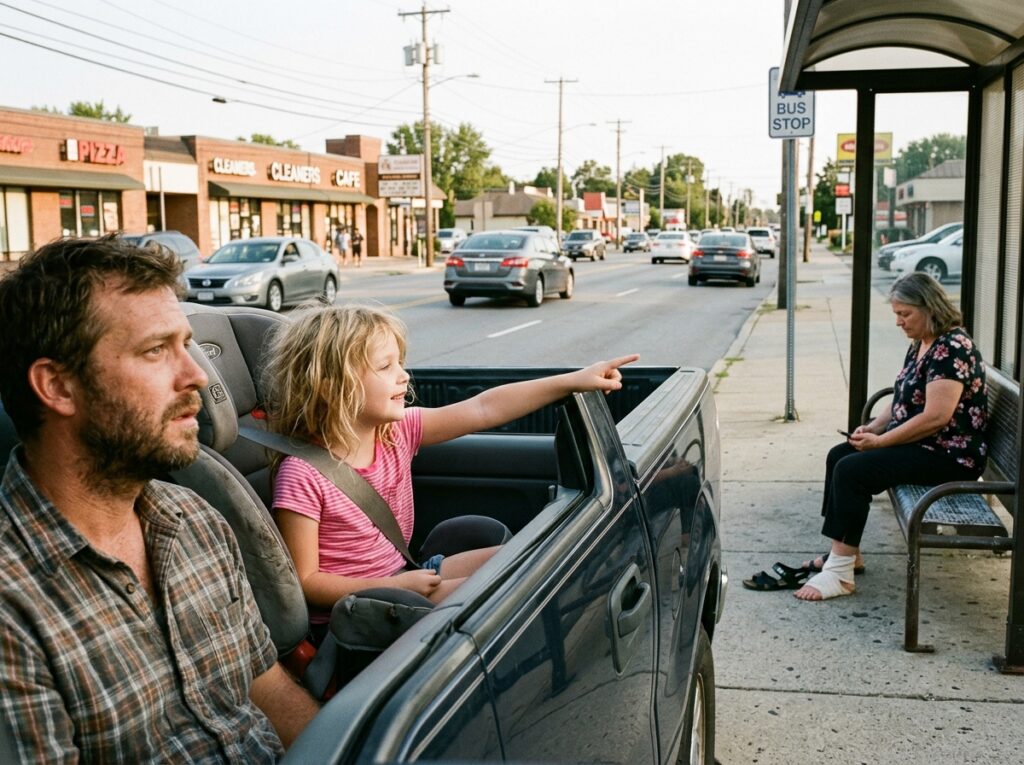
Stella was in the back seat wearing one pink sock and one purple sock because apparently matching socks had become “boring.”
I was thinking about dinner.
She was explaining, in exhausting detail, why a girl named Ava had violated the rules of freeze tag.
Then, halfway through a sentence, she stopped.
“Daddy.”
“Yeah?”
“Turn around.”
“What?”
“Turn around.”
I checked the mirror.
She was kneeling slightly toward the window, looking back at something we’d passed.
“Sit down, please.”
“But Daddy, there was a lady.”
“What lady?”
“The lady at the bus stop.”
I hadn’t noticed anyone.
“What about her?”
“She didn’t have shoes.”
That got my attention.
I found a place to turn around.
Maybe I shouldn’t have.
Maybe the practical thing would’ve been to keep driving.
It was getting late.
Traffic was building.
I didn’t know the woman.
I had my six-year-old daughter with me.
All reasonable concerns.
But Stella had noticed something I hadn’t.
And three weeks earlier, I’d explained to her what love looked like.
It felt hypocritical to suddenly become too busy to investigate.
So we went back.
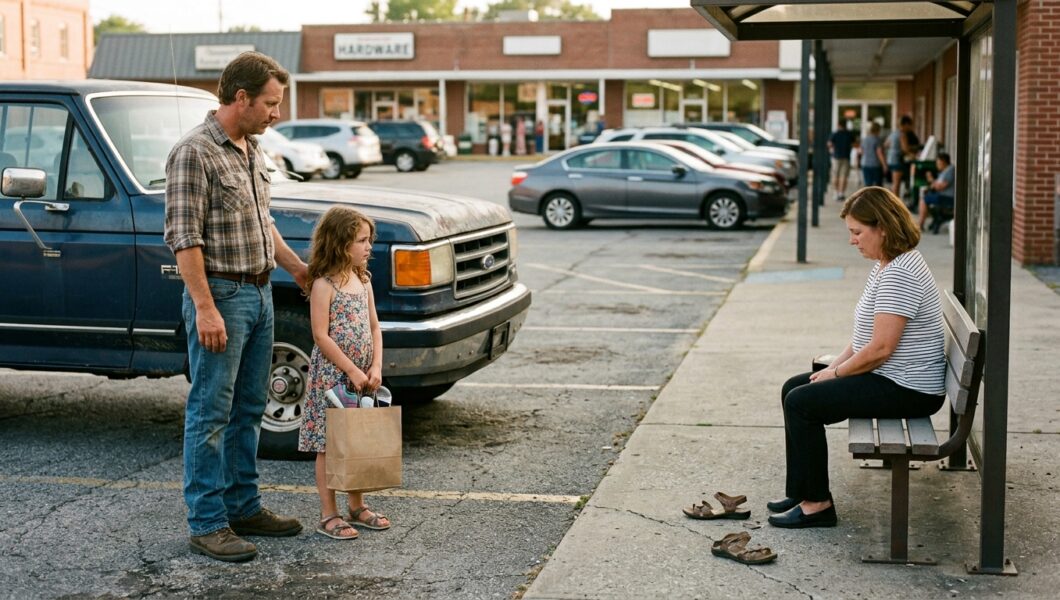
There was a woman sitting on the bus-stop bench.
Maybe fifty.
Maybe younger.
Hard to tell.
She had a plastic grocery bag beside her and a faded sweatshirt tied around her waist.
Stella had been partly wrong.
The woman had shoes.
One shoe.
The other foot was wrapped in what looked like an old T-shirt.
I didn’t let Stella get out.
I rolled down my window from a safe distance.
“Ma’am?”
She looked over.
“Are you okay?”
She nodded automatically.
That universal answer.
Fine.
Then she looked down at her foot.
“My sandal broke.”
She held up the remains.
Cheap flip-flop.
Strap torn straight through the sole.
She’d apparently been walking to a bus connection when it happened.
The pavement was hot.
She’d wrapped her foot because she’d already stepped on something sharp.
She didn’t ask me for money.
Didn’t ask for a ride.
She actually seemed embarrassed that we’d stopped.
I asked what shoe size she wore.
She stared at me.
“Why?”
“Just wondering.”
She told me.
I thanked her.
Then I drove away.
Stella exploded.
“DADDY!”
“What?”
“We’re leaving her!”
“No, we’re going to the store.”
Silence.
Then:
“Oh.”
Five minutes later:
“Can we get purple ones?”
“No.”
“Why?”
“Because not everybody wants purple shoes.”
She looked genuinely confused by that possibility.
At the store, I bought sneakers.
Nothing expensive.
Just sturdy walking shoes.
Socks.
A small package of bandages.
Stella insisted on carrying the bag.
When we returned, the woman was still there.
I parked.
This time, I got out while Stella stayed safely near me.
I handed the woman the bag.
“These should be close.”
She looked inside.
Then looked at me.
“No.”
I thought I’d bought the wrong size.
“What?”
“I can’t take these.”
“They’re yours.”
“I don’t have money.”
“I know.”
Her face tightened.
She looked embarrassed.
And suddenly I remembered the restaurant.
The hungry man had said almost the same thing.
I don’t want to cause trouble.
And the manager had answered:
You’re no trouble.
So I said it.
“Ma’am, you’re not causing us trouble.”
She looked toward Stella.
Stella waved.
Then said:
“My daddy wouldn’t let me get purple.”
Fantastic.
The woman laughed.
A real laugh.
Maybe the first comfortable thing that had happened since we stopped.
“Your daddy made the right choice.”
I looked at Stella.
“See?”
“Two against one,” the woman said.
Her name was Denise.
She put on the socks.
Then the shoes.
They fit.
Close enough, anyway.
She stood.
Took a few careful steps.
Then looked at me.
“You don’t know me.”
“No.”
“Why did you stop?”
Before I could answer, Stella did.
“Because you didn’t have a shoe.”
Denise laughed again.
There really wasn’t a better explanation.
We hadn’t stopped because I was particularly generous.
I’d driven right past her.
A six-year-old noticed.
That mattered.
Denise thanked us.
Then she asked Stella:
“What do you want to be when you grow up?”
Stella thought seriously.
“A veterinarian or a mermaid.”
Denise nodded.
“Keep your options open.”
We left.
On the drive home, Stella asked:
“Did we do what the chicken man did?”
I knew exactly who she meant.
“Sort of.”
“We didn’t pray.”
“No.”
“Should we go back?”
I laughed.
“No, sweetheart.”
Then I told her something I wanted her to understand.
“You don’t have to copy every part of what somebody else does. The important part is noticing when someone needs help and figuring out what you can safely do.”
She thought about that.
“So shoes count?”
“Shoes count.”
That should’ve been the end.
It wasn’t.
Six-year-olds are dangerous when they get ideas.
The following Saturday, Stella emptied her piggy bank onto the kitchen table.
Coins everywhere.
A few crumpled dollar bills.
One button.
No idea how the button got there.
“What are you doing?”
“Counting.”
“For what?”
“Shoes.”
I sat down.
Apparently, Stella had decided there were probably other people with broken shoes.
Reasonable assumption.
She wanted to buy shoes for all of them.
Less reasonable operational plan.
I explained that we couldn’t simply drive around looking for shoeless strangers.
She frowned.
“Why?”
Because parenting is mostly answering questions you never expected to hear.
I told her there were organizations in our community that already knew which families needed help.
“So they know the shoe people?”
“Something like that.”
We contacted a local family resource program.
They told us new socks were always useful.
Children’s sneakers too.
That became Stella’s project.
Not mine.
That’s important.
I helped with logistics.
She named it.
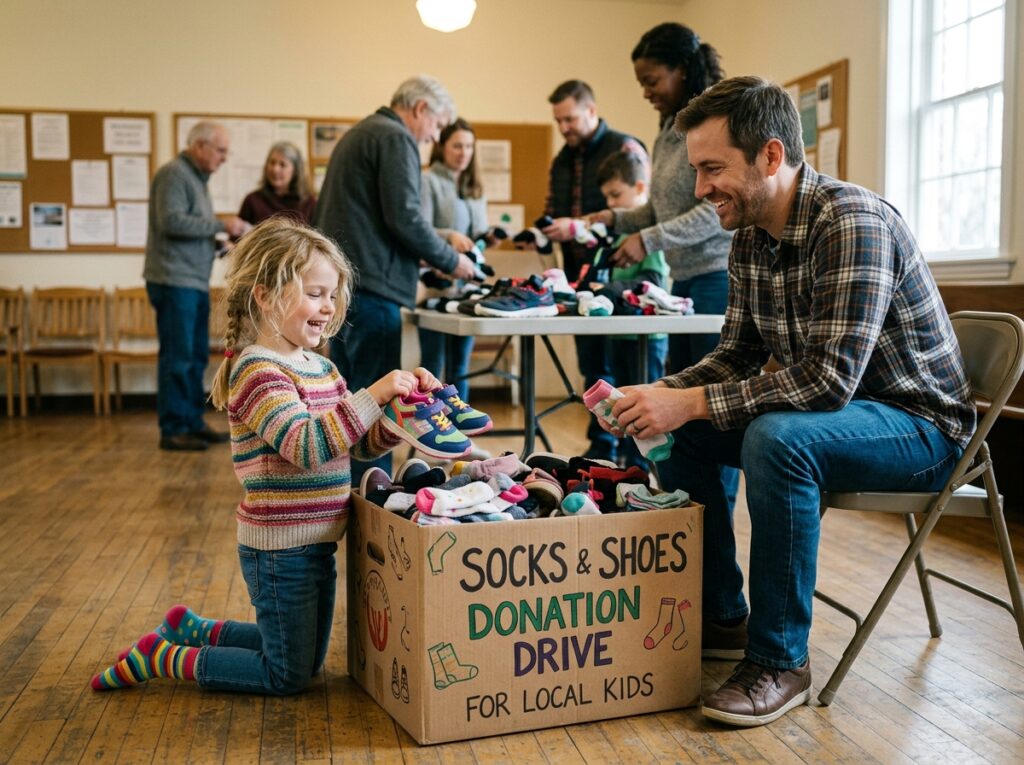
STELLA’S SOCK BOX.
I tried suggesting something less self-promotional.
She rejected my feedback.
We put a cardboard box near our church’s community room with a handwritten sign asking for new socks and new or gently used children’s shoes.
I expected maybe twenty pairs.
The first Sunday, there were eleven.
The second, thirty-four.
Then someone donated an entire unopened case of socks.
Stella stood over it like she’d inherited a fortune.
“Daddy.”
“Yes?”
“We are rich in socks.”
Apparently we were.
A month later, we delivered everything.
Stella expected to hand shoes directly to children.
The program coordinator explained why that wasn’t how it worked.
Families deserved privacy.
They weren’t there to become part of somebody else’s feel-good moment.
That was a lesson I needed too.
We left the boxes.
No photographs of recipients.
No social media video.
No asking anyone to say thank you.
On the drive home, Stella seemed disappointed.
“Nobody knows they’re from us.”
“That’s okay.”
“But what if they want to say thank you?”
“They don’t have to.”
She stared out the window.
Then:
“Do they know somebody wanted them to have shoes?”
“Yes.”
She nodded.
“Okay.”
That was enough.
Over the next year, the sock box became a small tradition.
Not huge.
Not a foundation.
Not something deserving a press release.
Just a cardboard box that appeared a few times a year.
Socks.
Sneakers.
Sometimes winter gloves.
Stella grew.
So did her questions.
When she was eight, she asked why some people didn’t have houses.
I gave her the best age-appropriate answer I could.
When she was nine, she asked why we couldn’t bring every person we saw asking for money home with us.
That required a longer conversation.
Compassion needed wisdom.
Safety mattered.
Boundaries mattered.
Helping effectively sometimes meant supporting people and organizations who knew more than we did.
But I never wanted caution to become an excuse for indifference.
There’s a difference between:
I can’t safely solve this
and:
I don’t want to see this.
Stella became very good at seeing.
Sometimes inconveniently.
She once made me turn around because she thought an elderly man had fallen.
He was tying his shoe.
He was extremely confused when we pulled up.
Another time she insisted a woman in a parking lot needed help.
The woman was looking for her keys.
She did, in fact, need help.
We found them under her car.
Not every moment became profound.
Thank God.
Real kindness is usually less cinematic than people imagine.
Sometimes it’s holding a door.
Returning a shopping cart.
Moving your bag so somebody can sit down.
Learning the janitor’s name.
Waiting while an elderly person crosses the parking lot.
And sometimes it’s leaving people alone.
That’s a form of respect too.
Years passed.
The daddy-daughter restaurant ritual continued.
Nuggets.
Playground.
Ice cream.
Except eventually she became too tall for the play area.
That happened without my permission.
One Saturday, she was eleven and sitting across from me eating fries.
I pointed toward the glass.
“You used to disappear in there for forty minutes.”
She looked horrified.
“Did I touch that?”
“You practically lived in it.”
“That’s disgusting.”
“You licked the glass once.”
“I did not.”
“You absolutely did.”
“I was six.”
“Still counts.”
She threw a fry at me.
Then she asked:
“Do you remember the man?”
I knew immediately.
“The hungry man?”
She nodded.
“I remember the prayer.”
That surprised me.
“You were six.”
“I remember everybody got quiet.”
Then:
“Do you know what happened to him?”
“No.”
We never did.
I hadn’t seen him again.
I didn’t know his name.
Didn’t know where he slept that night.
Didn’t know whether his circumstances improved.
I also didn’t know the manager’s name anymore.
Staff changed.
Years passed.
The building had been remodeled.
For a moment, that bothered me.
Then Stella said:
“I think about him sometimes.”
“Which one?”
“The man who needed food.”
I nodded.
Then she said:
“And the manager.”
“Why?”
“Because he wasn’t embarrassed to help him.”
That wasn’t how I had remembered the lesson.
I’d remembered faith.
Prayer.
Generosity.
Stella remembered something simpler.
He wasn’t embarrassed to help.
Kids notice different things.
That afternoon, we traded dessert for ice cream.
Old habits.
As we were leaving, Stella stopped near a table.
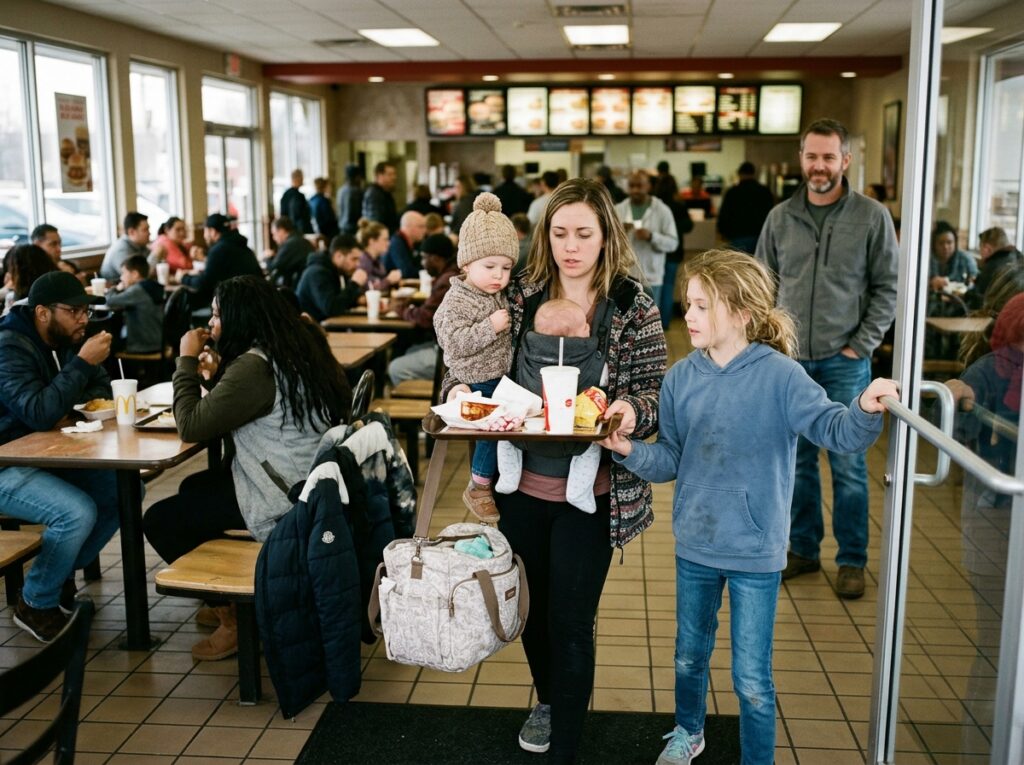
A mother was trying to manage a toddler, a baby carrier, a diaper bag and a tray.
Without saying anything, Stella held the door.
Then carried the woman’s tray to her table after asking if she’d like help.
The mother thanked her.
Stella shrugged.
No big moment.
No lesson.
No dramatic music.
She came outside.
“What?” she asked when she caught me staring.
“Nothing.”
“You’re doing the dad face.”
“What dad face?”
“The one where you look like you’re going to say something emotional.”
I laughed.
“Get in the truck.”
Stella is fourteen now.
Daddy-daughter lunches happen less often.
Friends happen more.
Sports.
Homework.
A phone that apparently contains information far more interesting than anything her father could possibly say.
That’s normal.
I’m learning to accept it.
Last month, she asked if we could go get lunch.
Just us.
I tried not to look too excited.
I failed.
She noticed.
“Don’t make it weird, Dad.”
“Wouldn’t dream of it.”
We sat in a booth.
No playground visit.
She’d probably disown me.
Halfway through lunch, she told me her school was collecting winter supplies for families.
“I volunteered us.”
“Us?”
“You have a truck.”
Apparently that’s my role now.
We spent Saturday hauling boxes.
Coats.
Blankets.
Socks.
Always socks.
While unloading, I found Stella standing beside a box marked CHILDREN’S SHOES.
She picked up a pair.
Plain gray sneakers.
Then looked at me.
“Remember Denise?”
I couldn’t believe she remembered the name.
“You remember Denise?”
“Of course.”
“You were six.”
“You tell the story all the time.”
Fair.
Then she smiled.
“You still should’ve let me buy purple ones.”
Eight years.
Still holding that grudge.
I laughed.
Then she carried the box inside.
Watching her walk away, I thought about that afternoon when all I wanted was to finish my grilled sandwich, let my daughter burn energy in the playground and get home to emails and laundry.
I almost told her we couldn’t sit inside for ice cream.
If I had, nothing terrible would’ve happened.
We simply would’ve missed something.
That’s humbling.
Parents spend enormous amounts of time trying to teach children.
Say please.
Say thank you.
Share.
Don’t hit.
Tell the truth.
Look both ways.
Be kind.
We imagine we’re shaping them through our instructions.
Sometimes we are.
But children are watching what happens when we aren’t instructing them.
They watch the manager at the counter.
The stranger at the bus stop.
The way Dad responds when someone interrupts his schedule.
The way Mom talks about someone who has less.
The way adults treat servers.
Cashiers.
Custodians.
People asking for help.
People who can’t give us anything.
And they remember.
That afternoon years ago, I thought Stella had learned something because I explained:
That’s what love looks like.
I was wrong.
She’d already understood before I said it.
She watched one human being notice another.
Then three weeks later, she looked through a truck window and noticed Denise.
Years after that, she noticed a mother struggling with a tray.
Now she notices families who need winter supplies.
None of those things makes my daughter extraordinary.
I don’t want her to think kindness makes her extraordinary.
Kindness should be ordinary.
That’s the goal.
Not applause.
Not photographs.
Not proving you’re a good person.
Just becoming the kind of person who notices often enough that helping stops feeling unusual.
I don’t know what happened to the hungry man from that first afternoon.
I hope he found stability.
I hope he found people who treated him with dignity.
I hope he remembers the meal more than the stares.
And I still think about that manager.
He probably forgot us.
Why wouldn’t he?
We were just a father and little girl eating ice cream.
He had no idea a six-year-old was watching.
That’s what gets me.
Most of the moments that shape children happen when adults don’t realize they’re teaching.
Maybe that’s why the smallest acts matter so much.
You never know who’s in the booth nearby.
You never know which child is watching.
You never know what they’ll remember eight years later.
Maybe they won’t remember your words.
Maybe they’ll remember that you stopped.
That you looked somebody in the eye.
That you treated a hungry person like a person.
And someday, when you’re the one driving too fast toward the next obligation, maybe a little voice from the back seat will say:
“Daddy, turn around.”
When that happens, listen.
They may have noticed something you missed.

No Comments