

Nine years after a little boy gave me a purple crayon for Christmas, I received a letter from him.
I almost threw it away.
Not intentionally.
It arrived mixed in with Christmas cards, advertisements, donation requests and the usual December pile that accumulates on my desk faster than I can deal with it.
The envelope was plain.
My name was handwritten across the front.
No return address I recognized.
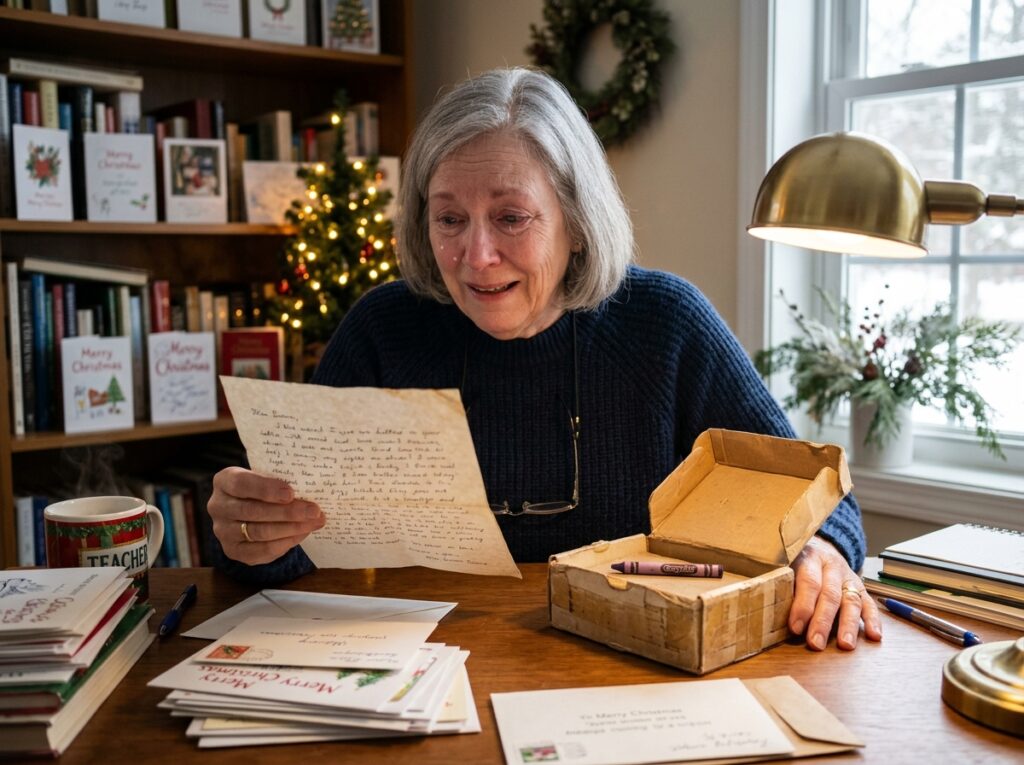
I opened it while drinking coffee.
The first line said:
You probably don’t remember me, but I gave you a purple crayon for Christmas.
I stopped.
Then I looked across my office.
The box was still there.
Same little box.
A little more worn now.
The tape had yellowed.
One corner was crushed from moving offices years earlier.
Inside was the purple crayon.
Shorter than a new one.
Paper wrapper peeling slightly.
Worth almost nothing.
Priceless to me.
Of course I remembered him.
His name was Marcus.
He had been eight years old.
Quiet most mornings.
Funny once he trusted you.
The kind of child who noticed everything but didn’t always say what he’d noticed.
And apparently, all those years ago, he’d noticed my favorite color.
Purple.
I pulled the box from the shelf and placed it beside the letter.
Then I kept reading.
I saw something you wrote about the crayon. My aunt sent it to me. I didn’t know you still had it.
My eyes filled immediately.
But the next sentence was the one that made me put down my coffee.
I need to tell you what I remember about that Christmas.
I remembered that December as one of the happiest parts of my final year teaching.
Marcus remembered something else.
His mother had lost her job in November.
He hadn’t told me.
I hadn’t known.
They were behind on rent.
The electricity had been shut off once.
His mother had managed to get it restored before Christmas.
There wasn’t much food in the house.
Christmas presents weren’t exactly a priority.
But children don’t understand household finances the way adults do.
They understand comparison.
Marcus came to school and watched other students carry bags toward my desk.
Candles.
Mugs.
Chocolate.
Hand lotion.
Christmas ornaments.
Teacher gifts.
Nothing extravagant.
But when you’re eight years old and have nothing, even a five-dollar mug can look enormous.
Marcus wrote:
Everybody had something for you and I didn’t. I remember feeling embarrassed because I thought you would know my family didn’t have money.
I covered my mouth.
All these years, I’d told the story as an example of a child’s beautiful generosity.
I’d never understood what was underneath it.
He wasn’t only trying to give me something.
He was trying to protect himself from being seen as the child who couldn’t.
He’d received one small present from a community holiday program.
I don’t know what was originally inside the box.
Marcus didn’t remember anymore either.
But he kept the packaging.
Then, on the last school morning before Christmas break, he looked through his pencil pouch.
A red crayon.
Two broken pencils.
A green marker without a cap.
And one purple crayon.
He remembered me using purple pens.
Purple bulletin-board borders.
A purple coffee cup.
I’d apparently mentioned once that it was my favorite color.
So he put the crayon into the little box.
Closed it.
And brought it to school.
I remembered what happened next.
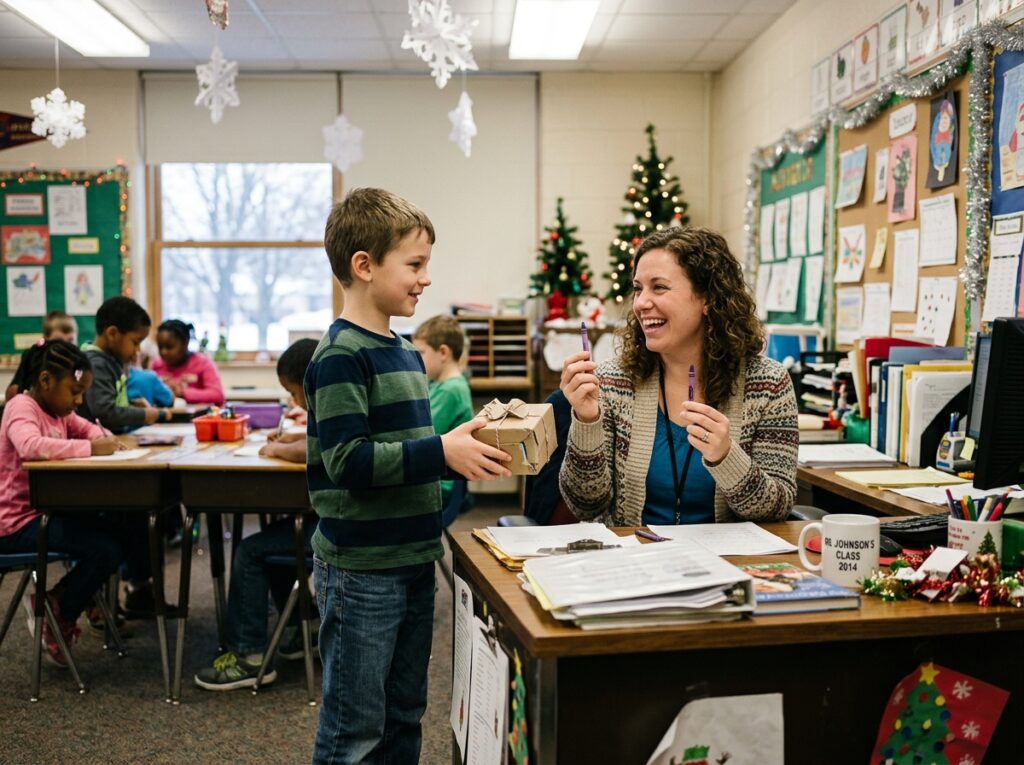
Marcus walked to my desk.
Held out the box.
“I hope you love it.”
Then:
“It’s your favorite color.”
What I didn’t remember was what happened immediately afterward.
Marcus did.
He wrote:
You opened it like there was something expensive inside.
I sat back.
Apparently, I gasped.
Not a polite teacher gasp.
A ridiculous one.
I held up the crayon.
“A PURPLE CRAYON?”
The class looked over.
I told Marcus:
“You remembered my favorite color.”
He nodded.
Then I said:
“This is perfect.”
Perfect.
One word.
I’d forgotten saying it.
Marcus hadn’t.
He wrote:
I thought you were pretending at first. Then you put it in the top drawer of your desk instead of throwing it in the supply box.
That mattered to him.
I had no idea.
At eight years old, Marcus had been afraid his gift would reveal what his family couldn’t afford.
Instead, for a few minutes, it made him feel like he’d given exactly the right thing.
Then came the line that made me cry.
That was the first Christmas I remember feeling like not having money didn’t mean I had nothing to give.
I stopped reading.
Nine years.
I’d kept the crayon because I thought Marcus had taught me something about kindness.
Marcus remembered the same moment because he thought I had taught him something about dignity.
Neither of us knew we were teaching anything.
We were just standing beside a teacher’s desk with a crayon between us.
That’s the strange thing about moments that change us.
They rarely announce themselves.
Marcus’s letter continued.
His mother eventually found steady work.
Things improved.
Not immediately.
There were more difficult months.
Another move.
A stretch when they lived with his aunt.
But by middle school, their situation had stabilized.
Marcus said he almost never thought about the crayon.
Then, during his senior year of high school, his aunt sent him a screenshot of something I’d written online.
There it was.
The story.
His purple crayon.
And a photograph of the box sitting in my office.
Marcus stared at it for several minutes.
He hadn’t known I’d kept it.
He showed his mother.
She remembered that Christmas instantly.
Apparently, she cried.
Then she told him something he’d never known.
She had considered keeping him home on the final school day before Christmas.
She was embarrassed too.
She knew other children might bring teacher gifts.
She worried Marcus would feel different.
But he’d insisted on going.
“He said he had something for his teacher,” she told him.
She hadn’t known what.
That tiny box had been his plan.
Marcus was seventeen now.
He was finishing high school.
Working part-time at a grocery store.
Planning to attend community college.
He wasn’t writing because he wanted anything.
He just thought I should know what happened after the purple crayon.
Then he told me about a boy named Jordan.
Jordan worked with him at the grocery store.
Sixteen.
First job.
Quiet.
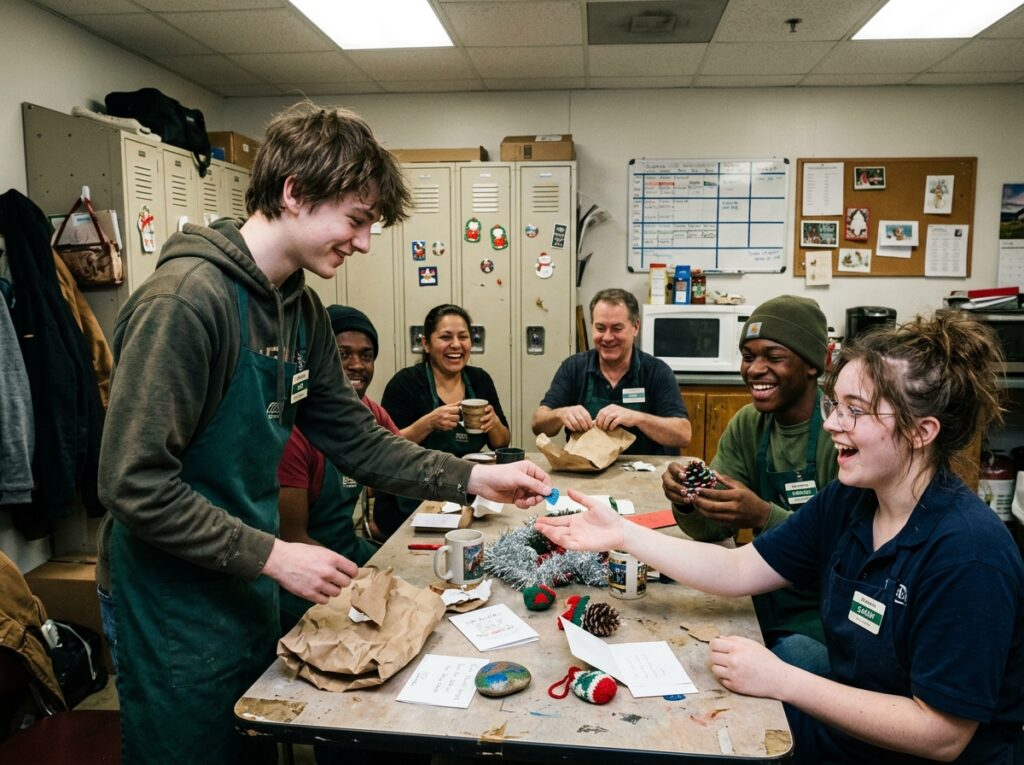
One evening in December, the employees were doing a small Secret Santa exchange.
Nothing expensive.
Twenty-dollar limit.
Marcus noticed Jordan wasn’t participating.
Someone teased him.
Not cruelly.
Just:
“Come on, man. It’s twenty bucks.”
Jordan laughed it off.
Marcus recognized the laugh.
He wrote:
I knew that laugh because I used to use it.
So Marcus pulled the organizer aside.
He suggested changing the exchange.
Instead of buying gifts, everybody had to give something they already owned that reminded them of the person whose name they’d drawn.
The organizer loved it.
Suddenly the whole thing became ridiculous.
One employee gave someone a hot-sauce bottle.
Someone received a lucky keychain.
A manager got a terrible paperback romance novel because she always complained about dating.
Jordan participated.
He gave another employee a guitar pick he’d kept in his wallet.
Apparently, the guy had been talking about learning guitar for months.
The gift cost nothing.
The guy loved it.
Afterward, Jordan asked Marcus:
“Was that your idea?”
Marcus said yes.
Jordan said:
“Thanks.”
Nothing more.
He didn’t need to explain.
Marcus understood.
Then he wrote:
I thought about the crayon the whole night.
That’s when I realized the gift hadn’t stopped with me.
I’d kept the object.
Marcus had kept the lesson.
At the end of Marcus’s letter, he wrote:
I used to think you kept the crayon because you felt sorry for me.
That hurt.
Then:
Now I think maybe you actually liked it.
I laughed through tears.
I immediately wrote back.
Not an email.
Not a message.
A letter.
If he had taken the time to put words on paper, so would I.
I told him the truth.
I didn’t keep that crayon because I felt sorry for him.
I didn’t even know there was anything to feel sorry about.
I kept it because an eight-year-old boy had paid attention.
He knew my favorite color.
He had something purple.
And he gave it away.
That was enough.
Then I told him something I’d never included in the original story.
During my final year of teaching, I was tired.
Really tired.
After decades in a classroom, I was ready to retire.
I loved my students.
But teaching had changed.
I had changed.
There were days when I wondered whether all those years had mattered in the ways I’d hoped.
Test scores disappear.
Assignments get thrown away.
Most children forget most lessons.
Teachers know this.
We teach anyway.
That Christmas, Marcus’s purple crayon reminded me that maybe the things children remembered wouldn’t always be the things I had written in my lesson plans.
Maybe they’d remember how a classroom felt.
Whether an adult listened.
Whether somebody noticed their effort.
Whether a tiny gift was treated like it mattered.
I wrote:
Marcus, you weren’t the poor kid who couldn’t afford a teacher present. You were the kid who remembered my favorite color. That’s how I remember you.
I mailed it.
Three weeks later, another envelope arrived.
Inside was a photograph.
Marcus in his graduation gown.
His mother beside him.
Both smiling.
On the back he’d written:
Still giving what I’ve got.
I framed it.
It sits beside the crayon now.
Years passed.
Marcus went to community college.
Then transferred to a state university.
We didn’t stay in constant contact.
I didn’t need us to.
Former students grow up.
That’s what they’re supposed to do.
Every couple of years, I’d hear something.
A Christmas card.
A short email.
A photograph.
He eventually became a social worker.
When he told me, I wasn’t surprised.
He worked with teenagers and families going through difficult periods.
He was careful about how he talked about his childhood.
He never turned his mother into a sad story.
He loved her.
She had worked unbelievably hard.
They had survived something difficult together.
That was their story to define.
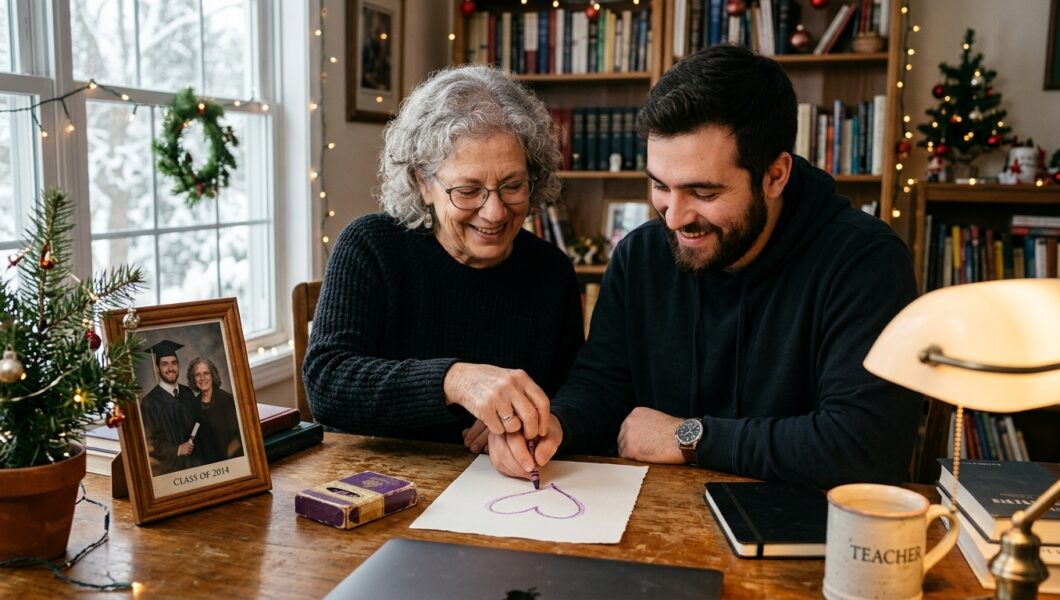
One December, Marcus visited me.
He was twenty-six.
Almost eighteen years had passed since the purple crayon.
I recognized him immediately.
Older face.
Same eyes.
He brought no gift.
“Good,” I told him.
“I learned my lesson.”
We sat in my office.
He saw the little box.
“You seriously still have it?”
“Of course.”
“Can I see it?”
I handed it to him.
He opened the box.
There was the crayon.
The wrapper had faded.
The tip was blunt.
Marcus stared.
Then started laughing.
“That thing looks terrible.”
“It’s vintage.”
“It’s garbage.”
“Get out of my house.”
He laughed harder.
Then he held it between his fingers.
For a moment, neither of us spoke.
Finally he said:
“I remember being so nervous.”
“I remember you looking proud.”
“I was both.”
That’s often true, isn’t it?
Children can be proud and terrified simultaneously.
Adults too.
Marcus asked:
“Did you ever use it?”
“No.”
He looked offended.
“Why not?”
“I wanted to keep it.”
He shook his head.
“That’s not what crayons are for.”
I stared at him.
He had me there.
So I found a piece of paper.
Placed it between us.
“What should we draw?”
“I can’t draw.”
“You’re the one criticizing my crayon usage.”
We decided on a heart.
Original, I know.
Marcus held one side of the crayon.
I held the other.
We drew the worst purple heart you’ve ever seen.
Uneven.
Crooked.
One side much larger than the other.
Perfect.
The crayon became slightly shorter.
And somehow that made the gift better.
I’d spent years preserving it.
Marcus reminded me that gifts aren’t always meant to remain untouched.
Sometimes honoring something means using it.
I put the crayon back in the box.
Then I framed the terrible purple heart.
It’s in my office too.
The crayon is still there as I write this.
So is Marcus’s graduation photograph.
So is the heart.
People sometimes ask teachers what their favorite gifts are.
I’ve received wonderful things.
Homemade ornaments.
Books.
Cards.
Mugs.
So many mugs.
Teachers apparently need enough mugs to survive the collapse of civilization.
But I don’t remember gifts by price.
I remember stories.
A child picking flowers from his own yard.
A handwritten card with every word misspelled except my name.
A Christmas ornament made from popsicle sticks.
And one purple crayon placed inside a reused box by a boy who thought he didn’t have enough to give.
He did.
More than enough.
That’s what I wish we’d teach children more often.
Generosity isn’t a competition.
You don’t need money to notice somebody.
You don’t need money to remember their favorite color.
You don’t need money to write a note.
Sit beside someone.
Share your snack.
Carry something.
Listen.
Draw a picture.
Make somebody laugh.
Give away the purple crayon.
And when someone gives you something small with a large piece of their heart attached to it, treat it carefully.
You may have no idea what your reaction will mean to them.
I certainly didn’t.
I thought I was accepting a Christmas present.
Marcus thought he was proving he had something worth giving.
Years later, he made sure another sixteen-year-old didn’t have to feel ashamed because he couldn’t spend twenty dollars on a workplace gift.
That’s how kindness moves.
Not always through grand gestures.
Sometimes through memory.
Someone once protected your dignity.
So years later, when you recognize that same nervous laugh in someone else, you protect theirs.
Marcus gave me a crayon.
I gave him a reaction.
Neither one seemed important enough to change anything.
But maybe that’s the point.
We rarely know which tiny moments people carry away from us.
So be generous with them.
Make the gasp a little bigger.
Say thank you like you mean it.
Notice the thought.
Because somewhere, there may be a child wondering whether what they have is enough.
Sometimes all they need is one person to show them that it is.
The purple crayon is shorter now.
I’m glad.
Love isn’t valuable because we preserve it perfectly.
It’s valuable because we use it.
And after all these years, purple is still my favorite color.




No Comments