

I found the letter on a Saturday afternoon while looking for her insurance card.
By then, I was forty-three.
She was seventy-eight.
Her name was Evelyn.
I realize I never used her name much when telling people our story.
Usually I just said “my mom.”
Because that’s what she was.
No explanation required.
That afternoon, she’d fallen in the kitchen.
Nothing dramatic.
No ambulance.
No broken bones.
But enough to scare both of us.
I drove her to urgent care, where the doctor told her what she absolutely did not want to hear.
She needed to slow down.
Maybe use a cane for a while.
Let somebody help with groceries.
Consider putting a handrail near the back steps.
Evelyn listened with the expression of someone being personally insulted by modern medicine.
On the drive home she said:
“He looked twelve.”
“He was probably thirty-five.”
“Exactly.”
The next morning, I came back to organize some paperwork.
That’s when I found the envelope.
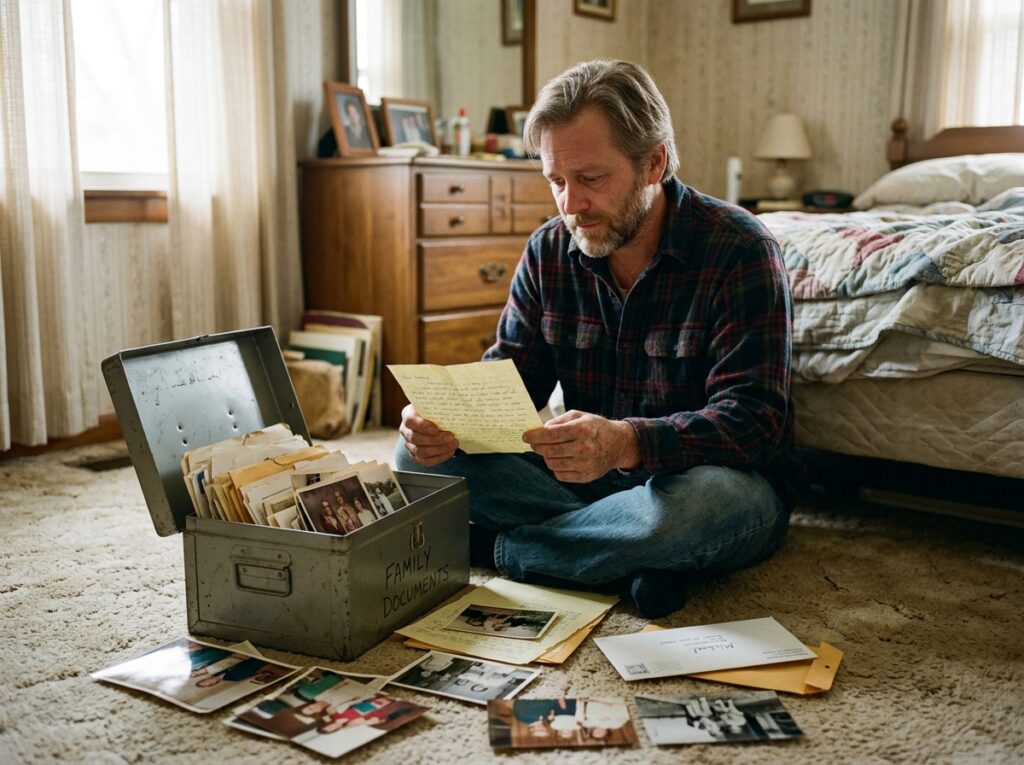
It was tucked into an old metal box in the bedroom closet beneath tax records, expired warranties and photographs.
Across the front was my name.
MICHAEL
My first thought was that it was something she’d prepared recently.
One of those documents older parents start leaving behind because they know their children will someday need them.
Then I opened it.
The paper was yellow.
The date at the top stopped me.
October 3, 1990.
I was seven years old.
Three days after my father left me at her house.
I sat down on the floor.
The first sentence read:
Michael, I don’t know if you’ll ever read this.
I should have stopped reading.
It was clearly private.
But my name was on it.
So I continued.
Evelyn had written the letter after I finally fell asleep that third night.
She described me sitting on the couch.
Shoes still on.
Refusing to change into pajamas because my father had said he’d be back in ten minutes.
Apparently, I believed taking off my shoes might make me miss him.
I didn’t remember that.
Some childhood memories disappear because they’re ordinary.
Others disappear because maybe your mind decides you’ve carried enough.
Evelyn wrote that on the first night, she’d called my father seventeen times.
No answer.
The second day, she contacted relatives.
Nobody knew where he was.
She contacted the appropriate authorities because a seven-year-old had been abandoned in her care and she couldn’t simply pretend the legal reality didn’t exist.
There were interviews.
Questions.
Paperwork.
People trying to determine where I should go.
I had always known some of that.
What I hadn’t known was that Evelyn had been terrified.
The version of the story I’d carried into adulthood was simple:
My father left.
Evelyn chose me.
But real choices rarely happen as cleanly as the stories we tell afterward.
She wrote:
I don’t know if I can do this.
I read that sentence four times.
Then:
I’m angry with your father. I’m angry that he put you here without asking me. I’m angry that I’m being asked to make decisions about a little boy who is sitting in my living room waiting for someone who may not return.
That hurt.
Not because she’d done anything wrong.
Because I’d spent decades imagining her decision as instant.
Certain.
Almost effortless.
It wasn’t.
She was afraid.
She was furious.
She had no idea what she was doing.
Then I reached the next paragraph.
But none of that is your fault, Michael. You keep asking when he’s coming back, and I don’t know how to answer you. Tonight you fell asleep holding the sleeve of my sweater because you didn’t want me to leave the room. I sat there for almost an hour because I didn’t know how to move without waking you.
I remembered that sweater.
Blue.
Soft.
One sleeve stretched longer than the other.
I never knew why.
Now I did.
Then came the sentence that changed the way I understood my entire childhood.
I don’t know yet what happens legally. But I know what happens tonight. You wake up here tomorrow, and somebody is still here.
I covered my face.
For thirty-six years, I’d believed Evelyn saved me because she wasn’t afraid.
The truth was better.
She was afraid and stayed anyway.
I heard the bedroom doorway creak.
“What are you doing on the floor?”
Evelyn.
I turned.
She saw the letter.
Her face changed immediately.
“Oh.”
“You wrote this?”
“Obviously.”
“Why didn’t you give it to me?”
She walked slowly toward the bed and sat down.
“I forgot about it.”
“You wrote my name on it.”
“I forget lots of things with your name on them.”
Classic Evelyn.
I held up the letter.
“You said you didn’t know if you could raise me.”
She looked at me for several seconds.
Then:
“I didn’t.”
That answer landed harder than reassurance would have.
“You never told me that.”
“You were seven.”
“What about when I was older?”
“You were busy being fourteen.”
“And twenty?”
“You thought you knew everything.”
“Thirty?”
“You were still recovering from thinking you knew everything.”
I laughed despite myself.
Then she became serious.
“Michael, being unsure about raising you wasn’t the same as being unsure about you.”
I stopped.
She continued.
“I didn’t know if I had enough money. I didn’t know whether the court would let you stay. I didn’t know how angry your father might become. I didn’t know anything about raising a boy.”
“You did okay.”
“I was excellent.”
There she was.
Then she reached toward the letter.
“I was scared.”
I handed it to her.
She looked at the old handwriting.
“But you were more scared.”
That was why she’d stayed.
Not because some heavenly certainty descended on her.
Not because she immediately knew we’d become mother and son.
Because there was a seven-year-old boy on her couch whose father had promised ten minutes.
And somebody needed to still be there when the ten minutes ended.
That was all.
At first.
The rest came later.
The school plays.
Bike lessons.
Parent-teacher meetings.
Arguments over homework.
Flu.
Christmas mornings.
College applications.
My first broken heart.
My wedding.
Her becoming a grandmother to my children.
A lifetime had grown out of one decision that, on the night she made it, didn’t feel like a lifetime decision at all.
It felt like:
Stay tonight.
Then stay tomorrow.
Then see what happens.
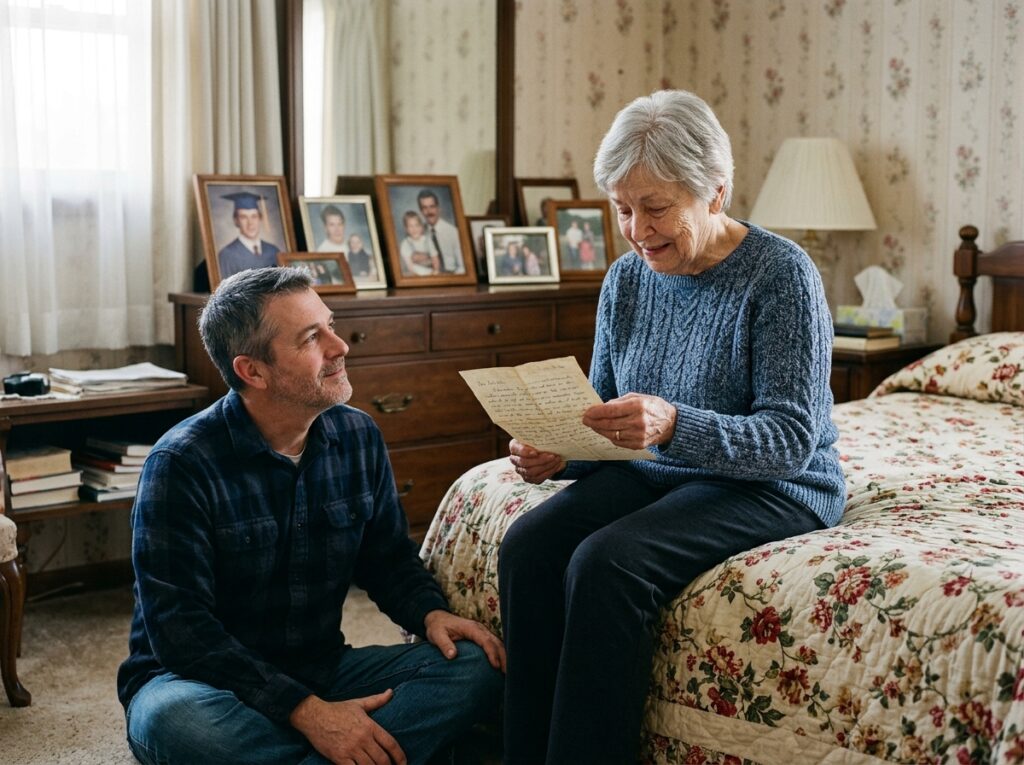
A few months after I found the letter, Evelyn fell again.
This time she broke her wrist.
That changed things.
She couldn’t drive for a while.
Couldn’t easily cook.
Couldn’t carry laundry.
Couldn’t open half the containers in her refrigerator without inventing new swear words.
I started visiting more than once a week.
Then three times.
My wife brought meals.
Our kids helped with the yard.
I drove Evelyn to appointments.
She hated every second of needing us.
One afternoon, I was helping her put groceries away when she snapped:
“I can do that.”
“You have one functioning hand.”
“I have teeth.”
“You are not opening a jar of pasta sauce with your teeth.”
“You underestimate me.”
I put the jar away.
She sat at the kitchen table, annoyed.
Then she said:
“I don’t want to become your responsibility.”
Everything in me stopped.
Thirty-six years disappeared.
For a second, I was seven again.
Sitting on that couch.
Wondering whether being someone’s responsibility was the same as being unwanted.
I pulled out a chair.
“Mom.”
She looked at me.
“You were never supposed to have to do all this.”
I almost laughed.
“Do you hear yourself?”
“This is different.”
“How?”
“I chose you.”
There it was.
The phrase I’d spent my life using as proof of her love.
Now she was using it as an excuse not to receive mine.
I leaned forward.
“So do I.”
She looked away.
“I mean it.”
“I know.”
“No, I mean I choose this.”
I pointed toward the grocery bags.
“The appointments. The stupid jars. The handrail you hate. Coming over when you’re grumpy.”
“I am not grumpy.”
“You threatened pasta sauce with your teeth.”
“It knew what it did.”
I laughed.
Then I said:
“You didn’t owe me what you gave me.”
She shook her head.
“That’s not true.”
“Yes, it is.”
“Michael—”
“You could’ve made sure I was safe and let somebody else raise me. Instead, you stayed.”
I paused.
“I’m not paying you back.”
Her expression changed.
Because she understood.
Love wasn’t a debt.
If I treated caring for her as repayment, then everything she’d taught me would become a transaction.
She had never handed me an invoice for childhood.
I wasn’t going to hand her one for old age.
“I’m here because you’re my mother.”
She looked down at her hands.
Then whispered:
“I don’t want to be a burden.”
That word.
I hated it.
So I told her something she had once told me without saying it.
“Needing somebody isn’t the same as being a burden.”
She cried.
Quietly.
I did too.
Then she complained that the frozen food was melting.
Perfect.
Life continued.
Over the next two years, Evelyn gave up driving.
That was harder than the wrist.
Then she started using a walker outside.
She hated that even more.
Every loss of independence felt personal to her.
We tried not to take over.
That mattered.
Helping somebody doesn’t mean erasing their choices.
She still chose her clothes.
Her meals.
Her doctors.
Whether she wanted company.
She still had the right to tell me to go home.
Which she exercised frequently.
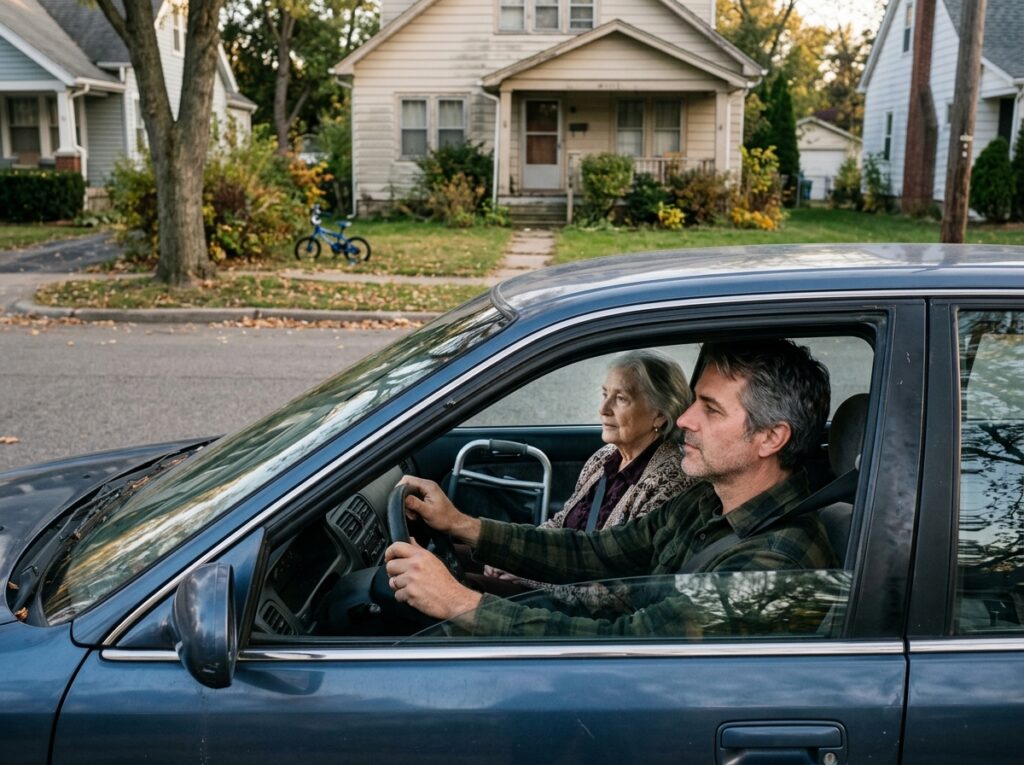
Then one Sunday, she asked me to drive her somewhere.
“Where?”
“The old house.”
I knew immediately which one.
The house where my father had left me.
Evelyn hadn’t lived there in more than twenty years.
Someone else owned it now.
We weren’t going inside.
We parked across the street.
The shutters were different.
The porch had been rebuilt.
A child’s bicycle lay in the grass.
Evelyn stared through the windshield.
“You sat right there.”
She pointed toward where the old couch would have been behind the front window.
“Shoes on.”
“Waiting.”
“Yes.”
I asked something I’d never asked before.
“How long did I wait for him?”
She was quiet.
“Years.”
I looked at her.
“You stopped sitting by the window after a few days.”
She touched my hand.
“But some part of you kept waiting.”
She was right.
At ten, I imagined he’d appear at Christmas.
At sixteen, I imagined he’d show up when I learned to drive.
At graduation, I searched faces in the crowd even though I told myself I wasn’t.
At my wedding, I wondered if somebody had told him.
When my first child was born, I thought perhaps becoming a grandfather would suddenly make him understand what he’d missed.
It never happened.
Evelyn had known.
She had watched me wait long after I’d stopped admitting I was waiting.
“Did you hate him?” I asked.
“For what he did to you?”
“Yes.”
She thought.
“For a long time.”
“And now?”
“Now I don’t have enough energy to waste on him.”
I smiled.
Then she said:
“He gave me you.”
I shook my head.
“No.”
She looked at me.
“He abandoned me. You gave me you.”
Evelyn went completely still.
That was important to say.
I had spent years trying to turn my father’s abandonment into something necessary because something beautiful followed it.
But one didn’t justify the other.
I didn’t need to be grateful that he left.
What he did was wrong.
The good part was what Evelyn chose afterward.
Those were separate truths.
We sat outside that house for maybe ten minutes.
Then Evelyn said:
“Let’s go.”
“That’s it?”
“What did you expect? Violins?”
I laughed.
“No.”
“Good. I’m hungry.”
We drove to get lunch.
I never returned to the house again.
I didn’t need to.
Evelyn turned eighty-two last spring.
We had a small party.
She insisted she didn’t want one.
Then complained that my daughter hadn’t made her usual chocolate cake.
My daughter produced the cake from the kitchen.
Evelyn said:
“I knew she would.”
Manipulative woman.
After everyone left, I found her sitting outside.
Same silver hair.
Slower steps.
A cardigan even though the evening was warm.
I sat beside her.
She asked:
“Do you still have that letter?”
“Yes.”
“You should throw it away.”
“No.”
“Why?”
“Because it’s mine.”
“It was technically mine first.”
“My name’s on it.”
She rolled her eyes.
Then she said:
“I don’t like that you read the part where I was scared.”
“That’s my favorite part.”
She looked genuinely confused.
“Why?”
Because for years I’d made her into something almost impossible.
The woman who never hesitated.
Never resented.
Never struggled.
The perfect mother who stepped into a terrible situation and immediately knew exactly what to do.
That version of Evelyn was easier to tell people about.
But it wasn’t true.
The real woman was better.
She was newly married to a man who disappeared.
She suddenly had a seven-year-old child in her house.
She was angry.
Scared.
Financially uncertain.
Legally overwhelmed.
And probably furious that her life had been rearranged without her permission.
She stayed anyway.
Not flawlessly.
Not effortlessly.
By choice.
Again and again.
“You weren’t some saint,” I told her.
“Finally, recognition.”
“You were just a person.”
“Careful.”
“A person who kept choosing me.”
She became quiet.
Then she said:
“You chose me too, you know.”
I hadn’t thought about that.
Children don’t choose where they’re placed.
But over time, maybe I had.
I stopped calling her by her first name.
Started calling her Mom.
Ran to her when I was hurt.
Asked her for advice.
Trusted her with my children.
Kept showing up every weekend.
Family had grown in both directions.
A few months later, Evelyn moved into a smaller apartment closer to us.
Her decision.
Mostly.
I may have aggressively provided brochures.
While packing her house, we found the old blue sweater.
The one from the letter.
I couldn’t believe she’d kept it.
One sleeve was stretched.
I held it up.
“This?”
She smiled.
“That.”
“You kept this for thirty-six years?”
“Apparently I’m sentimental.”
I touched the sleeve I’d held while sleeping as a seven-year-old.
For a second, I could see that boy.
Shoes on.
Waiting for ten minutes to end.
I wish I could go back and sit beside him.
I wish I could tell him:
He’s not coming back.
That would hurt.
But then I’d tell him something else.
Someone is staying.
You just don’t know yet how long.
I can’t speak to that boy.
So sometimes I speak to people carrying their own version of him.
Adults who were abandoned.
Children raised by grandparents.
Stepparents who became parents.
Foster parents.
Adoptive families.
Teachers who became safe adults.
Neighbors who stepped in.
Families built in ways nobody planned.
I never tell them blood doesn’t matter.
Blood can matter deeply.
I lost my biological mother before I ever got to know what that bond could have been.
That absence is real too.
But blood is not the only way a family becomes real.
Consistency matters.
Safety matters.
Presence matters.
Choice matters.
Evelyn is eighty-three now.
I still visit.
Not because of a promise.
Not because I owe her.
Not because she saved me and I have to repay the balance.
There is no balance.
That’s the whole point.
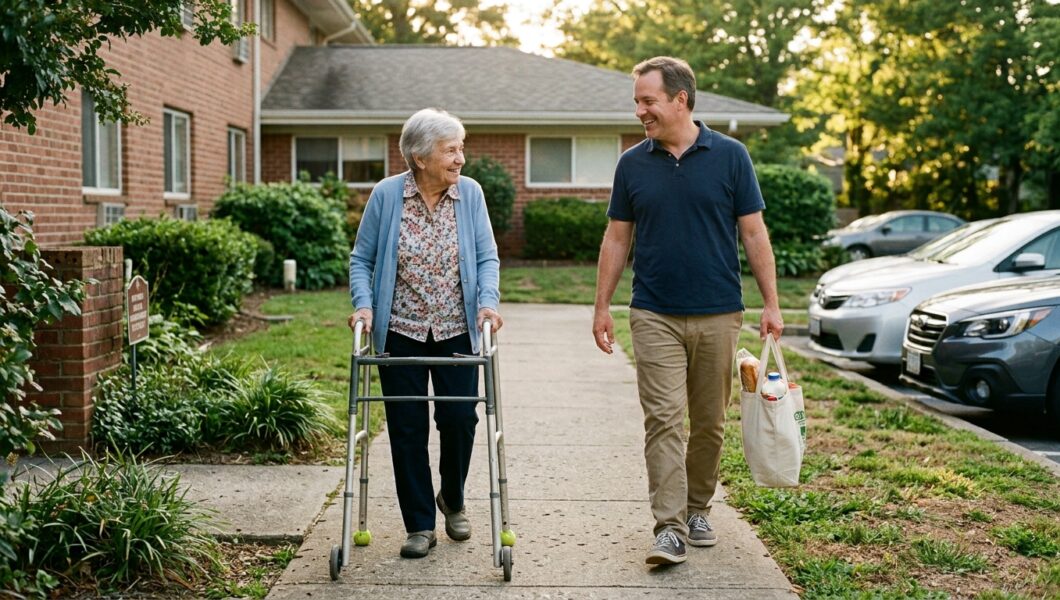
Last Sunday, I pulled into her apartment complex and saw her walking slowly toward me.
Silver hair.
Walker.
That same determined expression.
I got out.
For a moment, I thought about the photograph we took years earlier.
Her walking toward me.
Me walking toward her.
Two people without shared blood.
A lifetime between them.
This time I took no picture.
I just walked over.
She said:
“You’re late.”
“Three minutes.”
“I noticed.”
“Want me to leave?”
“No.”
She turned toward the building.
“I’m hungry.”
I took the grocery bag from her walker.
She let me.
That’s progress.
Halfway inside, she stopped.
“Michael?”
“Yeah?”
“Do you remember that first night?”
“Some of it.”
“You kept asking me what time it was.”
I didn’t remember.
“Why?”
“Because he said ten minutes.”
She looked at me.
“You kept thinking maybe you had counted wrong.”
That nearly broke me.
She touched my arm.
Then she said:
“I couldn’t make him come back.”
“I know.”
“All I could do was stay.”
I looked at her.
“No.”
She raised an eyebrow.
“You did more than stay.”
Maybe.
But I’ve realized something as I’ve gotten older.
Staying was the beginning of everything.
Staying meant breakfast the next morning.
Then school.
Then dinner.
Then another night.
Birthdays.
Christmases.
Arguments.
Graduations.
Weddings.
Grandchildren.
Forty years of ordinary Tuesdays.
People like dramatic stories about love.
Grand sacrifices.
Big speeches.
Moments when everything changes.
But most of the love that raised me wasn’t dramatic.
It was Evelyn packing lunch.
Waiting outside school.
Making me brush my teeth.
Sitting through terrible elementary-school concerts.
Teaching me to drive.
Calling when I was sick.
Leaving the porch light on.
Showing up.
Again.
Again.
Again.
My father promised ten minutes.
Evelyn never promised forever.
She simply stayed long enough that forever took care of itself.
That’s the lesson I carry now.
Sometimes somebody’s life changes because another person makes one enormous decision.
But more often, love is made from thousands of smaller ones.
Stay tonight.
Make breakfast.
Answer the question.
Go to the school play.
Pick up the phone.
Drive across town.
Come back next weekend.
And then do it again.
If you’re lucky, one day you look behind you and realize all those ordinary choices became a family.
Not because anyone owed anyone anything.
Because somebody stayed.

No Comments