

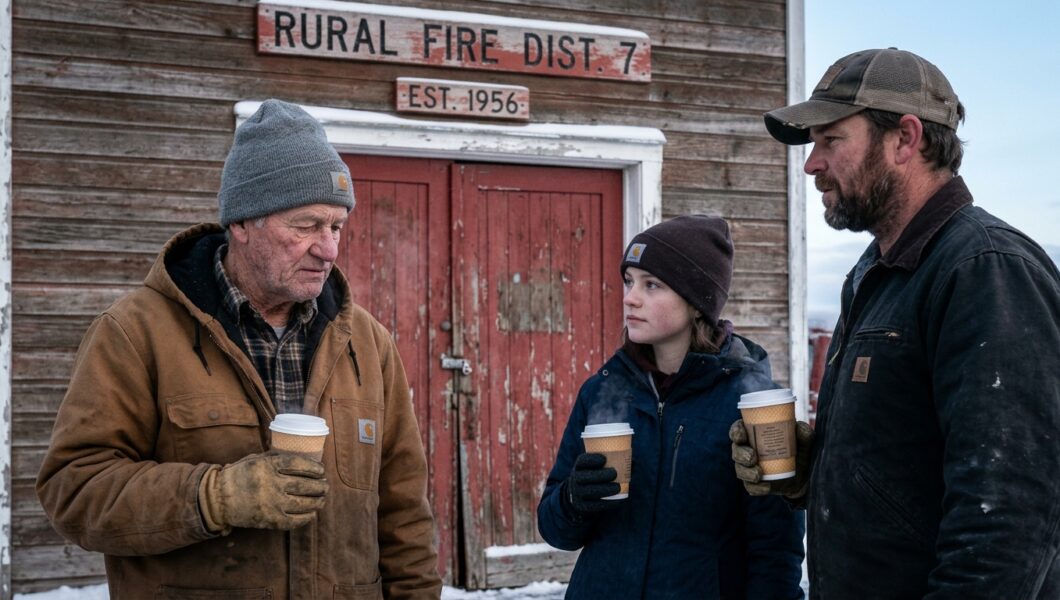
Two winters after Sophie stopped me outside the old fire station, a letter arrived there addressed to a man who didn’t technically work there anymore.
The envelope said:
RAY DONNELLY
OLD FIRE STATION
MONTANA
No street number.
No zip code.
Just that.
Somehow, it reached him.
Ray was seventy-nine by then.
He still came to the station every January 17 at 6:43 in the morning.
The community history room Sophie had helped start was open one Saturday a month, and Ray had become its unofficial caretaker.
He hated that title.
“Caretaker makes me sound useful.”
“You are useful,” Sophie told him.
“Watch your mouth.”
Sophie was sixteen now.
Driving herself.
Working weekends at the grocery store.
Talking about college in a way that made me uncomfortable because I preferred pretending she would remain fourteen forever.
She still visited Ray.
Sometimes without me.
That surprised me at first.
Then I realized their friendship had stopped needing me somewhere along the way.
Ray taught her how to read old fire-call logs.
Sophie helped him scan photographs.
He told her stories.
She made him explain details he’d forgotten everybody else cared about.
The letter arrived on a Tuesday.
Ray called Sophie first.
Not me.
I tried not to be offended.
She called me immediately afterward.
“Dad, we have to go to the station.”
“What happened?”
“Ray got a letter.”
“People still get those.”
“Dad.”
That tone.
Twenty minutes later, we were there.
Ray was sitting at the old wooden table in what had once been the firefighters’ kitchen.
The envelope lay unopened in front of him.
“You haven’t read it?” Sophie asked.
“Nope.”
“Why?”
Ray pushed it toward her.
“Look at the return address.”
Minnesota.
The sender was a woman named Rebecca Keller.
Keller.
Sophie looked at Ray.
“Tom’s family?”
Ray nodded.
“His sister’s daughter.”
He hadn’t heard from that side of Tom’s family in decades.
“Open it,” I said.
Ray glared at me.
“I was waiting for the boss.”
He nodded toward Sophie.
She rolled her eyes.
Ray opened the envelope.
Inside were three pages.
And a photograph.
The photograph showed two young men standing beside an old fire truck.
Ray recognized it immediately.
Himself and Tom.
Both in their early thirties.
Both wearing turnout coats.
Tom had one boot resting on the truck bumper.
Ray was holding a coffee mug.
Neither looked heroic.
They looked tired.
Young.
Ridiculous.
Alive.
On the back, Tom had written:
Donnelly says he’s the handsome one. Donnelly is a liar.
Ray laughed.
Then he covered his mouth.
“That’s him.”
He didn’t mean the face.
He meant the joke.
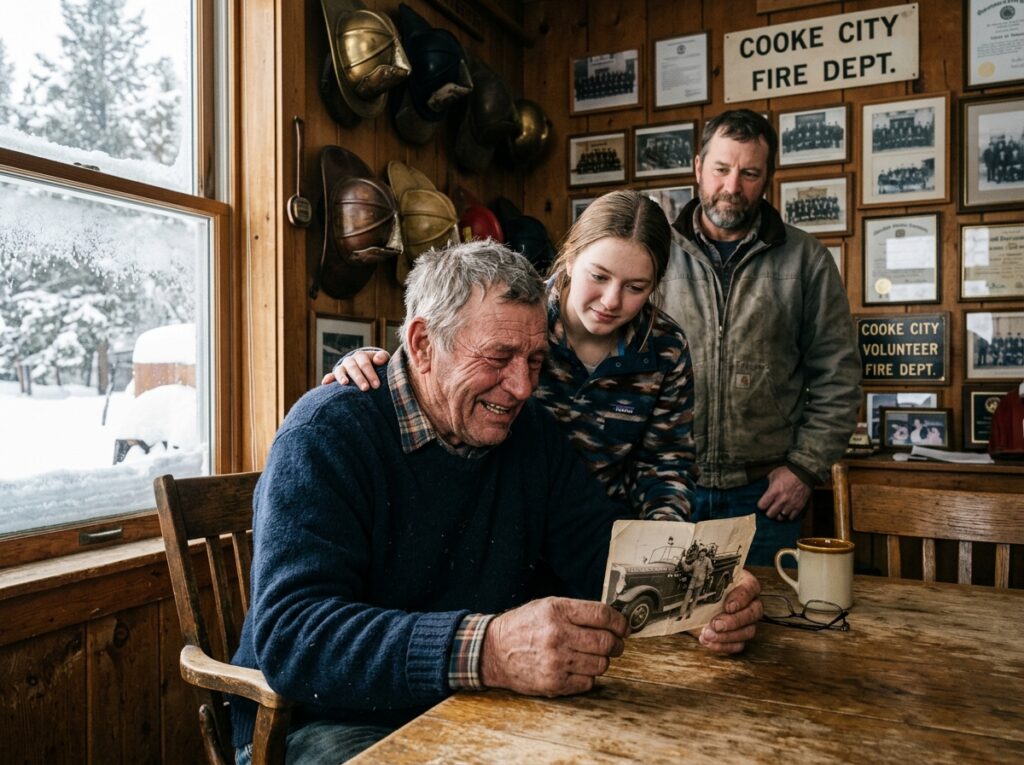
Rebecca’s letter explained that her mother—Tom’s older sister—had recently moved into assisted living.
The family was cleaning out her house.
In a box labeled THOMAS, they found photographs, old department papers and several letters Tom had written during his first years as a volunteer firefighter.
Most were ordinary.
He complained about the cold.
He complained about Ray.
He complained about the fire chief’s coffee.
Apparently bad fire-station coffee was a tradition older than civilization.
But one letter mentioned Ray specifically.
Rebecca had copied the passage.
Tom had written:
Ray acts like he doesn’t need anybody. That’s nonsense. If anything ever happens to me, somebody better make sure that idiot lets people look after him too.
Ray stopped reading.
Sophie looked over his shoulder.
“Oh, wow.”
Ray shook his head.
“That son of a—”
“Ray.”
“Sorry.”
He wasn’t sorry.
I had known him long enough to see what was happening.
For forty-four years, Ray had carried one version of the story.
Tom came back for him.
Tom died.
Ray lived.
Therefore Ray owed something.
Not because Tom had asked for repayment.
Because Ray had decided surviving created a debt.
Every driveway shoveled for June.
Every baseball game with Danny.
Every envelope.
Every repair.
Every January morning in the snow.
All of it had become part gratitude and part obligation.
Then, forty-four years later, Tom’s own words reached him.
Let people look after him too.
Sophie read the sentence again.
Then she said:
“He knew you.”
Ray stared at the paper.
“Unfortunately.”
“No. I mean really knew you.”
Ray didn’t answer.
Sophie sat across from him.
“You spent your whole life looking after everybody connected to him.”
“Wouldn’t say that.”
“I would.”
“That’s because you’re dramatic.”
“And he literally wrote that somebody should look after you.”
Ray folded the letter carefully.
“Dead men are bossy.”
That ended the conversation.
Or so he thought.
Three weeks later, Ray fell on his back steps.
Nothing catastrophic.
A patch of ice.
A bad landing.
A fractured wrist and two cracked ribs.
At seventy-nine, that was enough.
Danny found out.
Then June.
Then Sophie.
Then half the old fire department.
Ray’s driveway got plowed.
His groceries appeared.
Danny took him to appointments.
June sent enough soup to feed a logging crew.
Sophie carried firewood onto his porch.
Ray complained about every single thing.
“This is ridiculous.”
Sophie set another armful of wood beside his stove.
“You have cracked ribs.”
“I still have one good arm.”
“You also have Tom’s letter.”
Ray narrowed his eyes.
“That was private correspondence.”
“You showed it to me.”
“Poor judgment.”
She smiled.
“Let people look after him too.”
“Get out of my house.”
She stayed for dinner.
For perhaps the first time in his adult life, Ray had no convincing argument against being helped.
Tom had ruined that from beyond the reach of forty-four years.
I think Ray secretly loved it.
Not the broken ribs.
Definitely not the wrist.
But the permission.
There is a strange burden that can come with surviving someone.
You start treating your life like borrowed property.
Every year has to be justified.
Every good thing has to be earned.
Every act of kindness becomes another payment against a bill that can never actually reach zero.
Tom’s letter gave Ray something nobody else had managed to give him.
Permission to stop paying.
Not to stop caring.
Not to stop remembering.
Just to stop keeping score.
When January 17 came, Ray was still wearing a wrist brace.
The temperature was nine degrees.
I assumed he’d finally skip the station.
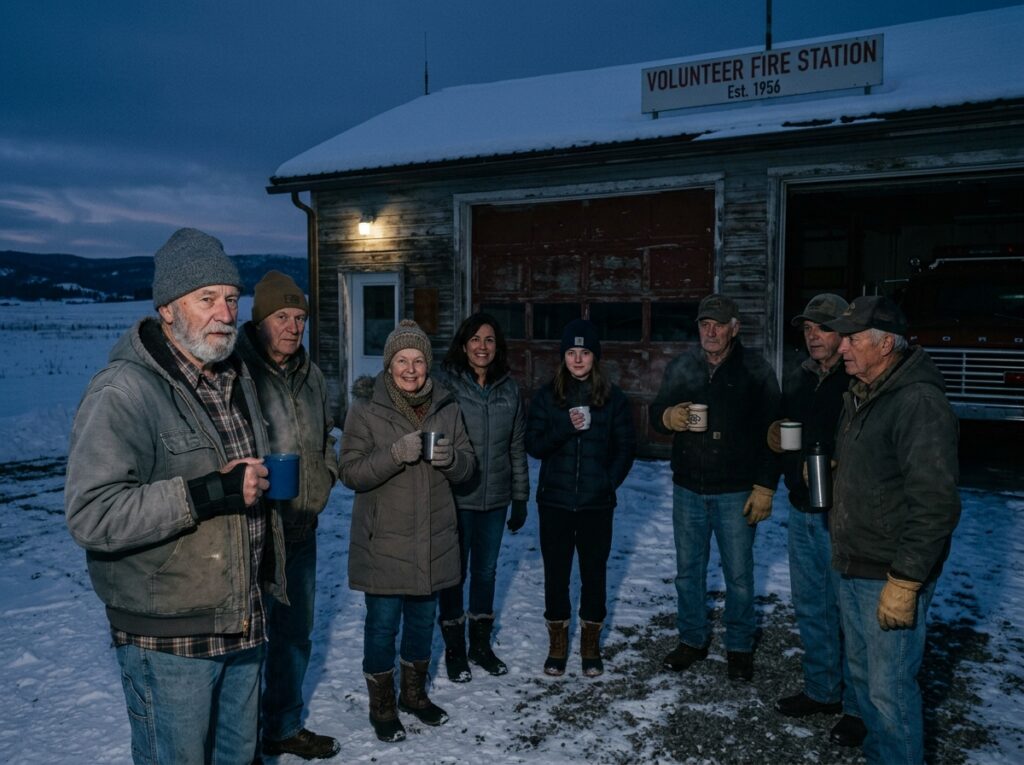
At 6:35, Sophie and I pulled into the lot.
Ray’s silver pickup was already there.
“Of course,” I muttered.
He was standing beside it.
Danny had apparently driven him.
June was there too.
So were three retired firefighters.
Anna came.
That surprised me.
The seven-year-old girl from the 1984 fire was fifty-one now.
She carried a thermos.
At exactly 6:43, nobody said anything.
The old building stood behind us.
Snow covered the field.
The cottonwoods were bare.
No eagle appeared.
Ray looked up anyway.
For years, I think I had assumed the eagle was part of why he returned.
It wasn’t.
The sky could be empty.
Tom was still remembered.
At 6:47, Ray put his cap back on.
Then Anna walked over.
She handed him a coffee.
“Four minutes,” she said.
“For what?”
“You’ve remembered him.”
Ray looked confused.
Anna continued.
“Now we’re going inside before we all freeze to death.”
Ray laughed.
And for the first time anyone could remember, the January 17 gathering moved indoors before seven.
It sounds like nothing.
It wasn’t.
Ray had spent decades standing in the cold because Tom never got to walk back into that station.
Some part of him believed leaving early would be disloyal.
That morning, he went inside.
He drank coffee.
He ate one of June’s cinnamon rolls.
He told the chicken story.
And he laughed.
Really laughed.
That was different.
That spring, Sophie started interviewing Ray for a school oral-history project.
I assumed it would be mostly about Tom.
It wasn’t.
That was Sophie’s idea.
“Everybody asks him about the fire,” she told me.
“So?”
“So Ray had seventy-nine years. The fire was one morning.”
She had a point.
She recorded him talking about growing up on a cattle ranch.
His first truck.
His wife, Ellen.
Their disastrous honeymoon camping trip when a raccoon got into their food.
The daughter he’d taught to drive.
The son he’d argued with for six months about college.
The volunteer department softball team.
The first time he’d held a grandchild.
His retirement.
The garden he couldn’t keep deer out of.
His terrible attempt at making bread during the pandemic.
Normal things.
Ray resisted at first.
“Who cares about this?”
Sophie did.
That was enough.
During one interview, she asked:
“What was the best day of your life?”
Ray thought for almost a minute.
Then said:
“My daughter’s birth.”
Sophie smiled.
“What was the second best?”
“My son’s.”
“Third?”
“My wedding.”
“Tom isn’t in the top three?”
Ray looked startled.
Then amused.
“No.”
“Good.”
He understood what she was doing.
Tom mattered.
The fire mattered.
But Ray’s life wasn’t only the life Tom saved.
It belonged to Ray too.
That became the real heart of Sophie’s project.
She titled it:
THE YEARS AFTER
Not “The Hero Firefighter.”
Not “The Man Who Survived.”
The Years After.
She included Tom.
Of course.
But she also included Ellen.
Danny.
June.
Anna.
Children.
Grandchildren.
Friends.
Forty-four January mornings.
And thousands of completely ordinary days in between.
When she presented it at school, Ray sat in the back row.
He wore a clean button-down shirt under his work coat.
Afterward, a student asked him:
“Do you feel guilty that you survived?”
The room became painfully quiet.
I wanted to rescue him from the question.
Ray didn’t need rescuing.
He thought about it.
Then said:
“I did.”
Past tense.
Sophie looked at him.
So did Danny.
Ray continued.
“For a long time, I thought surviving meant I had to make my life worth what Tom gave up.”
He rubbed his hands together.
“But Tom didn’t go back into that house because he expected me to spend fifty years miserable enough to prove I appreciated it.”
Nobody moved.
Ray swallowed.
“I think he’d want me to use the life.”
A student asked:
“How?”
Ray smiled.
“That’s the hard part.”
Then:
“Live it.”
That was all.
Afterward, Danny found him in the hallway.
He hugged Ray.
Not quickly.
Not the half-hug men sometimes use when emotion becomes uncomfortable.
He held on.
When they separated, Danny said:
“I’ve wanted to hear you say that for thirty years.”
Ray looked down.
“I’ve been slow.”
“You’re old.”
“Watch yourself.”
Some things didn’t change.
That summer, another letter came from Rebecca.
This time, there was no heavy revelation.
Just a package.
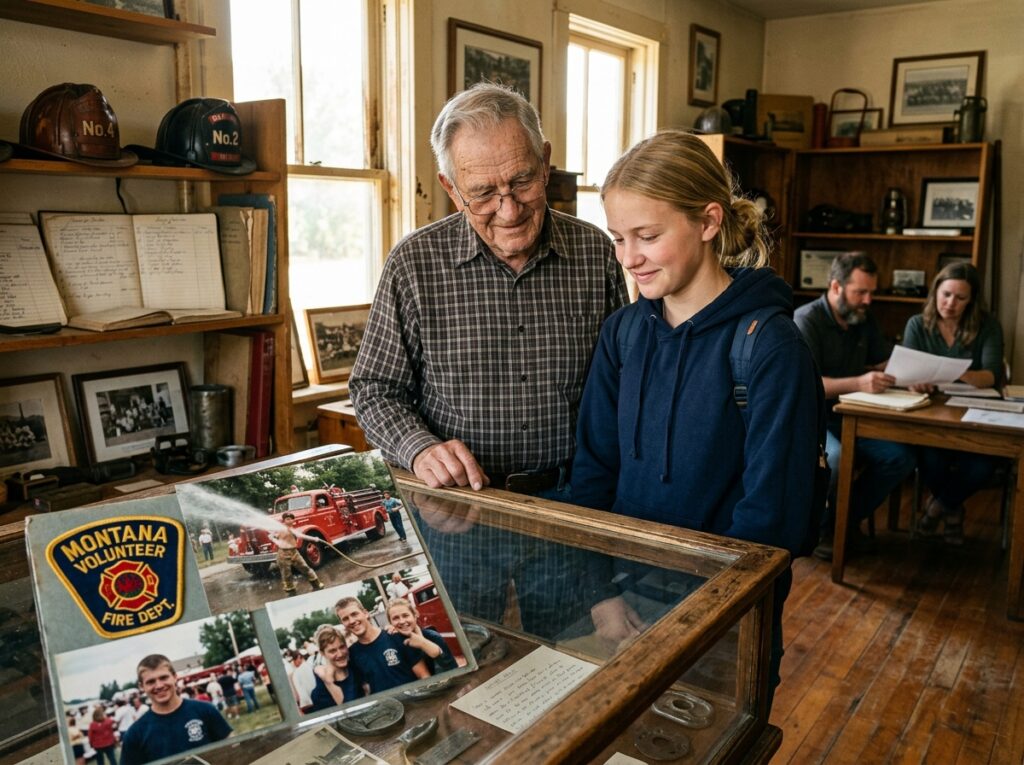
Inside was Tom’s old volunteer fire department patch.
Rebecca said her family had talked and wanted it displayed at the station.
Ray didn’t put it beside the newspaper clipping about the fatal fire.
He put it in a case with photographs of the whole volunteer crew.
Tom laughing.
Tom washing a truck.
Tom holding a plate at a department picnic.
Tom asleep in a chair.
Tom alive.
That mattered.
Ray had spent years telling people how Tom died.
Now he wanted them to know how Tom lived.
Then came the January when Ray didn’t make it to the station.
He was eighty-one.
Nothing dramatic had happened.
No emergency.
No terrible phone call.
He’d simply caught a respiratory infection, and his doctor had made it very clear that standing outside in Montana before sunrise was not an intelligent plan.
Ray argued.
The doctor won.
At 6:30 that morning, Sophie picked me up.
She was eighteen now.
Leaving for college the following fall.
Danny met us at the station.
June was no longer able to manage the cold either, so she stayed home.
Anna came.
Two retired firefighters.
A current firefighter named Luis whom Ray had been mentoring.
We stood outside.
At 6:43, Danny looked at his watch.
Nobody spoke.
The sky slowly brightened.
No eagle.
At 6:50, Sophie’s phone rang.
Ray.
She put him on speaker.
“Anything?” he asked.
“Snow.”
“That’s exciting.”
“Danny brought terrible coffee.”
“I trained him poorly.”
Danny leaned toward the phone.
“You’re welcome.”
Then, at 6:54, Anna pointed.
Far beyond the field, an adult bald eagle was moving toward the river.
High.
Distant.
Exactly where a wild eagle might reasonably be on a Montana winter morning.
Sophie smiled.
“There is one.”
Ray was quiet on the phone.
“Yeah?”
“Yeah.”
“Good.”
Nobody called it Tom.
Nobody called it a sign.
Nobody needed to.
We described it.
It banked once.
Crossed beyond the cottonwoods.
Disappeared.
Then Ray said:
“All right. Get inside.”
Sophie laughed.
“Who are you and what have you done with Ray Donnelly?”
“It’s cold.”
“You stood out here for forty-five years.”
“And I’ve finally collected enough evidence.”
We went inside.
Someone had brought cinnamon rolls.
Luis started coffee.
Danny put Ray’s phone on the table so he could hear everyone.
Then Sophie took out an old call log.
She read the January 17, 1984 entry aloud.
Not the dramatic parts.
Just the names.
Every firefighter who responded.
The dispatcher.
The ambulance crew.
People history usually reduces to a sentence.
That morning, we gave them their names back.
When Sophie reached Thomas Keller, Ray interrupted through the phone.
“Wait.”
She stopped.
There was silence.
Then Ray said:
“Tell them about the chicken.”
Everyone laughed.
So Sophie did.
That became the tradition.
Not only how Tom died.
How he lived.
The chicken.
The bad coffee.
His habit of singing one line of a song repeatedly until people threatened violence.
How he carried peppermints.
How he cheated at cards.
How he loved his son.
How he went back for Ray.
All of it.
Because a person should not become only the worst thing that happened to them.
Ray understood that eventually.
Maybe that’s what all those years had been leading toward.
The following summer, Sophie left for college.
The night before we drove her to campus, she stopped at Ray’s house.
She stayed almost two hours.
When she came home, her eyes were red.
“What happened?”
“Nothing.”
That usually means something.
She finally told me Ray had given her the original photograph from Rebecca’s first letter.
The one of him and Tom beside the fire truck.
On the back, beneath Tom’s old joke, Ray had added:
Sophie — Don’t remember us as heroes. Remember us as people who showed up. Then you show up too. — Ray
She took that photograph to college.
It sat on her desk.
Not because she wanted to become a firefighter.
She didn’t.
She was studying education.
But Ray’s lesson wasn’t really about fire.
It was about presence.
The willingness to interrupt your own schedule because somebody else is standing alone.
Which, I should point out, was exactly how Sophie met him.
She noticed.
I wanted to keep driving.
She made me stop.
Years later, I asked her why.
She shrugged.
“He was crying.”
As if that explained everything.
Maybe it did.
Ray died at eighty-three.
Peacefully.
Danny was with him.
So were his children.
Sophie came home for the funeral.
June was too frail to attend, but she sent a handwritten note that Danny read privately.
The old fire station opened afterward.
People gathered there instead of a formal reception hall.
Coffee.
Sandwiches.
Photographs.
Stories.
No one called Ray a hero because he had specifically asked us not to.
We called him what he had asked to be called.
A person who showed up.
Danny spoke briefly.
He stood beside his father’s photograph.
Tom’s photograph.
Then Ray’s.
Two men connected by one terrible morning and all the ordinary years that followed.
Danny said:
“Ray spent most of his life making sure I knew my father.”
His voice broke.
“He never tried to replace him.”
He paused.
“But I hope Ray knew that somewhere along the way, he became family anyway.”
That finished me.
Sophie was beside me.
She took my hand.
After the crowd left, the two of us stayed behind to help clean.
It was nearly dark when we carried the last garbage bag outside.
Snow had started falling.
Sophie stopped in the lot.
“Dad.”
For one second, I thought I knew what she was going to say.
Eagle.
I looked toward the field.
Nothing.
Empty sky.
She laughed.
“What are you looking for?”
“Nothing.”
“You were looking for an eagle.”
“Maybe.”
She shook her head.
Then pointed toward the station window.
Inside, Luis—the younger firefighter Ray had mentored—was helping Danny put chairs away.
That was what Sophie had noticed.
People still showing up.
No eagle required.
The following January 17, we returned at 6:43.
There were more people than I’d ever seen.
Not hundreds.
Ray would’ve hated that.
Maybe twenty.
Danny.
Anna.
Luis.
Retired firefighters.
Current volunteers.
Sophie.
Me.
A few teenagers from the school history club.
Coffee steamed in paper cups.
At exactly 6:43, Danny removed his cap.
We were silent for a minute.
Then he said:
“Morning, Dad.”
A pause.
“Morning, Ray.”
The sky stayed empty.
It didn’t matter.
We went inside.
Someone told the chicken story.
Someone else told a story I’d never heard about Ray accidentally backing a fire truck into a mailbox in 1979.
Sophie nearly fell out of her chair laughing.
And that is how I think Ray would’ve wanted it.
For forty-two years, he stood outside that station believing remembering Tom was his responsibility.
Eventually, he learned memory can be shared.
Grief can be shared.
Stories can be shared.
Even gratitude can be shared.
Ray couldn’t repay Tom for going back into that burning house.
There was never a scale where the numbers could balance.
But maybe that was the mistake in the question.
Love isn’t accounting.
A saved life isn’t a loan.
Ray did not owe Tom forty-nine more years of guilt.
What he had was forty-nine years of opportunity.
He shoveled a widow’s driveway.
Taught a boy about his father.
Showed up at baseball games.
Paid for furnace repairs.
Held grandchildren.
Told stories.
Accepted soup when it was finally his turn to need somebody.
And on one freezing morning, he stood beside a fourteen-year-old girl who had been late for school and accidentally taught her something she carried into adulthood.
Use your life well.
Not perfectly.
Not heroically.
Well.
Notice the person standing alone.
Ask the question.
Bring the coffee.
Tell the story.
And when somebody comes back for you, don’t spend the rest of your life trying to repay an impossible debt.
Live.
That’s enough.

No Comments