

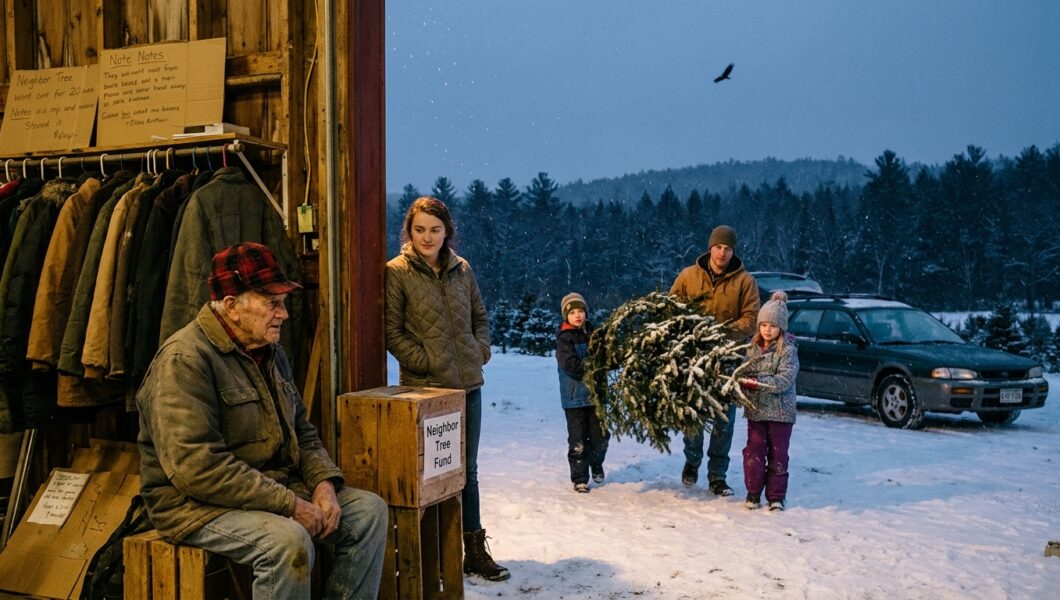
Five winters after we first met Arthur, a woman walked into our barn holding an old photograph in a sandwich bag.
It was the first Saturday in December.
Snow had started just after lunch and was sticking to the shoulders of people’s coats as they came in from the tree rows.
Emily was eighteen by then.
Home from college for the weekend.
Still running the register like she owned the place.
Arthur was sitting near the wood stove in his usual chair, drinking coffee and pretending he wasn’t watching everyone.
He was eighty-three.
Slower.
Thinner.
Still stubborn.
Still wearing the same red-and-black wool cap.
The woman looked around the barn and asked:
“Is Arthur here?”
Emily pointed toward the stove.
Arthur heard his name and immediately looked suspicious.
“Depends who’s asking.”
The woman laughed.
Then she started crying.
That got everybody’s attention.
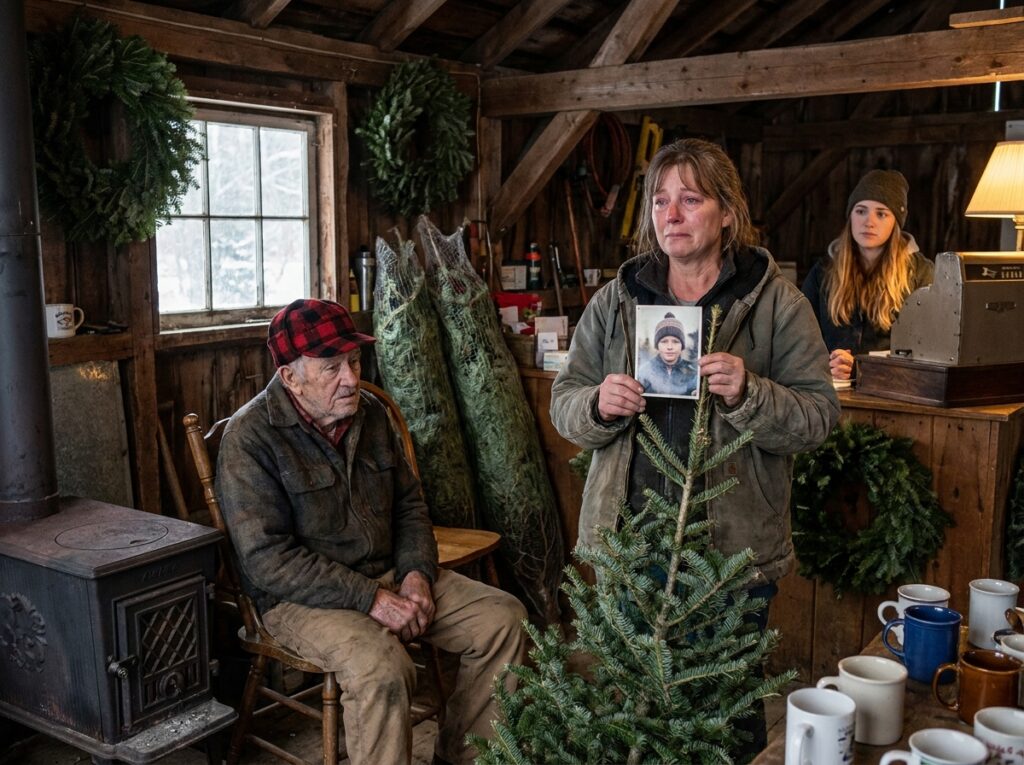
She walked over and held out the photograph.
Arthur didn’t take it at first.
He just stared.
“What is that?”
The woman carefully removed it from the plastic bag.
The picture was faded.
Maybe twenty years old.
A little boy stood beside a crooked Christmas tree in a small living room.
He was missing his two front teeth.
There were maybe three presents underneath.
Nothing elaborate.
On the back, written in blue ink, were four words:
THANK YOU, WHOEVER YOU ARE.
Arthur’s hand started shaking.
The woman said:
“That little boy is my son.”
Nobody spoke.
Arthur looked at her.
She continued.
“My name is Melissa.”
Her voice broke.
“Someone bought that tree for us in 2004.”
Arthur closed his eyes.
He remembered.
It had been one of the years Margaret’s death still felt recent to him.
Not recent on a calendar.
Recent in the body.
The kind of grief where you could get through an entire morning fine and then see her coffee mug in the wrong cabinet and lose the rest of the day.
Arthur had heard about Melissa through a local church pantry.
She was twenty-six then.
Newly divorced.
Working nights at a nursing home.
Her son was six.
Her car needed repairs.
The heat in their rental barely worked.
That Christmas, Arthur had bought a tree.
Then groceries.
Then, because he had discovered their furnace was struggling, he quietly paid part of their heating bill through the fuel company.
He never met Melissa.
Never delivered anything himself.
He didn’t want thanks.
He wanted distance.
The same kind Tom Bennett had given him years earlier.
Help without making somebody stand there and explain why they deserved it.
Melissa had spent two decades wondering who had done it.
“I thought it was the church,” she said.
Arthur shifted in his chair.
“Could’ve been anybody.”
Melissa laughed through tears.
“Apparently not.”
She had only found out because Carol Bennett had mentioned the Neighbor Tree Fund during a community dinner.
Melissa recognized the story.
A man who helped anonymously every Christmas.
Trees.
Food.
Heating oil.
“Keep it moving.”
She went home and pulled the old photograph from a box.
Then she called around until someone finally gave her Arthur’s first name.
Arthur looked annoyed.
“People talk too much.”
Emily leaned against the counter.
“You are literally the reason the fund exists.”
“I was trying to avoid that.”
Melissa sat in the chair beside him.
“I don’t want to embarrass you.”
“Too late.”
That made her smile.
Then she said:
“You need to know what happened after.”
Arthur stopped joking.
Melissa told him that the year after he helped her, life had improved a little.
Not magically.
Slowly.
She changed jobs.
Saved some money.
Moved into a better apartment.
Her son grew.
Graduated.
Joined the Coast Guard.
He was married now.
Had a little girl.
Arthur smiled.
“Good.”
Melissa nodded.
“But every December, I remembered that tree.”
She started quietly doing something for another family each year.
Sometimes she paid an electric bill.
Sometimes she bought children’s coats.
One year she left grocery gift cards at a school office.
She never knew Arthur’s name.
She just remembered what it felt like to open her door and see a tree she couldn’t afford.
“I didn’t know your phrase,” she said.
“But I guess I was doing it anyway.”
Arthur looked toward Emily.
She was already crying.
He said:
“Don’t start.”
“I haven’t said anything.”
“Your face is loud.”
Melissa laughed.
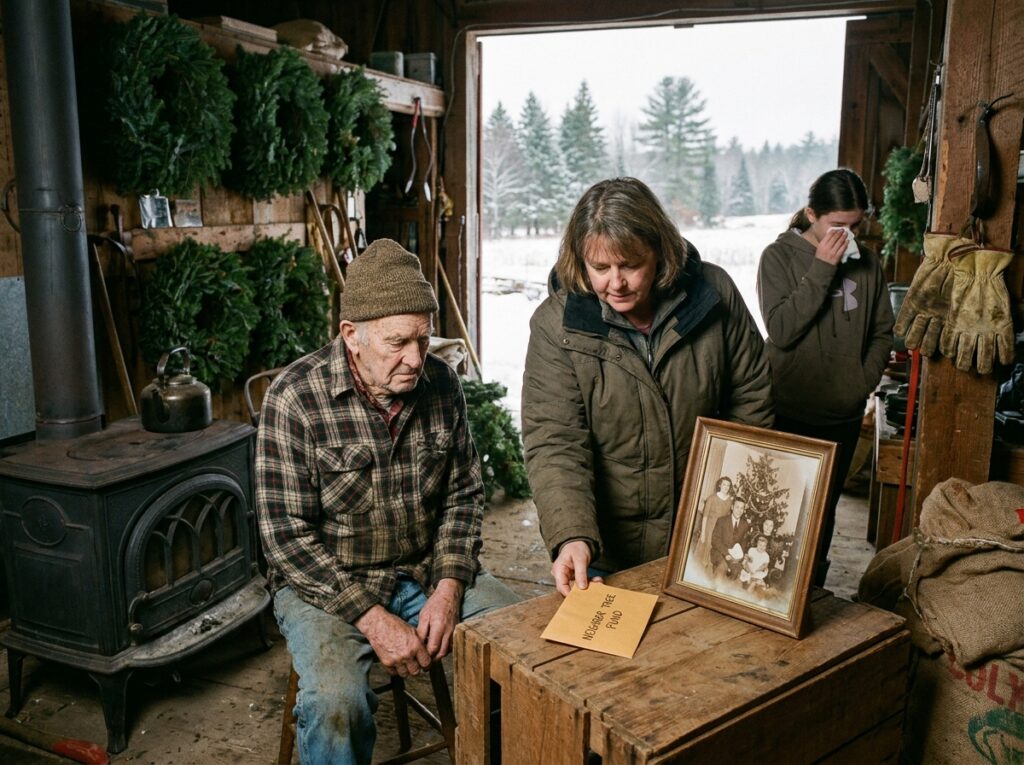
Then she reached into her coat.
She pulled out an envelope.
Arthur immediately shook his head.
“No.”
“You don’t even know what’s in it.”
“If it’s money, no.”
“It is.”
“No.”
Melissa put it on the table anyway.
“This isn’t for you.”
Arthur stared at it.
“It’s for the fund.”
Inside was five hundred dollars.
Exactly what the electrician donated every year.
Arthur looked at Melissa.
She said:
“My son sent half.”
That broke him.
He leaned back in the chair and covered his face with one hand.
For a long moment, nobody said anything.
Then Arthur whispered:
“Tom would’ve liked that.”
I think he was talking to himself more than us.
That was the first time I understood that the Neighbor Tree Fund had been moving farther than we could see.
We had counted trees.
Thirty-one the first year.
Forty-three the next.
Then fifty-something.
But we had no idea how many people had taken that experience and carried it somewhere else.
You can’t count that.
That’s the strange thing about kindness.
The visible part is usually the smallest part.
That winter changed the fund.
Not because Melissa donated five hundred dollars.
Because she gave us an idea.
We stopped tracking only how much money came in.
Instead, we started putting out blank cards beside the donation box.
No names required.
The top simply said:
SOMEONE HELPED ME ONCE.
If people wanted, they could finish the sentence.
At first, I thought nobody would.
I was wrong.
By Christmas Eve, the wooden box held more notes than cash receipts.
Someone helped me once when my husband was deployed.
Someone helped me once after my house burned.
Someone helped me once when I was eighteen and pregnant.
Someone paid my rent during chemo.
Someone fixed my truck and wouldn’t take money.
Someone bought my kids winter coats.
Someone gave me a job when I had no references.
Someone left groceries on my porch.
One note said:
I don’t know who helped us. I hope they know we made it.
Arthur read every single one.
Slowly.
Usually alone.
Sometimes I caught him wiping his eyes.
He claimed the barn was smoky.
It was not.
One afternoon Emily found a card tucked beneath the stack.
The handwriting looked childish.
SOMEONE HELPED ME ONCE.
Then underneath:
MY MOM NEEDED A TREE. NOW SHE IS OKAY.
Emily carried it to Arthur.
He stared at it.
“You think that’s one of ours?”
“Maybe.”
Arthur shook his head.
“Doesn’t matter.”
He put the note back.
That became his answer whenever we tried to trace anything.
Doesn’t matter.
Not because people didn’t matter.
Because ownership didn’t.
He didn’t need proof that an act started with him.
The point was that somebody was moving it.
That winter, we also learned the fund needed boundaries.
Kindness can go wrong when people want so badly to help that they stop thinking about dignity.
A local business offered to sponsor ten families if they could take photographs for social media.
Arthur said no before I finished explaining.
“They’re not decorations.”
The owner was offended.
I understood why.
Publicity can bring more donations.
Sometimes photos inspire people.
But Arthur would not budge.
“If helping them requires them standing beside a tree smiling for strangers, then find another ten.”
We did.
No photos.
No names.
No stories shared without permission.
We worked through schools, churches, the food pantry, and community organizations that already knew families.
The fund didn’t ask why somebody needed help.
We weren’t qualified to judge that anyway.
We bought trees.
Gift cards.
Heating fuel.
Occasionally groceries.
Small things.
Quiet things.
That was enough.
Then Arthur got sick.
Not dramatically at first.
He started missing Saturdays.
Said the cold bothered him.
Then he stopped coming by during the week.
One afternoon I drove to his house.
He answered the door in slippers.
That scared me more than anything.
Arthur always wore boots.
“What’s going on?”
“Nothing.”
“You look terrible.”
“You’ve always been rude.”
He had pneumonia.
He’d been trying to recover at home.
Luke, his son, had been checking on him.
But Arthur hadn’t told us.
Of course he hadn’t.
“I don’t like fuss.”
“You built an entire Christmas tradition around people fussing over strangers.”
“Different.”
“How?”
“It just is.”
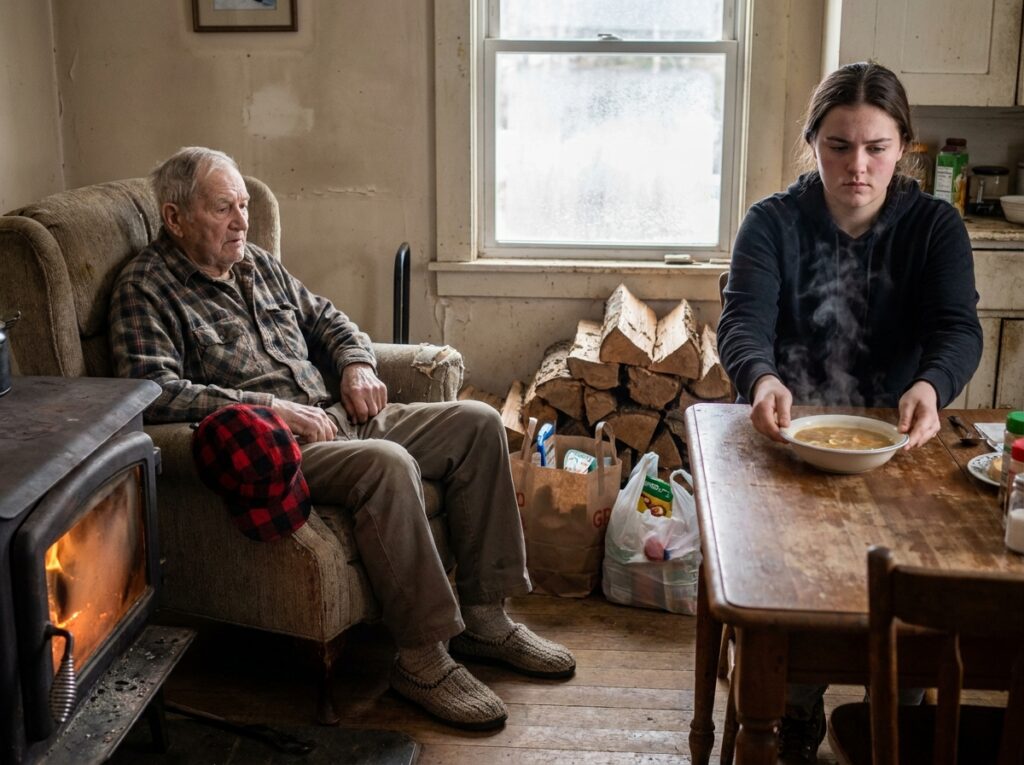
Emily came home from college the next weekend.
The moment she heard, she went to his house carrying soup.
Arthur complained.
She ignored him.
For the first time since I’d known him, the direction of help reversed.
People brought meals.
Luke handled appointments.
Carol called every morning.
Melissa sent a grocery delivery from two towns away.
The electrician plowed Arthur’s driveway.
Somebody stacked firewood.
He hated all of it.
“I can take care of myself.”
Emily sat across from him.
“Tom let you say that?”
Arthur gave her a look.
She continued.
“Would you have let Melissa say that?”
Silence.
“Would you have let Carol sit alone without a tree?”
More silence.
Emily leaned back.
“Then stop being a hypocrite.”
I nearly choked on my coffee.
Arthur stared at her.
Then, very slowly, smiled.
“Your father failed raising you.”
“Probably.”
That was the day Arthur finally let people help.
Not gracefully.
But he let them.
Arthur recovered.
Mostly.
But that winter changed him.
He still donated anonymously.
Still complained whenever anyone mentioned his name.
Still refused to be photographed beside the fund box.
But he stopped pretending receiving kindness was weaker than giving it.
One afternoon he said to me:
“Tom told me to keep it moving. I thought that meant forward.”
“What do you mean?”
He looked toward the barn door.
“Turns out it moves back sometimes.”
I wrote that down.
Because he was right.
For years, Arthur had thought kindness was something you received once and then owed to the future.
Tom helped Arthur.
Arthur helped Melissa.
Melissa helped somebody else.
Straight line.
But people are not lines.
They’re circles.
Webs.
Families.
Towns.
Sometimes the person you helped twenty years ago shows up when you’re old and sick.
Sometimes the teenager you met because she noticed you crying brings soup to your house.
Sometimes receiving is part of keeping it moving too.
By the time Emily was twenty-one, she was helping run the farm full time during December.
I pretended this was because she loved Christmas trees.
Really, she loved the people.
The Neighbor Tree Fund was hers more than mine by then.
She redesigned the wooden box.
Arthur hated the new one because it was “too nice.”
She added a second card beside it:
GIVE IF YOU CAN.
TAKE IF YOU NEED.
NO EXPLANATION.
Arthur approved of that.
High praise.
One December evening, just before closing, a young father came into the barn with two children.
He wandered around for fifteen minutes.
Checked price tags.
Put one tree back.
Looked at another.
I recognized the pattern.
I had seen it too many times.
He wasn’t deciding which tree he liked.
He was deciding whether he could afford one.
Emily noticed too.
She walked over.
“Looking for something around five feet?”
The man nodded.
“Maybe.”
She showed him three.
He asked the prices.
Then shook his head.
“We’re just looking.”
His little girl touched one of the branches.
“This one smells good.”
The father’s face changed.
I knew that look too.
Emily didn’t embarrass him.
She didn’t say:
You look like you need help.
She didn’t mention money.
She simply said:
“That one’s already covered.”
He looked confused.
“What?”
“Neighbor Tree Fund.”
“I didn’t apply for anything.”
“You don’t apply.”
“I can’t take somebody else’s tree.”
Emily smiled.
“It isn’t somebody else’s.”
He looked at her.
She said:
“It’s yours if you want it.”
The man stared at the floor.
His son tugged his sleeve.
“Dad?”
Finally he asked:
“Who paid for it?”
Emily pointed toward the wooden box.
“People.”
He looked over.
At the cards.
At the bills.
At decades of invisible hands he could not see.
Then he said quietly:
“I’ll pay it back.”
Arthur happened to be sitting by the stove.
He had heard everything.
He called across the barn:
“No, you won’t.”
The father turned.
Arthur lifted his coffee.
“Keep it moving.”
The man stood completely still.
Then nodded.
His children never knew why he cried while we tied the tree to their car.
That’s okay.
They didn’t need to.
Maybe someday he’ll tell them.
Maybe he won’t.
The kindness still counts.
Arthur died the following spring.
Eighty-six.
At home.
Luke called me before breakfast.
I sat on the edge of my bed for a long time.
Then I called Emily.
Neither of us said much.
There are people who enter your life so quietly you don’t realize how much space they occupy until they’re gone.
Arthur was like that.
His funeral was small.
Exactly how he would have wanted it.
Luke.
Grandchildren.
Carol.
Melissa.
People from the farm.
A few mechanics who had known him for decades.
No speeches about the fund.
No big public tribute.
Luke did say one thing.
“My dad spent a lot of his life believing he owed somebody for saving one Christmas.”
He paused.
“Eventually he figured out it wasn’t a debt.”
Then he smiled.
“It was directions.”
That was Arthur.
Afterward, Luke gave Emily the red-and-black wool cap.
She cried so hard she couldn’t put it on.
She still keeps it in the barn office.
We didn’t rename the fund after Arthur.
He would have come back and haunted us.
It remained the Neighbor Tree Fund.
No plaque.
No portrait.
No giant sign.
But we added one small thing.
Beside the donation box is a handwritten card.
Arthur’s words.
DON’T PAY IT BACK.
KEEP IT MOVING.
That’s all.
Last December was our biggest year.
Seventy-eight trees.
Hundreds of grocery cards.
Fuel assistance through local partners.
Winter coats.
And more anonymous notes than we could count.
Near closing on Christmas Eve, Emily and I stepped outside.
Snow was falling.
The lot was almost empty.
Rows of trees stood dark against the ridge.
Someone had turned off the music.
For once, the farm was completely quiet.
Then Emily looked up.
“Dad.”
I followed her eyes.
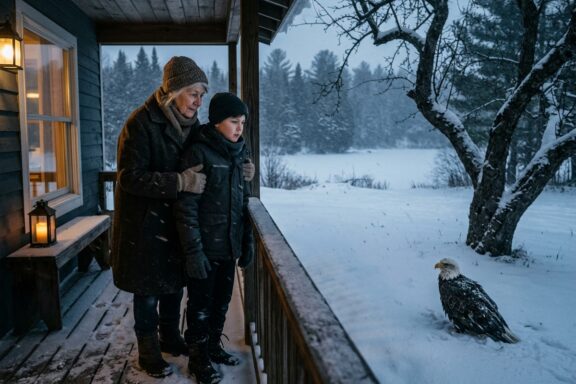
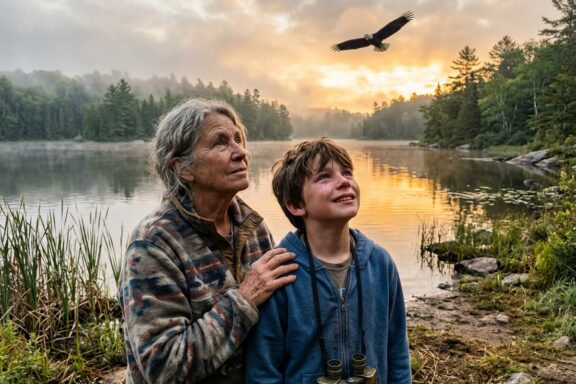
A bald eagle was crossing high above the far pines.
Same ridge.
Same winter light.
For a second, neither of us spoke.
Then Emily smiled.
“Arthur would’ve said it’s just doing eagle stuff.”
I laughed.
“He absolutely would.”
We watched until it disappeared.
No sign.
No message.
No miracle.
Just a wild bird heading toward the river.
But it brought me back to that first evening.
Arthur beside his old green truck.
My thirteen-year-old daughter noticing tears I might have missed.
A crooked little tree from twenty-seven years earlier.
Tom Bennett carrying groceries into a dark repair shop.
One sentence:
Keep it moving.
I used to think kindness was measured by what you gave.
Money.
Food.
A tree.
Time.
Now I think the larger measure is what happens after you leave.
Does the person feel smaller because they needed help?
Or more human?
Do they remember shame?
Or relief?
Do they carry debt?
Or direction?
Tom Bennett gave Arthur something without making him feel like a failure.
Arthur spent the rest of his life trying to do the same.
That is why it traveled.
Not because the tree was special.
Because the dignity was.
There are people right now sitting in dark rooms saying they’re fine.
Parents putting things back at the store.
Widows facing first holidays.
Families choosing which bill waits.
Proud people who will never ask.
You may never know what your small act becomes twenty years later.
Most likely, you won’t.
Do it anyway.
Bring the crooked tree.
Leave the groceries.
Pay quietly.
Let somebody receive without performing gratitude.
And if, years later, they ask how to repay you, give them the same directions Arthur lived by.
Not back.
Forward.
Sideways.
Around.
Wherever it’s needed next.
Just keep it moving.


No Comments