
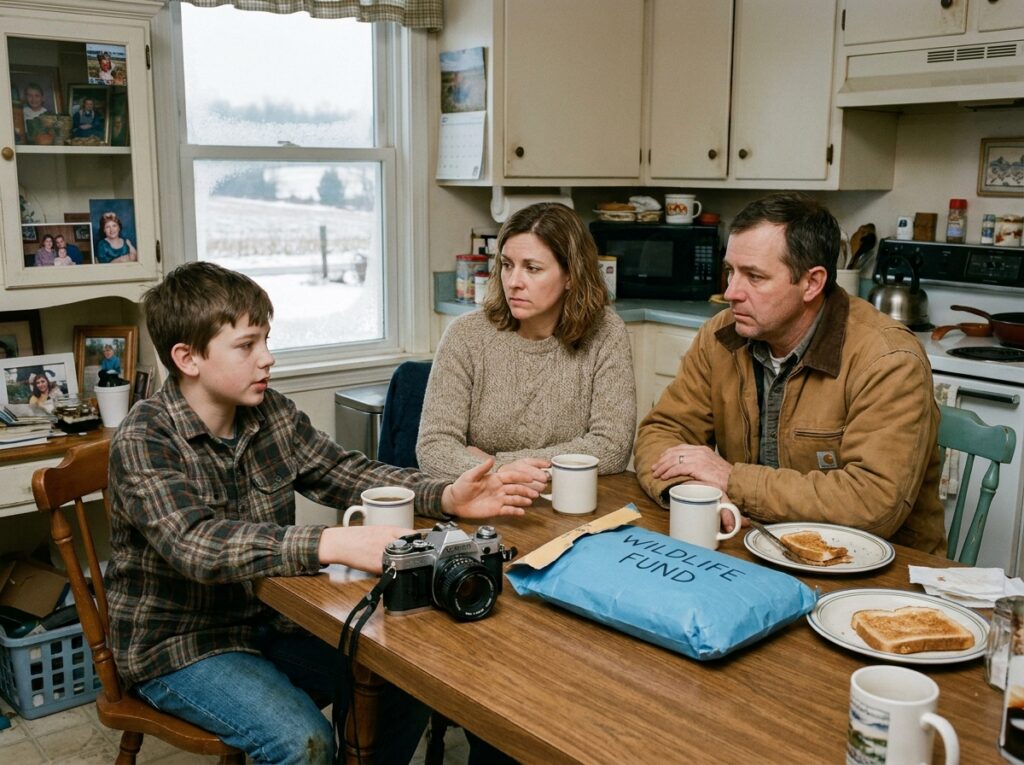
Almost one year after my son gave up part of his birthday camera money to help an injured bald eagle, I found him standing at the kitchen table with a blue envelope in his hands.
The same kind of envelope.
The sight of it stopped me.
For a second, I was back in the previous winter.
The frozen pond.
The eagle hunched beside the ice.
Noah standing in his boots, asking me whether the bird was going to die.
The hundred dollars he pushed across our kitchen table.
“I can save again,” he had said.
Now he was thirteen.
Taller.
Thinner.
Hair constantly falling into his eyes.
And he had become the kind of kid who carried a camera almost everywhere.
The old camera that local photographer Henry Bishop had given him was sitting beside the envelope.
“What’s that?” I asked.
Noah looked up.
“Money.”
“I gathered that.”
He rolled his eyes.
“I’ve been saving.”
“For what?”
He hesitated.
That made me suspicious.
Noah wasn’t usually mysterious about money.
If he wanted something, I heard about it approximately four hundred times.
A new lens.
A memory card.
A tripod.
A better camera bag.
This time he pushed the envelope toward me.
Inside was $173.
“What’s this for?”
“The rehab center.”
I looked at him.
“Again?”
He nodded.
“Not all of it.”
He pointed to another smaller pile on the table.
“I’m still saving for a lens.”
Then he shrugged.
“I just thought maybe we could do the cookie thing again.”
Rachel walked into the kitchen behind me.
“The cookie thing?”
Noah immediately started explaining.
He wanted to organize another small fundraiser for the wildlife rehabilitation center before his birthday.
Not because of the eagle from the year before.
That bird had already returned to the wild.
This was for the animals that would need help next.
That distinction mattered to him.
“Last year everybody cared because there was an eagle,” he said. “But they have animals there all the time.”
Rachel looked at me.
I knew that look.
Our kitchen was about to become a bakery again.
The second fundraiser was different.
The first time, Noah had been nervous.
He stood behind the cookie table answering questions quietly while adults did most of the talking.
This time, he organized it himself.
Not completely.
He was thirteen.
His mother still had to explain why you cannot make four hundred cookies without buying flour first.
But Noah called the community center.
He contacted the rehabilitation organization through their official channels.
He asked what supplies or funding areas they currently needed support for.
He made sure we weren’t using photographs or stories about recovering wildlife in ways that might encourage people to approach injured animals themselves.
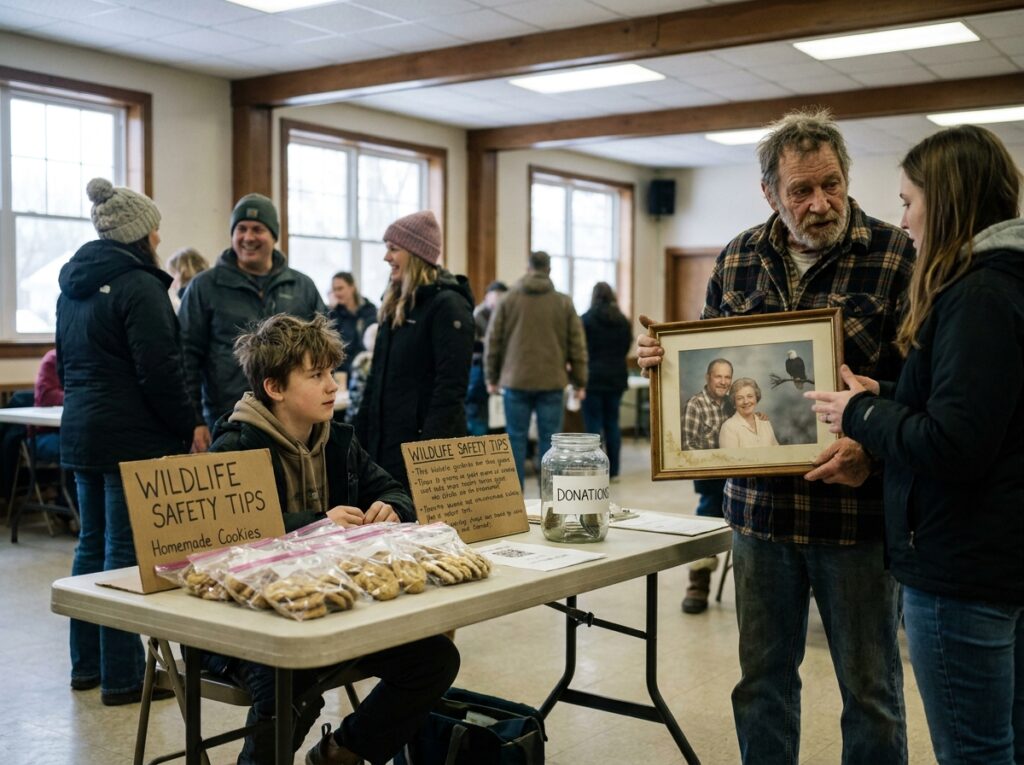
He even made a sign that said:
SEE HURT WILDLIFE?
KEEP YOUR DISTANCE.
CALL TRAINED PROFESSIONALS.
Then, in smaller letters:
YOU CAN STILL HELP.
Henry came.
The retired teacher came.
The older widower who had given Noah his late wife’s bird books came too.
His name was Arthur.
By then, Arthur and Noah had developed one of the strangest friendships I’d ever seen.
Arthur was eighty-two.
Noah was thirteen.
They argued constantly about binoculars.
Arthur believed anything manufactured after 1995 was unnecessarily complicated.
Noah believed anything that couldn’t connect to a phone was prehistoric.
But every other Saturday, Arthur came over.
He brought bird books.
Noah brought his camera.
They sat at the kitchen table identifying whatever Noah had photographed that week.
Sometimes they agreed.
Sometimes Arthur announced that Noah had photographed “a brown bird.”
Noah would sigh.
“That narrows it down.”
Arthur would smile.
“Glad I could help.”
The morning of the fundraiser, Arthur arrived carrying a framed photograph.
It showed a younger Arthur standing beside his wife, Margaret, somewhere along the Maine coast.
Behind them, barely visible above the trees, was a bald eagle.
“This was our first one,” he told Noah.
Noah held the frame carefully.
“Your first eagle?”
Arthur nodded.
“Margaret spotted it.”
He smiled.
“She spotted everything before I did.”
Then his expression changed.
“She would’ve liked what you’re doing.”
Noah didn’t know what to say.
So he did something better.
He pulled up a chair.
“Tell me about her.”
Arthur sat down.
And for the next twenty minutes, while Rachel packed cookies and I tried unsuccessfully to make a donation sign stand upright, Arthur told Noah about his wife.
Not about her death.
About her life.
How she hated camping but loved birds.
How she always carried peppermints.
How she once made him drive forty miles in the wrong direction because she wanted to see a lighthouse.
Noah listened.
That has become one of the things I admire most about him.
He notices birds.
But somewhere along the way, he started noticing people too.
The fundraiser raised $847.
More than the first year.
Noah wanted to know exactly where the money would go.
The rehabilitation center explained that unrestricted donations helped cover things like veterinary care, food, specialized supplies, transport needs, and facility operations.
He nodded as if somebody had just handed him corporate financial statements.
“Good.”
That night, he put $73 back into his lens envelope.
The rest of his savings joined the fundraiser total.
“You sure?” I asked.
“Yeah.”
“You don’t have to keep giving away your money every birthday.”
He looked at me.
“I know.”
Then he smiled.
“I still want the lens.”
That made me laugh.
Good.
He was kind.
He was not trying to become a saint.
By spring, Noah had started doing something else.
He went back to the pond.
Not because he expected to see the eagle.
He understood that part now.
Wild animals don’t owe us reunions.
They don’t return because humans did something kind.
The point of rehabilitation is independence.
Still, the pond had become his favorite place to photograph.
He’d sit behind the fence line with his camera and binoculars, far enough from wildlife to avoid disturbing anything.
He photographed ducks.
Geese.
Red-tailed hawks.
Crows.
A fox once, at such a distance that the photograph looked mostly like a reddish smudge.
He printed it anyway.
Henry began teaching him the basics of wildlife photography.
Patience.
Distance.
Light.
Why chasing an animal usually creates a worse photograph and a worse outcome for the animal.
“The best wildlife photographers,” Henry told him, “know when not to take the picture.”
Noah repeated that sentence for weeks.
Then one Saturday, he came running into the garage.
Not panicked this time.
Excited.
“Dad.”
I looked up from the lawn mower.
“What?”
“You have to see this.”
He held out his camera.
On the screen was a photograph of a bald eagle.
Not close.
Not dramatic.
It was perched in a sycamore near the creek.
The image was sharp enough to see the white head and yellow beak.
The background was soft.
The bird looked completely unaware of Noah.
“That’s good.”
Noah grinned.
“Henry says that’s the point.”
“What is?”
“It doesn’t know I’m there.”
I looked at him.
One year earlier, he would have wanted to get closer.
He would’ve wanted the biggest image possible.
Now he understood that respecting the bird mattered more than filling the frame.
“Print it,” I said.
“I already did.”
Of course he had.
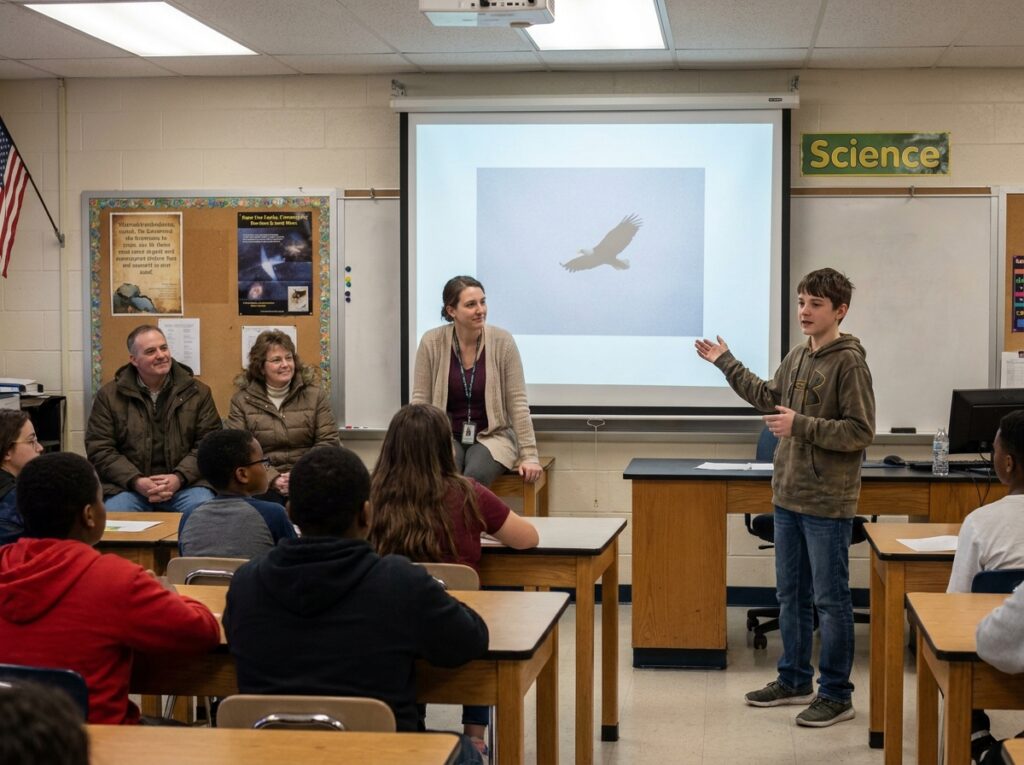
That photograph became part of a small display at his middle school.
His science teacher asked him to put together something about local wildlife.
Noah agreed under one condition.
He didn’t want the presentation to be titled “The Boy Who Saved an Eagle.”
He hated that phrase.
“I didn’t save him,” he told his teacher.
She smiled.
“What should we call it?”
Noah thought.
Then said:
WHAT TO DO WHEN WILDLIFE NEEDS HELP.
That became the title.
He talked about keeping distance.
Getting an adult.
Calling appropriate wildlife authorities or licensed rehabilitators.
Not feeding injured wildlife.
Not attempting capture.
And not assuming that every animal sitting still needs intervention.
His teacher asked why that last point mattered.
“Because sometimes people help when the animal doesn’t need help,” Noah said. “And that can make things worse.”
I sat in the back row listening.
He never mentioned the money he donated.
Never mentioned the fundraiser totals.
Never said that his birthday had started the whole thing.
Then he reached the final slide.
It was the first photograph he’d taken of a bald eagle after getting Henry’s camera.
The one from the previous spring.
Slightly blurry.
Mostly sky.
But the wings were open.
Noah looked at the class.
“I wanted a camera because I thought getting a picture was the important part.”
Then he shrugged.
“It’s not.”
Nobody said anything.
“The animal getting to stay wild is the important part.”
That one got me.
Rachel squeezed my hand.
I pretended my eyes were watering because the classroom was dry.
A few weeks later, Arthur stopped coming over.
At first Noah assumed he was busy.
Then we learned he’d been hospitalized after a fall.
Nothing life-threatening, thankfully, but he needed rehabilitation and couldn’t drive for a while.
Noah asked if we could visit.
Arthur was sitting in a chair beside the hospital window when we arrived.
He looked annoyed.
That was reassuring.
“They won’t let me leave.”
“You broke your hip,” I said.
“Technicality.”
Noah brought him something.
The eagle photograph from the creek.
Printed properly.
Matted.
Framed.
Arthur stared at it.
“That’s yours?”
Noah nodded.
Arthur studied it for a long time.
Then he pointed toward the empty wall across from his bed.
“Put it there.”
Noah did.
Arthur leaned back.
“Margaret would’ve liked that one.”
Noah smiled.
“Because it’s an eagle?”
“No.”
Arthur looked at him.
“Because you didn’t get too close.”
That surprised me.
Apparently Arthur had been listening too.
Before we left, he reached toward the little cabinet beside his bed.
Inside was a small envelope.
He handed it to Noah.
“No.”
Noah hadn’t even opened it yet.
Arthur frowned.
“You don’t know what it is.”
“Money.”
“How do you know?”
“Because adults put money in envelopes when they want teenagers to argue with them.”
Arthur laughed.
Inside was $200.
“For the lens.”
Noah immediately tried to give it back.
Arthur refused.
“You’ve raised enough money for everybody else’s birds.”
He pointed at Noah.
“Buy your lens.”
Noah looked uncomfortable.
Arthur’s voice softened.
“Kindness isn’t only giving things away.”
Noah stopped.
Arthur continued.
“Sometimes you let somebody give something to you.”
I watched that sentence land.
Noah sat down again.
“Are you sure?”
“Yes.”
“Really sure?”
“Take the money before I spend it on hospital pudding.”
Noah laughed.
He kept it.
Two months later, he bought a used lens.
Not the expensive one he’d originally dreamed about.
A practical telephoto Henry found secondhand.
Noah paid most of it himself.
Arthur’s money covered the rest.
The first picture he took with it wasn’t an eagle.
It was Arthur.
By then, Arthur was back home and walking with a cane.
He was sitting on our porch holding one of Margaret’s old bird books.
Noah took the picture without telling him.
Arthur looked up afterward.
“You photographing old men now?”
“Wildlife was slow.”
Arthur threatened to hit him with the cane.
That photograph is still one of Noah’s favorites.
Then January came around again.
His thirteenth birthday.
Exactly one year after the eagle.
At 9:14 that morning, Noah was already outside.
Of course he was.
The pond had frozen again.
Snow covered the field.
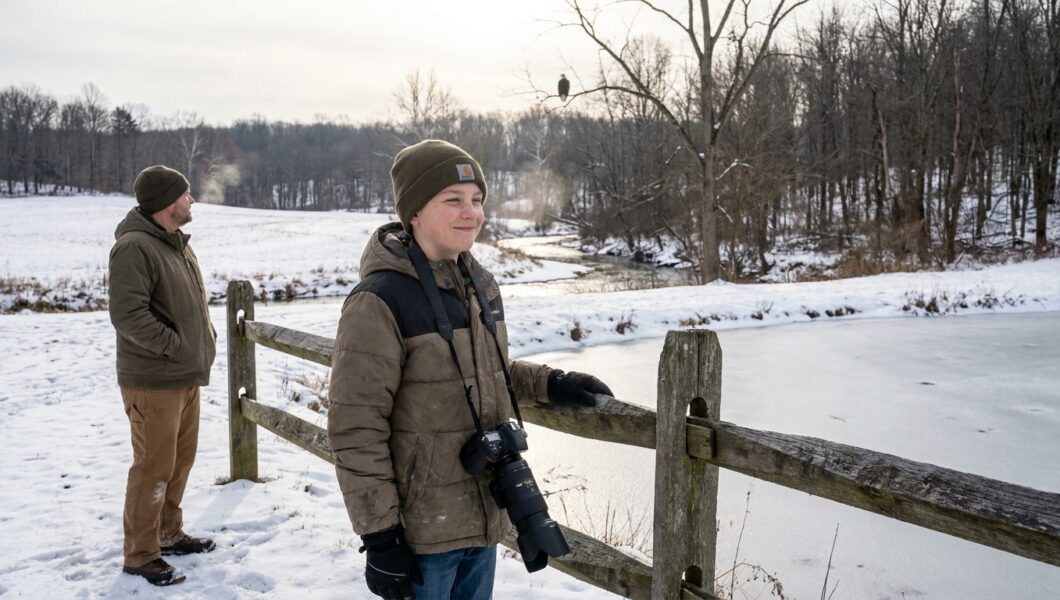
I found him beside the fence with his camera hanging around his neck.
For one terrifying second, I thought something was wrong.
Then I saw him smiling.
“What?”
He pointed toward the far end of the pond.
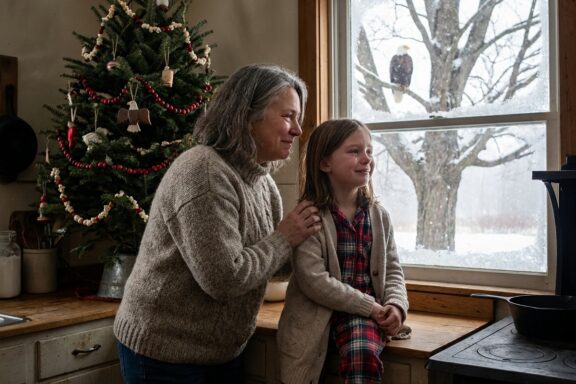
There was a bald eagle in one of the trees.
Healthy-looking.
Alert.
High above the ground.
Exactly where a wild eagle ought to be.
We stayed where we were.
Noah lifted his camera.
Then lowered it.
“You’re not taking the picture?”
“Light’s bad.”
I laughed.
One year earlier, the kid would’ve photographed a bald eagle through a dirty kitchen window during an earthquake.
Now apparently he had standards.
We stood together.
The eagle stayed for maybe two minutes.
Then it spread its wings.
For a moment, the winter sun caught the white feathers on its head.
It lifted from the branch and crossed above the creek.
Noah watched through his binoculars instead of his camera.
“Think it’s him?” I asked.
He smiled.
“No way to know.”
He didn’t sound disappointed.
That might have been the biggest change of all.
When the eagle disappeared, Noah turned toward the house.
“Pancakes?”
“Your mom’s making them.”
“Good.”
We started walking.
Halfway back, he looked at me.
“You know what’s weird?”
“What?”
“I thought last birthday got ruined.”
I stopped.
He laughed.
“Like, at first.”
I understood.
No camera trip.
Cold pancakes.
Hours worrying about an injured bird.
“And now?”
He looked back toward the pond.
“Best birthday I’ve had.”
That evening, there were no big presents.
His main gift was the lens he’d already helped buy.
Arthur came for dinner.
Henry came too.
His grandmother brought too much cake.
The wildlife rehabilitation center sent Noah a handwritten birthday card thanking him for continuing to support responsible wildlife care.
He put it beside the first letter he’d written them.
Later, after everyone left, I found him organizing photographs on his computer.
There were hundreds now.
Birds.
Fields.
Creeks.
Arthur.
Henry.
His sister making a face at him.
Rachel carrying cookies.
Some were technically good.
Most weren’t.
But they showed something I hadn’t noticed while it was happening.
Noah hadn’t just learned photography.
He’d built relationships around paying attention.
That eagle never knew Noah’s name.
It didn’t know about the hundred dollars.
It didn’t know about cookies or Arthur or Henry or the school presentation.
And that’s exactly how it should be.
Wildlife doesn’t need to understand our kindness.
Sometimes people don’t either.
The point isn’t recognition.
The point is doing what helps.
My son wanted a camera so he could photograph eagles.
An injured one delayed that plan.
Then somehow the delay taught him how to use the camera when it finally came.
Keep your distance.
Be patient.
Notice what’s happening.
Know when to ask for help.
Know when to let trained people take over.
Know when not to take the picture.
And maybe most importantly, know that generosity works both ways.
You give when you can.
You receive when somebody else wants to give.
That’s how communities become communities.
One person notices an injured bird.
Another knows who to call.
A rehabilitation team does the skilled work.
A family donates.
Neighbors buy cookies.
A photographer gives away an unused camera.
An old widower shares his wife’s books.
A kid visits him when he falls.
Then one morning, everyone looks up and sees an eagle exactly where it belongs.
In the sky.
I used to think Noah’s twelfth birthday was the day he gave up a camera.
Now I understand it differently.
That was the day he started learning what the camera was actually for.
Not collecting things.
Not proving he had been close.
Not turning wildlife into trophies.
It taught him to pay attention without needing to possess the moment.
And maybe that’s why my favorite photograph Noah has ever taken isn’t the sharp eagle over the creek.
It’s one he took a few weeks after his thirteenth birthday.
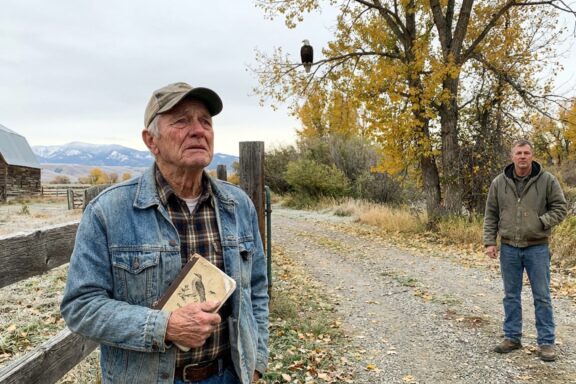
Arthur is standing near our frozen pond in his heavy coat, leaning on his cane.
Henry is beside him.
Both men are looking upward.
You can’t see what they’re watching.
The eagle is outside the frame.
At first, I asked Noah why he hadn’t included it.
He looked at me like the answer was obvious.
“Because I was watching them.”
That’s when I realized the eagle had taught him the same thing twice.
First, to notice the animal that needed help.
Then to notice the people who showed up because of it.
And of all the gifts my son received that year, I think that one will last the longest.
No Comments