

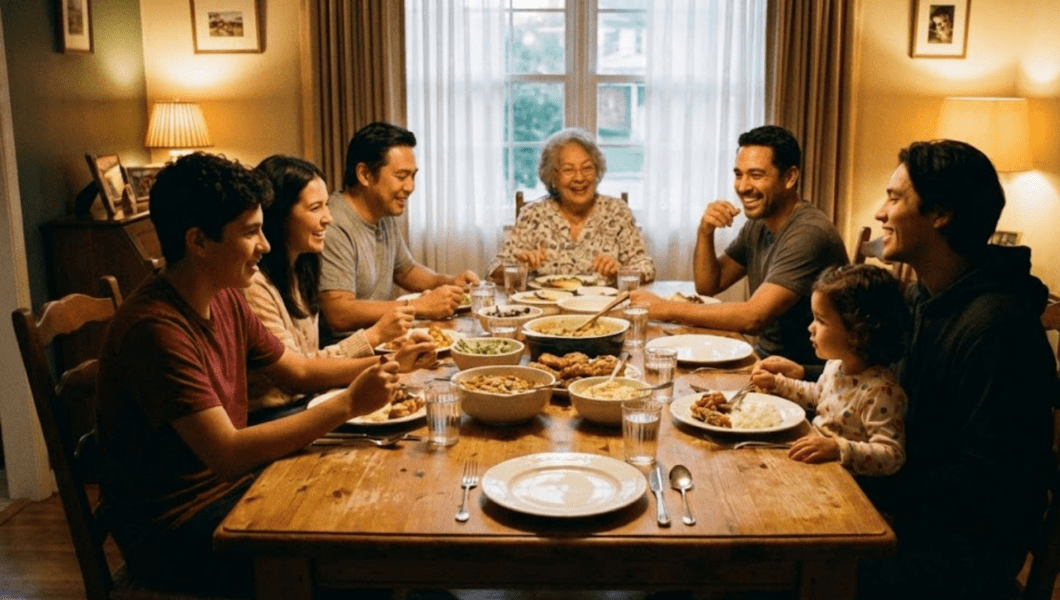
The fall after Lila left for college, the house felt strangely quiet at dinnertime.
Not empty. Drew still talked nonstop. Caleb still argued about everything from politics to pasta sauce. Aaron still told jokes that made everyone groan. But there was a space at the table that didn’t belong to anyone else, a small gap in the rhythm we had built without realizing it.
For four years, I had cooked as if five people lived in our home.
Now there were four again, and I kept getting it wrong.
Too much rice. Too many potatoes. An extra serving spoon hovering over an empty spot before I caught myself.
The first night after she moved into her dorm, I still set out five plates.
I didn’t even notice until Drew pointed at the extra one.
“Mom,” he said carefully, “nobody’s sitting there.”
I stood frozen for a second, dish towel in my hand.
“Oh,” I said, forcing a small laugh. “Habit.”
I picked up the plate and put it back in the cabinet, but the table looked wrong afterward. Too neat. Too balanced.
Lila had always sat slightly crooked, her chair angled toward Caleb, one foot tucked under her leg. She leaned forward when she talked, elbows near the table despite my halfhearted reminders about manners. There had always been a quiet intensity to the way she occupied space, like she was determined to absorb everything before it disappeared.
Now there was just wood and air.
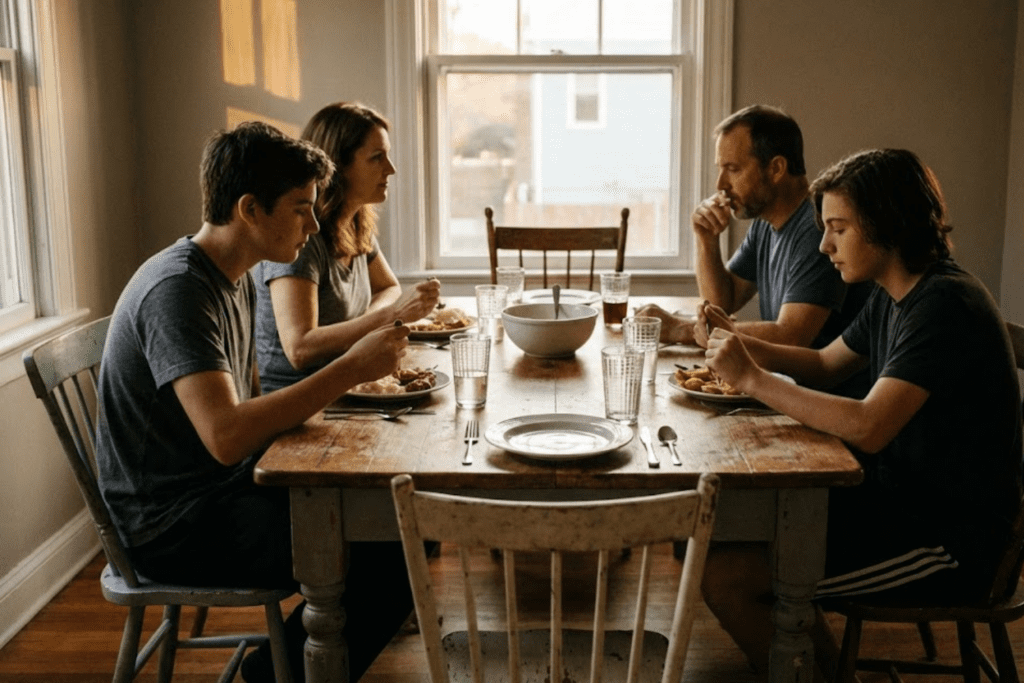
Caleb noticed it too, though he pretended not to.
He ate quickly those first few weeks, pushing food around his plate instead of savoring it. His phone stayed face down beside him, silent, as if he were waiting for it to light up on its own.
One night, Aaron asked casually, “Have you heard from her?”
Caleb shrugged. “She’s busy.”
Teenage code for yes, but I don’t want to talk about it.
Later, I found him standing in the kitchen with the fridge open, staring inside without reaching for anything.
“You can text her, you know,” I said gently.
“I know,” he replied, still looking at the shelves. “I just don’t want to be annoying.”
I wanted to tell him that love is rarely annoyed by presence. That people who matter usually want to hear from you more than you think. But I remembered being seventeen and unsure how much space I was allowed to take up in someone else’s life.
So I just said, “She misses you too.”
He closed the fridge and nodded once.
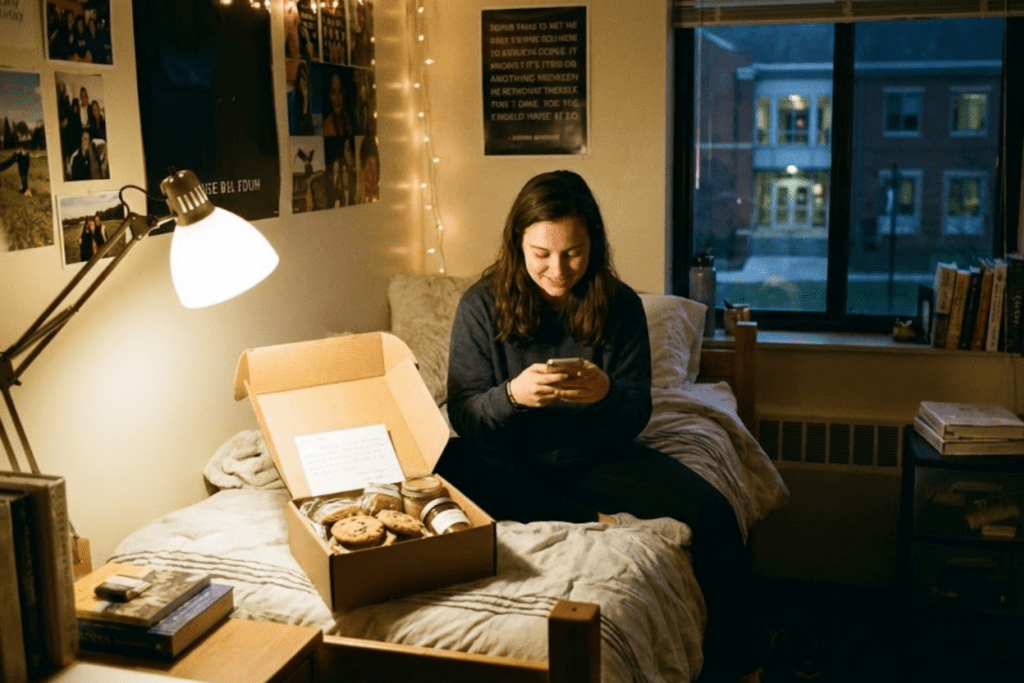
The first package arrived in October.
It was addressed to all of us, though Lila had underlined Caleb’s name twice in blue ink. Inside were small things. A campus bookstore T-shirt. A postcard with a picture of the ocean she had finally seen in person. A bag of fancy instant coffee she claimed tasted like “real adulthood.”
At the bottom was a folded piece of paper.
“Dining hall food is technically edible,” she wrote, “but nothing tastes like home. Thank you for teaching me what normal feels like. I’m trying to build that here.”
I sat at the table and read it twice before passing it around.
Aaron cleared his throat when he finished. Drew asked if college meant you could eat ice cream for dinner. Caleb took the letter back and stared at it longer than necessary, tracing the indentations of her handwriting with his finger.
That night, I cooked one of her favorites. Lemon chicken with too much garlic, the way she liked it.
Halfway through dinner, Caleb looked up.
“We should send her something,” he said.
“Like what?” Aaron asked.
Caleb hesitated. “Food.”
So we did.
A care package went out the next morning packed with homemade cookies, microwave rice cups, instant soup, and a handwritten recipe card for that lemon chicken. I included a note that said she could come home anytime, no explanation required.
Two weeks later, my phone rang while I was chopping onions.
“Mrs. Turner?”
Her voice sounded thinner through the speaker, stretched by distance and something else I couldn’t quite name.
“Hi, sweetheart,” I said, smiling before I could stop myself.
She exhaled, a shaky sound. “I didn’t realize how loud college is. Not noise exactly. Just… people everywhere. Everyone seems to know where they belong.”
“And you don’t yet,” I said gently.
“Not yet.”
There was a pause.
“I burned the rice,” she added quietly. “I didn’t know you had to rinse it first.”
I leaned against the counter, onion forgotten.
“You’ll learn,” I said. “Or you’ll decide life’s too short and switch to pasta.”
She laughed then, a small, surprised sound, like she hadn’t expected joy to slip in.
“Thank you for the food,” she said. “It felt like… like someone remembered I exist.”
As winter approached, the extra plate returned.
Not because I forgot this time. Because I chose to.
I set it out on Sundays, the day Lila used to come most reliably. Sometimes we video called her and propped the phone against a salt shaker so she could “sit” with us. Sometimes she was studying and couldn’t join, but the plate stayed anyway.
It wasn’t pretending she was there. It was leaving room.
Caleb began inviting people over more often too. Not with announcements anymore. Just a quiet “Is it okay if someone stays for dinner?” shouted from the hallway.
Of course it was okay.
The debate team boy came back twice. A girl from art class stayed one night and fell asleep on the couch afterward. Drew started assuming guests were part of the plan and setting out extra napkins without being told.
Our table grew noisy again.
Different voices. Different stories. Same sense of fullness.
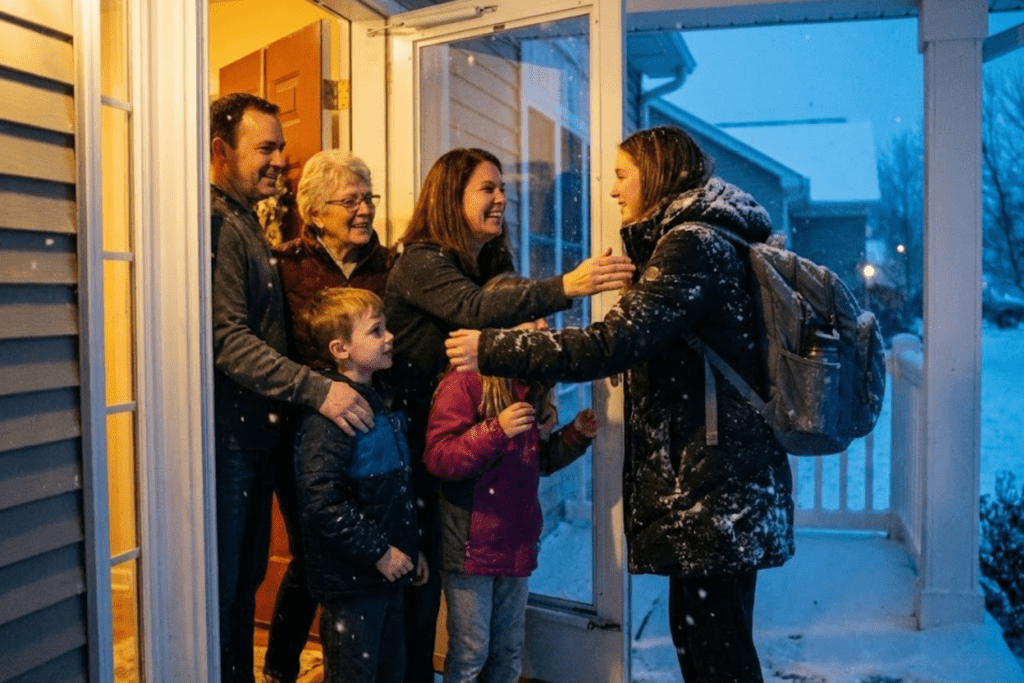
One snowy evening, as wind rattled the windows, a knock came at the door.
I opened it expecting a delivery.
Instead, Lila stood there, backpack slung over one shoulder, snow melting in her hair.
“I missed the bus home for Thanksgiving,” she said breathlessly. “And then I realized home is actually here.”
I didn’t remember deciding to hug her. My arms just moved.
She smelled like cold air and shampoo and something faintly metallic from the bus station. Underneath it all was a familiar scent I couldn’t name, something that belonged to her specifically.
Aaron appeared behind me, eyes wide. Drew shouted her name from the living room. Caleb barreled down the stairs so fast he nearly slipped.
For a moment, the hallway was just a tangle of arms and laughter and relief.
Dinner that night felt different from all the others.
Not special in a formal way. No fancy dishes. Just a big pot of stew and too much bread because I panicked in the grocery store. But every movement carried an undercurrent of gratitude, like we were aware of how fragile these gatherings could be.
Lila talked more than she ate, describing classes and roommates and the ocean in winter. Caleb interrupted constantly to correct details or add jokes. Aaron kept refilling everyone’s glasses whether they needed it or not.
At one point, Lila stopped mid-sentence and looked around the table.
“You didn’t change anything,” she said softly.
“Should we have?” Aaron asked.
She shook her head, eyes shining. “No. It’s just… exactly the same.”
She reached out and touched the table with her fingertips, almost reverently.
“I didn’t realize how much this place anchored me until I left.”
After dinner, she helped me wash dishes like she always had. No fuss, no ceremony. Just hands in warm water, plates passing back and forth.
“You know,” she said quietly, “when I first started coming here, I thought it would stop someday. That you’d decide it was too much.”
I met her eyes.
“Did we?”
“No,” she said, smiling. “You just kept making space.”
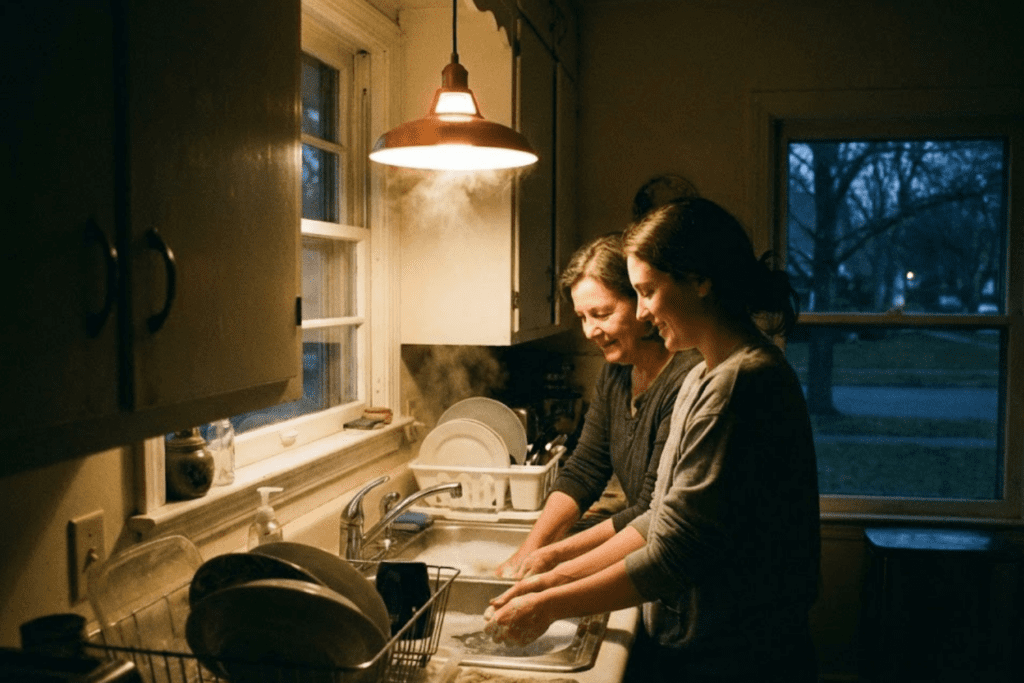
By the time she left two days later, the house felt alive in that specific way it only does after someone beloved has filled it with stories and laughter.
But this time, the quiet afterward didn’t feel like absence.
It felt like continuation.
Years have passed now.
Caleb is in college himself. Drew is taller than me and eats like a professional athlete. Aaron still tells terrible jokes. And the extra plate has never truly gone away.
Sometimes it’s used. Sometimes it isn’t.
But it stays within reach.
Lila visits when she can, usually arriving with armfuls of groceries as if she’s trying to repay a debt that never existed. She’s studying marine biology now, chasing those coral reefs she used to read about under a flashlight.
Last summer, she brought a small cooler to dinner.
Inside was a container of homemade lemon chicken.
“I finally got it right,” she said proudly. “Too much garlic and everything.”
We ate it together, laughing at how closely it matched mine. Not identical. Hers had a sharper edge, a brightness that belonged to her.
After dessert, she lingered at the table while the others drifted into the living room.
“Do you know what you really gave me?” she asked.
“Food,” I said automatically.
She shook her head.
“A template,” she said. “For how to care about people without making them feel small.”
My throat tightened.
“I’ve started doing the same thing,” she continued. “There’s a girl in my building who never leaves her room except for class. I invite her over on Sundays. Nothing big. Just dinner.”
I stared at her, stunned by the quiet symmetry.
“Does she come?” I asked.
“Most weeks,” Lila said. “She eats slowly. Says thank you too much. Sound familiar?”
We both laughed, though my eyes blurred.
Love had not stopped at our table. It had traveled outward, carried by someone who once needed a place to land.
I used to think we helped Lila.
Now I understand something different.
She helped us too.
She showed my children that generosity isn’t theoretical. It happens in real time, with real people, often in the middle of ordinary evenings. She turned our home into a place where extra chairs weren’t an inconvenience but an expectation.
The world still feels overwhelming sometimes. Problems too big. Needs too endless. Headlines that make you wonder what difference one family can possibly make.
But every night, somewhere, a door opens without warning.
A teenager stands in a hallway clutching a backpack.
Someone says, “They’re staying for dinner.”
And a life quietly shifts direction.
You don’t always see the ripple right away.
Sometimes it takes years.
Sometimes it travels farther than you’ll ever know.
All you did was make extra rice.
But somewhere down the line, another table grows louder.
Another lonely kid feels normal for an hour.
Another door opens.
And the extra plate never really leaves the table.



No Comments