

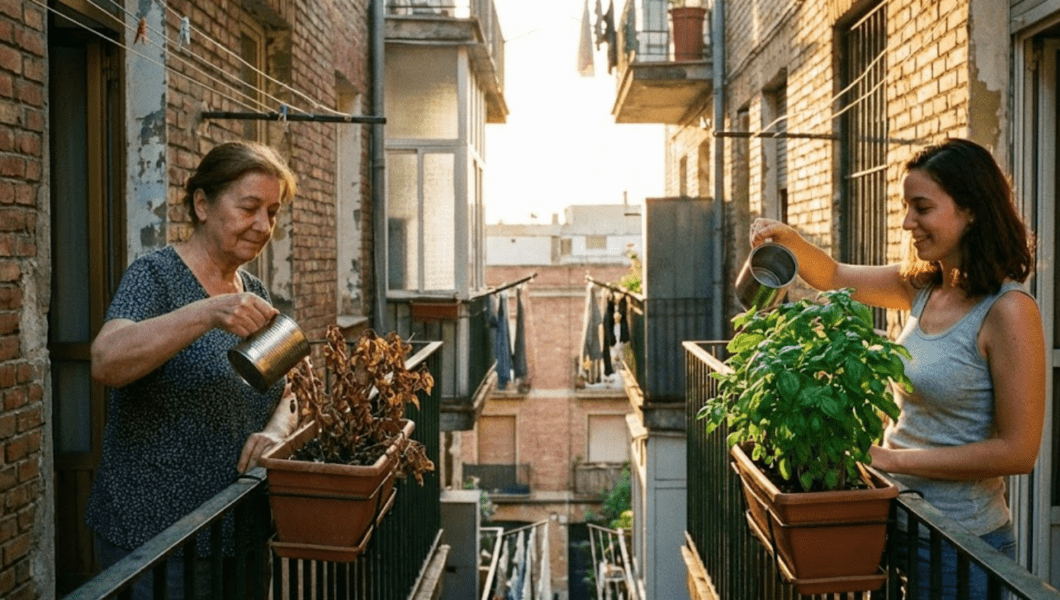
The first morning I didn’t hear the metal watering can, I thought I had overslept.
My alarm still read 6:10 when I opened my eyes. The room looked the same, gray-blue with early light just beginning to push through the curtains. I waited for the familiar soft scrape of a balcony door sliding open across the courtyard.
Nothing.
I lay there another minute, listening harder, as if the sound might arrive late if I concentrated enough. Pipes clanked somewhere in the building. A car passed outside. A bird landed on the railing near my window and shook out its wings.
Still nothing.
By 6:12, my chest felt tight in a way that didn’t make sense. It was just a plant. Just a ritual that wasn’t mine. And yet the absence landed heavily, like walking into a room where someone important should be sitting and finding only an empty chair.
I got up and went to the window anyway.
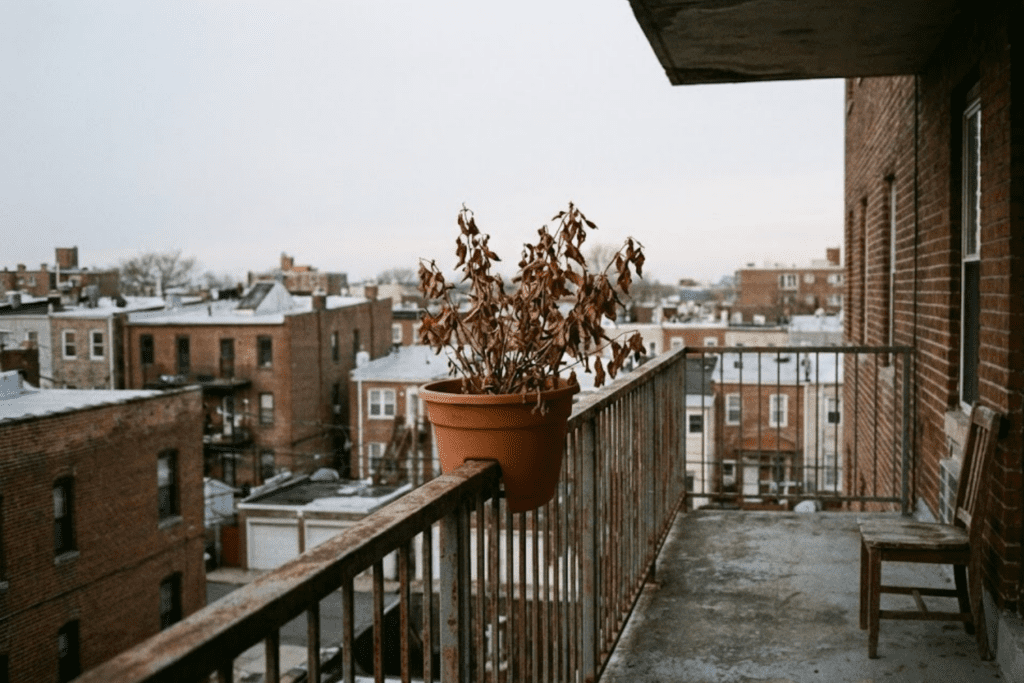
Miriam’s balcony was bare except for the pot. The same gray ceramic pot, the same brittle stems reaching upward like small fingers frozen mid-gesture. No watering can. No robe. No careful, reverent pour.
Just stillness.
Tyler noticed before I said anything.
“She didn’t come out?” he asked from the kitchen, pouring cereal into a bowl.
I shook my head.
“Maybe she slept in,” he said casually. “People do that.”
But Miriam had never slept in. Not once in all the months I had watched. Not during storms. Not during freezing weather. Not even on holidays when the rest of the building moved slower.
“Maybe,” I said, though the word felt flimsy.
The next morning, I was awake before the alarm.
I watched the clock tick from 6:10 to 6:11, then to 6:12, holding my breath like the moment might be scared off by noise.
Nothing.
By the third day, curiosity had turned into something heavier. Concern, maybe. Or a quiet dread that I didn’t want to name because naming it would make it real.
I found myself standing outside Apartment 4C that afternoon, staring at the door. The hallway smelled faintly of detergent and someone’s overcooked onions. Ordinary building smells. Life continuing, indifferent.
I knocked.
No answer.
I knocked again, louder this time, suddenly aware of how intrusive it might look. A neighbor hovering at someone’s door for reasons that sounded ridiculous when spoken out loud. I’m here because you didn’t water a dead plant.
As I turned to leave, the door opened a few inches.
Miriam stood there, looking smaller somehow. Not physically. More like the space around her had grown too large.
“Oh,” she said softly. “Window Neighbor.”
Her robe was different. Thicker. Wrapped tightly around her, even though the hallway was warm.
“I just wanted to make sure you were okay,” I said. “You haven’t been… out.”
She nodded once, eyes dropping briefly to the floor.
“I know,” she said. “I couldn’t.”
She opened the door wider and stepped back to let me in.
The apartment felt dimmer than before, curtains half drawn. The photographs were still there, but something about the room had shifted, as if the air itself had settled.
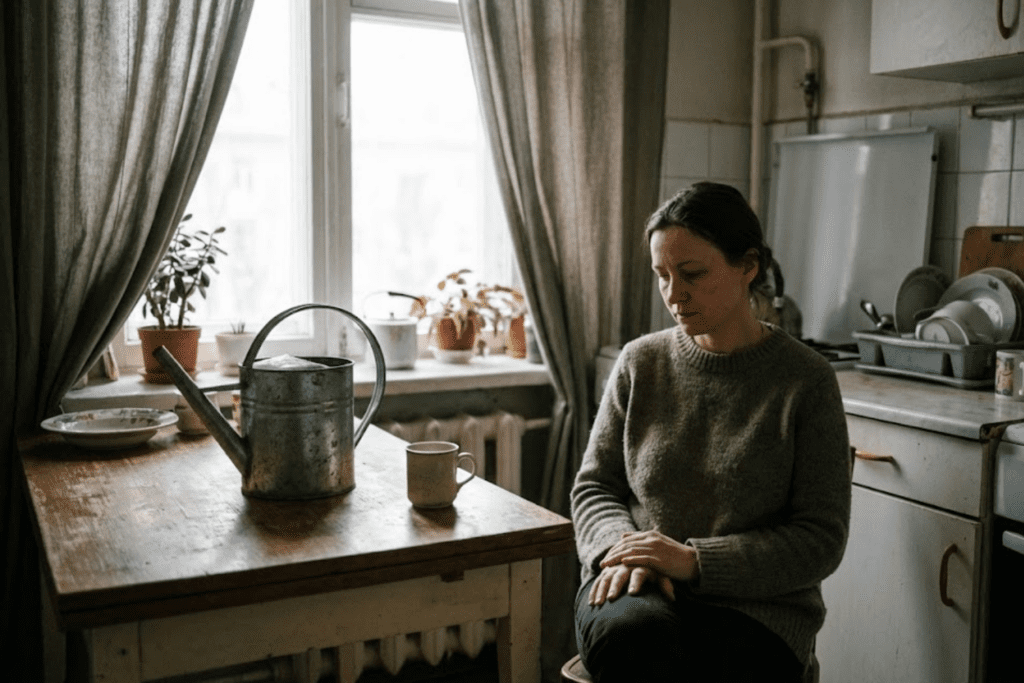
On the kitchen table sat the metal watering can.
Empty.
“I tried yesterday,” she said, following my gaze. “I picked it up. I even opened the door. But I couldn’t step outside.”
Her hands moved restlessly, folding and unfolding the edge of her sleeve.
“I thought if I skipped one day, I could pretend it didn’t matter. But then the clock hit 6:12 and I felt like I had broken something I couldn’t fix.”
She sank into a chair, exhaling slowly.
“It’s been a year,” she said. “Yesterday was exactly a year since Clara died.”
The words landed gently but with weight.
“I thought it would get easier,” Miriam continued. “People say anniversaries are hard, but I didn’t expect this. I woke up and it felt like the air had been taken out of the room.”
I sat across from her, unsure what to say that wouldn’t sound rehearsed or inadequate.
“You don’t have to water it today,” I offered gently.
She gave a small, tired smile.
“That’s the problem,” she said. “If I stop, I don’t know what replaces it. The ritual was a bridge. Without it, there’s just… the absence.”
Her eyes moved to the window, though the balcony itself wasn’t visible from the table.
“I kept her alive in those minutes,” she said. “At least it felt that way. Now I’m afraid that if I let go of the routine, I’ll lose the sound of her voice too.”
I thought about my dad’s voicemail. About Tyler’s untouched playlists. About all the small things we hold onto not because they make sense, but because they keep something warm inside from going cold.
“You won’t lose her,” I said quietly. “You just won’t be looking for her in the same place.”
She looked at me for a long moment, as if weighing whether to believe that.
That evening, I told Tyler what she had said.
He leaned back against the counter, arms crossed, thinking.
“You know,” he said finally, “rituals aren’t just about remembering. Sometimes they’re about having something to do with the love.”
I blinked. “What do you mean?”
“When someone’s here, you can make them soup or call them or sit next to them. When they’re gone, all that energy has nowhere to go. So you water a plant. Or replay a voicemail. Or keep playlists you don’t listen to.”
He shrugged, a little embarrassed by his own insight.
“It’s like muscle memory for caring.”
The phrase stuck with me.
Muscle memory for caring.
The next morning, I woke up with a strange sense of purpose. Not urgency. Just a quiet pull in a direction I hadn’t expected.
I went to the small hardware store two blocks away before work. The air smelled like soil and fertilizer and wood. Plants lined the front display, leaves beaded with water, bright and unapologetically alive.
I didn’t know much about herbs, but I found myself standing in front of the basil anyway. Small pots, green leaves catching the light, delicate and ordinary.
I bought one.
Carrying it back felt oddly significant, like transporting something fragile that wasn’t just a plant.
At 6:11 the next morning, I stepped onto my own balcony for the first time since moving into the building.
The air was cool, the city still stretching awake. Across the courtyard, Miriam’s balcony remained empty, the dead plant waiting in its pot like it had nowhere else to be.
My heart pounded in a way that felt disproportionate to the act I was about to perform.
At exactly 6:12, I lifted my watering can and poured a small stream into the new basil plant I had set on the railing.
The water soaked into the soil, darkening it instantly.
For a second, nothing happened.
Then a soft sliding sound cut through the morning air.
Miriam’s balcony door opened.
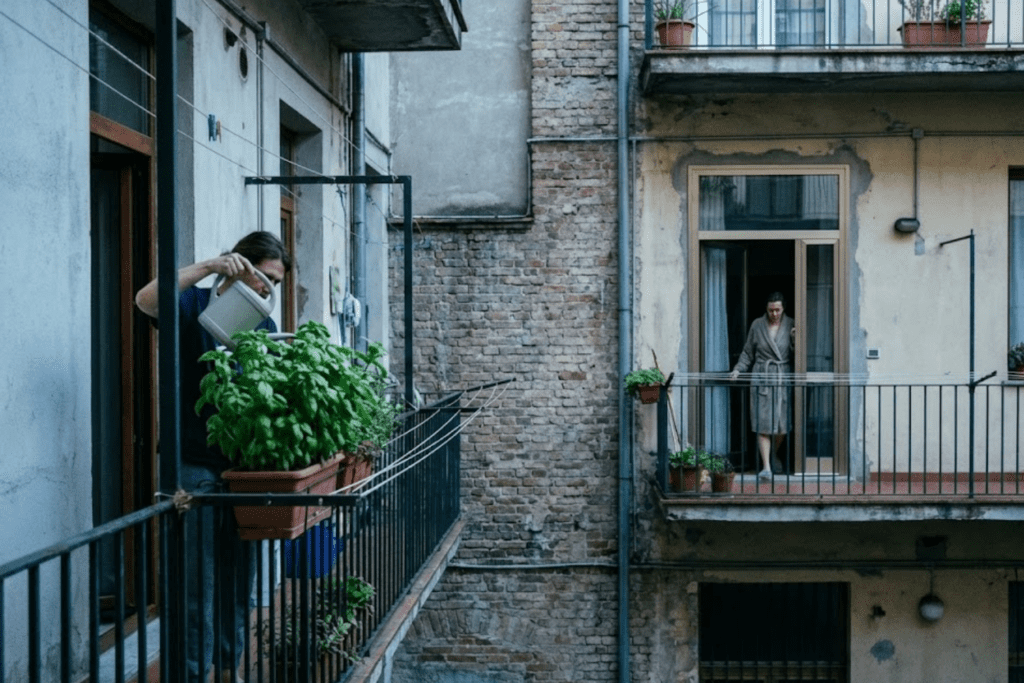
She stepped out slowly, wrapped in her robe, eyes fixed not on her own pot but on mine.
We didn’t speak. The distance was too far for quiet voices anyway.
But something passed between us that didn’t need words.
After a moment, she disappeared inside again. My stomach dropped, worried I had misread everything, intruded somehow, made it worse.
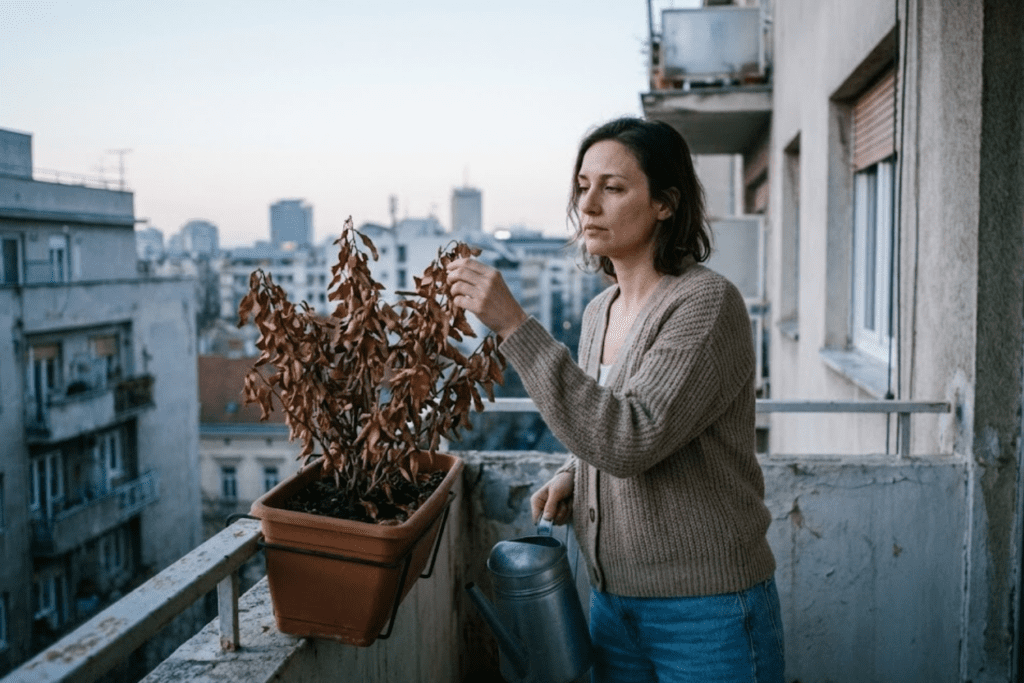
Then she came back out holding her metal watering can.
She walked to the dead plant, paused, and rested her hand lightly on the brittle stems, not pouring yet. Just touching them, like greeting something familiar after time apart.
Finally, she tipped the can.
Water hit dry soil with the same soft sound I had heard so many mornings before.
But this time, she didn’t leave right away.
She looked up at me and nodded once. Not a smile exactly. Something steadier than that.
Acknowledgment. Gratitude. Permission to witness.
I nodded back.
For the first time, the ritual didn’t feel like watching someone cling to the past. It felt like watching someone build a bridge forward while still honoring where they had come from.
Days passed, and the pattern shifted.
Miriam still watered the old basil at 6:12. But now she lingered longer, sometimes glancing toward my balcony, sometimes simply standing in the quiet. My plant grew quickly, new leaves unfurling as if they had been waiting for the chance.
One morning, she called across the courtyard, voice soft but clear.
“Don’t drown it,” she said, a faint smile breaking through.
I laughed, surprised by the sound of it in the early air.
“I’ll try,” I called back.
That was all. No dramatic conversation. No declarations. Just two neighbors acknowledging that grief had room for both memory and growth.
Later that week, I found another note slipped under my door.
“Thank you for reminding me that love can move forward without leaving the past behind. Clara would have liked that there’s basil growing again somewhere. – Miriam”
I held the paper for a long time, feeling the weight of it settle into something warm rather than heavy.
The next morning at 6:12, I stepped onto the balcony before my alarm even had a chance to ring.
Miriam was already there, watering her plant.
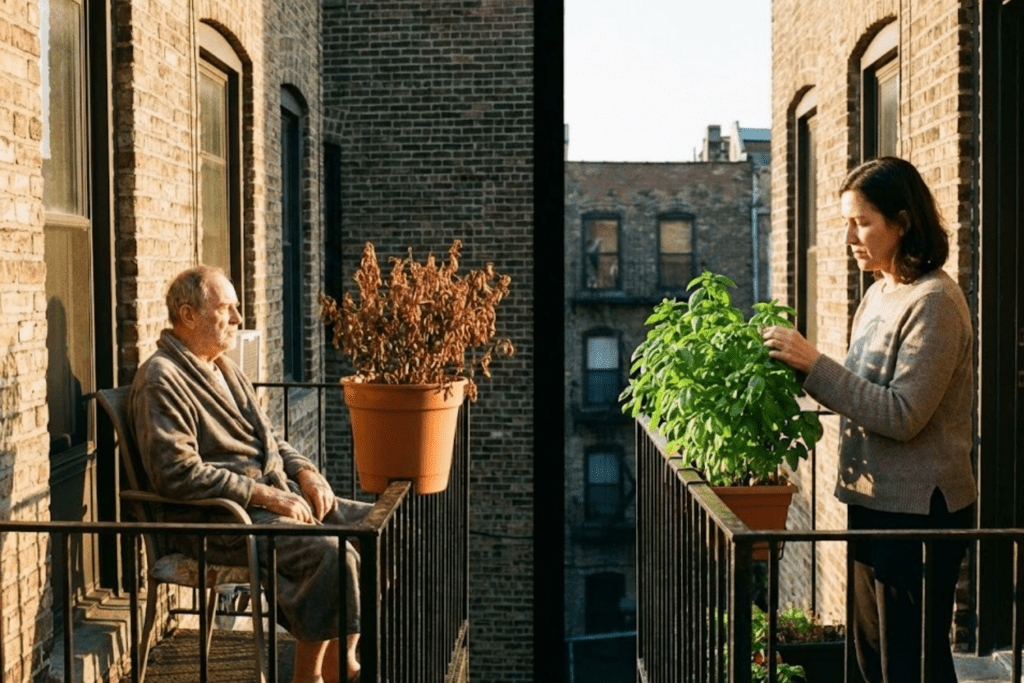
Across from her, green leaves shimmered in the soft light on my railing.
The air smelled faintly of herbs.
For seven quiet minutes, two sisters existed in that space. One remembered. One newly imagined. Both held in the simple act of pouring water into soil.
Love had not disappeared.
It had just learned a new place to stand.
And at 6:12 every morning, the courtyard held more than memory now. It held continuation.
Not a replacement. Not an ending.
Something gentler.
Something alive.



No Comments