

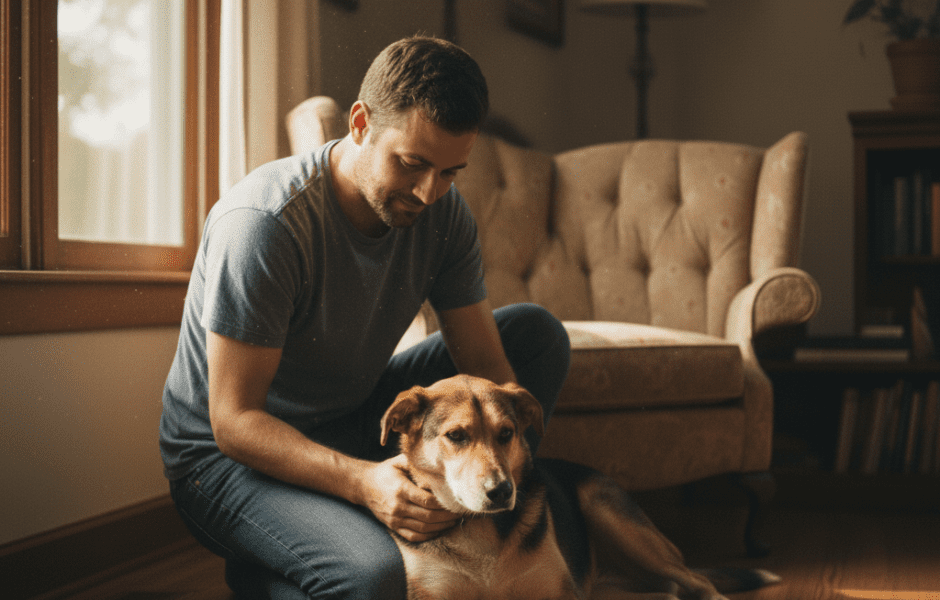
I learned quickly that healing does not move in straight lines. It moves like Nala did across our living room those first weeks—sideways, stopping, retreating, circling back, testing the air before committing to a single step.
Three mornings after that first night with Evan on the floor, I woke before dawn to the faint sound of nails on hardwood. Not hurried. Not anxious. Just soft, careful movement.
I turned my head and saw Nala standing at the foot of our bed.
She wasn’t close enough to touch us, but she wasn’t at the door either. She simply stood there, framed by the pale blue light of early morning, watching Evan breathe. Her tail hung low and still, not wagging, not tucked, just existing.
For a long time she did nothing.
Then she took one deliberate step forward and placed her chin on the mattress beside his hand.
He did not move. He did not open his eyes. His breathing stayed slow and even, and I understood in that moment that his stillness had become its own language to her. A language that said, you can come as close as you want, and nothing bad will happen.
When the sun finally rose, painting the curtains gold, she slipped quietly back to her bed in the hallway as if she had only come to check that he was still there.
That small vigil changed everything in our house.
The days that followed were not dramatic. There were no miracles, no sudden transformation into a carefree dog. Nala still flinched at loud sounds. She still hid behind the couch when a delivery truck rumbled down the street. She still melted into the shadows when a man’s voice came too close.
But with Evan, something new began to grow.
She started following him—not like a shadow, but like a witness. When he brewed coffee in the morning, she sat just outside the kitchen doorway and watched the way his shoulders moved. When he worked at the dining table, she curled at the edge of the rug, always angled so she could see him.
He never called her. Never coaxed. Never patted his leg or shook a treat bag. He simply let himself be someone she could study.
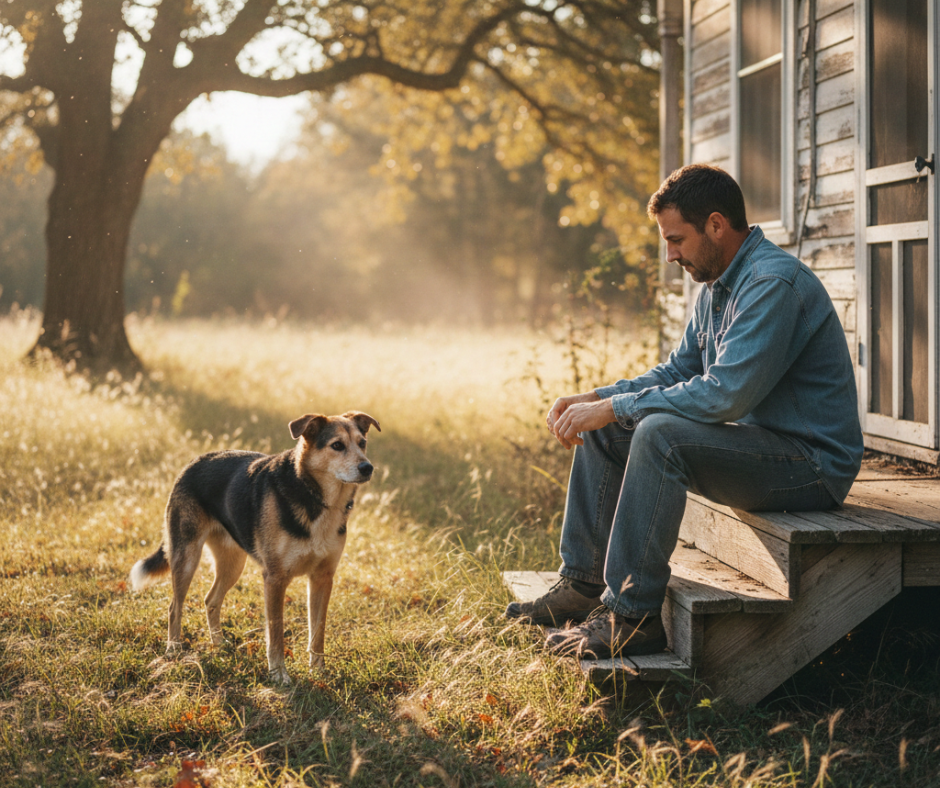
One afternoon, I came home from the grocery store to find them in the backyard together. Evan was sitting on the bottom step of the porch, back straight, hands resting on his knees. Nala was ten feet away in the grass, nose lowered, sniffing the wind.
A leaf fluttered down between them. She startled, then caught herself, then looked at Evan as if to check whether he had been frightened too.
He had not moved.
She relaxed again.
It was in these small, ordinary moments that I began to understand the depth of what he was giving her.
Not reassurance. Not instruction. Not protection in the heroic sense.
Permission.
Permission to be afraid without being corrected. Permission to come close without being grabbed. Permission to leave without being chased.
At night, she crept closer and closer to our bed. First the doorway. Then the rug beside it. Then the side of the mattress.
One evening, as Evan lay reading, she rested her chin on the edge of the bed, inches from his hand. His fingers hovered, wanting to touch her, but he did not move them.
I watched his restraint like I might watch someone carry glass across a slick floor.
Minutes passed.
Her eyes softened. Her breathing slowed.
And then, almost imperceptibly, she nudged his hand.
He exhaled and placed two fingers lightly on her head, not patting, not stroking, just resting.
She did not pull away.
In that quiet contact, I felt something inside me loosen that I hadn’t even known was tight.

Three weeks in, Evan invited her to walk with him.
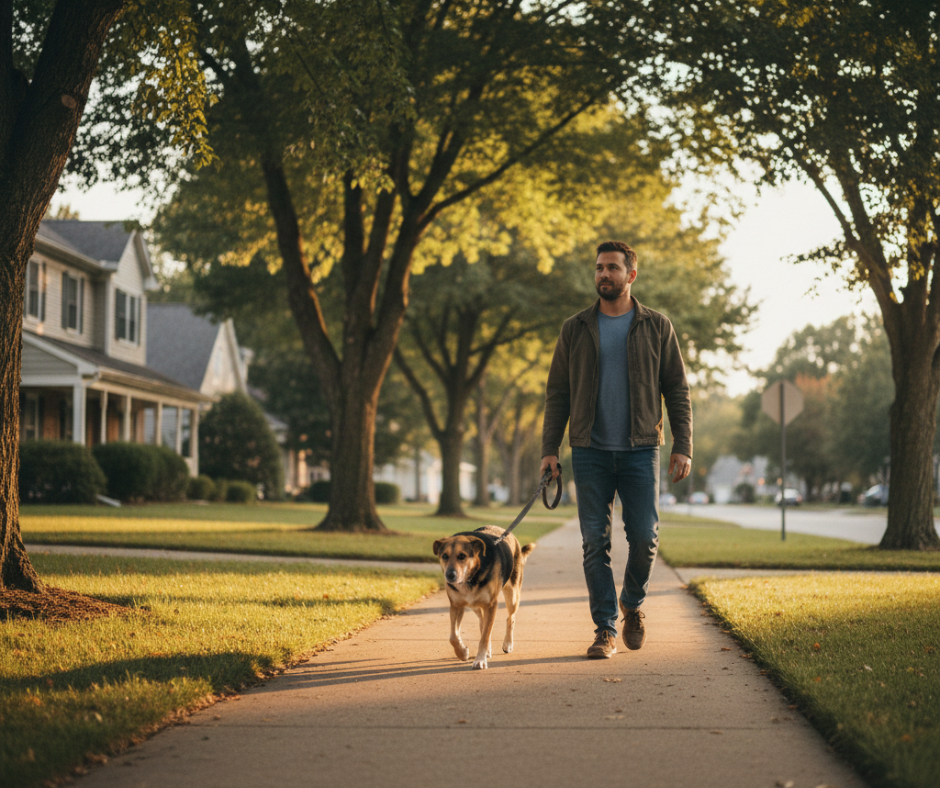
Not “come here.” Not a leash in the air. He simply clipped her collar, held the leash loose in his hand, and opened the front door.
She hesitated on the threshold.
Outside, a neighbor laughed across the street. A car door slammed. The world was loud and unpredictable.
Nala retreated half a step.
Evan did not tug. He did not encourage. He stood perfectly still, leash slack, as if time itself had slowed to match her heartbeat.
After a long pause, she stepped out beside him.
The first few walks were short. Half a block. Then one block. Then around the corner.
She stayed close to Evan’s left side, not pressed against him, but aligned with him, her body angled toward his leg like she was reading his rhythm. When a man jogged past, she stiffened, but she did not bolt. She looked up at Evan instead.
He did not look down at her. He did not speak. He simply kept walking.
Trust grew like that—quietly, sideways, almost unnoticed until you turned around and realized how far you had come.
The real turning point came one Saturday morning.
My brother came over unexpectedly. He’s tall, broad-shouldered, deep-voiced—the kind of man who, without meaning to, embodies everything that once terrified Nala.
She vanished instantly behind the couch.
Evan went to the living room, not to coax her out, but to sit on the floor in his usual spot, blanket between him and the space where she hid.
He did not call her name.
Minutes passed.
Eventually, her nose appeared around the edge of the couch cushion, then one eye.
She looked at my brother standing awkwardly in the kitchen, then back at Evan, then at the blanket.
Slowly, she crept out.
Not to greet. Not to investigate. Simply to sit beside Evan, body angled toward him, back turned to the stranger.
In that moment, I realized something profound.
She was not “over” her fear. She was learning how to hold it while still choosing connection.
That is what healing looks like.
Not the absence of scars, but the courage to live alongside them.
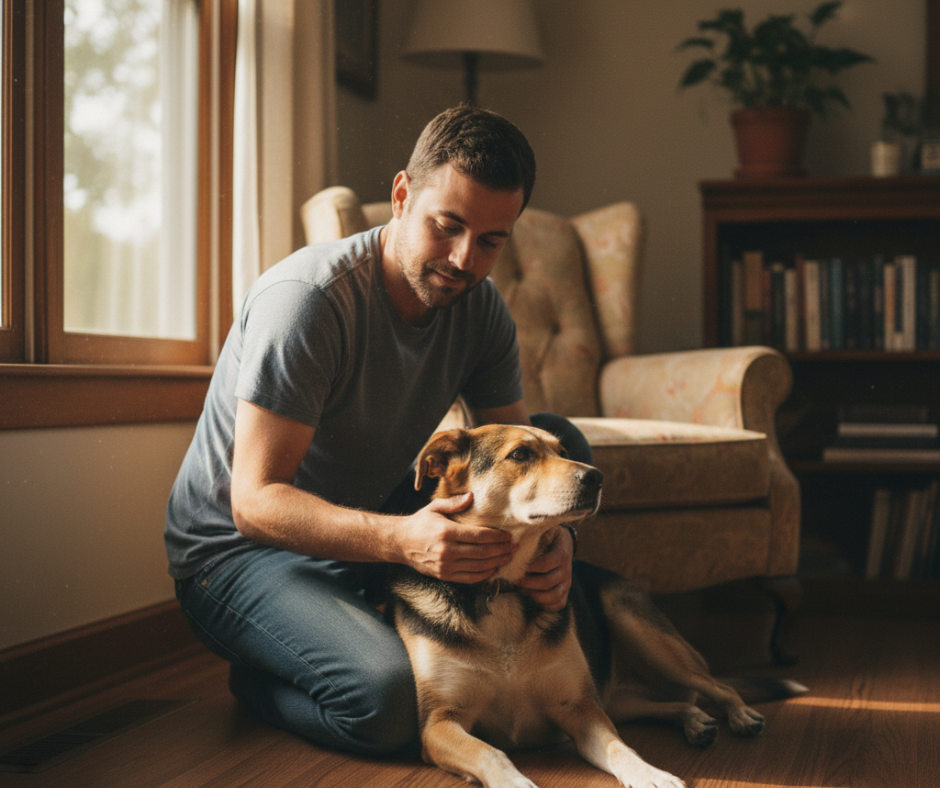
Later that day, when my brother left, Evan crouched down beside her and—very gently—ran his hand from the top of her head to the base of her neck.
She leaned into it.
I cried.
As weeks turned into months, Nala found her place in our life.
She claimed the sunlit patch of floor near the back door in the mornings. She carried toys—not to play at first, but to hold, as if she needed something to remind her that this house was safe. She learned the sound of Evan’s keys and began to wait by the door when he was due home.
I watched their relationship deepen in ways that felt sacred.
Sometimes I caught Evan talking to her, not in the high-pitched baby voice people use with pets, but in his normal tone.
“I’ll be right back.”
“I’ve got you.”
“You’re okay.”
Not commands. Not training phrases. Just steady presence.
And little by little, Nala answered him in her own way.
One evening, during a thunderstorm, she did not bolt for the bathroom or disappear into a closet. Instead, she walked straight to Evan, pressed her body against his leg, and sat there trembling—but present.
He placed his hand on her back and stayed with her until the storm passed.
Afterward, she fell asleep beside him, chin resting on his foot.
I realized then that she was no longer surviving in our house.
She was living.
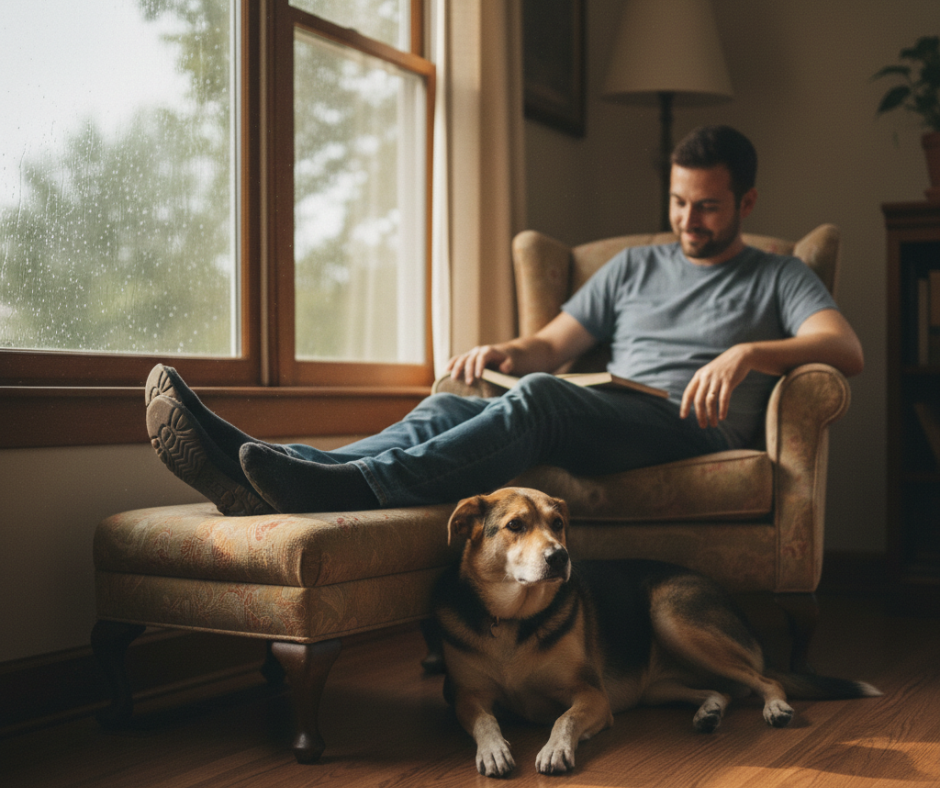
Nala changed us too.
I became quieter. More patient. Less desperate to “fix” things immediately.
Evan became even more grounded, if that was possible. His gentleness with her softened the way he moved through the world in general. I saw it in how he spoke to strangers, how he listened in difficult conversations, how he slowed down instead of rushing.
We began volunteering together at the shelter on weekends.
Not to rescue every dog. Not to solve every story. Just to sit in kennels with the scared ones, the ones everyone else passed by.
Evan had a way with them.
He never reached through bars. Never pushed. Never spoke too much.
He simply sat.
And somehow, dogs that had been labeled “difficult” would inch closer, nose forward, tail tentative, testing the space between fear and hope.
One afternoon, a staff member pulled me aside.
“You know,” she said quietly, watching Evan sit on the floor beside a trembling shepherd mix, “some people rescue dogs. And some people… dogs rescue them.”
I looked at Nala waiting calmly at Evan’s feet.
I understood exactly what she meant.
A year after we brought her home, we adopted another dog from the shelter—an older, gentle hound who had been overlooked for too long.
Nala did not react with jealousy or anxiety.
She welcomed him like someone who had finally learned there was enough love to go around.
At night, the two of them curled together at the foot of our bed while Evan and I lay beside each other, listening to their soft breathing.
Sometimes, when I watched Nala asleep—ears relaxed, body loose, no trace of the fear that once defined her—I remembered that first night when she froze at Evan’s presence.
And I marveled at how far she had come.
Not because of training.
Not because of tricks.
But because of one man who chose patience over pressure, stillness over speed, and trust over control.
If you ever bring home a frightened animal—or love a frightened human—you should know this:
Healing is not a race.
It is a series of small, brave choices made again and again in a safe space.
And sometimes, the most powerful thing you can do is nothing at all—except stay.
Nala still startles at sudden noises. She still hides when certain men visit. She may always carry that history in her body.
But she is no longer defined by it.
She is defined now by sunlight on warm floors, by steady footsteps she can follow without fear, by a home that chose her and refused to give up.
And every time she presses her head into Evan’s leg, I am reminded of a simple, beautiful truth.
Love, when it is quiet and patient, can rewire even the most wounded heart.
This is not the end of their story.
Because next week, Evan will return to the shelter for a case that will test everything he has learned about fear, trust, and mercy.


No Comments