


The Stray Who Saved Her: Pine Hollow’s River Miracle
Pine Hollow, Kentucky – June 3rd, 2021 – 7:14 AM
The early morning sun hadn’t burned the dew off the grass yet when little Lila June Whitaker waddled across the front lawn in polka-dot pajamas.
She was barefoot, still soft with sleep, chasing a beat-up yellow pinwheel that had slipped free from the porch railing and caught the breeze like it had places to be. It skipped once, then tumbled downhill toward the water.
The white picket gate stood open.
Unlatched again.
It was the kind of small mistake that never looks dangerous until it becomes one.
The Salt River curved behind the row of rental houses like a brown ribbon, slow and quiet, only thirty feet from the yard. Its banks were slick with mud and crowded with reeds that never seemed to stop growing. Most days, it whispered.
That morning, it waited.
Across the street, a stray dog lifted his head.
He wasn’t big, but he wasn’t small either. A mix of something like Australian Shepherd and something no one could name. His coat was ash and honey, his fur matted in places, one ear torn as if he’d once lost an argument with the world.
He had no collar. No tags. No person.
Just a crooked heart-shaped patch of white fur on his chest, and a limp in his back leg that made every step look like it cost him something.
The locals called him Strayboy.
He’d been hanging around Pine Hollow for months, never close enough to touch, never far enough to disappear. Always on the edge of things. Watching.
He watched now as Lila stumbled after her pinwheel.
The toy caught on a root and stopped.
Lila didn’t.
Her foot snagged. Her arms swung out wildly, windmilling like she could balance herself with air.
Then she vanished.
There was a splash, sharp and sudden. A burst of bubbles. And a silence so complete it felt like the whole neighborhood held its breath.
No one saw.
No one heard.
Except the dog.
Strayboy bolted.
He barked twice, loud and urgent, not the kind of bark meant to scare, but the kind meant to wake people up. Then he sprinted across the grass, cleared the gravel road, and launched himself down the muddy bank without hesitation.
Inside the house, Catherine Whitaker stood in the kitchen with coffee in one hand and the dishwasher handle in the other. The appliance rumbled. The radio hummed an old Patsy Cline song low enough to feel like background comfort.
She didn’t hear the splash.
She didn’t hear the bark.
Outside, Strayboy hit the river like he’d been doing it his whole life.
The cold brown water swallowed him. For a terrifying moment he disappeared beneath the surface, his weak back leg dragging him down.
Seconds passed.
Then the surface broke again, and there he was, paddling hard.
Between his jaws was Lila’s pajama sleeve.
He wasn’t biting her. He wasn’t shaking her. He was holding her the way a mother dog carries a pup, careful and steady, keeping her head above water like his whole body had decided this child mattered more than his own fear.
Lila didn’t cry.
She didn’t move.
Strayboy kicked harder, chest heaving, water streaming off his face. Every few seconds he barked again. Hoarse. Broken. Waterlogged.
But he didn’t stop.
That bark cut through the quiet and caught the ear of Ruth Ellen Massey, seventy-three, power-walking her usual route like she had every morning since her husband died.
She froze, squinting toward the reeds.
Then she saw it.
A dog in the river, swimming toward the bank, dragging something that looked too small to be true.
“Oh Lord,” she whispered.
And she ran.
It wasn’t a graceful run. It was the run of a woman who no longer cares what her knees say when a child needs her.
Ruth slid down the muddy slope, waded waist-deep, and reached out just as Strayboy bumped into the shallows.
Her fingers caught wet cloth.
She pulled.
Lila came up in her arms like a miracle and a warning all at once.
Strayboy didn’t let go until Ruth had the child in both hands.
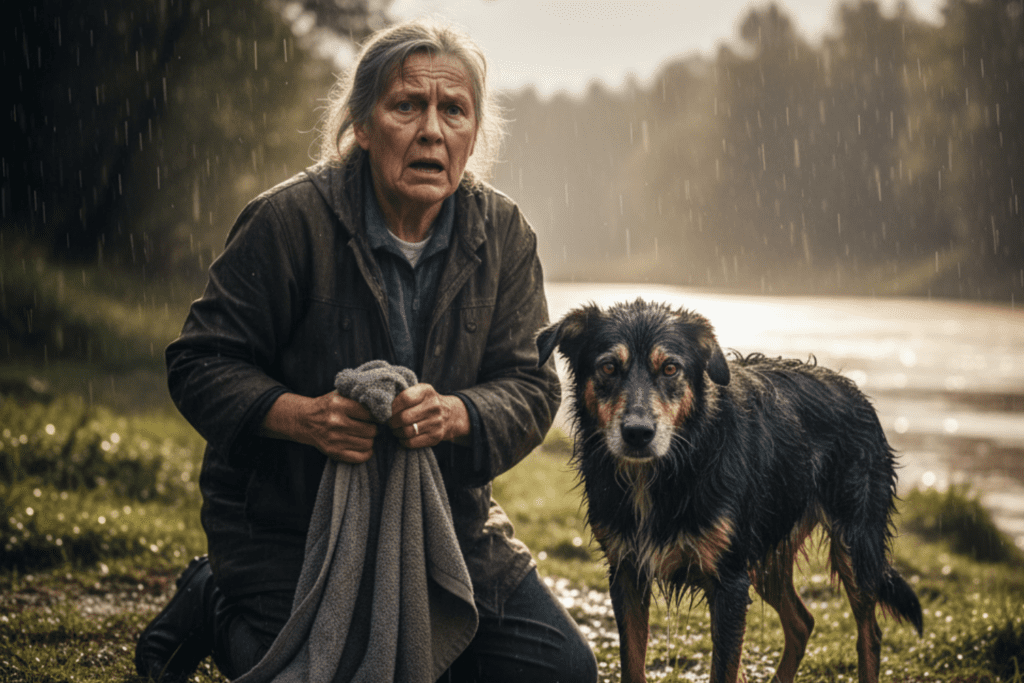
Ruth carried Lila onto the bank and laid her flat on the mud. Her hands began compressions without thinking, muscle memory from the days she worked as a school nurse back in the eighties.
Come on. Come on.
Lila sputtered.
Coughed.
Then wailed.
The sound was loud and angry and alive. Ruth sobbed openly as she pulled the girl against her chest.
Behind her, Strayboy stood trembling, soaked down to the skin, ribs showing under plastered fur. He wagged his tail once, like he had to prove to himself it had been real.
Then he collapsed in the dirt.
That’s when Catherine came sprinting from the house in pajama pants and one slipper, hair wild, face pale with terror.
She saw Ruth first.
Then Lila.
Then the dog.
“What… what the hell?!” she screamed, running forward.
“She fell in,” Ruth gasped, still breathless. “The dog pulled her out.”
Catherine snatched her daughter, squeezing her so tightly it almost looked painful.
For a second, I thought she would collapse with relief.
Instead, her face twisted through something darker. Horror. Shock. And then a kind of panic that needed an enemy.
Her eyes locked on Strayboy.
“Get away from her!” she shrieked.
Strayboy flinched, trying to stand. His bad leg buckled slightly.
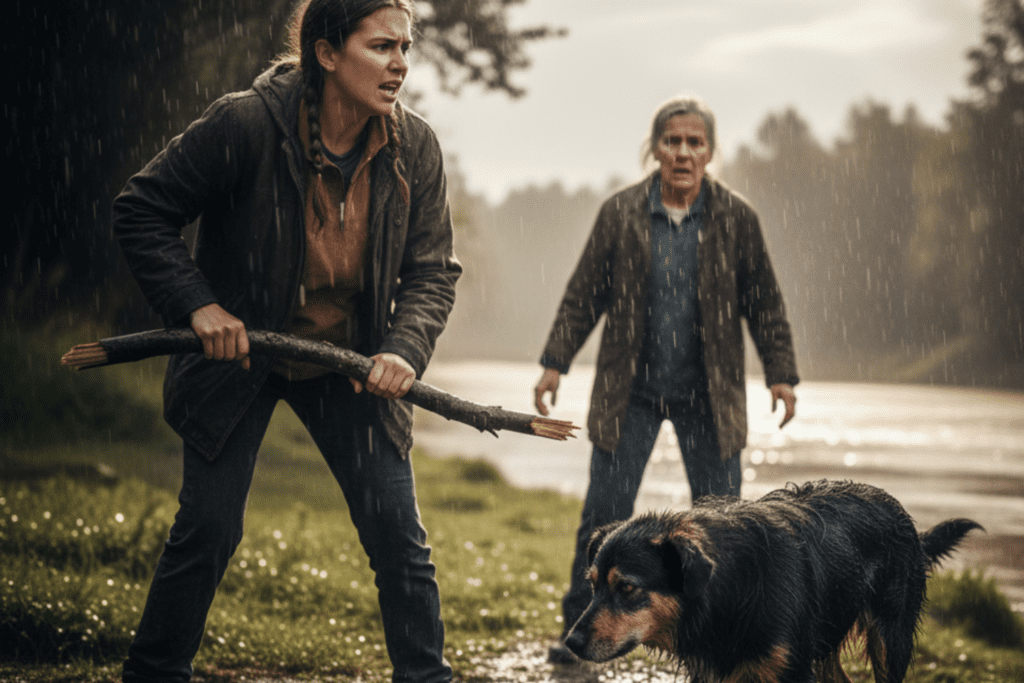
“I said GET!” Catherine yelled, grabbing a thick branch from the ground and swinging it hard.
The stick cracked inches from the dog’s muzzle.
He yelped.
Not aggressive. Not angry.
Just hurt.
He stumbled backward and limped away, dripping river water and fear into the grass.
Ruth stared at Catherine like she couldn’t understand what she was seeing.
“He saved her,” Ruth said softly, like the words themselves should fix this.
Catherine’s arms tightened around Lila. “He’s a stray,” she hissed. “Filthy. God knows what diseases he has.”
Ruth shook her head. “He just—”
“I’m calling Animal Control,” Catherine snapped, backing toward the house like the dog had tried to attack.
Strayboy didn’t wait to see what humans do next.
He fled.
Down the road.
Into the mist.
Leaving nothing but muddy paw prints and wet tufts of fur caught in the grass.
Inside the house, Lila sat wrapped in a towel, shivering, eyes wide.
She stared out the window and pointed.
“My dog…” she whispered.
Catherine didn’t answer.
She turned her face away as if the words were too heavy to look at.
Outside, the wind picked up.
And far off in the trees, a dog barked once.
Not loud.
Not angry.
Just enough to say: I’m still here.
By noon, Pine Hollow had split into two towns.
One town called Strayboy a hero.
The other called him a threat.
News travels fast in places like this. Faster than truth, faster than reflection. A river rescue becomes a rumor in an hour. By lunchtime, there were versions of the story that didn’t even resemble what happened.
Someone said the dog had tried to “drag Lila into the woods.”
Someone else said it had “attacked Ruth.”
One post claimed the dog was rabid.
And the part that mattered, the part that made the whole thing sacred, was being buried alive under fear.
Ruth went to the Whitaker house twice.
The first time, Catherine didn’t open the door.
The second time, Catherine yelled through it, “Stop coming here!”
Ruth stood on the porch anyway, voice steady through the screen door.
“I’m not here for you,” she said. “I’m here for the dog.”
There was silence.
Then Catherine’s voice, sharp and shaking. “That dog is dangerous.”
“That dog saved your baby,” Ruth replied.
“I didn’t ask him to!”
The words fell into the air like broken glass.
Ruth exhaled slowly, and when she spoke again it was quieter, more tired.
“None of us ask for help,” she said. “That doesn’t mean we don’t need it.”
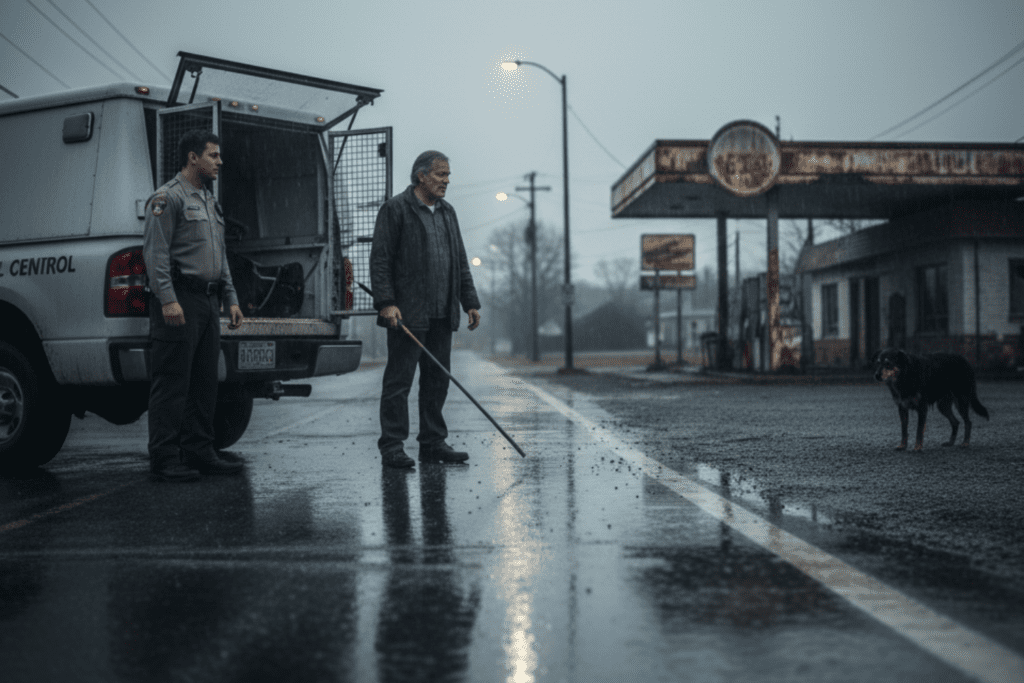
Later that evening, Animal Control drove through town.
They weren’t cruising for a dog.
They were hunting for a problem.
Two trucks, one cage, one long pole, the kind that makes a dog’s world shrink down to metal bars.
Strayboy stayed unseen.
But he was there.
You could feel it.
A shadow slipping between yards. A shape behind a shed. A heartbeat in the tree line.
At 8:21 PM, a teenager spotted him near the abandoned gas station and filmed it. The video showed a limping stray in the headlights, eyes glowing, looking like a creature from a cautionary tale.
The caption said: “RABID RIVER DOG STILL LOOSE.”
That one post did more damage than Catherine’s branch ever did.
That night, Ruth couldn’t sleep.
She sat at her kitchen table with her porch light on, sipping tea that went cold, staring out the window like the darkness might answer her.
She kept seeing Lila’s face.
Kept hearing that first cough.
Kept seeing the dog’s eyes, not pleading, not begging, just watching like he’d already learned how quickly love can turn into fear.
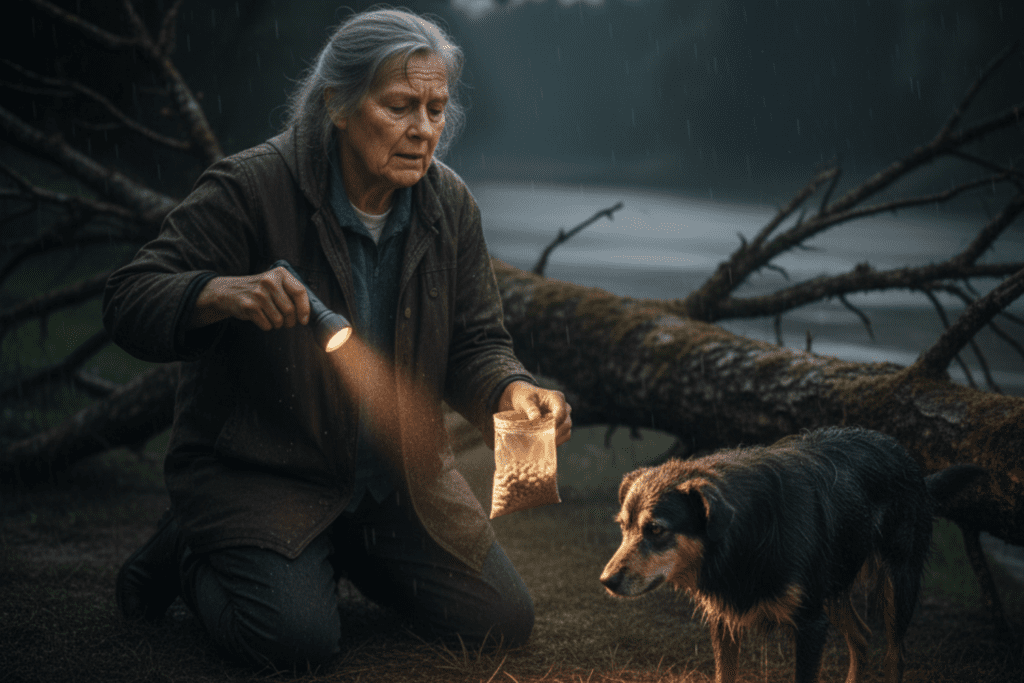
At 11:06 PM, Ruth put on her raincoat and boots and walked out into the night with a flashlight and a bag of leftover chicken.
Her daughter had once called her stubborn like it was a flaw.
Tonight, stubborn was a weapon.
She walked the same route she’d walked in the morning. The path along the river. Past the reeds. Past the mud that still held faint paw prints like fingerprints.
“Strayboy,” she called softly, as if she was calling a child.
Nothing.
“Hey,” she said again. “It’s Ruth. I’m the one who picked her up.”
She waited.
The wind answered.
Then, from somewhere deeper, a faint sound. Not a bark.
A whimper.
Ruth’s flashlight swung.
The beam caught him under an old fallen tree near the bank.
Strayboy lay curled into himself, shaking, his back leg bent at an unnatural angle. The river had saved Lila.
But it had broken him.
Ruth’s chest tightened so hard she couldn’t breathe properly for a second.
“Oh, sweetheart,” she whispered.
Strayboy tried to stand.
He couldn’t.
He dragged himself back, eyes wide, not trusting kindness anymore.
Ruth lowered herself slowly to the ground, keeping her hands open.
“No one’s gonna hit you,” she promised. “Not tonight.”
She slid the chicken forward.
Strayboy stared at it.
Then at her.
Then, after a long moment, he crawled forward inch by inch and ate like hunger was the only thing stronger than fear.
Ruth cried silently, not wiping her cheeks, just letting it happen.
Then she did what old women in small towns do when the world refuses to be kind.
She made a decision.
She reached for her phone.
And she called the only person who could stop Animal Control without a fight.
Sheriff Dale Whitmore.
The next morning, Pine Hollow woke up to a new sound.
Not motorcycles.
Not sirens.
Not outrage.
A quiet gathering.
Ruth stood outside the community church with a cardboard sign that said:
HE SAVED HER. WHO SAVES HIM?
No hashtags. No slogans. Just truth.
People came slowly at first. Two women from the diner. A man who’d never spoken to Ruth before but had watched the rescue from a distance and hadn’t stopped thinking about it since. A teenage girl who brought an old blanket and a bag of dog treats.
And then, unexpectedly, Sheriff Whitmore arrived.
He didn’t come with lights flashing.
He came like a man walking into a moral decision.
He stepped beside Ruth and looked at the sign.
“Where is he?” he asked quietly.
Ruth pointed toward the river path. “Hurt,” she said. “Scared. But alive.”
The sheriff nodded once.
Then he turned toward the little crowd forming behind them.
“We’re not hunting that dog,” he said loud enough for everyone to hear. “We’re helping him.”
A breath ran through the group, like relief moving from one body to the next.
Two deputies went with Ruth.
So did the teenage girl.
So did the man from the diner.
They found Strayboy exactly where Ruth left him, eyes still cautious, body still trembling.
When the sheriff knelt down near him, Strayboy bared his teeth for half a second.
Not aggression.
Warning.
The sheriff didn’t move.
“Easy,” he murmured. “You did good.”
And because life is strange and unfair and holy sometimes, the dog seemed to understand.
Strayboy’s teeth disappeared.
He let his head fall back down.
When they carried him into the truck wrapped in blankets, the town watched.
Some with gratitude.
Some with suspicion.
But they watched.
And that matters.
Because once a town sees the truth, it’s harder to pretend it isn’t real.
Inside Catherine’s house, Lila stood at the window again, tiny fingers pressed to the glass.
She watched the truck pull away.
“My dog,” she whispered again.
This time, Catherine didn’t turn away.
Her face stayed in the window. Her eyes stayed on the road.
And her hand, slowly, moved to cover her mouth like she was finally hearing something she couldn’t unhear.

No Comments