

Part 2
The plane emptied slowly.
People stood, stretched, reached for overhead bags. The usual shuffle followed, the low impatience that comes after hours in a narrow seat. But for Talia Monroe, everything felt muted, like the world had been turned down a few notches.
Her son slept against her chest, warm and heavy in the way only a sleeping child can be. His breathing was steady. His cheek rested just beneath her collarbone. She had not moved in several minutes, afraid that even the smallest shift might wake him.
She kept looking toward the aisle.
Marcus was already gone.
Not in a dramatic way. No final wave. No moment that marked his leaving. One second he had been there, smiling gently as he handed her son back, and the next he was swallowed by the movement of strangers heading toward their own lives.
She wondered if she would have recognized him again if she passed him in the terminal.
Probably not.
That thought made her chest ache in a way she could not quite explain.
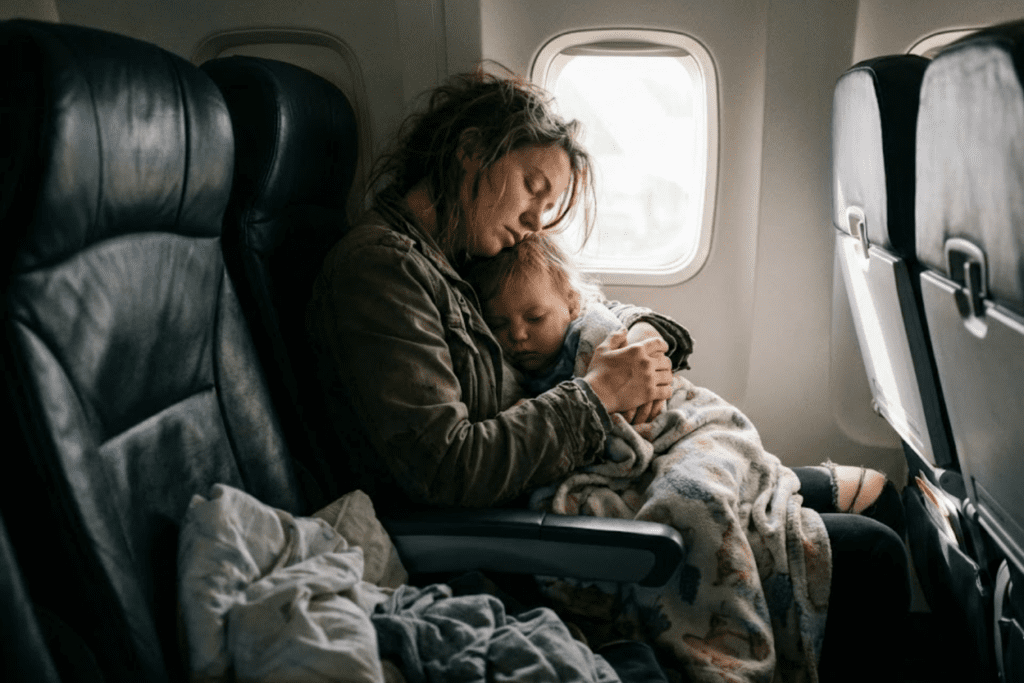
When she finally stood, she moved carefully, one hand supporting her belly, the other cradling her son. Her body hurt in places she had stopped noticing hours earlier. Her back ached. Her feet throbbed. But there was something else now, something lighter sitting just beneath the exhaustion.
Relief.
Not because the flight was over.
But because she had not been alone in it.
In the terminal, everything rushed back to life. Rolling suitcases clicked across the floor. Voices echoed. Announcements crackled overhead. She followed the signs toward baggage claim, her son still asleep, his small arm draped loosely across her chest.
A woman passed her and smiled. Another man held the door open without saying anything. These were small gestures, barely worth noting, yet they felt louder than usual.
As if the world had softened, just slightly.
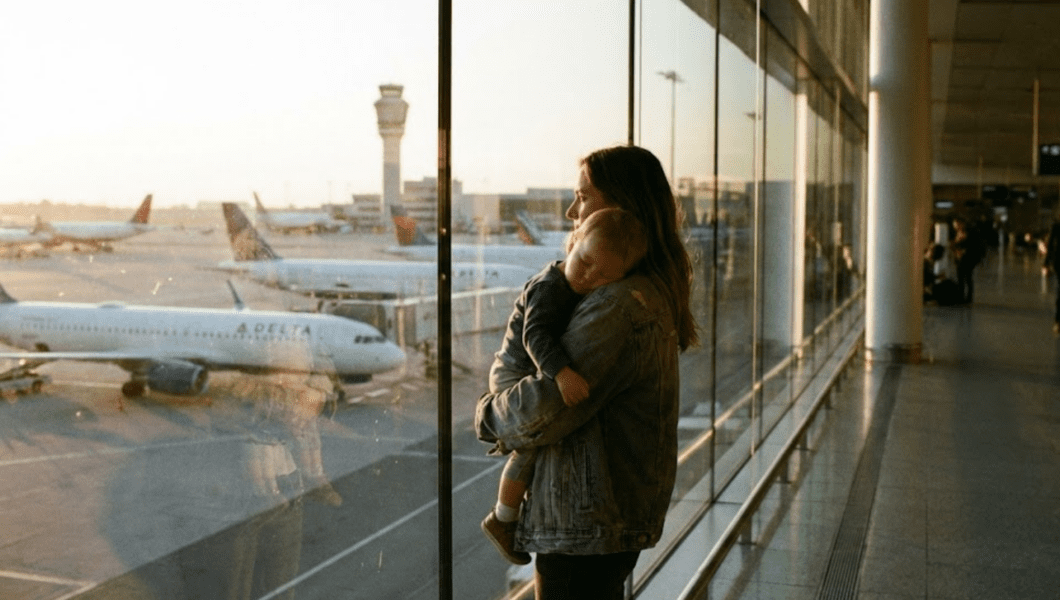
She sat on a bench near the windows while waiting for her ride. Outside, planes moved slowly across the tarmac. The sky was pale, stretched wide and calm, the kind of sky that feels like a pause between chapters.
She thought about Marcus again.
She did not know where he was headed. Did he have kids waiting at home. Was someone expecting him. Did he realize what he had done, not just for her son, but for her.
She doubted it.
People like that rarely do.
They step in, then step out, carrying kindness the way others carry keys or wallets. Something practical. Something used often.
Her son stirred then, blinking awake. He lifted his head and looked around, disoriented for a moment before his eyes found her face.
“Mama,” he murmured.
“I am right here,” she whispered.
He nestled closer, then asked, “Where is the man?”
Her throat tightened.
“He had to go,” she said softly.
Her son frowned, thinking hard. “He was nice.”
“Yes,” she replied. “He really was.”
He seemed satisfied with that answer. Within minutes, he fell asleep again.

Later that evening, once they reached her sister’s home in Georgia, the house felt too quiet.
Her sister helped with bags, offered food, asked gentle questions. Talia answered politely but briefly. She wanted a shower. Clean clothes. A moment to sit without thinking.
After putting her son down for the night, she stood in the doorway for a long time, watching him sleep. His face was peaceful. No tension around his eyes. No restless shifting.
She sat on the edge of the bed and brushed her fingers through his hair.
Only then did the weight of the day settle fully into her body.
She cried quietly, not from stress this time, but from release.
The kind that comes after holding yourself together for too long.
She thought of all the moments she had felt invisible as a mother. The judgment in grocery store aisles. The sideways looks when her child cried. The comments that lingered long after they were spoken.
You should control him.
Why bring a child if you cannot handle it.
Some parents just do not try hard enough.
None of those voices had spoken today.
Instead, one man had leaned forward and said, I am a dad.
That was all.
No explanation of qualifications. No performance of goodness.
Just presence.
She lay awake long after the house fell silent, her hand resting on her belly. The baby inside shifted gently, as if reminding her that life was still moving forward.
She wondered what kind of world this child would enter.
And what kind of people would meet them along the way.
The next morning, she posted the story.
Not because she wanted attention.
But because she needed to put it somewhere outside her own chest.
She wrote about the flight. About the crying. About the stranger who helped. She chose her words carefully, trying not to turn it into something larger than it was.
She did not use his photo.
She did not know his last name at the time.
She simply told the truth.
Within hours, messages poured in.
Some thanked her for sharing. Others said they had witnessed similar moments but never spoken about them. A few admitted they had once been the overwhelmed parent on a plane and wished someone had helped.
The story traveled farther than she expected.
But what stayed with her most were not the comments.
It was the memory.
Of watching her child relax in someone else’s arms.
Of feeling, for once, that the world was not asking her to prove herself.

Days passed.
Life resumed its shape.
Doctor appointments. Laundry. Grocery runs. Bedtime routines. The normal weight of being a mother did not disappear. It never does.
But something inside her had shifted.
She found herself softer with strangers.
More patient when other children cried in public.
More willing to offer help instead of assuming someone else would.
At the playground one afternoon, she noticed a young mother struggling with two toddlers, one screaming, the other trying to run toward the street. Without thinking, Talia stepped forward and gently blocked the path, smiling as she handed the child back.
The mother looked at her with surprise, then relief.
“Thank you,” she breathed.
Talia nodded. “You are doing great.”
The words came easily.
They felt familiar.
That night, as she tucked her son in, he asked about the airplane again.
“Do you think the man remembers me,” he asked.
“I think he does,” she said.
“Even if he sees lots of kids?”
“Yes,” she replied. “Because you were important to him in that moment.”
Her son considered this, then smiled sleepily. “I want to help people when I am big.”
She kissed his forehead. “I think you already do.”

Weeks later, she learned Marcus’s full name through a mutual connection who recognized the story. She debated reaching out. Part of her worried it would make the moment feel smaller, like trying to label something that had already completed itself.
But eventually, she sent a message.
Just a simple thank you.
He replied hours later.
He said he almost had not stood up that day. He had been tired. Distracted. Thinking about his own responsibilities waiting at home. But something told him not to stay seated.
He wrote that he did not see himself as extraordinary.
He just remembered how hard those early years of parenting had been.
That was all.
She read his message several times.
Then she closed the phone and sat quietly, letting it settle.
Kindness, she realized, does not always roar.
Sometimes it moves softly through crowded places, touching only one life at a time.
It does not fix everything.
It does not stay forever.
But it changes the shape of a memory.
And sometimes, that is enough.

Years from now, her son may not remember the flight clearly.
He may not recall the aisle or the humming or the way his body relaxed against a stranger’s shoulder.
But she believes something will remain.
A sense that the world can be gentle.
That help can come from unexpected places.
That being cared for does not always require knowing someone’s name.
And when life feels loud again, when airports blur and patience runs thin, she hopes that memory will surface quietly within him.
Not as a story he tells.
But as a way he lives.
Because sometimes the most important lessons are not taught.
They are carried.
And passed on.



No Comments