

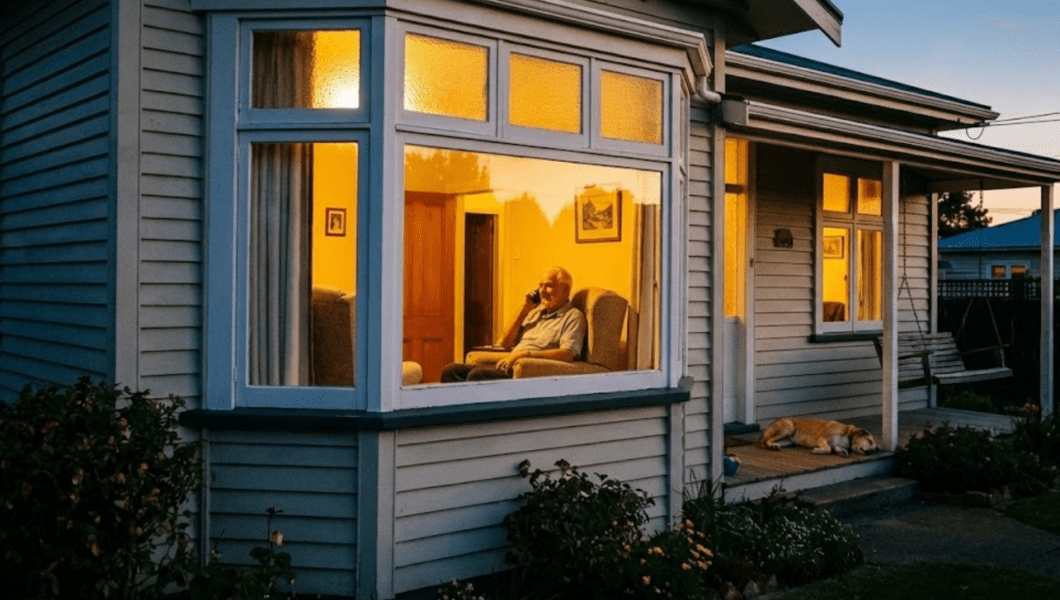
The first night after everything changed, my father did not sit in his chair at four o’clock.
That might sound like nothing, but in that small house it was a shift you could feel. Four o’clock had been a fixed point in his day, the way some people anchor themselves to sunrise or the evening news. For two years, that hour belonged to a ritual that hurt him and steadied him at the same time. It was the moment he heard my mother’s voice and proved to himself that grief could still find him.
That Sunday evening, after dinner at our place, after Leo fell asleep on the couch with his head on Frank’s leg and my wife gently lifted him to carry him upstairs, I drove my dad home. We did not talk much in the car. The road between our houses is only fifteen minutes long, but it felt longer than usual, the kind of quiet that asks you to pay attention.
When we pulled into his driveway, the porch light was on. It always was. My mom had insisted on it years ago, said it made the house feel welcoming. Frank paused with his hand on the door handle, as if he were deciding whether to go inside at all.
“Want me to come in?” I asked.
He shook his head. “No. I think… I think I need to be alone tonight. But not the bad kind.”
I watched him walk up the steps, unlock the door, and step into the dim living room. The light from the television flickered across the window for a moment, then went dark. I sat there in my car longer than I meant to, the engine still running, wondering if grief ever really loosens its grip or if it only changes where it holds you.
I did not know then that what Leo had done was not the end of something for my father. It was the beginning of something harder and gentler at the same time.
The next afternoon, I stopped by his house on my way home from work. I had told myself it was just to drop off the extra lasagna my wife had sent, but really, I wanted to see what four o’clock would look like now.
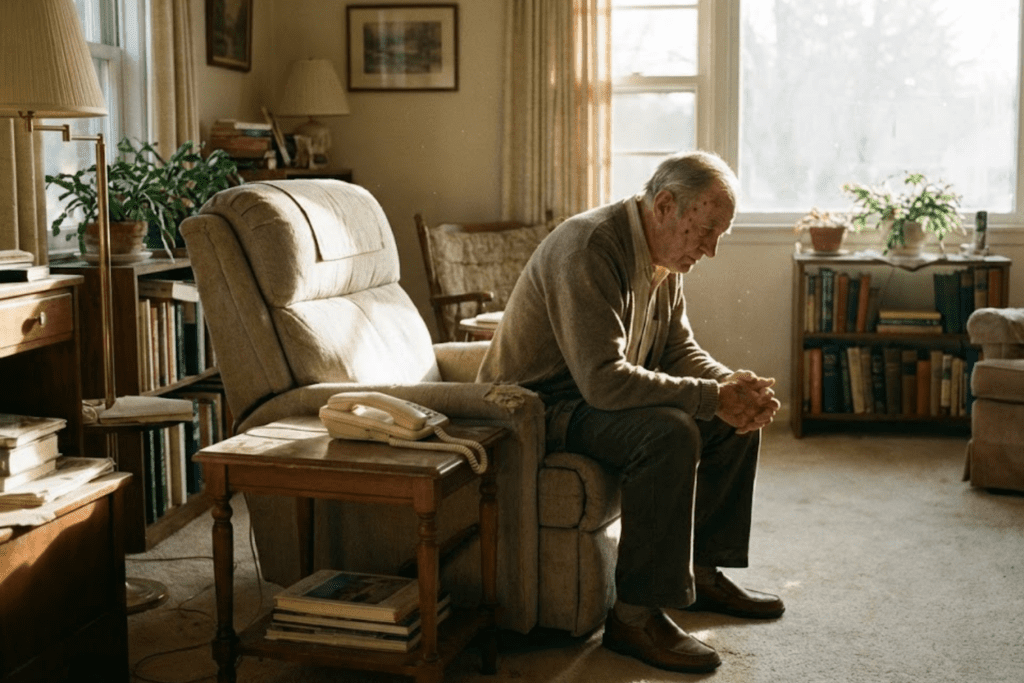
The house was quiet when I came in. The recliner sat in its usual place. The old landline phone rested on the end table, the cord still coiled like a tired snake. The answering machine was on the bookshelf, the small red light blinking.
Frank was in the kitchen, washing a single mug.
“You’re early,” he said.
“I was in the neighborhood,” I replied.
We stood there for a moment, both of us aware of the clock on the wall ticking closer to four.
At exactly four o’clock, nothing happened.
No phone lifted from the table. No number dialed. No familiar voice filling the room.
Frank dried the mug with a towel, set it in the cupboard, and came to sit on the edge of the recliner. He rested his hands on his knees, not quite relaxed, not quite tense.
“I keep thinking I should call,” he said quietly. “Like my hand just wants to pick it up on its own.”
I nodded. “Do you want to?”
He thought about it. Then he shook his head again. “No. I already heard what I needed to hear.”
The silence that followed was different from the silence that used to fill that house. It was still heavy, but it was not sharp. It did not feel like a wound being reopened. It felt like a room that had been emptied of something fragile and was waiting to be filled again.
A week later, Leo asked if we could go see Pop-Pop after school. He did not explain why. He rarely does. When we pulled up to Frank’s house, Leo ran ahead of us and disappeared inside.
We found him in the living room, standing on a chair, reaching for the answering machine on the shelf.
“Leo,” I said, my voice sharper than I meant it to be. “Careful with that.”
He froze, then looked down at me. “I just want to hear it again.”
Frank stepped forward. “It’s all right, Mike. Let him.”
Leo pressed the play button. The machine whirred. His own small voice filled the room.
“Hi, Grandpa…”
He listened all the way through, his face serious, his hands gripping the sides of the chair. When the message ended, he did not press play again. He climbed down, walked over to Frank, and wrapped his arms around his waist.
“I didn’t mean to erase Grandma,” he said.
Frank knelt in front of him, slowly, carefully, the way his body now required him to do most things. He took Leo’s face in his hands.
“You didn’t erase her,” he said. “You just… you gave me something else to hold on to.”
Leo nodded, as if he understood exactly what that meant.
That night, after Leo was in bed, I found myself sitting at the kitchen table long after my wife had gone upstairs. I kept thinking about that answering machine, about how easily a piece of someone’s voice can be lost, how fragile our proof of love really is.
I realized then that I had never asked my dad about the day my mom recorded that message. I had never asked him what was in that voice for him. It had always felt too private.
The next time I saw him, I asked.
He was in his garage, sorting through a box of old tools. He paused, wrench in hand.
“She hated her voice on tape,” he said. “She said it sounded thin. But she recorded it anyway. I was the one who wanted the machine. I said it was practical. She said it was silly. But she smiled when she did it. She always smiled when I asked for things like that.”
He put the wrench down. “After she died, that voice… it was proof that she had been here. That I hadn’t imagined my whole life with her.”
“And now?” I asked.
“Now I know she was here because you are,” he said. “Because Leo is. Because I can still smell her cinnamon in the kitchen sometimes, even when I know it’s just my memory.”
He closed the box of tools. “I don’t need a machine to tell me that anymore.”
Over the next few weeks, something in my father shifted.
It was not dramatic. There were no speeches, no declarations about moving on. It showed up in smaller ways. He started answering his phone again when people called. He agreed to come to Leo’s soccer game, even though it meant sitting on cold bleachers. He asked my wife for the recipe to the soup my mom used to make, the one he had always said only Eleanor could get right.
One afternoon, I came over to find him in the hallway, holding a small cardboard box.
“I found these in the closet,” he said.
Inside were cassette tapes, their labels faded. “Eleanor birthday,” one said, in my mother’s neat handwriting. “Christmas 1994.” “Mike graduation.”
I had forgotten they existed.
“Do you want to listen to them?” I asked.
He hesitated. Then he nodded.
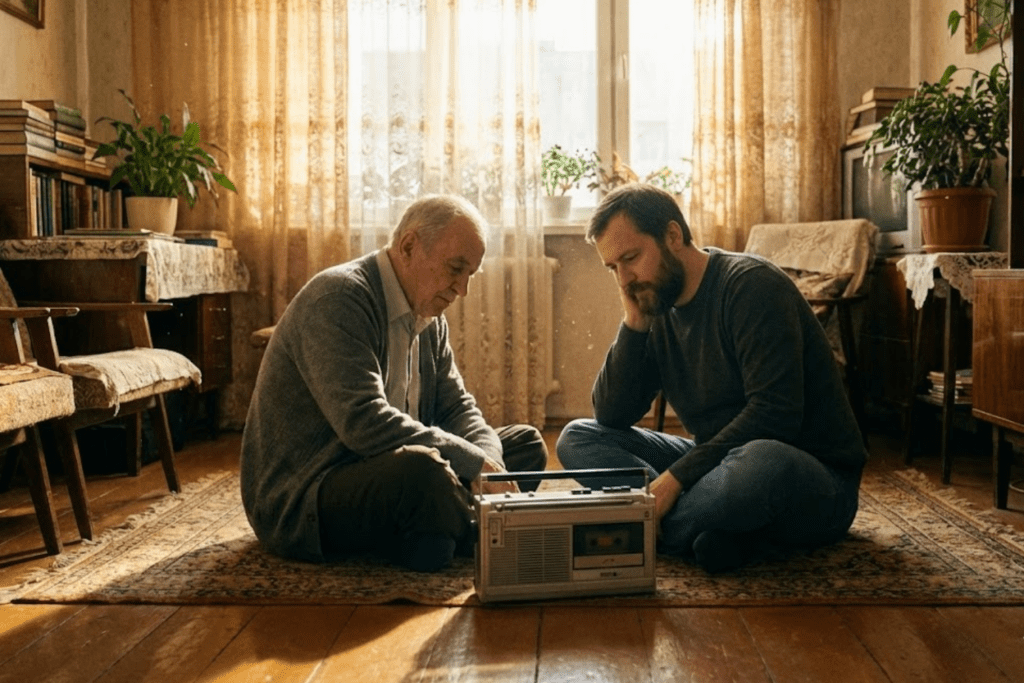
We sat on the living room floor, the tape player between us. My mother’s voice filled the room again, not from an answering machine this time, but from moments captured long before any of us knew how precious they would become.
She laughed. She teased my dad about burning the turkey. She told a story about me as a child that I had never heard.
Frank closed his eyes as he listened, but he did not flinch the way he used to. When the tape ended, he did not rush to turn it off. He let the quiet settle.
“I thought I was protecting her by not listening to these,” he said. “I thought if I stayed with that one message, I wouldn’t have to face everything else. But maybe I was just… hiding.”
“Hiding from what?” I asked.
“From the fact that she lived,” he said. “Not just that she died.”
I did not have an answer for that. I just sat with him, the way he had sat with me so many times when I was a kid and did not have the words for what I felt.
Leo noticed the changes too.
One evening, as we were driving home from Frank’s house, he asked, “Is Pop-Pop still sad about Grandma?”
“Yes,” I said. “He always will be a little.”
“But not like before,” Leo said.
“No,” I agreed. “Not like before.”
Leo stared out the window for a while. “I’m glad I called him,” he said.
“So am I,” I told him.
“What if I didn’t?” he asked. “What if I never thought to?”
I thought about that. About how easily life could have gone on the same way for my father, day after day, four o’clock after four o’clock, listening to the same thirty seconds of the past because it felt safer than risking something new.
“I think your grandpa would have found another way eventually,” I said. “But you helped him get there sooner.”
Leo nodded, satisfied with that answer.
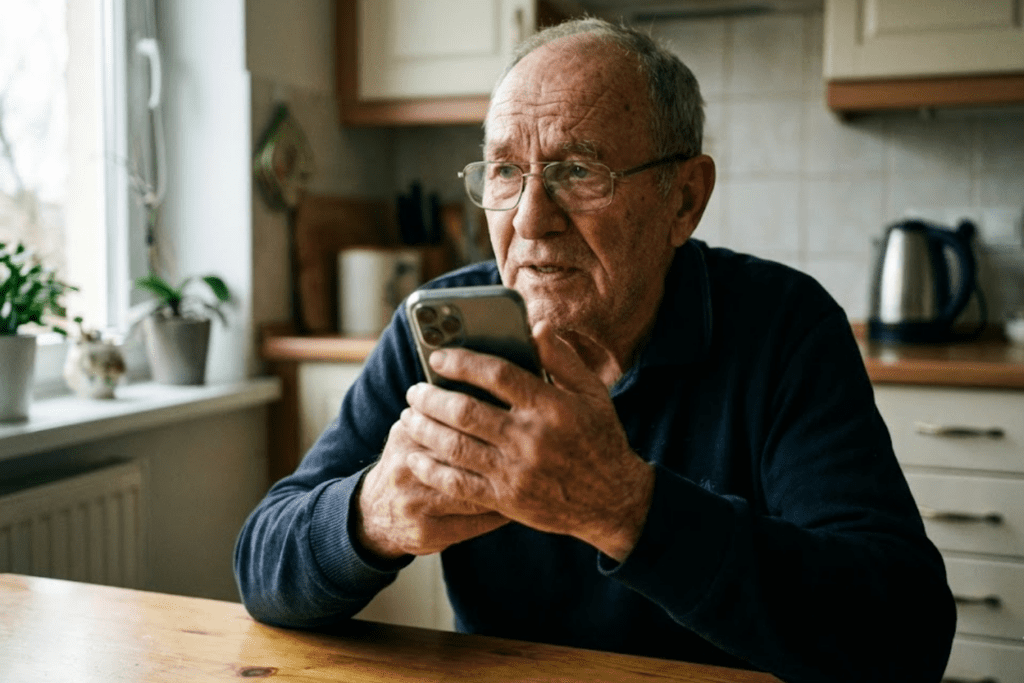
A month after that first message, Frank did something that surprised all of us. He asked for help setting up a voicemail on his cell phone.
“I don’t trust that little machine in the house anymore,” he said, only half joking. “And if I’m going to have people leaving messages, I want it to be… current.”
We sat at the kitchen table, his phone between us. I explained how to record a greeting. He listened carefully, brow furrowed, the way he used to when he was teaching me how to drive.
When it was time to record, he cleared his throat.
“Hi,” he said into the phone, his voice unsteady at first. “This is Frank. I can’t get to the phone right now, but leave a message. I’ll call you back.”
He stopped, listened, and shook his head. “That’s no good.”
He tried again.
“This is Frank. If you’re calling, I’m probably either in the garage or with my family. Leave a message. I’d like to hear from you.”
He finished and looked at me. “Is that… all right?”
“It’s perfect,” I said.
Later that day, Leo called him from our house, just to test it.
When Frank played the message back, he smiled in a way I had not seen in years. It was not the smile of someone clinging to what they had lost. It was the smile of someone still connected to what they had.
There were still hard days.
Sometimes I would find him standing in the doorway of the bedroom he had shared with my mom, staring at the empty side of the bed. Sometimes he would mention her in the middle of a story and then go quiet, as if surprised by his own words.
Grief did not disappear. It did not need to.
What changed was how he carried it.
Instead of holding it alone at four o’clock in the afternoon, he let it exist alongside other things. Alongside Leo’s laughter. Alongside the hum of conversation at our dinner table. Alongside the small, ordinary moments that make up a life.
One Saturday, he brought a box of old photos to our house. We spread them out on the floor. Leo picked them up one by one, asking questions.
“Is that Grandma when she was my age?”
“Yes.”
“What’s she doing there?”
“She was teaching your dad how to ride a bike.”
Leo looked at the picture, then at me. “You didn’t know how?”
I laughed. “Not very well.”
Frank watched us, his eyes soft. “She was patient,” he said. “More patient than I ever was.”
Leo held up another photo. “She looks happy,” he said.
“She was,” Frank replied. “Most of the time.”
They sat there together, my son and my father, connected by a woman who was no longer physically present but somehow more real than ever.
That night, after Frank went home, I stood in the hallway outside Leo’s room for a moment, listening to him breathe. I thought about how close we had come to never seeing this version of my father. A version that was still grieving, yes, but also living.
It was easy to think of what Leo had done as something sweet, something innocent. A child calling his grandfather because he wanted him to feel less alone.
But it was more than that.
Without meaning to, Leo had taught my father that love does not require preservation in amber. That it does not have to be replayed in the same form forever to remain real. That remembering someone does not mean staying exactly where you lost them.
A few weeks later, I called my dad at four o’clock on a random Tuesday.
“Hey,” I said when he answered.
“Hey,” he replied. I could hear the television in the background.
“What are you doing?”
“Watching some old baseball game. Why?”
“No reason,” I said. “Just wanted to hear your voice.”
He was quiet for a moment. Then he said, “I’m glad you called.”
When I hung up, I thought about the old answering machine, still sitting on that shelf in his living room. He had not thrown it away. He did not need to. It no longer held something he was afraid to lose.
It had been replaced by something better. By living voices. By messages that came from now, not from what was already gone.
The past did not vanish. It simply stopped being the only place where love existed.
Sometimes I still think about how easily Leo could have missed that moment. How easily my father could have gone on, day after day, dialing a number that no longer led anywhere new.
We talk a lot about holding on to what we love. We talk less about when it might be time to let it change.
My father did not stop loving my mother when her voice disappeared from that machine. If anything, he finally gave himself permission to love her in a way that did not keep him frozen in the moment of her absence.
And Leo, without knowing it, gave his grandfather something my mother would have wanted for him more than anything.
A life that still had room for laughter.
A heart that could still answer the phone.
No Comments